

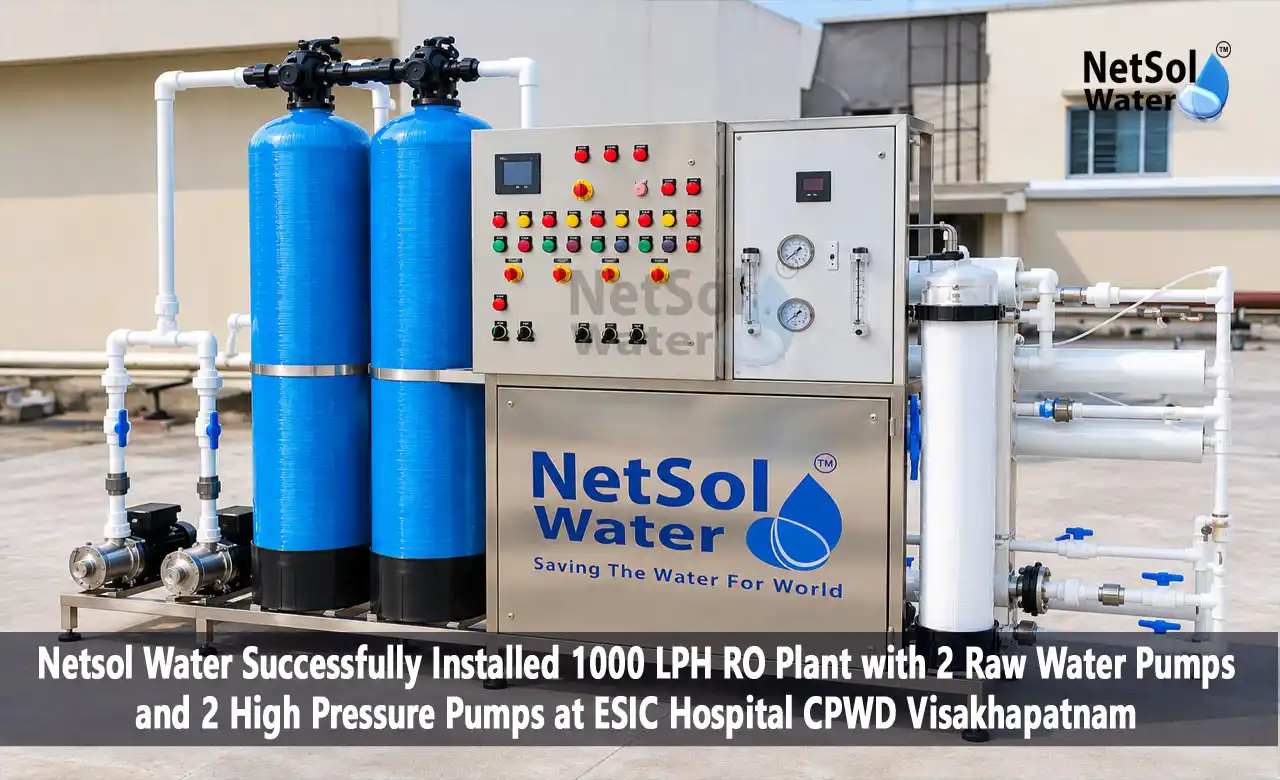
Case Study: Installed 1000 LPH RO Plant at ESIC Hospital, Visakhapatnam
In September 2026, Netsol Water installed and commissioned a 1000 LPH RO plant at ESIC Hospital, CPWD, in Visakhapatnam, Andhra Pradesh. The hospital draws its raw water from a borewell, and that water carries approximately 2,000 mg/L of TDS. The treated water was needed for supply inside the hospital for drinking, hospital operations, the kitchen, general utility and several other internal uses. Similar borewell water RO plant projects follow the same basic logic, but every site has its own constraints.
The plant uses 2 raw water pumps (2 × 1 HP), 2 high-pressure pumps (2 × 3 HP), a pressure sand filter, an activated carbon filter, a micron filter, antiscalant dosing and three LG RO membranes. The installation had one defining difficulty: the equipment had to be lifted to the top floor of the hospital building. This case study covers the requirement, the configuration, the treatment process, that lifting challenge and the water quality result of this commercial RO plant installation.
Project at a Glance
| Item | Details |
|---|---|
| Client | ESIC Hospital, CPWD |
| Location | ESIC Hospital, Visakhapatnam, Andhra Pradesh |
| Installation/Commissioning | September 2026 |
| Plant Capacity | 1000 LPH |
| Water Source | Borewell |
| Raw Water TDS | Approx. 2,000 mg/L |
| Daily Production | Approx. 12 KLD |
| Raw Water Pumps | 2 × 1 HP |
| High Pressure Pumps | 2 × 3 HP |
| Number of RO Membranes | 3 |
| Membrane Brand | LG |
| Recovery | Approx. 60% |
| Product Water TDS | Approx. 70–80 mg/L |
| Major Installation Challenge | Lifting the RO plant/equipment to the top floor |
Why ESIC Hospital Required a 1000 LPH RO Plant?
A hospital uses water in many places at once. The requirement here was a supply of treated water for use across the hospital, rather than for one isolated point of use. Hospital water treatment projects usually have to serve several departments from a common source, and this one was no different. Netsol has also worked with hospitals on the wastewater side, for example the 15 KLD CETP plant at Baby Bloom Hospital, Greater Noida.
| Requirement | Project Detail |
|---|---|
| Water Source | Borewell |
| Raw Water TDS | Approx. 2,000 mg/L |
| Intended Uses | Drinking, hospital operations, kitchen, general utility, multiple internal uses |
| Approximate Production Requirement | 12 KLD |
| Selected Plant | 1000 LPH RO Plant |
Water at about 2,000 mg/L of dissolved solids is normally treated before use where a lower-TDS supply is wanted. Reverse osmosis is the usual route for reducing dissolved solids in borewell water, so an RO plant sized for the hospital demand was selected.
The 1000 LPH rating fits the approximate 12 KLD requirement once operating hours are considered:
| Basis | Calculation | Result |
|---|---|---|
| Rated Output | 1000 litres per hour | 1000 L/h |
| Illustrative Running Time | About 12 hours per day | 12 h |
| Approximate Daily Volume | 1000 L/h × 12 h | About 12,000 L (12 KLD) |
A 1000 LPH plant does not give 12 KLD on continuous 24-hour operation. The 12 KLD figure reflects the plant operating requirement and running hours. The 12-hour value is shown only to explain the arithmetic.
We make no claim that the treated water is sterile or suited to every clinical application. The project requirement was water supply for the applications listed above.
Raw Water Quality and Treatment Requirement
The one raw water parameter confirmed for this project is TDS, at approximately 2,000 mg/L. TDS (total dissolved solids) is the combined amount of dissolved salts and minerals in the water. At this level, filters alone would not lower dissolved solids in any meaningful way. Membrane separation is needed for that.
An RO membrane works best when the water reaching it is clean and stable. Suspended particles, organic matter and scale-forming salts shorten membrane life and reduce output. That is why the plant includes a full pretreatment train ahead of the membranes: sand filtration, carbon filtration, micron filtration and antiscalant dosing.
Hardness, iron, chloride and turbidity are not part of the confirmed project information, so they are not discussed here. On any borewell water project these are checked during site assessment. Netsol has explained in its Knowledge Center why feed water testing matters before choosing a commercial RO plant and how TDS levels affect RO plant selection.
Complete RO Water Treatment Process
The treatment flow is: Raw Water Tank → Raw Water Pump → Pressure Sand Filter → Activated Carbon Filter → Micron Filter → Antiscalant Dosing → High Pressure Pump → RO Membranes → RO Product Water.
| Stage | Equipment | Purpose |
|---|---|---|
| 1 | Raw water tank | Holds borewell water and buffers the supply |
| 2 | 2 × 1 HP raw water pumps | Move water into pretreatment |
| 3 | Pressure sand filter | Removes suspended solids |
| 4 | Activated carbon filter | Removes organics by adsorption |
| 5 | Micron filter | Final fine particle filtration before RO |
| 6 | Antiscalant dosing | Slows scale formation on membranes |
| 7 | 2 × 3 HP high-pressure pumps | Provide membrane feed pressure |
| 8 | 3 LG RO membranes | Separate dissolved salts from water |
| 9 | RO product water | Treated water for hospital supply |
Antiscalant dosing is described as part of the RO pretreatment system. Its exact physical position on the skid or piping is not stated as a project fact. SMBS dosing is not part of this plant.
.Raw Water Tank
Borewell water is collected here first. The tank acts as a buffer, so the plant draws from a steady volume of water instead of depending directly on borewell delivery at every moment.
.2 × 1 HP Raw Water Pumps
These pumps move water from the tank into the pretreatment section at the pressure and flow the filters need.
.Pressure Sand Filter
The sand filter removes suspended solids and fine particles, so everything downstream is not loaded with dirt. It needs periodic backwashing to stay effective.
.Activated Carbon Filter
Activated carbon removes organic matter and certain dissolved contaminants by adsorption. It also protects the membranes from substances that can foul them.
.Micron Filter
This is the final cartridge filtration step before the high-pressure pumps and membranes. It catches fine particles that may pass through the earlier filters, such as media fines.
.Antiscalant Dosing
Antiscalant is dosed in small controlled quantities to slow mineral scale on the membrane surface. As water passes through a membrane, the reject stream becomes more concentrated and scale can form from the salts in it. Antiscalant reduces this risk.
.2 × 3 HP High Pressure Pumps
These raise the pretreated water to the pressure needed to push it through the membranes.
.3 LG RO Membranes
The membranes separate most dissolved salts from the water. Clean product water passes through and the concentrated reject stream is discharged.
.RO Product Water
This is the treated water that goes on for supply within the hospital.
Role of the Two Raw Water Pumps
The two 1 HP raw water pumps feed the pretreatment section. Sand, carbon and micron filters all need a reliable inlet flow and pressure to perform as designed, and the pumps supply it from the raw water tank.
Two pumps give the plant more flexibility in feeding the pretreatment train than a single unit would. We have not stated how the two are operated, whether one runs while the other rests or both run together, because that arrangement is not confirmed project information.
Role of the Two High Pressure Pumps
Reverse osmosis works by applying pressure greater than the natural osmotic pressure of the feed water. That forces water through the membrane and leaves most dissolved salts behind. The two 3 HP high-pressure pumps supply this pressure to the membranes.
These are the most important rotating equipment in the plant. Pump performance directly affects how much product water is made and how stable the operation is. As with the raw water pumps, the operating arrangement (duty, standby or shared) has not been confirmed and is not assumed.
| Point | 2 × 1 HP Raw Water Pumps | 2 × 3 HP High Pressure Pumps |
|---|---|---|
| Position in Flow | Between raw water tank and pretreatment | Between micron filter/dosing and membranes |
| Main Job | Feed water to filters | Push water through RO membranes |
| Downstream Equipment | Sand, carbon and micron filters | 3 LG RO membranes |
Three LG RO Membranes and Approximately 60% Recovery
The plant uses three LG RO membranes. Membrane model, size, operating pressure, flow and rejection figures are not part of the confirmed information, so none are quoted.
| Parameter | Project Value |
|---|---|
| Number of Membranes | 3 |
| Membrane Brand | LG |
| Approx. Feed TDS | 2,000 mg/L |
| Approx. Recovery | 60% |
| Approx. Product TDS | 70–80 mg/L |
Recovery is the share of feed water that comes out as product water. At approximately 60% recovery, about 60 parts of every 100 parts of feed become product and the remaining portion leaves as reject.
| Illustration at 60% Recovery | Approx. Volume per Hour |
|---|---|
| Product Water | 1,000 litres |
| Feed Water Required | About 1,667 litres |
| Reject Water | About 667 litres |
These figures are simple arithmetic from the stated recovery. They are not measured flow readings from the site.
Recovery is a design choice. Higher recovery saves water but concentrates the reject stream more, which raises scaling risk on a feed of about 2,000 mg/L. That is one reason antiscalant dosing sits in the pretreatment system.
Major Installation Challenge: Lifting the Plant to the Top Floor
The plant was installed at the top floor of the hospital, so the equipment first had to be lifted there. On an ordinary ground-level project, an RO skid, tanks, filters and pumps are moved in by trolley or light vehicle and set on a prepared floor. Here, every heavy item had to travel up through or along a working hospital building. This changed the project in several practical ways.
| Aspect | Why It Mattered |
|---|---|
| Equipment Movement and Site Access | Filter vessels, pumps, skid-mounted parts and membrane housings are heavy and awkward. Each item has to move from the delivery point to the lifting point, and then from the top-floor landing to its final position, without damage to equipment, finishes or nearby services. |
| Lifting and Positioning | Lifting is only half the job. Equipment must be placed accurately so piping, electrical connections and service access all work afterwards. Slightly wrong placement causes pipework rework later. |
| Installation Planning | With a lift involved, sequence matters more: which items go up first, where they stage on arrival, and how pretreatment, pumps and membrane sections connect once in place. Planning also had to respect day-to-day hospital activity. |
| Safe Placement | Heavy equipment on an upper floor must be set down in a way that suits the building and keeps the area safe for staff and people nearby. |
| Connections and Commissioning | Piping, pumps, dosing, electrical and control connections, trial operation and commissioning could only follow once everything was in position. |
This table describes the practical impact of a top-floor installation in general terms. Crane capacity, lifting method, floor height, manpower and equipment dimensions are not part of the confirmed project record and are not stated.
What can be said is that the top-floor installation was successfully completed, and that it required more coordination than a standard ground-level installation. For plants of other capacities, see the full range of RO plants manufactured by Netsol.
Installation and Commissioning Process
The sequence below is a logical project flow. Confirmed project facts are the equipment list, the top-floor lifting challenge, the September 2026 timing and the water quality result. The step order is general installation methodology and not a record of exact site events.
| # | Stage | What Is Done |
|---|---|---|
| 1 | Site Assessment | Check location, access routes, raw water source and quality and power availability |
| 2 | Installation Planning | Plan the lift, staging areas and sequence of work |
| 3 | Equipment Positioning | Lift and place equipment on the top floor |
| 4 | Raw Water Pump Connection | Connect 2 × 1 HP pumps to raw water tank and pretreatment inlet |
| 5 | Pretreatment Connection | Connect pressure sand filter and activated carbon filter |
| 6 | Micron Filtration | Install and connect the micron filter |
| 7 | Antiscalant System | Set up dosing within RO pretreatment |
| 8 | High-Pressure Pump Connection | Connect 2 × 3 HP pumps to membrane section |
| 9 | RO Membrane Installation | Fit the three LG membranes |
| 10 | Product and Reject Connections | Connect product outlet and reject line |
| 11 | Electrical/Control Connections | Wire pumps, dosing and controls |
| 12 | Trial Operation | Run the plant, check flows and pressures |
| 13 | Water Quality Checking | Check product water TDS |
| 14 | Commissioning | Hand over plant for regular operation |
Water Quality Result
| Parameter | Before RO | After RO |
|---|---|---|
| TDS | Approx. 2,000 mg/L | Approx. 70–80 mg/L |
On these approximate figures, TDS fell by roughly 96 percent, from about 2,000 mg/L in the borewell water to about 70-80 mg/L in the RO product water.
This is the water quality result available for the project. TDS is a useful indicator of dissolved salt and of how well the RO system is working, but it is a single measure. A low TDS value alone does not prove that water is safe to drink. No laboratory report is quoted here, and we make no claim of compliance with any drinking-water standard. Suitability for any specific use depends on the full water analysis and the hospital requirements.
Project Outcome
| Outcome Area | Result |
|---|---|
| Plant Installed | 1000 LPH RO plant, commissioned September 2026 |
| Production Requirement | Approx. 12 KLD |
| Source and Raw TDS | Borewell, approx. 2,000 mg/L |
| Product Water TDS | Approx. 70–80 mg/L |
| Pumps | 2 × 1 HP raw water, 2 × 3 HP high pressure |
| Membranes | 3 LG membranes at approx. 60% recovery |
| Requirement Addressed | Hospital water supply |
| Installation | Top-floor installation successfully completed |
Watch the 1000 LPH RO Plant Installation at ESIC Hospital, Visakhapatnam
The project video documents the RO plant at the ESIC Hospital site. It gives a visual view of the installed 1000 LPH system and the equipment discussed above, so readers can relate the pumps, filters and membrane section to the process description in this article. Because this project involved a top-floor installation, the video also helps in understanding the setting in which the plant was placed.
Why This RO Configuration Was Selected for the Project
As an industrial RO plant manufacturer, we select configuration from the site conditions. For this project the factors were as follows.
| Factor | Configuration | Reason |
|---|---|---|
| Borewell source and high TDS | RO with pretreatment | About 2,000 mg/L needs membrane treatment, with pretreatment to protect the membranes |
| Hospital requirement | Common supply for several uses | Water was needed across drinking, operations, kitchen and utility |
| 1000 LPH capacity | Matches about 12 KLD | Rated output fits the daily requirement once running hours are considered |
| Pumping | 2 raw water + 2 high pressure pumps | Each set is matched to its own duty: pretreatment feed and membrane pressure |
| Pretreatment | Sand, carbon, micron, antiscalant | Prepares water for the membranes |
| Membrane configuration | 3 LG membranes, about 60% recovery | Balances product output against reject volume on this feed |
| Top-floor installation | Modular equipment layout | Equipment that is lifted and positioned in stages suits a modular arrangement. This is a general engineering rationale, not a recorded design statement. |
For the wider range of plants we build across India, see our RO plant manufacturer page.
Maintenance Considerations
An RO plant performs well over time only if it is monitored and maintained. A planned service arrangement such as an RO plant maintenance/AMC contract keeps this routine consistent. Older plants can also be fitted with monitoring, as explained in how to add remote monitoring to an RO plant.
| Item | What to Do |
|---|---|
| Raw Water Quality Monitoring | Check periodically, since borewell quality can change |
| Pressure Sand Filter | Backwash on schedule to clear trapped solids |
| Activated Carbon Filter | Monitor performance and service the media as needed |
| Micron Filter | Replace cartridges when clogged or pressure drop rises |
| Antiscalant Dosing | Confirm dosing continues at the intended rate and stock does not run out |
| Pumps | Inspect raw water and high pressure pumps for noise, vibration and leaks |
| RO Pressure | Watch feed and differential pressure for early signs of fouling or scaling |
| Product Water TDS | Track regularly, since a rising trend often points to a membrane or system issue |
| Membrane Performance | Compare product flow and TDS over time |
| Preventive Maintenance | Follow a planned schedule, which costs less than breakdown repair |
Frequently Asked Questions (FAQs)
Q1. What was the capacity of the RO plant installed at ESIC Hospital, Visakhapatnam?
1000 LPH, with an approximate production requirement of 12 KLD.
Q2. What was the raw water source?
Borewell.
Q3. What was the raw water TDS?
Approximately 2,000 mg/L.
Q4. How many raw water pumps and high-pressure pumps were installed?
Two raw water pumps (2 × 1 HP) and two high-pressure pumps (2 × 3 HP).
Q5. Which RO membrane brand was used?
LG, with three membranes installed.
Q6. What was the approximate RO recovery?
Approximately 60%.
Q7. What TDS was achieved after RO treatment?
Approximately 70-80 mg/L.
Q8. What was the main installation challenge?
Lifting the RO plant and equipment to the top floor of the hospital.
Conclusion
At ESIC Hospital, CPWD, Visakhapatnam, a 1000 LPH RO plant was installed and commissioned in September 2026 to treat borewell water of about 2,000 mg/L TDS for hospital use. The plant combines two 1 HP raw water pumps, sand, carbon and micron filtration, antiscalant dosing, two 3 HP high-pressure pumps and three LG membranes at approximately 60% recovery, bringing TDS down to approximately 70-80 mg/L. The top-floor lift was the main site challenge, and the installation was completed successfully.
Planning a similar plant in Andhra Pradesh? Netsol lists Andhra Pradesh among its service locations. For a quotation, use the Get a Quote page or the contact page. More technical guides are in the Knowledge Center.