

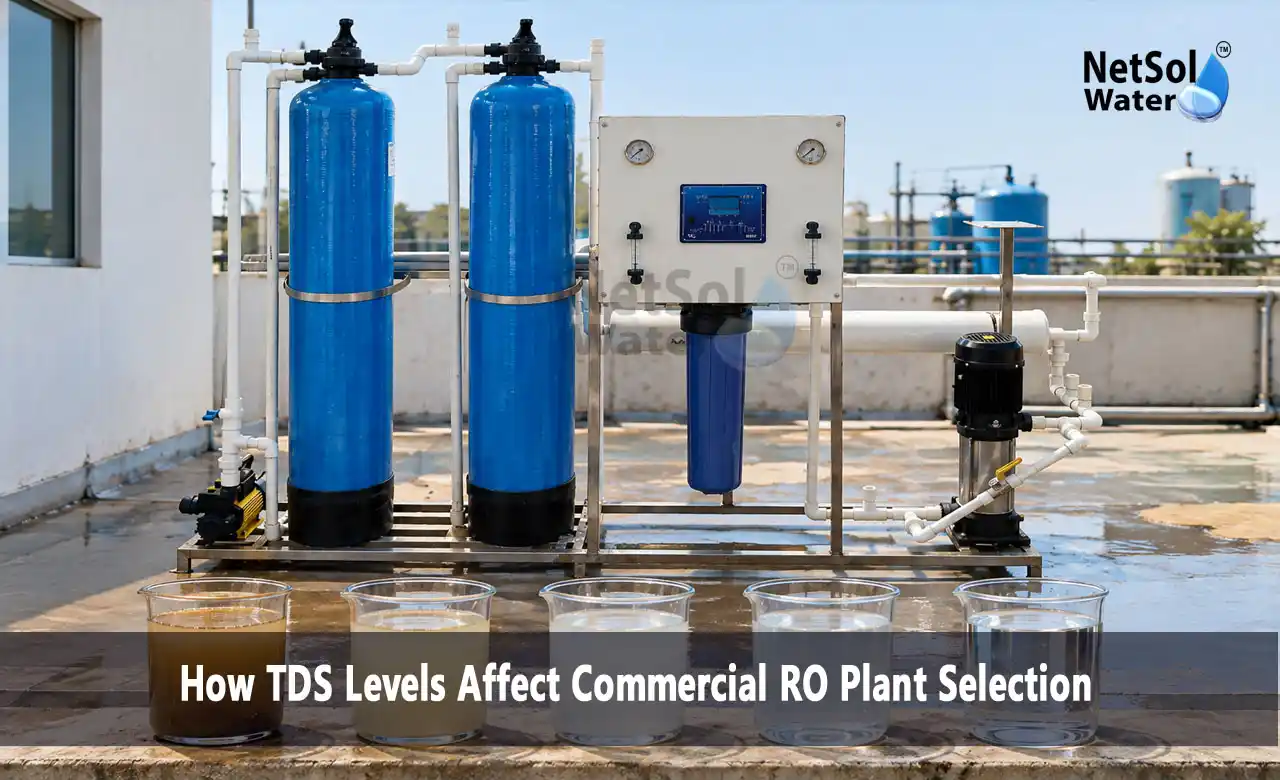
How TDS Levels Affect Commercial RO Plant Selection?
Every commercial setup that depends on treated water, whether it is an office, a hotel, a hospital or a manufacturing unit, has to deal with one basic reality: water quality is never the same from one location to another. India's water sources vary widely by region. Some areas draw from groundwater loaded with dissolved salts, while others rely on surface water that carries lower TDS but higher suspended and organic matter.
TDS, or Total Dissolved Solids, measures the concentration of dissolved substances in water. A high TDS level changes not only the taste of water but also how an RO system performs, which is why it plays a central role in commercial RO plant selection. The right choice always comes down to two things: the quality of the incoming water and the quality expected at the outlet. Netsol Water designs commercial RO plants around exactly these site-specific conditions.
Why TDS Matters When Selecting an RO Plant?
TDS is usually the first indicator of how much dissolved load an RO membrane will need to handle, which makes it a natural starting point for any commercial RO plant selection process. A configuration that performs well at moderate TDS may not hold up once the feed water carries a much heavier salt load. Higher TDS also raises the osmotic pressure the system must overcome, which in turn affects pump pressure requirements and permeate output. The FDA has also pointed out that RO system design should be based on feed TDS together with the target rejection and recovery rates.
Before finalising any equipment, it helps to understand exactly how TDS influences system behaviour. The sections below walk through the key factors that connect TDS with RO plant design.
Feed Water TDS and Membrane Performance
An RO membrane separates dissolved salts from water through pressure-driven filtration. As the dissolved salt content in feed water rises, the system encounters greater osmotic pressure, and the plant needs sufficient operating pressure to keep producing the required volume of treated water. Membrane selection also has to match the incoming water quality and the rejection rate the application demands.
A site with moderate TDS can often run on a fairly standard configuration. Water with a much higher TDS usually calls for a different membrane arrangement, stronger pumping, and sometimes additional treatment ahead of the RO stage. Netsol Water's experience across industrial RO plants confirms that higher feed TDS almost always changes both the membrane choice and the overall system design.
TDS and Product Water Requirements
The quality expected from the treated water has just as much bearing on plant selection as the inlet TDS figure. Drinking water and process water have very different requirements. Boiler feed water, for instance, often needs far lower dissolved solids since scale build-up can damage equipment, and certain industrial processes may need extra treatment stages after RO to hit a specific purity target.
Because of this, a plant should never be chosen purely on the basis of inlet TDS. The final water requirement of the application should guide the complete system design.
How Different TDS Levels Change Commercial RO Selection?
Since TDS levels vary so widely from one site to another, a sound selection process has to connect the actual inlet water condition with the type of RO system required. No single design fits every commercial application; the plant has to handle whatever enters it while still meeting the expected output.
. Moderate TDS Water
Water with moderate TDS is generally easier to treat using a conventional RO configuration, though the exact design still depends on other parameters such as hardness and pH. Suspended solids and biological impurities need attention too, since RO membranes can foul even when TDS itself is not very high. A well-designed pretreatment stage protects the membrane and keeps operation stable, letting the plant deliver consistent treated water without adding unnecessary treatment stages and helping businesses control running costs while still meeting their water quality targets.
. High TDS Water
High TDS water needs more careful planning. As dissolved salt concentration climbs, the RO system faces higher osmotic pressure, which means the plant may need specific membrane elements and higher operating pressure. Water with very high TDS can also call for additional treatment stages depending on the source and the application. Netsol Water's commercial RO systems are typically built to treat inlet water in the range of around 2,000 to 3,000 ppm TDS in standard configurations, and higher TDS levels may call for two-pass RO or added softening. The final selection should always be guided by an actual water analysis, since TDS alone never tells the whole story about what is in the water.
The Role of Pretreatment in Commercial RO Selection
TDS is only one piece of the water quality picture. Pretreatment is just as important, because RO membranes need protection from substances that cause scaling or fouling. Even a plant with a perfectly suitable membrane can run into performance issues if the feed water arrives without proper conditioning.
. Hardness and Scaling Control
High hardness can leave scale on RO membranes, which lowers water production and increases maintenance needs. Depending on the water analysis, the system may need a water softener or another suitable scale-control method ahead of the RO stage. Silica and other dissolved minerals can shape the pretreatment design as well, so a proper water test is essential to flag these risks before installation. Netsol Water recommends checking hardness and scaling potential as a standard part of RO system design.
. Sediment and Fouling Protection
Turbidity and suspended particles can block or foul membrane surfaces. Sand filters and micron filtration remove these materials before water reaches the RO membrane, and activated carbon treatment may be needed where chlorine or organic impurities are a concern. This is exactly why a commercial RO plant should never be chosen on TDS alone. The complete water profile gives the designer what is needed to build suitable pretreatment. The Indian Standard for drinking water also covers several parameters beyond TDS, including pH, turbidity, and chemical and microbiological requirements.
Choosing Commercial RO Plants Based on Application
The final choice has to match both water quality and water demand. A hotel mainly needs treated water for drinking and food use, a manufacturing facility needs water for its production processes, and a healthcare facility often has strict quality needs across different uses. These differences change the required RO capacity and treatment configuration.
. Match Plant Capacity With Demand
A plant should be able to produce enough treated water during both normal and peak use. Choosing an undersized unit can disrupt operations, while an oversized system adds equipment and operating cost without adding real value. The required flow should be calculated from actual water demand. Netsol Water offers commercial RO plants across a broad capacity range, with designs based on site-specific needs.
. Match Water Quality With End Use
The required output TDS should come from the application itself rather than a generic target. Drinking water has to meet the relevant regulatory quality, while industrial use may require a particular conductivity or dissolved solids level. A complete water analysis helps determine the right membrane setup and pretreatment, and shows whether the project needs additional treatment after RO. This approach supports better performance and avoids equipment that does not match the actual site conditions.
Conclusion
TDS levels directly influence membrane selection and operating pressure, and they also affect pretreatment and the overall RO configuration. Even so, TDS should never be the only factor in commercial RO plant selection. Water hardness, turbidity, the intended use of the treated water, and the required capacity all matter just as much.
Choosing the right commercial RO plant starts with a clear understanding of the source water and the final water requirement. A detailed water test helps define the correct design for any site. Netsol Water can help businesses assess these requirements and select a suitable treatment solution. Get in touch with Netsol Water to discuss your water quality needs or to request a consultation for your project.
Contact Netsol Water at:
Phone: +91-9650608473, Email: enquiry@netsolwater.com