How to Add Remote Monitoring to an Old RO Plant?
A large number of industrial RO plants running today were built long before remote monitoring became a standard feature. They still produce good water, but the people looking after them often have to walk to the plant several times a day to note down pressure, flow, conductivity, tank levels and alarm status.
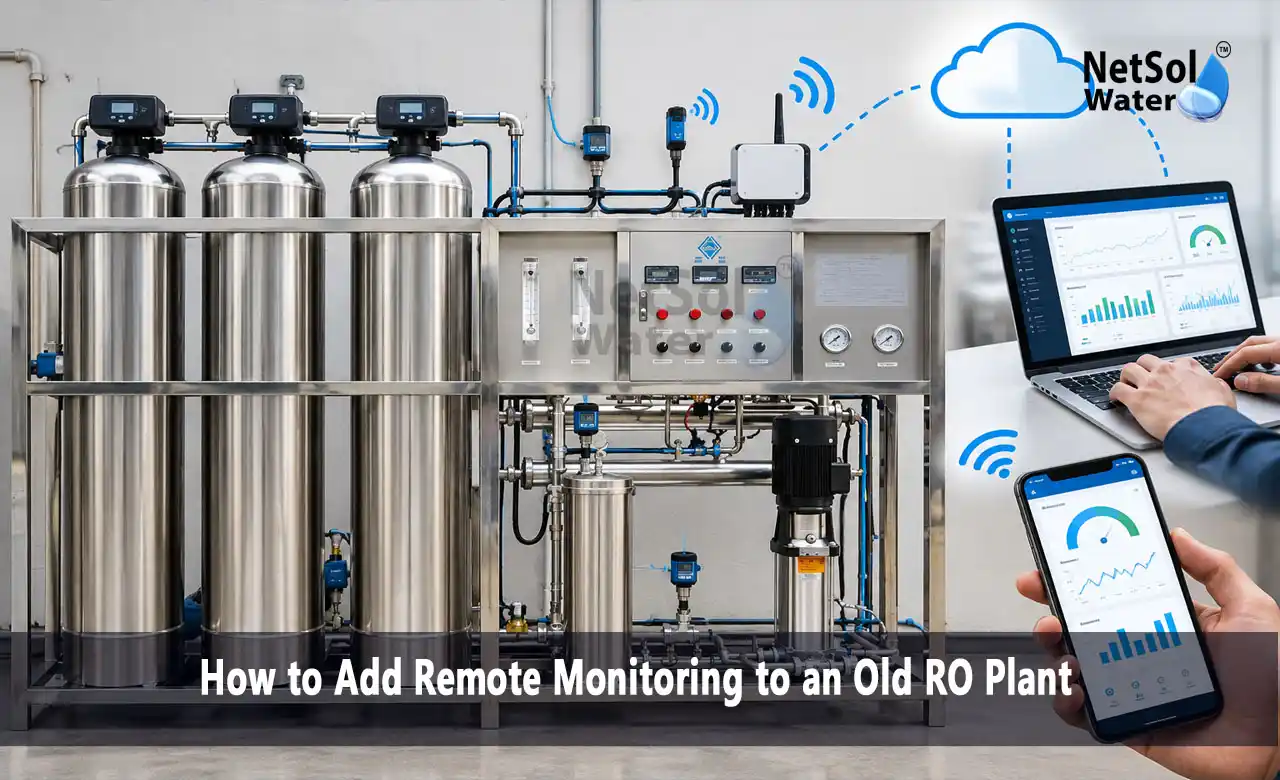
The good news is that you do not have to scrap a working system to fix this. An older plant can be upgraded with the right sensors, a data-collection device and a monitoring platform. Once that is in place, operators and maintenance teams can see the health of the plant from a phone or laptop and react to a problem much faster. If you are new to the basics of the technology, our guide on how an industrial RO plant works is a useful starting point.
Step 1: Study the Existing RO Plant
Begin with a careful inspection of the control panel and the instruments already installed. Make a list of the sensors, switches, flow meters, pressure gauges, conductivity meters, pumps, valves and controllers on the industrial RO plant. Some of these devices already give out an electrical output signal, and that signal can be reused by the new monitoring system.
Also check the age and condition of the panel. If an instrument is worn out or gives unreliable readings, it is better to replace it before connecting it to a remote system, because bad data sent remotely is still bad data.
Step 2: Decide What Needs to Be Monitored
Not every signal is worth tracking. Pick the parameters that truly tell you how the RO system is performing. The most useful ones are feed pressure, membrane pressure, permeate flow, reject flow, feed water conductivity, permeate conductivity, tank levels, pump status and system alarms.
With these values visible online, an operator can spot a drop in production or a change in water quality without making repeated trips to the plant floor.
Step 3: Fit the Right Sensors
If the plant is missing any of the required measuring points, new sensors can be added during the retrofit. Here is what is commonly used:
. Pressure transmitters, either replacing or working alongside the old pressure gauges.
. Flow transmitters on the feed, permeate and reject lines.
. Conductivity sensors to track how well salts are being rejected.
. Level sensors in storage tanks to warn about low or overflow conditions.
Step 4: Install a PLC or Data Gateway
A Programmable Logic Controller (PLC) or an industrial data gateway collects the signals from all these instruments and sends them to the monitoring platform. If your old plant already has a PLC, you may be able to connect it to the new communication setup instead of replacing it, which saves both cost and downtime.
Whatever device you choose, make sure it works well with the electrical and control system already present in the plant.
Step 5: Choose a Communication Method
Plant data needs a reliable path to reach the monitoring system. Depending on the site, this can be Ethernet, Wi-Fi, a cellular connection or another industrial network. Where a stable wired internet line is not available, a cellular gateway is often the practical answer.
Security should be built into this layer from the start, with proper access controls protecting both the plant data and the connected equipment.
Step 6: Build a Remote Dashboard
A dashboard lets operators check RO performance on a computer, tablet or mobile phone. A good one shows live flow, pressure, conductivity, tank levels, pump status and the important alarms in one place. Historical trend graphs are equally valuable, since they let the team compare performance across days, weeks or months.
Keep the layout clean and simple so that any abnormal reading stands out at a glance.
Step 7: Set Up Remote Alarms
Remote alarms notify the right people the moment a critical parameter moves outside its normal range. Typical alerts include high feed pressure, low permeate flow, high permeate conductivity, low tank level, pump failure and abnormal differential pressure.
Alarm limits should be based on the design and operating conditions of each plant. Using one common set point for every RO unit leads to false alarms or, worse, missed ones. If you want to understand how the original design affects these limits, read our article on how to design an industrial RO plant.
Step 8: Link Monitoring with Preventive Maintenance
Remote data becomes far more powerful when it feeds your maintenance plan. A steady rise in differential pressure or a gradual fall in permeate flow often points to membrane fouling or scaling. A change in permeate conductivity can signal a membrane performance problem.
By watching these trends, the maintenance team can investigate early and act before the issue turns into a serious production loss. The same automation thinking is used in other treatment systems too, as explained in our post on how to automate an effluent treatment plant.
Step 9: Protect the Upgraded System
Remote connectivity also brings cyber security responsibilities. Limit access to authorised users only, use strong passwords, keep communication encrypted and update software and firmware wherever applicable.
The monitoring network should also be kept properly separated from the critical control functions of the plant, so that the new connection never adds unnecessary operational risk.
Benefits of Remote Monitoring for Older RO Plants
. Better visibility of pressure, flow, conductivity and tank levels at any time.
. Faster response to faults and reduced unplanned downtime.
. Less dependence on manual readings and logbooks.
. Early detection of membrane fouling and scaling.
. Lower cost compared with replacing the complete RO system.
Conclusion
An old industrial RO plant can be brought into the digital age without replacing the whole treatment system. The usual path is to assess the current instruments, add the sensors that are missing, connect everything to a PLC or gateway and create a secure monitoring dashboard with well-planned alarms.
The result is clear visibility of pressure, flow, conductivity, tank levels and equipment performance, along with a strong support tool for preventive maintenance. Before upgrading, it also helps to know what factors to consider when selecting an industrial RO plant, especially if you are also thinking of expanding capacity.
Netsol Water, a trusted industrial RO plant manufacturer and supplier of commercial RO plants, can audit your existing RO system and suggest the most suitable monitoring solution based on your plant capacity, instrumentation and age.
Do you need advice or assistance on selecting the best water and waste water treatment unit? We have solutions for all your problems!
Tell us your problem and our experts will make sure it goes away.
For assistance or related queries,
Call on +91-9650608473 Or write to us at enquiry@netsolwater.com