

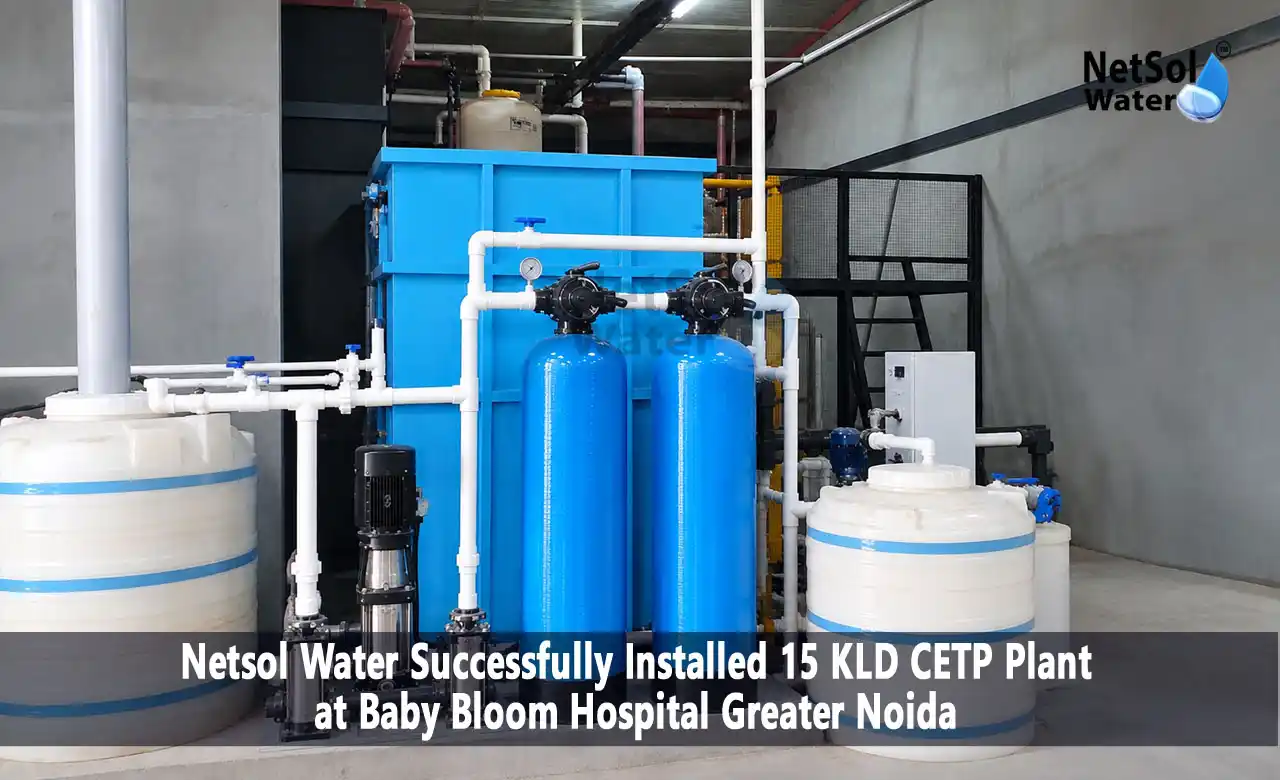
Case Study: Installed 15 KLD CETP Plant at Baby Bloom Hospital, Greater Noida
Baby Bloom Hospital in Greater Noida, Uttar Pradesh, is a healthcare facility that, like any hospital, generates wastewater daily from patient care areas, washrooms, cleaning operations and other routine activities. Managing this wastewater responsibly is a basic operational requirement for any healthcare setup.
To address this need, the hospital commissioned a 15 KLD CETP (Common Effluent Treatment Plant), designed to treat approximately 15,000 litres of wastewater per day. The project was executed by Netsol Water a company engaged in the design, manufacturing and installation of water and wastewater treatment systems.
This case study covers the project background, the treatment approach followed, the installation process at the hospital site, and the outcome of setting up a dedicated treatment system, giving a factual, on-ground view of the project.
Project Overview
| Project Detail | Information |
|---|---|
| Project Name | 15 KLD CETP Installation |
| Client | Baby Bloom Hospital |
| Location | Greater Noida, Uttar Pradesh |
| Plant Capacity | 15 KLD |
| Plant Type | CETP / Effluent Treatment System |
| Application | Hospital Wastewater Treatment |
| Executed By | Netsol Water Solutions Pvt. Ltd. |
A 15 KLD capacity means the plant is designed to handle around 15,000 litres of wastewater a day, sized to correspond to the hospital's day-to-day generation so effluent can be collected and treated on an ongoing basis rather than discharged without treatment.
It functions as a dedicated effluent treatment plant for the hospital's daily wastewater generation.
About Baby Bloom Hospital, Greater Noida
Baby Bloom Hospital operates as a healthcare facility in Greater Noida, providing medical services to patients in the region. Like most hospitals, its daily operations generate wastewater from multiple sources, including patient care areas, toilets and washrooms, general cleaning and housekeeping activities, and utility sections used for routine hospital functions.
This wastewater differs from typical domestic sewage because hospital operations bring together water from clinical, sanitary and operational use points. Because of this mix, hospitals generally need a structured approach to wastewater collection and treatment rather than ad-hoc discharge arrangements, which formed the backdrop for the 15 KLD CETP project.
Why Wastewater Treatment Was Required at the Hospital?
Hospitals need particular attention when it comes to hospital wastewater treatment, since water used across patient areas, washrooms and cleaning operations can carry organic matter, suspended solids and other contaminants that should not be released into the environment without treatment.
Untreated hospital wastewater, if discharged directly, can affect local drainage systems and the surrounding environment. Suspended solids can burden downstream infrastructure, while organic pollutants can affect water quality if they enter open drains or water bodies without any treatment step in between.
A CETP, or Common Effluent Treatment Plant, addresses this by providing a structured process through which wastewater is collected, treated and only then discharged or handled further, passing through defined stages that reduce its pollutant load rather than leaving the premises untreated.
For a healthcare facility, having such a system in place also supports compliance with applicable environmental and municipal requirements related to wastewater discharge. This was a key consideration behind the hospital's decision to install a dedicated 15 KLD CETP rather than depend on unmanaged disposal routes.
15 KLD CETP Capacity and Project Requirement
The term 15 KLD refers to a treatment capacity of 15 kilolitres per day, or approximately 15,000 litres per day, representing the volume of wastewater the plant is designed to process within a 24-hour cycle under normal operating conditions.
Sizing a treatment plant correctly is important. A plant too small for the actual wastewater generated at a site can get overloaded, while one that is oversized adds unnecessary cost and space requirements. The 15 KLD capacity for Baby Bloom Hospital was determined based on the hospital's operational wastewater generation, so the plant could manage daily flow without being under or over designed.
Beyond daily volume, a treatment plant also needs to account for how wastewater flows through the day, since hospital activity is not always uniform. Proper hydraulic management within the plant helps ensure variations in flow do not disrupt the treatment process.
CETP Treatment Process
A CETP generally treats wastewater through a series of connected stages, each performing a specific function before the water moves to the next step. The general flow followed in such systems typically looks like this: wastewater collection, screening, equalization, treatment, clarification, filtration or polishing, disinfection, and finally treated water.
. Screening
The first stage in most CETP systems is screening, where larger floating solids and coarse materials are removed from the incoming wastewater. This protects downstream equipment such as pumps and pipelines from blockages and reduces the load on later stages.
. Collection and Equalization
Once screened, wastewater is directed to a collection and equalization tank. This stage gathers wastewater arriving from different points across the facility and balances out variations in flow and pollutant load over the day, helping the treatment system receive a more consistent input.
. Biological Treatment
A biological treatment stage is commonly used in wastewater systems to reduce biodegradable organic matter present in the effluent. In general terms, this stage relies on biological processes to break down organic pollutants before the water moves further along the treatment chain. The specific biological technology used depends on the project design and site requirements.
. Clarification
After biological treatment, a clarification stage allows suspended solids to settle out or separate from the treated water, producing a clearer effluent and supporting sludge management.
. Filtration
Filtration, where used, acts as a polishing step, further reducing any remaining suspended particles after clarification and improving overall treated water quality.
. Disinfection
A disinfection stage, where applicable, addresses microbial content in the treated water before discharge or further use, a standard consideration for wastewater systems connected to healthcare facilities.
Major Components of the 15 KLD CETP
CETP systems are generally built using a combination of the following components. The table below outlines components commonly found in such systems.
| Component | Purpose |
|---|---|
| Screening Unit | Removal of coarse solids |
| Collection/Equalization Tank | Wastewater collection and flow balancing |
| Treatment Unit | Wastewater treatment |
| Clarifier | Suspended solids separation |
| Filtration Unit | Further water polishing |
| Disinfection System | Microbial control |
| Sludge Handling System | Sludge management |
| Pumps | Wastewater transfer |
| Blower (if applicable) | Aeration |
| Control Panel | Plant operation and control |
This table represents components generally used across CETP projects of this type. The exact configuration installed at Baby Bloom Hospital was finalized based on site-specific requirements and available space, and not every listed component is necessarily part of every installation.
Installation Process at Baby Bloom Hospital
Setting up the 15 KLD CETP at the hospital followed a structured, step-by-step approach, as is typical for projects of this nature:
1. Site assessment to understand available space and layout constraints.
2. Planning the plant layout based on the assessment.
3. Placement of treatment equipment at designated locations.
4. Connection of tanks and piping between treatment units.
5. Installation of pumps required for wastewater transfer.
6. Electrical connections for equipment operation.
7. Connection and setup of the control panel.
8. Interconnection of all treatment units into a single working system.
9. Testing and inspection of the installed system.
10. Trial operation to observe plant performance before full use.
11. Final commissioning of the plant.
Each step was carried out to ensure the plant could operate as a connected, functioning system rather than a set of standalone units. Installation work at an operating hospital also requires care in scheduling and coordination, since ongoing hospital activities need to continue with minimal disruption.
Operation and Maintenance Requirements
Like any treatment system, a CETP requires regular operation and maintenance to keep performing consistently; skipping it can reduce treatment efficiency or cause operational issues.
Routine activities generally include:
. Cleaning screening units to prevent clogging
. Periodic pump and, where applicable, blower inspection
. Sludge removal and appropriate disposal
. Monitoring pH levels and tracking flow rates
. Periodic tank cleaning and filtration unit maintenance
. Checking that disinfection systems are functioning as intended
Preventive maintenance, done on a scheduled basis rather than only when a problem arises, plays an important role in keeping plant performance steady over time.
Project Challenges
Installing a treatment plant within an existing, operational facility like a hospital comes with practical considerations. Available installation space is often limited, requiring the layout to be planned around existing structures. Integrating new piping and equipment with existing infrastructure requires careful alignment, especially where connections tie into pre-existing drainage. Electrical connections need to suit the site's power setup, and equipment placement must allow accessibility for future maintenance, all while minimizing disruption to the hospital's ongoing operations.
Project Outcome
With the 15 KLD CETP now installed, Baby Bloom Hospital has a dedicated system in place to treat its wastewater on an ongoing basis rather than relying on unmanaged discharge. Wastewater generated across the facility can now move through a defined, controlled treatment process before further handling.
This also brings a more organized approach to sludge management, since the plant includes a system for handling sludge generated during treatment, rather than leaving this aspect unaddressed. Overall, the installation gives the hospital treatment infrastructure sized for its stated capacity requirement, supporting more responsible wastewater management as part of regular operations.
The project reflects a practical, functional outcome: a working treatment system matched to the facility's needs, not a claim of any specific performance benchmark beyond what the plant was designed to do.
Watch the 15 KLD CETP Installation at Baby Bloom Hospital
For a closer look at the installed treatment system, a video covering the 15 KLD CETP project at Baby Bloom Hospital is available, offering a walkthrough of the plant setup and a practical sense of how the system was installed at the site.
Watch here:
Benefits of the 15 KLD CETP Installation
The installation of a dedicated 15 KLD CETP brings several practical benefits to Baby Bloom Hospital's daily operations:
. A dedicated wastewater treatment system suited to the hospital's needs
. More structured and organized wastewater management across the facility
. A controlled, defined treatment process rather than untreated discharge
. Reduced release of untreated effluent from hospital operations
. Support for more responsible environmental management practices
. Organized handling and management of sludge generated during treatment
. Easier day-to-day monitoring of the treatment process
. Infrastructure that supports applicable compliance requirements related to wastewater discharge
These benefits are practical and operational in nature, reflecting what a properly installed treatment system is designed to deliver for a facility of this kind.
Why Choose Netsol Water for Wastewater Treatment Projects?
Netsol Water Solutions Pvt. Ltd. is a wastewater treatment plant manufacturer that works across water and wastewater treatment projects, including industrial wastewater treatment, STP, ETP and CETP systems for various facility types. The company's work spans plant design, manufacturing, on-site installation and commissioning support for clients across different sectors.
For a project like the one at Baby Bloom Hospital, this includes planning the system around the client's site conditions and requirements, followed by installation and setup of the plant as a functioning unit. Beyond installation, Netsol Water also supports clients with operation and maintenance or AMC arrangements, helping treatment systems perform reliably after commissioning.
This combination of design, execution and ongoing support is central to how Netsol Water approaches such projects across healthcare and other facility types.
Frequently Asked Questions (FAQs)
Q1. What is the capacity of the CETP installed at Baby Bloom Hospital?
The plant has a capacity of 15 KLD, or approximately 15,000 litres per day.
Q2. Where was the 15 KLD CETP installed?
The plant was installed at Baby Bloom Hospital, Greater Noida, Uttar Pradesh.
Q3. What is the purpose of a CETP in a hospital?
It treats wastewater from hospital operations before discharge, helping manage pollutants and support proper wastewater management.
Q4. How much wastewater can a 15 KLD CETP treat?
Approximately 15,000 litres per day under normal operating conditions.
Q5. Why is wastewater treatment important in hospitals?
Hospital wastewater can carry organic matter and suspended solids from patient, sanitary and cleaning activities. Treating it before discharge reduces its impact on the surrounding environment and supports compliance with applicable requirements.
Q6. Does a CETP require regular maintenance?
Yes. Cleaning, pump and blower inspection, sludge removal, and flow/pH monitoring are necessary to keep the plant performing consistently.
Q7. Can treated wastewater be reused?
This depends on the quality of the treated water, the intended application and applicable local requirements, and is assessed case by case.
Q8. Who installed the 15 KLD CETP at Baby Bloom Hospital?
The plant was installed by Netsol Water Solutions Pvt. Ltd.