

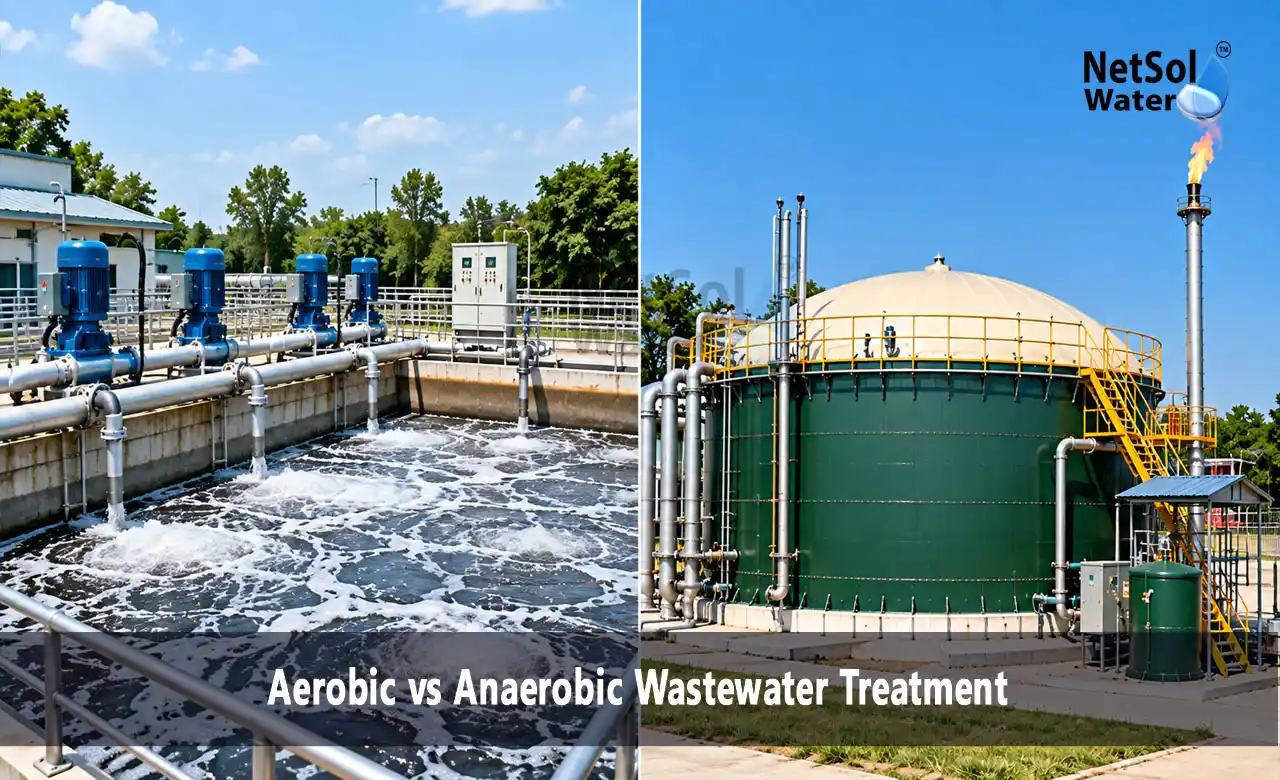
Aerobic vs Anaerobic Wastewater Treatment: Which Is Better?
Every factory, hotel, hospital and housing society produces wastewater, and every one of them must treat it before it is discharged or reused. As Indian cities and industries keep growing, the pressure to treat water properly, cut operating cost and meet pollution control board norms keeps rising. The biggest early decision is the biological process at the heart of the plant: aerobic or anaerobic.
Both methods use microorganisms to break down organic pollutants, but they work in very different conditions and suit very different wastewater. In this guide we compare aerobic vs anaerobic wastewater treatment in plain language, so you can decide which one fits your effluent, your budget and your discharge targets.
Quick answer: Neither process is better in every case. Aerobic treatment is the better choice for low to medium strength wastewater such as sewage and for meeting strict discharge limits. Anaerobic treatment is the better choice for high strength organic effluent from food, dairy and distillery units, where it saves energy and recovers biogas. Many plants get the best result by combining both.
What Is Biological Wastewater Treatment?
Biological treatment uses naturally occurring bacteria to consume the dissolved and fine organic matter in wastewater. This organic load is measured as BOD (biochemical oxygen demand) and COD (chemical oxygen demand). The higher these values, the stronger the wastewater and the more work the biological stage has to do. Whether bacteria need oxygen to do that work is what separates aerobic from anaerobic treatment.
Aerobic Wastewater Treatment
Aerobic treatment relies on bacteria that need dissolved oxygen. It is the most widely used biological process in municipal sewage plants and in many industrial plants, because it reliably produces clear, low BOD water.
How the aerobic process works?
Blowers and diffusers push air into an aeration tank. The bacteria use this oxygen to convert organic pollutants into carbon dioxide, water and new bacterial cells. These cells settle out as sludge, and the clarified water moves on to disinfection, filtration or reuse. When oxygen levels, pH and loading are kept in range, the process is stable and well proven, and it can bring BOD down by roughly 90 percent or more.
Common aerobic technologies
. Activated sludge process (ASP) and extended aeration for general sewage treatment.
. Sequencing batch reactor (SBR) for plants that need flexible, batch based operation.
. MBBR (Moving Bed Biofilm Reactor) for compact plants, where bacteria grow on floating plastic media and handle load variations well.
. MBR (Membrane Bioreactor) when very high quality, reuse grade water is required.
Advantages of aerobic treatment
. Consistently high removal of BOD and COD, so it meets strict discharge norms.
. Quick start-up and good tolerance of changing flow and load.
. Little odour when operated correctly, which suits plants near buildings.
. Flexible designs that scale from small packaged units to large municipal plants.
Limitations of aerobic treatment
. Aeration is usually the biggest share of a plant's power bill.
. It produces more excess sludge, which adds handling and disposal cost.
. It becomes uneconomical for very high strength wastewater unless it is diluted or pre-treated.
Anaerobic Wastewater Treatment
Anaerobic treatment uses bacteria that work without oxygen, inside a closed reactor. It is especially attractive when the effluent is rich in organic matter, because the process turns that pollution into a usable energy source.
How the anaerobic process works?
Anaerobic digestion happens in four connected stages: hydrolysis, acidogenesis, acetogenesis and methanogenesis. Large organic molecules are first broken into simpler compounds, then into organic acids, and finally into biogas, which is typically a mix of methane and carbon dioxide. This biogas can be used for boilers, heating or power generation. Because no aeration is needed, the energy demand is far lower than in aerobic systems.
Common anaerobic technologies
. UASB (Upflow Anaerobic Sludge Blanket) reactors, widely used for food, beverage and distillery effluent.
. Anaerobic filters and fixed film reactors for medium strength industrial wastewater.
. Covered lagoons and high rate digesters for very large volumes of organic waste.
Advantages of anaerobic treatment
. Much lower energy use because there is no continuous aeration.
. Biogas recovery that can reduce fuel or electricity cost.
. Far less sludge than aerobic systems, so disposal cost falls.
. Handles high COD loads that would overwhelm an aerobic plant.
Limitations of anaerobic treatment
. Treated water rarely meets final discharge limits alone, so a polishing stage is usually needed.
. Start-up is slow, and the system is sensitive to pH, temperature and toxic shocks.
. It performs best in a warm, steady temperature range, so heating may be needed in cold sites.
. Biogas needs safe handling, gas cleaning and proper flaring or utilisation.
Aerobic vs Anaerobic Wastewater Treatment: Side by Side
The table below summarises the main differences that affect plant selection and running cost.
| Factor | Aerobic treatment | Anaerobic treatment |
|---|---|---|
| Oxygen need | Needs continuous oxygen supply through blowers or aerators | Works in an oxygen-free, sealed reactor |
| Best organic load | Low to medium strength wastewater (sewage, hotels, hospitals, campuses) | High strength wastewater (food, dairy, distillery, paper, brewery) |
| Energy use | High, because aeration is the largest power consumer | Low, and biogas can offset energy costs |
| Sludge produced | More biological sludge to dewater and dispose | Much less sludge, but it needs stable operation |
| By-products | Carbon dioxide, water and biomass | Biogas (mainly methane and carbon dioxide) |
| Treated water quality | Can meet strict discharge and reuse norms on its own | Usually needs aerobic or tertiary polishing afterwards |
| Start-up and sensitivity | Faster start-up and more tolerant of load changes | Slow start-up, sensitive to pH, temperature and toxic shocks |
| Footprint | Compact with MBBR, SBR or MBR designs | Reactors are compact, but gas handling adds equipment |
Which Treatment Is Better for Your Plant?
The right answer depends on your wastewater, not on a general rule. These are the factors that matter most:
. Organic load: As a rough guide, low strength wastewater suits aerobic treatment, while effluent with COD in the thousands of mg/L is a strong candidate for anaerobic treatment.
. Energy availability and cost: Where power is expensive or unreliable, anaerobic or low energy designs gain an advantage.
. Discharge or reuse target: Strict limits for BOD, COD and suspended solids usually require an aerobic stage at the end.
. Space: Compact aerobic systems such as MBBR suit sites with limited land.
. Sludge handling: If sludge disposal is difficult or costly, lower sludge production becomes a major benefit.
. Operating skill: Anaerobic reactors need steady monitoring and trained operators to stay healthy.
When aerobic treatment makes more sense?
Choose aerobic treatment for domestic and municipal sewage, hotels, hospitals, malls, campuses and housing projects, where the wastewater is moderate in strength and the treated water will be reused for flushing or gardening. A well designed MBBR or SBR plant is the usual choice here. If you are planning one, explore our guide to packaged sewage treatment plants or speak to a sewage treatment plant manufacturer in India who can size the system for your flow.
When anaerobic treatment makes more sense?
Choose anaerobic treatment when your effluent is highly organic, as in dairies, distilleries, food processing, breweries and paper mills. Here, a UASB or similar reactor removes most of the organic load cheaply and creates biogas. Because industrial effluent varies so much between sectors, it is best to work with an experienced effluent treatment plant manufacturer who designs around your actual wastewater analysis.
Why many plants use both?
A combined system is often the most economical answer. The anaerobic stage removes the bulk of the organic load and produces biogas, and an aerobic stage then polishes the water to meet discharge or reuse standards. This hybrid approach cuts the aeration energy and the sludge volume compared with a fully aerobic plant. Industrial clients in the capital region can look at the options from an effluent treatment plant manufacturer in Noida for sector specific designs.
Practical Steps Before You Decide
. Test your wastewater. Get a full analysis of BOD, COD, TSS, pH, oil and grease, and any toxic compounds.
. Study flow patterns. Note average and peak flow, and whether production is seasonal.
. Check the applicable norms. Confirm the discharge standards set by your State Pollution Control Board for your industry.
. Plan for sludge and biogas. Decide in advance how sludge will be dewatered and disposed of, and how biogas will be used.
. Consider future expansion. Choose a modular design so capacity can grow with your business.
. Compare lifecycle cost. Look at power, manpower, chemicals and sludge cost over the plant life, not only the purchase price.
Frequently Asked Questions (FAQs)
Q1. What is the main difference between aerobic and anaerobic wastewater treatment?
Aerobic treatment uses bacteria that need oxygen and produces carbon dioxide, water and sludge. Anaerobic treatment uses bacteria that work without oxygen and produces biogas along with a smaller amount of sludge.
Q2. Which is cheaper to run, aerobic or anaerobic treatment?
Anaerobic treatment is usually cheaper to run for high strength wastewater because it needs no aeration and can generate biogas. For low strength wastewater, aerobic treatment is often the practical and economical choice.
Q3. Can anaerobic treatment alone meet discharge standards?
In most cases it cannot. Anaerobic treatment removes a large share of the organic load, but the treated water normally needs aerobic or tertiary polishing to meet final discharge or reuse limits.
Q4. Is aerobic or anaerobic treatment better for sewage?
Aerobic treatment, especially MBBR, SBR and extended aeration, is generally preferred for sewage because the load is moderate and the treated water must meet strict quality limits.
Q5. Can aerobic and anaerobic treatment be used together?
Yes. Combining an anaerobic first stage with an aerobic second stage is common in industrial plants. It reduces energy and sludge while still delivering high quality treated water.
Conclusion
The choice between aerobic and anaerobic treatment should come from your wastewater data and project goals, not from a one size fits all rule. Aerobic systems give dependable, high quality treated water. Anaerobic systems save energy and turn strong organic waste into biogas. For many industries, a well planned combination delivers the best balance of performance and cost.
At Netsol Water, we design and manufacture sewage treatment plants, effluent treatment plants and related water treatment systems that are matched to your effluent and compliance needs. Share your wastewater details with our team and we will help you select the right process for your facility.
Contact Netsol Water
Phone: +91-9650608473, Email: enquiry@netsolwater.com