

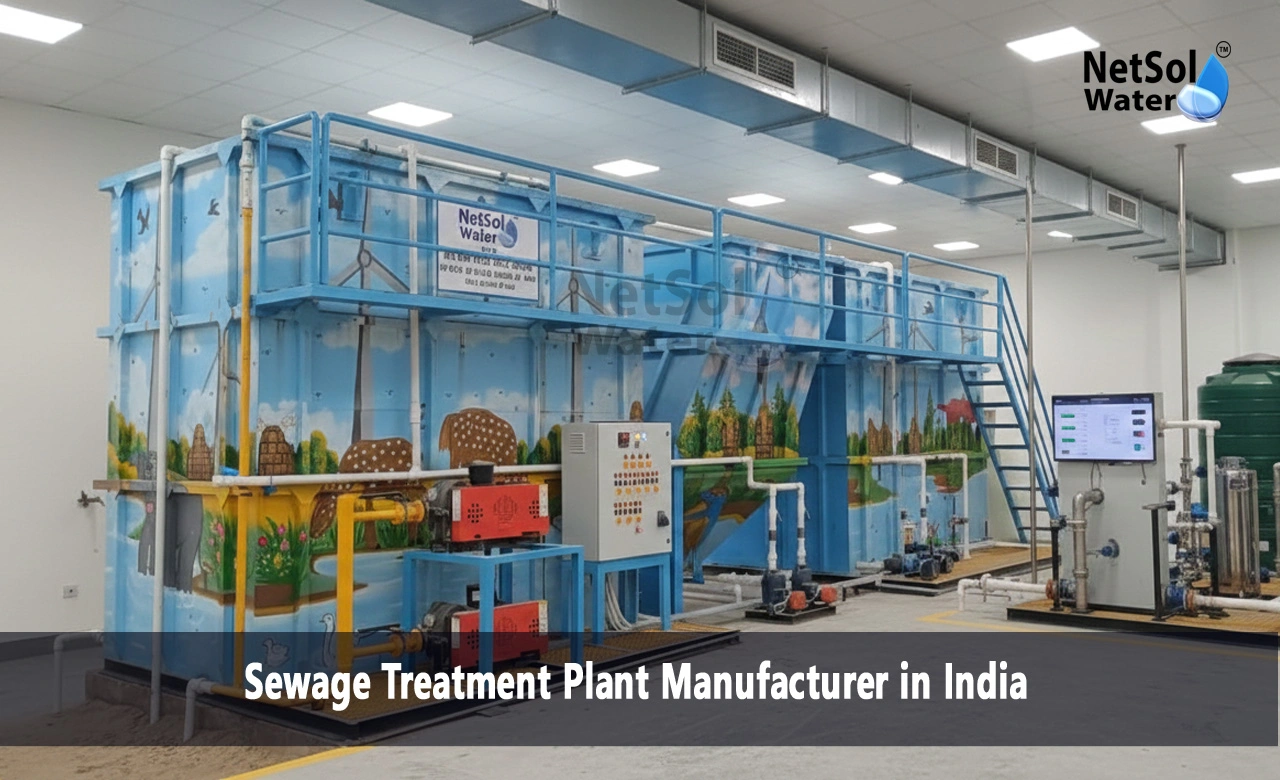
Sewage Treatment Plant Manufacturer in India
India is growing fast. New residential colonies are coming up every month. Industrial zones are expanding. And with all this growth, one thing is becoming impossible to ignore wastewater management.
Netsol Water is a trusted sewage treatment plant manufacturer in India with 15+ years of experience in designing and installing STP plants across the country. We have completed 1000+ installations in 20+ states. Our systems are CPCB compliant, built for long-term performance, and supported by our own technical team.
Whether you need a small packaged STP for a housing society or a large-scale plant for an industrial facility, we have the right solution for you.
Get a Free Quote Today
Why Choose Netsol Water as Your STP Manufacturer in India?
There are many sewage treatment plant manufacturers in India. But very few combine technology expertise, in-house engineering, and long-term service support under one roof.
Here is what makes Netsol Water different:
1. CPCB Compliant Systems
Every plant we build meets the Central Pollution Control Board discharge standards. You stay legally compliant and avoid penalties.
2. MBBR, SBR and MBR Technologies
We work with all major biological treatment technologies. We recommend the right one for your site based on space, budget, and reuse goals.
3. Turnkey EPC Solutions
We handle design, engineering, civil construction, installation, and commissioning. You deal with one company from start to finish.
4. AMC and O&M Support
Our Annual Maintenance Contracts keep your plant running at full efficiency. We also offer full Operation and Maintenance support if you need a dedicated operator team.
5. PAN India Installation
Our project teams work across all major states. No matter where your site is, we can execute the project.
6. Custom Designed Plants
We do not use standard templates. Every STP is engineered based on your actual flow rates, inlet quality, space constraints, and treated water reuse requirements.
Sewage Treatment Plant Solutions We Offer in India
We manufacture and install four core types of sewage treatment plants. Each technology has specific advantages depending on your project type and capacity requirement.
1. MBBR Sewage Treatment Plant
MBBR (Moving Bed Biofilm Reactor) is one of the most widely used sewage treatment technologies in India. It uses specially designed plastic media that provide a large surface area for beneficial microorganisms to grow and break down organic pollutants in wastewater.
MBBR systems are known for their reliable performance, low maintenance requirements, and compact design. They can efficiently handle fluctuations in wastewater flow and load, making them ideal for residential societies, hotels, schools, hospitals, and commercial buildings.
Learn More About Our MBBR STP Plants
2. SBR Sewage Treatment Plant
SBR (Sequencing Batch Reactor) is an advanced biological wastewater treatment technology that performs multiple treatment processes within a single tank. The treatment cycle includes filling, aeration, settling, and decanting, all carried out in a controlled sequence.
SBR plants offer high treatment efficiency, require less space, and are fully automated for easy operation. They are widely used in residential apartments, commercial complexes, educational institutions, and industrial facilities where consistent treated water quality is required.
Learn More About Our SBR STP Plants
3. MBR Sewage Treatment Plant
MBR (Membrane Bioreactor) combines biological treatment with membrane filtration technology to produce high-quality treated water. The membrane acts as a physical barrier, removing suspended solids, bacteria, and other contaminants from wastewater.
MBR systems are ideal for projects that require superior water quality for reuse applications such as toilet flushing, landscaping, cooling towers, and industrial processes. Due to their compact footprint and excellent performance, MBR plants are commonly installed in hospitals, hotels, IT parks, and premium commercial developments.
Learn More About Our MBR STP Plants
4. Packaged Sewage Treatment Plant
A Packaged Sewage Treatment Plant is a pre-engineered, factory-fabricated system designed for quick installation and operation. These plants are delivered as ready-to-install units, reducing on-site construction time and project complexity.
Packaged STPs are an excellent solution for locations with limited space, remote project sites, temporary facilities, and projects requiring fast deployment. Netsol Water offers packaged sewage treatment plants ranging from 5 KLD to 100 KLD, designed to deliver reliable performance while meeting CPCB compliance standards.
Learn More About Our Packaged STP Plants
Industries We Serve as a Sewage Treatment Plant Manufacturer in India
Our sewage treatment plants are installed across a wide range of sectors. Here is a look at the key industries we serve:
1. Government Projects
We have executed STP projects for municipal bodies, smart city initiatives, defence establishments, and public infrastructure projects across India.
2. Residential Societies
Big housing complexes, apartments and gated communities produce a lot of water every day. Our Sewage Treatment Plants clean this water so it can be used again for things like watering plants, flushing toilets and cleaning floors. This helps use water and saves money on water bills. Our Sewage Treatment Plants are really good at helping Residential Societies use water wisely.
3. Hotels and Resorts
Hotels need treatment plants that work well and quietly all the time. Our hotel STPs are designed to work, are easy to install and do not produce any bad smells. The treated water is then used for watering gardens and cleaning rooms.
4. Hospitals
Wastewater from hospitals can contain germs, medicines and other contaminants. Our hospital STP systems are designed to handle this kind of wastewater and meet all the rules for healthcare waste disposal.
5. Educational Institutions
Schools, colleges and universities produce a lot of wastewater from hostels, canteens and toilets. Our compact STP plants handle this wastewater efficiently without disrupting the activities on campus.
6. Commercial Buildings
Malls, office buildings and IT parks have to follow rules for wastewater disposal. We. Install STPs that help these properties meet the rules all year round.
7. Industrial Facilities
Factories produce wastewater with compositions. We design STPs based on the specific characteristics of the wastewater and the requirements for reuse or disposal.
Recent Sewage Treatment Plant Projects Across India
Here is a quick look at some of our recently completed STP installations:
1. 15 KLD STP Plant in Haryana
We installed a compact MBBR-based sewage treatment plant for Noble Alchem in Haryana in 2025. The plant treats 15,000 litres of wastewater per day. Treated water is reused for garden irrigation within the complex.
2. 125 KLD STP Plant in Madhya Pradesh
A 125 KLD sewage treatment plant was commissioned for IT park in Madhya Pradesh in 2026. The system runs fully automated with remote monitoring. Treated water quality meets CPCB standards for surface discharge and reuse.
3. 50 KLD STP Plant Rajasthan
We designed and built a 50 KLD SBR-based STP in Suprajit, Bhiwadi, Rajasthan in 2024. The plant produces high-quality treated water that is reused for toilet flushing and air conditioning cooling towers, saving significant freshwater costs for the client.
4. 75 KLD STP Plant in Maharashtra
A 75 KLD sewage treatment plant was installed for Dalmia Cement, Maharashtra in 2025. The system handles combined domestic and light industrial wastewater. Treated water is used for greenbelt irrigation across the college.
STP Capacity Range and Applications
Different projects need different plant capacities. Here is a general reference for the capacity ranges we supply across key segments:
| Segment | Capacity Range |
|---|---|
| Residential Societies | 1 KLD to 15 KLD |
| Hotels and Resorts | 20 KLD to 500 KLD |
| Hospitals | 10 KLD to 500 KLD |
| Industrial Facilities | 50 KLD to Multi MLD |
If your requirement falls outside this range, contact us directly. We engineer custom capacity plants based on actual flow calculations and future expansion requirements.
How Much is Sewage Treatment Plant Cost in India?
One of the most common questions we get is: how much does a sewage treatment plant cost in India? The honest answer is that STP cost depends on several factors. There is no single fixed price, and any vendor who quotes a price without understanding your project is giving you a rough guess, not a real number.
Here are the key factors that affect sewage treatment plant cost in India:
| Plant Capacity | Approximate Cost Range |
|---|---|
| 1 KLD | Rs. 4.5 Lakh to Rs. 6 Lakh |
| 10 KLD | Rs. 8 Lakh to Rs. 15 Lakh |
| 25 KLD | Rs. 18 Lakh to Rs. 30 Lakh |
| 50 KLD | Rs. 30 Lakh to Rs. 55 Lakh |
| 100 KLD | Rs. 55 Lakh to Rs. 1 Crore |
1. Technology Selection
MBBR plants are generally more economical than MBR systems. MBR costs more because of the membrane modules. SBR falls in the middle range. Your treatment goal and output quality requirement will decide which technology makes sense.
2. Plant Capacity
Larger capacity plants cost more in absolute terms but cost less per KLD. A 100 KLD plant does not cost ten times a 10 KLD plant. There is an economy of scale as capacity increases.
3. Civil Work
If you need full civil construction including RCC tanks, the total project cost goes up. Packaged plants with pre-fabricated MS or FRP tanks cost less on civil but may have higher equipment cost.
4. Reuse Requirement
If you only need basic treated water for irrigation, a standard MBBR or SBR system is sufficient. If you need MBR-quality water for toilet flushing or cooling tower reuse, the plant design and cost changes accordingly.
CPCB Compliance and Water Reuse Benefits of Sewage Treatment Plants
Every sewage treatment plant we install is made to follow the rules set by the Central Pollution Control Board. The Central Pollution Control Board decides how clean the water has to be before we can put it back into rivers or use it again on the site.
If we do not follow these rules we can get in trouble. We might have to pay a lot of money or even get closed down. The State Pollution Control Board can also take us to court. That is why our plants are designed to meet these rules from the beginning so you do not have to worry.
Treated Water Reuse Applications
A good sewage treatment plant does more than just follow the rules. It also gives you water that you can use again. Here are some ways we use the treated water from our plants:
. We use it for toilets in buildings and apartments.
. We use it to water plants and gardens.
. We use it to fill up cooling towers.
. We use it to wash cars.
. We use it for construction work.
. We use it to water crops in the areas.
Sustainability Benefits
Every drop of water we clean and reuse is one we do not need to take from elsewhere. For schools and factories this can save a lot of money on water bills. It also helps reduce stress on the sewage system and rivers. Every litre of wastewater that we treat and reuse is one litre of water that we do not consume. This is a help to the environment and it saves you money too.
Our Presence Across India as STP Manufacturer
Netsol Water operates across all major Indian states. We have regional offices, site teams, and service engineers positioned across the country to support fast project execution and quick after-sales response.
Our installations span metro cities, tier-2 towns, industrial corridors, and rural project sites. Wherever your project is, we can reach you.
Explore our state-specific STP services:
. Sewage Treatment Plant Manufacturer in Haryana
. Sewage Treatment Plant Manufacturer in Rajasthan
. Sewage Treatment Plant Manufacturer in Delhi
. Sewage Treatment Plant Manufacturer in Gujarat
. Sewage Treatment Plant Manufacturer in Uttar Pradesh
If your state is not listed here, contact us directly. We work across all of India.
Why Our Clients Trust Netsol Water for Sewage Treatment Plants?
We have been doing this for 15 years. In that time, we have learned what clients actually need from an STP manufacturer. It is not just a working plant. It is peace of mind.
Here is why clients across India trust us for their sewage treatment requirements:
1. Engineering First Approach
Every project starts with a site assessment and flow calculation. We will not recommend a system without understanding what your project actually needs. This way we can prevent mistakes that cost a lot of money and make sure the plant works the way it is supposed to.
2. Dedicated Project Team
Each project gets a project manager who takes care of the design, procurement, civil work and commissioning. You will always have one person to talk to.
3. After-Sales Support
Our work with clients does not stop when the project is finished. We provide support after the project is done, including making sure spare parts are available, monitoring the system from a distance and sending a technician to visit when needed.
4. Long-Term AMC
Our Annual Maintenance Contracts are designed to keep your plant running and meeting the rules for a time. We take care of maintenance, replace things that get used up and check to make sure everything is okay, with the rules and regulations.
5. Fast Service Response
STP breakdowns cannot wait. Our service teams are positioned across regions to respond quickly and minimize plant downtime.
Frequently Asked Questions About Sewage Treatment Plants in India
Q1. What is the cost of sewage treatment plant in India?
The cost depends on capacity, technology, civil work requirements and water reuse goals. A 10 KLD system may cost Rs. 8–15 lakh, while a 100 KLD plant can range from Rs. 55 lakh to Rs. 1 crore.
Q2. Which sewage treatment plant technology is best for my project?
The best sewage treatment plant technology for your project depends on a things. The space you have your budget for the sewage treatment plant and the quality of treated water you need from the sewage treatment plant. MBBR technology is an option if you want something that is economical and does not take up too much space. SBR technology is good if you want to automate the sewage treatment plant and save space. But if you want the best quality treated water from the sewage treatment plant you should go for MBR technology. Our engineers can help you choose the technology for your sewage treatment plant if you give them your project details.
Q3. Is sewage treatment plant mandatory in India?
Yes a sewage treatment plant is mandatory in India. The government has made rules that say housing societies, commercial buildings, hotels, hospitals and industries must have a sewage treatment plant if they are above a size. The rules for a sewage treatment plant are different in states and depend on the type of project you have.
Q4. How long does it take to install sewage treatment plant?
If you have a packaged sewage treatment plant it can be installed in 2 to 4 weeks.. If you have a civil-based sewage treatment plant it can take anywhere from 6 to 14 weeks to install. The time it takes to install a sewage treatment plant depends on the capacity of the sewage treatment plant the scope of the sewage treatment plant and the conditions at the site where the sewage treatment plant will be installed.
Q5. What is the power consumption of sewage treatment plant?
The power consumption of a sewage treatment plant depends on the technology used in the sewage treatment plant and the capacity of the sewage treatment plant. If you have an MBBR sewage treatment plant it can consume around 0.3 to 0.5 kWh of power per KLD of treated water.. If you have an MBR sewage treatment plant it can consume a bit more power because it has membranes that need to be operated.
Q6. Can treated water from sewage treatment plant be reused?
Yes, treated water from a sewage treatment plant can be reused. You can use the treated water from the sewage treatment plant for things like flushing toilets, watering your garden cooling towers, washing vehicles and even, for agriculture in some cases.. What you can use the treated water from the sewage treatment plant depends on the technology used in the sewage treatment plant and the quality of the treated water.
Get a Free Technical Consultation for Your Sewage Treatment Plant
If you are planning a new STP or need to upgrade an existing one, talk to our engineers first. We will review your project, suggest the right technology, and give you a detailed cost estimate with no obligation.
Call Us: +91-9650608473, Email Us: info@netsolwater.com