

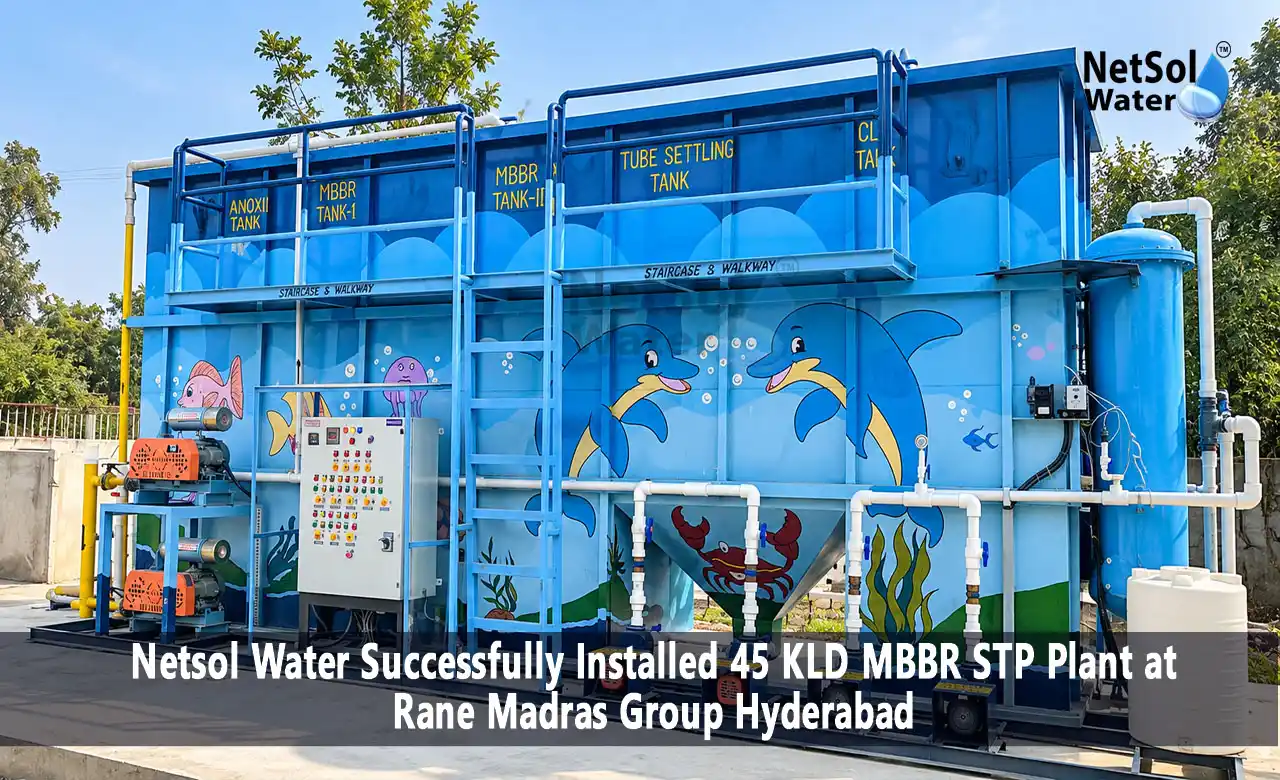
Case Study: Installed 45 KLD MBBR STP Plant at Rane Madras, Hyderabad
In September 2025, Netsol Water completed a 45 KLD STP plant installation at Rane Madras Group in Hyderabad, Telangana. KLD means kilolitres per day, so the plant is rated to treat 45,000 litres of sewage in a day. It is an MBBR STP plant, which means it uses the Moving Bed Biofilm Reactor process for biological treatment.
The plant is a packaged, above-ground unit built with MSFRP and controlled by a PLC panel. The installation at site was completed in seven days. This case study explains the client's sewage treatment need, the treatment process, the challenges faced during installation and the planned reuse of treated water. Rane Madras Group needed a Sewage Treatment Plant in Hyderabad that could be installed quickly within the available site conditions.
Project Specifications at a Glance
The table below gives the confirmed technical details of the project in one place.
| Parameter | Details |
|---|---|
| Client | Rane Madras Group |
| Location | Hyderabad, Telangana, India |
| Installation Date | September 2025 |
| Plant Capacity | 45 KLD |
| Technology | MBBR (Moving Bed Biofilm Reactor) |
| Plant Type | Packaged, Above-Ground STP |
| Construction Material | MSFRP |
| Wastewater Sources | Factory Employees, Toilets and Kitchen |
| Treatment Stages | Collection Tank → Equalization Tank → MBBR Stage 1 → MBBR Stage 2 → Settling → Filtration → Disinfection |
| Main Equipment | Blowers, Pumps, Filters and PLC Panel |
| Control System | PLC-Based Automatic Control |
| Installation Duration | 7 Days |
| Planned Treated Water Reuse | Gardening and Toilet Flushing |
Client Requirement and Sewage Treatment Needs
The wastewater at this site comes from factory employees. It includes water from toilets and from the kitchen. This is domestic sewage, so it is different from industrial process effluent. Sewage of this kind contains organic matter, suspended solids and bacteria. Kitchen water can also add oil and grease. If such water is not treated properly, it can cause bad odour, pollute the surroundings and create health risks.
Employees use toilets and the kitchen every working day, so sewage is generated daily. The client needed a plant that can handle this flow in a steady and organised way. The client also planned to reuse the treated water for gardening and toilet flushing. These are non-potable uses, which means the water is not meant for drinking. For reuse to be considered, the sewage must first be treated in a controlled and consistent manner. This was the main requirement for the 45 KLD plant.
Why a Packaged MBBR STP Was Used?
MBBR Technology for Sewage Treatment
MBBR stands for Moving Bed Biofilm Reactor. It is a form of biological wastewater treatment. Small plastic carriers, called bio media, move freely inside an aerated tank. Microorganisms grow on the surface of these carriers and form a thin layer known as biofilm. Air from the blowers keeps the media moving and supplies oxygen. The microorganisms use the organic pollutants in sewage as food and break them down into simpler substances. Because the microorganisms stay attached to the media, the tank can hold a good amount of active biomass.
Above-Ground Packaged STP Design
A packaged STP plant is built as a ready unit, with tanks, piping and equipment planned together before it reaches the site. An above-ground design does not need the deep excavation that an underground tank needs. This makes site planning simpler, because the work mainly involves preparing the base and making the connections. At Rane Madras Group, the plant is above ground and made of MSFRP. Whether this design suits a site depends on the available area, access for delivery and the quantity of wastewater, so every project needs its own assessment. You can read more in our guide on packaged STP vs conventional STP.
Treatment Process of the 45 KLD MBBR STP
The sewage passes through seven stages, one after another. Each stage prepares the water for the next stage.
1. Collection Tank: Raw sewage from toilets and the kitchen is collected here first. The tank receives the incoming flow and holds it, so the plant can draw sewage in a controlled way. Heavier particles can also settle here to some extent.
2. Equalization Tank: The quantity and strength of sewage change during the day, for example around meal times. The equalization tank balances this variation, so the biological stages receive a more even feed.
3. MBBR Stage 1: This is the first biological stage. Microorganisms on the moving media begin breaking down the organic pollutants in the sewage. Blowers supply the air needed for this process.
4. MBBR Stage 2: The second biological stage continues the work. It treats the organic pollutants that remain after Stage 1. Two stages in series divide the biological treatment into steps.
5. Settling: Biological solids that come out of the MBBR stages are allowed to settle. The solids collect at the bottom, and the clearer water moves ahead. Settled sludge needs to be removed from time to time as part of normal plant operation.
6. Filtration: The water then passes through filters. Filtration removes fine suspended particles that did not settle in the earlier stage.
7. Disinfection: In the last stage, the water is disinfected to reduce harmful microorganisms before it is considered for reuse.
The stages support each other. Collection and equalization manage the flow. The two MBBR stages remove most of the dissolved organic load through biological action. Settling and filtration remove solids, and disinfection deals with microorganisms. Pumps move the water where needed, and the PLC panel coordinates the equipment.
Installation Process Completed in 7 Days
. Plant Delivery and Unloading
Delivery and unloading of the plant was an important part of the job. A packaged plant arrives as a large and heavy unit, and it has to be unloaded without damage. This needs planning of the unloading point and the final position of the plant. At this site, unloading was one of the two main challenges, and it is explained further in the challenges section.
. Plant Positioning and Installation
After unloading, the MSFRP plant was placed at its planned position. The pumps, blowers, filters and PLC panel supplied with the plant were then installed. In general, installing a packaged STP involves placing the plant on a prepared base, fixing the equipment, connecting the inlet and outlet pipes, completing the electrical connections to the control panel and checking that every machine runs properly before the plant is put to use.
. Installation Timeline
The installation was completed in seven days. Packaged plants are built in advance, so most of the work at site is limited to positioning and connections. This is one reason why such plants are often installed in a short time.
Watch the 45 KLD STP Installation at Rane Madras Group
Challenges During Installation
. Space Constraints at the Site
Space was limited at the site. Even a packaged STP needs clear area for the plant, and it also needs room for operators to reach the equipment for daily checks and maintenance. When space is tight, the position of the plant must be planned with care so that it fits and stays accessible. The sewage inlet and the treated water outlet also have to be considered during this planning.
. Unloading and Equipment Placement
Unloading and placing the plant was the second main challenge. A heavy packaged unit has to be handled carefully to protect the MSFRP body, piping and equipment. Limited space makes this harder, because the unloading position and the final position must be planned together. Despite these two challenges, the installation was completed within seven days.
PLC-Based Automatic Control System
PLC stands for Programmable Logic Controller. It is an industrial controller kept inside the control panel. It follows programmed logic and sends start and stop commands to connected equipment such as pumps and blowers. In an STP, this helps run the equipment in the right order without constant manual operation.
This project is an STP plant with PLC automation, with a PLC-based automatic control system. Features such as remote monitoring, automatic alarms or specific sensors have not been confirmed for this installation, so they are not described here. Even with automation, regular inspection and maintenance by the plant operator remain necessary.
Treated Water Reuse for Gardening and Flushing
Sewage water reuse for gardening and flushing is a common practice when the water is properly treated. These are non-potable uses, and they are the planned uses for the treated water at this project.
It is important to separate the plan from the result. Reuse at this site is planned. This case study does not report actual reuse volumes or confirmed water savings. Whether the treated water is suitable for gardening or flushing depends on its quality. This must be established through laboratory testing and checked against the requirements that apply to the site and the intended use. Tests commonly include parameters such as pH, BOD, COD and TSS. Treated sewage water should never be used for drinking.
Project Outcome and Available Performance Data
The confirmed facts of this project are simple. The plant has a capacity of 45 KLD. It uses MBBR technology and is a packaged, above-ground unit. It has PLC-based automatic control, and the installation was completed in seven days.
Laboratory results for the treated water are not available for this case study. For this reason, we are not reporting treated water quality, removal efficiency or compliance status. No performance guarantee is made here. Any STP owner should get the treated water tested by a laboratory after commissioning.
Netsol Water's Approach to Packaged STP Installation
Netsol Water installed this 45 KLD plant at Rane Madras Group within seven days, while working around limited space and the challenge of unloading. As a sewage treatment plant manufacturer, we begin every project with the site details: wastewater quantity, available area, access for delivery and the planned use of treated water. Our sewage treatment plant solutions are then matched to these needs.
If you want to see another MBBR-based project, read our case study on a 50 KLD STP plant at JSW Paradip, Odisha.
Frequently Asked Questions (FAQs)
Q1. What is the capacity of the STP installed at Rane Madras Group?
The plant has a capacity of 45 KLD, which means it is rated to treat 45,000 litres of sewage per day.
Q2. Where was the 45 KLD STP installed?
It was installed at Rane Madras Group in Hyderabad, Telangana, in September 2025.
Q3. Which technology is used in this STP?
The plant uses MBBR (Moving Bed Biofilm Reactor) technology. It is a packaged, above-ground plant made of MSFRP.
Q4. How long did the installation take?
The installation was completed in seven days.
Q5. What are the main stages of the treatment process?
The stages are Collection Tank, Equalization Tank, MBBR Stage 1, MBBR Stage 2, Settling, Filtration and Disinfection.
Q6. Can treated water be reused for gardening and toilet flushing?
Gardening and toilet flushing are the planned reuse applications at this site. Reuse is possible only when the treated water quality is suitable. This must be confirmed through laboratory testing and applicable requirements. Laboratory results are not available for this project.
Q7. Does the STP use an automatic control system?
Yes. The plant uses a PLC-based automatic control system to coordinate its equipment.
Conclusion
The 45 KLD MBBR STP at Rane Madras Group is a packaged, above-ground plant with PLC-based automatic control, installed in Hyderabad in September 2025 in seven days. Limited space and unloading were the main challenges, and the treated water is planned for gardening and toilet flushing.
If you are planning an STP for your factory, institution or residential project, contact Netsol Water. Share your wastewater quantity, site conditions and treatment requirements, and our team will discuss a suitable solution with you.