

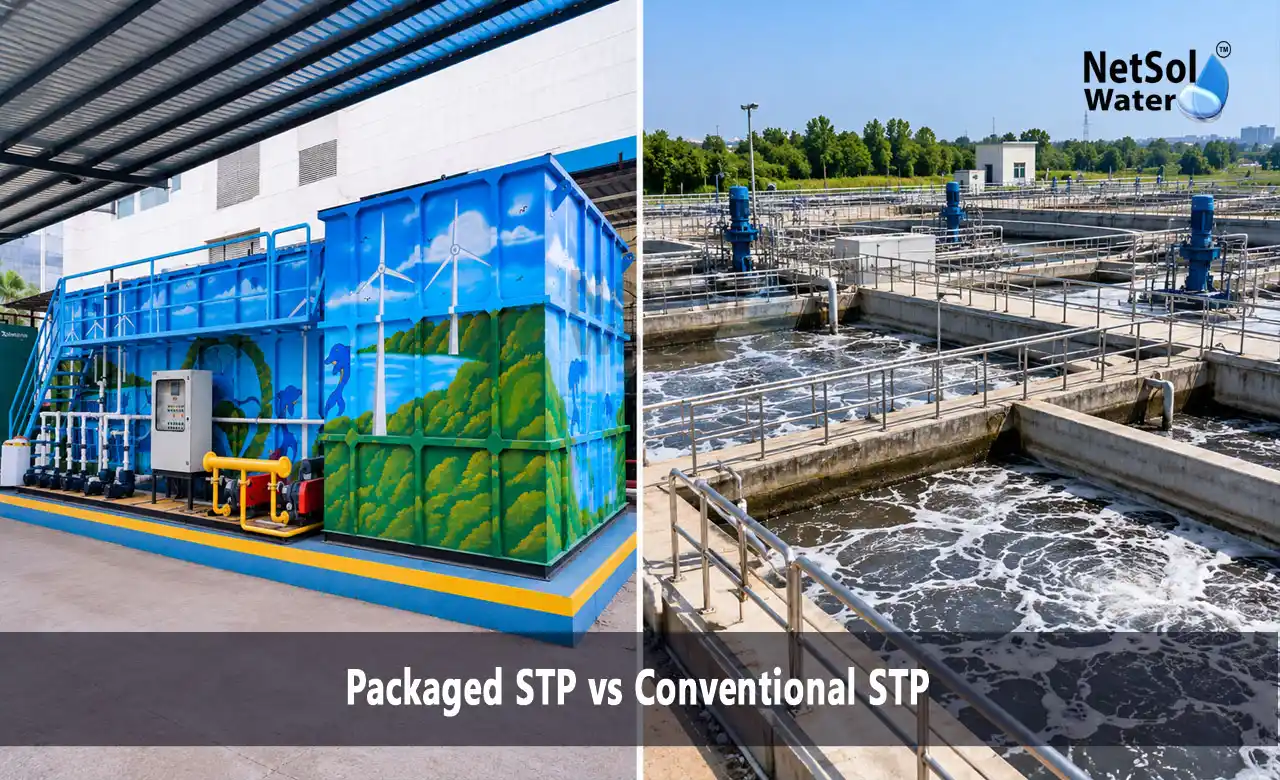
Packaged STP vs Conventional STP: Cost, Space & Performance
Treating wastewater is now a basic requirement for every household and industry in India. Rapid urbanization keeps pushing up the sewage volume that cities and facilities produce each day. Residential societies, hotels, schools, hospitals, commercial buildings and industrial units all need a sewage treatment system that fits their own situation. The choice between a packaged and a conventional plant affects your budget, the land you need and the quality of treated water you get.
Netsol Water is a water and wastewater treatment company based in Noida, Delhi NCR, offering sewage treatment solutions for many applications across India. This guide explains the differences in simple terms so you can decide with confidence. It is written to be practical and people-first, which is exactly the kind of content Google keeps rewarding.
Cost Comparison
Cost is never something to overlook when you select a sewage treatment plant. The purchase price of the equipment may look attractive, but the true cost also covers construction, installation, power use, maintenance and future upgrades. This is why the total project cost should be compared instead of the equipment cost alone.
Initial Installation Cost
A packaged STP is built in a factory, which reduces the civil work needed at the project site. Packaged sewage treatment plants are pre-engineered, so installation is quicker and site complexity is lower. You can read more about how these plants are designed and how to choose a reliable supplier in this guide on choosing the right packaged sewage treatment plant manufacturer in India.
A conventional STP usually needs far more construction on site. Concrete tanks, treatment chambers, pipework and other underground structures all add labour cost and project time. NITI Aayog notes that STP cost varies with technology and land use, and it also points out how much land value matters in Indian cities.
Operation and Maintenance Cost
The first investment is only part of the story, because a plant must be operated and maintained every day. NITI Aayog observes that traditional treatment technologies need a good amount of energy and skilled workers. A compact, factory-integrated design helps simplify routine operation, and Netsol Water's packaged systems are built to need little maintenance. The final price will still depend on plant capacity, treatment technology, water demand and the level of treatment you need.
Space Comparison
When space is limited, the right STP can make or break the site plan. This matters most in urban areas, where every square metre is paid for. Residential and commercial properties already have to share land with parking, buildings, roads and other services, so a sewage treatment plant must fit without creating planning problems.
Space Needs of Packaged Systems
Packaged STPs are manufactured with the treatment unit and tank built in, so the equipment works in a smaller area. Netsol Water's packaged STPs have a low footprint and can be installed above ground or underground, in compact capacities from 5 KLD up to 100 KLD. This makes them a good fit for new projects and for properties that need to add a plant to an existing site. If you want a closer look at one such option, see this page on a compact modern sewage treatment plant.
Space Needs of Conventional Systems
Land requirement for a conventional STP depends on the process and on the treatment level required. According to MoHUA guidance, conventional activated sludge systems usually need larger land areas than compact activated sludge systems such as SBR. Where open land is plentiful, large structures work well and suit higher treatment capacities. In a crowded urban setting, though, a large civil footprint can be hard to manage, so plant size and available land should be considered early in planning.
Performance Comparison
Money and space matter, but the most important question is performance, because the main job of an STP is to treat sewage properly. The plant must handle the expected sewage load and deliver the discharge or reuse quality you need. Good performance depends on good design, correct operation and regular maintenance.
Treatment Quality and Process Control
Both packaged and conventional systems can use biological treatment. The format matters less than the technology and design you choose. Modern plants can use technologies such as MBBR, SBR and MBR, and Netsol Water offers several of these. A packaged system is designed as a single unit, which supports stable operation, and factory fabrication allows controlled manufacturing and easier installation.
Flexibility and Future Needs
Conventional plants offer design flexibility on large projects, since engineers can shape each civil structure around the site and the process. Packaged systems can use modular units to support future expansion, and Netsol Water's packaged systems can be upgraded as your needs grow.
Packaged STP vs Conventional STP at a Glance
| Factor | Packaged STP | Conventional STP |
|---|---|---|
| Construction | Factory built, minimal site work | Built on site with civil structures |
| Installation time | Faster, ready to install | Longer, depends on civil work |
| Space | Compact, above or below ground | Larger footprint, needs more land |
| Operation | Simpler routine operation | Often needs more skilled staff |
| Flexibility | Modular, can be upgraded | Custom civil design for large projects |
| Best suited for | Limited space, small to mid capacity | Large capacity with ample land |
How to Choose the Right STP for Your Project?
Start with the needs of your site and check these points before you decide:
. Budget: compare the total cost, including civil work, power and upkeep.
. Land area: confirm how much space is really available for the plant.
. Sewage flow: estimate daily and peak load for today and for the future.
. Treated water quality: decide whether the water is for discharge or for reuse such as flushing and gardening.
. Support: pick a partner who offers design, installation and after-sales service. Here is a useful overview of the best sewage treatment plant manufacturers in India.
Frequently Asked Questions (FAQs)
Q1. Is a packaged STP cheaper than a conventional STP?
A packaged STP often costs less to install because it needs less civil work and less time on site. The overall cost still depends on capacity, technology and the treatment level you need.
Q2. Which STP needs less space?
A packaged STP generally needs less space, and it can be installed above ground or underground.
Q3. Can a packaged STP be expanded later?
Yes. Modular packaged systems can support future expansion, and Netsol Water states that its packaged systems can be upgraded.
Q4. Is a conventional STP better for large projects?
A conventional plant can suit larger projects that have more land and specific civil design needs.
Conclusion
Choosing a sewage treatment plant should begin with the needs of your site. Weigh your budget, land area, sewage flow and required treated water quality before picking a system. A packaged plant offers a compact design and faster installation. A conventional plant can suit larger projects with more land and specific civil design needs. The right answer comes from comparing the full project requirements instead of judging one system on a single factor.
For a clearer understanding of packaged STP vs conventional STP and a solution that fits your project, contact Netsol Water for professional guidance. The team can help you assess your requirements and select a suitable sewage treatment solution for your site.
Contact Netsol Water
Phone: +91-9650608473, Email: enquiry@netsolwater.com