

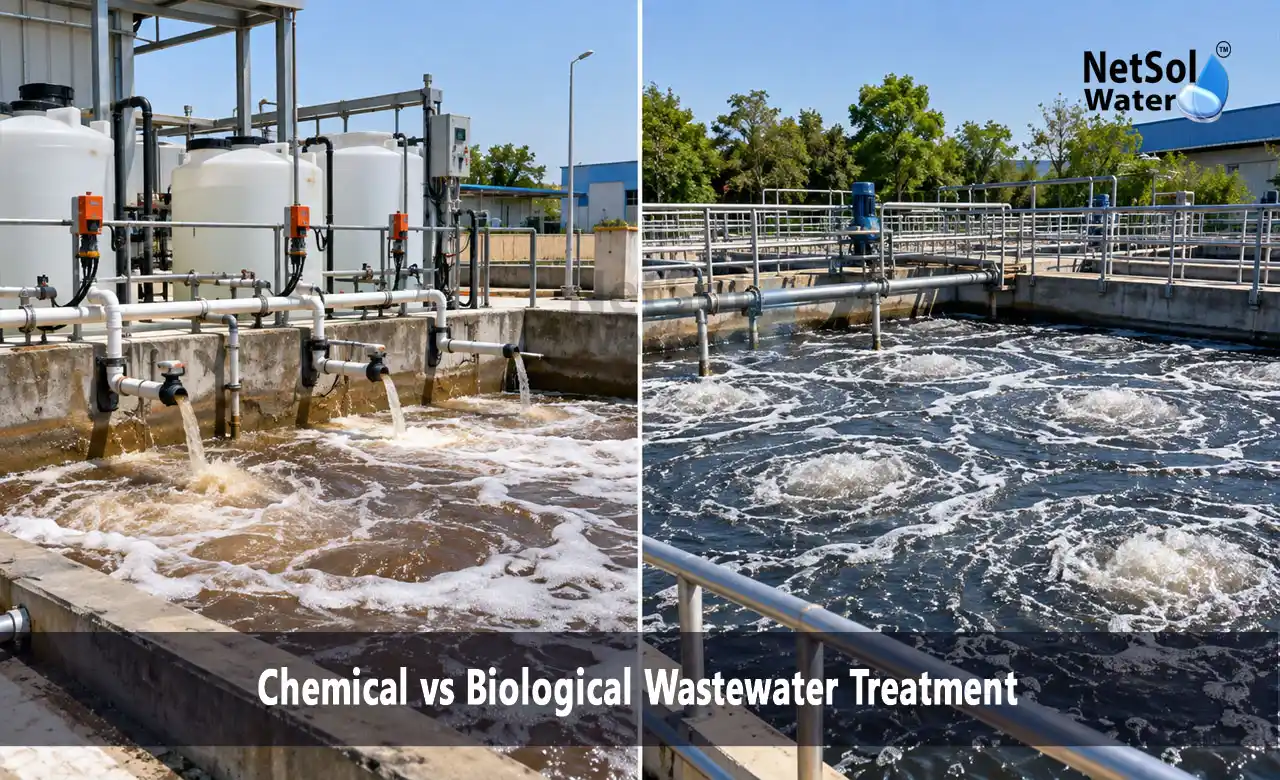
Chemical vs Biological Wastewater Treatment Guide 2026
Untreated wastewater carries oils, metals, suspended solids, nutrients and organic matter that damage rivers, groundwater and soil. Factories, hospitals, hotels and housing societies are all expected to treat their water before discharge or reuse. The real question for most plant owners is not whether to treat, but how. That is where chemical vs biological wastewater treatment comes in, because the two methods remove pollutants in very different ways.
Chemical treatment adds reagents that change or capture pollutants. Biological treatment uses microorganisms to digest organic matter. Neither is "better" in every case. The right choice depends on what is actually in your water, how much it varies, and what quality you need at the outlet.
What Is Chemical Wastewater Treatment?
Chemical wastewater treatment uses reagents such as coagulants, pH adjusters and oxidising agents to react with pollutants so they can be separated from the water. It works well when pollutants are dissolved, very fine, or toxic to microbes, and when quick action is needed.
How Chemical Treatment Works?
. Characterisation: Operators first test pH, COD, suspended solids and metal content. Dosing without this data is guesswork.
. Coagulation: Coagulants such as alum, ferric chloride or poly aluminium chloride neutralise the charge on tiny particles so they start to clump.
. Flocculation: Gentle mixing with a polymer builds these clumps into larger flocs that settle or float easily.
. Precipitation: Adjusting pH converts many dissolved metals into insoluble hydroxides that can be removed as sludge.
. Separation: Clarifiers, tube settlers or filters remove the flocs, leaving clearer water.
The strength of this approach is speed and precision. Its limits are also clear: chemical cost, tighter dosing control, and extra sludge that needs proper disposal. A jar test on a fresh effluent sample is the usual way to fix the right dose.
Where Chemical Treatment Fits Best?
. Industrial effluent with heavy metals or high suspended solids
. Phosphate removal and colour reduction
. pH correction before a biological stage
. Tertiary polishing when treated water must meet a strict reuse target
What Is Biological Wastewater Treatment?
Biological treatment relies on bacteria and other microorganisms that feed on biodegradable organic pollutants. They convert that load into biomass, carbon dioxide and water. It is the backbone of most sewage treatment plants and many food, beverage, dairy and textile effluent plants.
How Biological Treatment Works?
Aerobic systems supply air so microbes can break down organics quickly. Anaerobic systems work without oxygen and suit very strong effluent. Common designs include:
. Activated sludge process: microbes stay suspended in an aerated tank, then settle in a clarifier and are recycled.
. MBBR (moving bed biofilm reactor): microbes grow on floating plastic media, which gives a compact footprint and handles load variation well.
. MBR (membrane bioreactor): a biological tank combined with membranes, giving high quality treated water suitable for reuse.
. SBR (sequencing batch reactor): fill, react, settle and decant happen in one tank in timed cycles.
A useful field check is the BOD to COD ratio. A higher ratio generally means the effluent is easier for microbes to digest, while a very low ratio points to hard-to-degrade or toxic compounds that may need chemical or advanced treatment first.
Where Biological Treatment Fits Best?
. Domestic and commercial sewage
. Food, dairy, beverage and similar effluent rich in biodegradable organics
. Plants that need lower chemical use and stable long-term running cost
. Nitrogen removal when the design includes anoxic and aerobic zones
The trade-off is sensitivity. Sudden changes in pH, temperature, salinity or toxic inflow can upset the microbial population and lower performance until it recovers.
Chemical vs Biological Wastewater Treatment: Side by Side
| Factor | Chemical treatment | Biological treatment |
|---|---|---|
| Core principle | Chemicals trigger reactions that turn dissolved or fine pollutants into settleable solids | Microorganisms consume organic pollutants and convert them to biomass, water and gases |
| Best for | Metals, suspended solids, phosphates, colour, pH correction | Biodegradable organics measured as BOD and COD, plus nitrogen removal |
| Speed | Fast reaction, results within minutes to hours | Slower, depends on retention time and microbial health |
| Operating input | Regular chemical dosing and jar-test based adjustment | Aeration energy, nutrient balance, stable feed |
| Sludge | Chemical sludge, often needs careful disposal | Biological sludge, usually easier to handle after dewatering |
| Main risk | Overdosing, rising chemical cost, extra sludge | Shock loads or toxic inflow can upset the microbes |
| Typical stage | Primary or pre-treatment, and polishing | Secondary treatment |
Which One Should You Choose?
For most industrial sites the honest answer is both. A common layout uses chemical pre-treatment to remove metals, oils and suspended solids and to correct pH, then a biological stage to digest the organic load, then a polishing step such as filtration or membranes if the water will be reused. Before finalising any design, ask these questions:
. What are the measured BOD, COD, TSS, oil and grease, and metal values?
. How much does flow and load change during the day or across seasons?
. Is there any toxic or non-biodegradable stream that could harm microbes?
. What discharge norms apply from CPCB or your State Pollution Control Board, and is reuse planned?
. How much space, power and skilled operator time do you have?
Treating this as a data-first decision keeps both capital and running costs under control and avoids oversizing or choosing the wrong process.
Treatment Support from Netsol Water in Noida
Netsol Water designs, supplies and supports wastewater systems for industrial and commercial users across Delhi NCR. If your wastewater has metals, high solids or process chemicals, you can explore our effluent treatment plant manufacturer in Noida page to see how ETP systems are planned around effluent characteristics. For domestic and commercial wastewater, our sewage treatment plant manufacturer in Noida page explains STP options built on biological processes. You can also learn more about the company and its wider range of water solutions on the Netsol Water.
The approach is simple: analyse the wastewater, survey the site, then select the process train and equipment to match the numbers rather than a template.
Frequently Asked Questions (FAQs)
Q1. Is chemical or biological wastewater treatment cheaper?
It depends on the effluent. Chemical treatment has lower civil cost but recurring chemical and sludge expense. Biological treatment usually needs more tank volume and aeration power but can have lower running cost for organic wastewater.
Q2. Can both methods be used in one plant?
Yes. Combining them is common in industrial ETPs, for example chemical pre-treatment followed by an MBBR or MBR stage.
Q3. Which method removes heavy metals?
Chemical precipitation is the primary route for metals. Biological stages mainly handle organic pollutants.
Q4. Why does biological treatment sometimes fail?
Most failures trace back to shock loads, toxic inflow, low oxygen, or poor nutrient balance that stress the microbes.
Q5. Which is used in an STP and which in an ETP?
STPs are mainly biological. ETPs often use a mix, depending on the industry and pollutants.
Conclusion
Chemical and biological treatment solve different problems. Chemical methods are fast and targeted for metals, solids and pH. Biological methods are efficient and economical for biodegradable organic load. Understanding your wastewater first, then combining the two where needed, gives the most reliable path to compliance and safe reuse.
Contact Netsol Water
Phone: +91-9650608473, Email: enquiry@netsolwater.com