


Sewage Treatment Plant Manufacturer in Noida
If you're looking for a sewage treatment plant manufacturer in Noida, you've probably already realised that picking the wrong one is an expensive mistake. A poorly designed STP doesn't just fail inspections - it breaks down at the worst possible time, creates odour complaints from residents, and leaves your RWA or facility team chasing repairs instead of running the building.
We started Netsol Water in 2012 with one straightforward goal: build STPs that actually work - not just on commissioning day, but five and ten years down the line. Since then, we've installed over 500 plants across Noida, Greater Noida, Delhi, and the wider NCR, ranging from compact 5 KLD systems for small housing societies to large 5,000 KLD plants for industrial campuses. We also serve clients across Uttar Pradesh as a leading STP manufacturer, with installations in multiple cities beyond NCR..
Every system we build uses one of three proven biological treatment technologies - MBBR, SBR, or MBR - chosen based on your site's specific needs, not what's easiest for us to manufacture. And because we're based in Greater Noida ourselves, our service engineers are never more than a short drive away when something needs attention.
Do You Actually Need an STP in Noida?
We get asked this a lot, especially by RWA committees and facility managers who are trying to figure out whether this is something they can defer. The honest answer is no - and the window for deferring has been getting smaller every year.
Under UPPCB rules and National Green Tribunal (NGT) orders, any residential or commercial property generating more than 10,000 litres of wastewater per day (10 KLD) must have a functioning STP. For context, a housing society with around 100 occupied flats will typically cross that threshold. Enforcement has become noticeably stricter since 2019 - we regularly hear from clients who received UPPCB show-cause notices before they called us.
Beyond the legal angle, there's a practical one. When wastewater isn't treated properly, it doesn't just disappear. It ends up in local drains, it contaminates groundwater, and it eventually becomes someone's problem - usually yours. The consequences of ignoring it include:
• Closure notices and fines under the Environment Protection Act, 1986
• Personal liability for RWA members and facility managers
• Contamination of drinking water sources and local water bodies
• Damage to the Yamuna river system and surrounding ecology
The good news is that a properly designed STP doesn't just keep you compliant - it pays for itself over time. The treated water coming out of your plant can be reused for toilet flushing, garden watering, and cooling towers. Most of our clients in Noida recover 30 to 40 percent of their daily freshwater demand this way, which adds up to real savings on tanker and municipal water costs.
Quick Numbers Worth Knowing
• 500+ plants installed by Netsol Water across NCR since 2012
• 30–40% of daily freshwater demand typically recovered through treated water reuse
• 10 KLD - the UPPCB threshold above which an STP is legally mandatory
• 99% of our commissioned systems consistently meet CPCB discharge norms
Which STP Technology Is Right for You?
This is the question we spend the most time on during our site assessments, because getting it wrong is costly. The three main technologies - MBBR, SBR, and MBR - all produce CPCB-compliant treated water, but they suit very different situations. Here's an honest breakdown of each.
1. MBBR - Moving Bed Biofilm Reactor
MBBR is the most widely used technology for mid-size residential and commercial projects in Noida, and for good reason. The system uses small plastic carrier media that float in the aeration tank and are colonised by the bacteria doing the treatment work. Because the bacteria live on the carriers rather than in a sludge blanket, there's no sludge return line to manage, and the system copes well with the kind of variable load you see in apartment buildings where occupancy isn't constant.
The footprint is roughly 30% smaller than a conventional activated sludge plant of the same capacity, and day-to-day maintenance is minimal once the system is established. BOD removal consistently reaches 95% or better.
Best suited for: Residential apartment societies, hotels, hospitals, schools, and any site where space is limited and maintenance staffing is lean.
2. SBR - Sequencing Batch Reactor
SBR works by treating wastewater in timed batches within a single tank - the same tank fills, aerates, settles, and then decants, all in a controlled sequence managed by a PLC. The big advantage is that one tank does the work of several in a conventional system, which simplifies the civil construction considerably.
SBR is also notably effective at removing nitrogen and phosphorus, which matters if your site is near a sensitive water body or if UPPCB has flagged nutrient levels as a concern. Because the process is fully automated, it runs reliably without constant operator attention - something large housing society committees tend to appreciate.
Best suited for: Large housing societies with 500 or more flats, IT parks, commercial campuses, and any site where energy efficiency over a large daily volume matters.
3. MBR - Membrane Bio Reactor
MBR is the premium option, and it earns that label. The technology combines biological treatment with ultrafiltration membranes that physically filter the treated water at a microscopic level. The result is effluent that's typically 10 times cleaner than what CPCB requires - turbidity under 1 NTU, fecal coliform near zero, and water that can go straight into reuse applications without further polishing.
If your project has a water reuse mandate, if you're on a water-scarce site, or if the available footprint is very tight (MBR needs the least space of the three), MBR is usually the right call despite the higher capital cost. The membrane modules do require periodic maintenance and eventual replacement, but for the right application the effluent quality more than justifies it.
Best suited for: Luxury residential projects, water-scarce sites, projects with mandatory water reuse targets, and any application where the treated water will be used for purposes beyond basic toilet flushing.
Comparing the Three Technologies
Here's a straightforward comparison to help you decide which direction makes sense before we do a site visit:
• Effluent quality - MBBR: Good, meets CPCB norms | SBR: Very good | MBR: Excellent, reuse-grade
• Space required - MBBR: Small | SBR: Medium | MBR: Smallest
• Capital cost - MBBR: Low to Medium | SBR: Medium | MBR: Medium to High
• Running cost - MBBR: Low | SBR: Low to Medium | MBR: Medium (membrane upkeep)
• Capacity range - MBBR: 5–500 KLD | SBR: 100–5,000 KLD | MBR: 5–1,000 KLD
• Automation - MBBR: Semi-automatic | SBR: Fully automated | MBR: Fully automated
• Reuse potential - MBBR: Flushing, landscaping | SBR: Flushing, cooling towers | MBR: Flushing, irrigation, cooling
Not sure which fits your project? Call us - a 15-minute conversation with one of our engineers will usually narrow it down.
Our Recent STP Installations in Noida
We can tell you our systems work, but it means more when you can see them running. Here are two plants we have designed, built and commissioned in Noida, each using a different technology from the comparison above. Full case studies and walkthrough videos are linked with each project.
1. LAVA International, Sector-63, Noida
90 KLD | MBR Technology
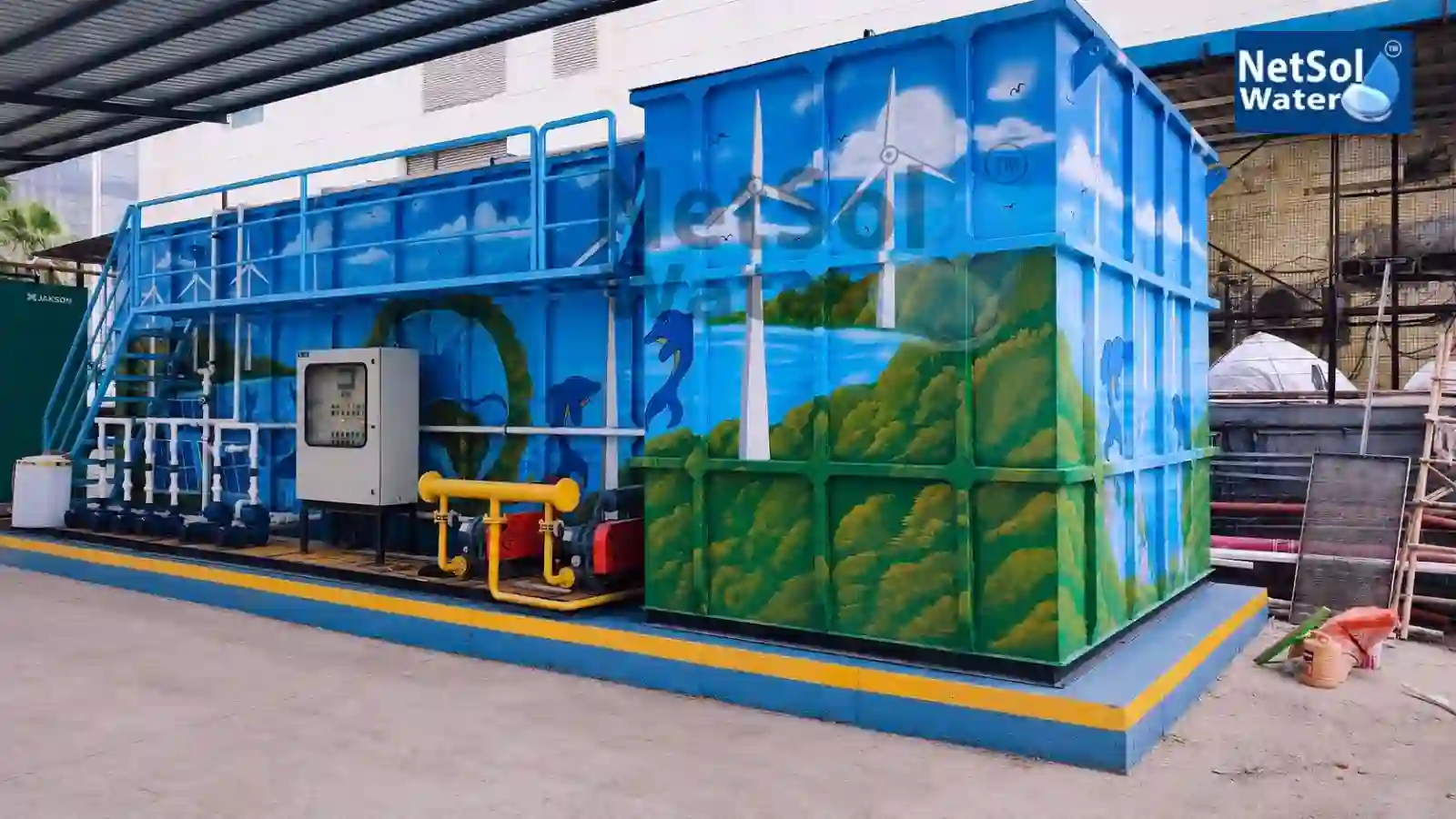
A corporate campus with limited plant room space and a clear water reuse requirement. We went with MBR because the ultrafiltration membranes deliver reuse-grade water in the smallest possible footprint.
Read the full LAVA International case study
2. Berger Tower, Noida
125 KLD | MBBR + UF Polishing
A commercial tower that needed better-than-basic effluent quality without the full cost of an MBR system. The answer was MBBR for biological treatment with an ultrafiltration polishing stage after it, a middle path that produces reuse-grade water at a lower capital cost than MBR.
Read the full Berger Tower case study
Want to see a plant like yours in operation before you decide? Ask us during the site visit and we will arrange a reference, most of our Noida clients are happy to show their systems to serious buyers.
How Sewage Treatment Actually Works?
If you're an RWA member, facility manager, or project developer trying to understand what you're buying, here's a plain-language explanation of what happens inside an STP from the moment wastewater enters to the moment clean water comes out.
Stage 1 - Primary Treatment (Removing the Big Stuff)
Raw sewage first passes through bar screens that catch rags, plastics, and solid debris, then through a grit chamber that settles out sand and small particles. From there it enters a primary sedimentation tank where heavier solids sink to the bottom as sludge. By the end of this stage, around 60% of suspended solids and 35% of the organic load (BOD) have already been removed - and no chemicals or biological processes have been involved yet.
Stage 2 - Secondary Treatment (Biological Treatment)
This is where the real work happens. The pre-treated wastewater moves into an aerated biological reactor - the MBBR, SBR, or MBR unit depending on the design. Billions of microorganisms break down the dissolved organic matter, consuming it as food in the presence of oxygen. After a few hours of this process, BOD levels drop by up to 97% and the water starts to look and smell dramatically cleaner. The bacteria and residual solids are then separated from the treated water before it moves to the final stage.
Stage 3 - Tertiary Treatment (Final Polishing)
The water is now close to CPCB standards, but it goes through one more round of treatment. Sand filters remove any remaining fine particles, and UV disinfection kills residual pathogens including bacteria and viruses. In MBR systems the ultrafiltration membranes handle both tasks simultaneously, producing water that's clean enough to see through. The treated effluent is then tested, and if it meets CPCB discharge norms, it either flows to the drain or - ideally - gets collected for reuse within the building.
What the CPCB Numbers Actually Mean?
Every STP we install in Noida is tested against the CPCB and UPPCB discharge standards before handover. These aren't just regulatory targets for us - they're the baseline. Our systems are designed to comfortably outperform them, which gives you a real buffer for variation in influent quality from day to day.
Required Limits vs. What Our Systems Typically Produce
• pH - Required: 6.5–9.0 | Netsol typical: 7.0–8.2 (neutral, safe for discharge or reuse)
• BOD (Biochemical Oxygen Demand) - Required: ≤ 10 mg/l | Netsol typical: 3–8 mg/l (main organic pollution measure)
• COD (Chemical Oxygen Demand) - Required: ≤ 50 mg/l | Netsol typical: 20–40 mg/l (broader chemical oxygen load)
• TSS (Total Suspended Solids) - Required: ≤ 20 mg/l | Netsol typical: 5–15 mg/l (water clarity indicator)
• Ammoniacal Nitrogen (NH3-N) - Required: ≤ 5 mg/l | Netsol typical: 1–4 mg/l (prevents aquatic damage)
• Total Nitrogen - Required: ≤ 10 mg/l | Netsol typical: 5–9 mg/l
• Fecal Coliform - Required: < 100 MPN/100 ml | Netsol typical: < 10 MPN/100 ml (pathogen indicator)
Source: CPCB General Standards for Discharge of Environmental Pollutants. Output values vary with influent quality and technology chosen.
What Working With Us Actually Looks Like
We know that most RWA committees and facility managers don't enjoy dealing with STP vendors. The process can feel opaque, the technical jargon is off-putting, and it's hard to know whether you're being quoted fairly. Here's what we try to do differently.
1. One Contract, One Team
From the initial site visit to the day we hand over the keys and the effluent test report, everything runs through a single Netsol team. We handle civil design coordination, fabrication, installation, and commissioning ourselves - you're not stitching together three different contractors and hoping they talk to each other.
2. Built for Your Site, Not Off a Shelf
We don't have a standard catalogue that we try to fit to every project. Every system starts with a proper assessment - we look at your daily flow volumes, the space you have, your inlet wastewater characteristics, and whether you want to reuse the treated water. The design follows from that reality, not from what's most convenient to manufacture.
3. We're Local - That Matters More Than It Sounds
Our main facility and service team are in Greater Noida. When something needs attention - a sensor fault, a pump issue, a last-minute check before a UPPCB inspection - we can have an engineer on site the same day. That's genuinely different from working with a manufacturer based in another state.
4. We Test Before We Hand Over
Before any system is commissioned, we run a performance trial and test the effluent in our own NABL-accredited lab. You get the test report at handover, showing actual measured values against CPCB norms. If something isn't right, we fix it before we leave - not after you've accepted the handover.
5. Your Treated Water Is a Resource, Not Waste
We design every system with reuse in mind. If your building has a garden, cooling towers, a car wash, or ongoing construction nearby, we'll show you what the treated water can be used for and size the storage and piping accordingly. Most of our Noida clients recover 30 to 40 percent of their daily freshwater demand this way.
6. We Handle the Compliance Paperwork
UPPCB consent applications, environmental monitoring reports, NOC documentation - we've been through this process hundreds of times. We handle the submissions and walk your team through what's needed at each stage, so you're not navigating environmental law on your own.
Our Credentials
• ISO 9001:2015 Certified
• Designs compliant with CPCB discharge standards
• GST No. 09AAECN1617P1Z3 Verify on GST Portal
• Compliant with current NGT guidelines
• UPPCB Recognised
• Over 14 years working in wastewater treatment across Delhi NCR
Quick Reference - Numbers Upfront
For those who want the key specifications before getting into a longer conversation:
• Capacity range: 5 KLD to 5,000 KLD
• Technologies: MBBR, SBR, MBR
• Compliance: CPCB, UPPCB, NGT standards
• Typical BOD in treated water: ≤ 8 mg/l (CPCB limit is 10 mg/l)
• Installation time: 2–4 weeks for small systems, up to 16 weeks for large civil plants
• Maintenance contract: Annual AMC available, 4-hour emergency response for Noida
• Warranty: 1 year on equipment, AMC packages available beyond that
• Treated water reuse: Flushing, gardens, cooling towers, construction - legally permitted under CPCB norms
Questions People Ask Us Most Often (FAQs)
Q1. How much does an STP cost in Noida?
A- It's hard to give one number because the range is wide - roughly Rs. 5 lakhs for a compact 5 KLD system, up to Rs. 50 lakhs or more for a 500 KLD industrial plant. What moves the cost most is the daily volume, the technology (MBBR, SBR, or MBR), how much civil work is involved, and the level of automation. The best thing to do is call us - we'll visit your site for free and give you a detailed itemised quote with no obligation attached.
Q2. Is it really mandatory? Can we wait a bit longer?
A- If your property generates more than 10 KLD of wastewater per day, it's legally mandatory - and most housing societies of any significant size will be above that threshold. We understand the instinct to defer, but enforcement has tightened considerably since 2019. UPPCB show-cause notices, stop-work orders, and fines are real consequences, and the cost of a rushed last-minute installation tends to be higher than doing it properly the first time.
Q3. Which technology should we go with for our residential society?
A- For most Noida apartment societies, MBBR is a sensible starting point. It copes well with the variable load patterns of residential buildings, takes up less space than conventional systems, and the day-to-day maintenance is manageable without a full-time operator. If your society is large - 500 flats or more - and you're serious about reusing the treated water, we'd look at MBR. Honestly, we'll give you a clear recommendation after seeing your site, because the right answer does depend on specifics.
Q4. How long will installation take?
A- For a compact packaged system up to 50 KLD, you're looking at two to four weeks. Mid-size plants between 50 and 200 KLD typically take four to eight weeks. Larger systems involving significant civil construction can take ten to sixteen weeks. We give you a clear project timeline at the start and manage the whole process, so there are no surprises.
Q5. Can we actually put the treated water to use?
A- Yes - and this is worth planning for from the beginning, not as an afterthought. Treated water meeting CPCB norms can legally go to toilet flushing, garden irrigation, car washing, cooling tower make-up, and construction. MBR-treated water is clean enough for drip irrigation directly. Most of our clients end up saving 30 to 40 percent on their monthly water costs once they set up a reuse system alongside the STP.
Q6. Do we need an Annual Maintenance Contract?
A- You don't legally need one, but an STP that isn't maintained will drift out of compliance over time - blowers wear, dosing systems clog, sludge builds up if it isn't managed. The cost of a compliance failure or an emergency breakdown is almost always higher than the AMC fee. Our contracts cover regular inspections, sludge management, equipment servicing, and quarterly lab testing. For Noida clients, we guarantee a four-hour response for emergency calls.
Q7. What are the actual CPCB limits we need to hit?
A- The key parameters are: pH between 6.5 and 9.0, BOD of 10 mg/l or lower, COD of 50 mg/l or lower, TSS of 20 mg/l or lower, Ammoniacal Nitrogen of 5 mg/l or lower, Total Nitrogen of 10 mg/l or lower, and Fecal Coliform below 100 MPN per 100 ml. Our systems are built to consistently come in well under these, which means you have a practical margin before anything gets close to a violation.
Q8. What's the difference between an STP and an ETP?
A- An STP treats the wastewater that comes from toilets, kitchens, and bathrooms - what you'd find in homes, offices, and hotels. An ETP treats industrial effluent from manufacturing processes, which might contain heavy metals, dyes, acids, or other chemicals that need specialist treatment before they can be safely discharged. If you run an industrial unit that generates both types, you'll typically need both. For residential and commercial properties, an STP is what you need.
Q9. How do we know if our existing STP is actually working properly?
A- The most reliable way is a lab test of the treated water against CPCB parameters. If you haven't had one done recently, that's a good starting point. Beyond that, a few signs that something's off: visible colour or turbidity in the treated water, persistent odour from the plant area, sludge building up more quickly than usual, or a UPPCB notice flagging non-compliance. If any of these are happening, call us - we do independent health checks on existing systems, not just our own installations.
Q10. We already have an STP but it's not meeting CPCB norms. Can it be fixed, or do we need to replace it?
A- More often than not, it can be fixed - and the fix is cheaper than replacement. The most common issues are biological imbalance (the bacteria aren't getting enough oxygen or the wrong mix of nutrients), mechanical problems with blowers or diffusers, or sludge management that's fallen behind schedule. We carry out STP audits on third-party systems and will tell you honestly whether a retrofit will solve the problem or whether replacement is the more sensible long-term call.
Q11. What happens to the sludge that comes out of the STP?
A- Sludge is the solid byproduct of the treatment process - the settled biomass that's separated from the treated water. In a well-run plant it's removed regularly, dewatered using a filter press or drying beds, and then disposed of as per UPPCB guidelines. Dried sludge from a domestic STP is generally safe and can sometimes be used as a soil conditioner. Irregular sludge removal is one of the most common reasons STPs underperform, so our AMC contracts always include it as a scheduled activity.
Q12. Does the STP need to run 24 hours a day? How much electricity does it use?
A- SBR and MBR systems run on automated timed cycles managed by a PLC, so they don't require 24-hour manual supervision - just periodic checks. MBBR systems run the aeration blowers continuously, which is the main electricity draw. Power consumption depends on plant size and technology, but as a working range, expect roughly 0.5 to 1.5 units of electricity per KL treated. For a 100 KLD plant, that's approximately 50 to 150 units per day depending on the aeration design and automation. SBR tends to be more energy-efficient at larger scales. We provide estimated power consumption figures during the design phase so you can factor it into your running cost projections.
Q13. Can an STP be installed underground or inside a building?
A- Yes - this is actually quite common in Noida and Greater Noida where basement or underground utility spaces are available. Package STPs, especially MBR systems, are well-suited to below-ground installation because of their compact footprint and enclosed design. There are ventilation and access considerations to plan for, but these are straightforward to design around. If you have a tight footprint or want the plant out of sight entirely, underground installation is a good option to discuss during the site visit.
Q14. We're a builder, not a society. Can Netsol handle STP for a project under construction?
A- Absolutely - and engaging us during the construction phase rather than after is genuinely better for everyone. When we're involved early, we can coordinate with your civil contractor on the STP chamber sizing, inlet and outlet pipework routing, and electrical supply, which avoids the expensive retrofits that happen when an STP is treated as an afterthought. We work with builders, architects, and PMCs across NCR regularly and are used to fitting into an existing project workflow.
Q15. What size STP do we need? We're not sure how to calculate our daily flow.
A- A rough rule of thumb for residential buildings is 135 litres per person per day - so a 200-flat society with an average occupancy of 3.5 people per flat would generate around 95,000 litres (95 KLD) of wastewater daily. For commercial or mixed-use buildings the figures vary considerably. When we visit your site, we'll help you work through the calculation properly, accounting for actual occupancy, any commercial units on-site, and a sensible design buffer. Sizing an STP too small is a common mistake - it leads to chronic overloading and non-compliance.
Q16. Is there a risk of odour from the STP affecting residents?
A- A well-designed and well-maintained STP should produce very little noticeable odour. The most common source of odour problems is a plant that's overloaded, has inadequate aeration, or hasn't had its sludge removed on schedule. Covered tanks, proper ventilation design, and regular maintenance are the standard remedies. When we design your system, we factor in odour control - particularly if the plant is going to be close to residential areas or common spaces. If you're experiencing odour from an existing system, it's usually a maintenance issue we can diagnose fairly quickly.
Q17. What documentation will we receive after installation?
A- At handover, you'll receive the effluent quality test report from our lab, the operations and maintenance manual for the system, as-built drawings, equipment warranties from the respective manufacturers, and a brief training session for whoever will be operating the plant day-to-day. We also help you prepare the UPPCB commissioning report and can assist with the consent-to-operate documentation if that's still pending.
Q18. Can the STP capacity be increased later if our building expands?
A- Yes - and it's worth thinking about this upfront. MBBR systems in particular are modular and can be expanded by adding more carrier media or additional aeration capacity without major civil work. SBR and MBR systems can also be scaled, though the extent depends on the original tank sizing. If there's any possibility of future expansion - additional floors, a second tower, or increased commercial occupancy - tell us during the design stage and we'll build in the right provisions from the start.
Q19. How do we handle a UPPCB inspection visit?
A- The inspector will typically want to see the plant in operation, review your effluent quality records (which should show test results at regular intervals), check that your consent-to-operate is current, and sometimes take their own water samples for independent testing. If your AMC is current with us, we'll help you prepare for the visit - making sure the records are in order, the plant is running cleanly, and that any minor issues are addressed before the inspection rather than during it. If you've received an inspection notice and aren't sure where you stand, call us first.
Talk to Us
If you have a project in mind - or even just a question you haven't been able to get a straight answer to - call us or drop an email. We'll arrange a free site visit, assess your requirements, and come back with a technology recommendation and a clear itemised quote. No jargon, no pressure, no obligation.
Get in Touch
• Phone: +91 9650608473 | +91 9650795306
• Email: enquiry@netsolwater.com