

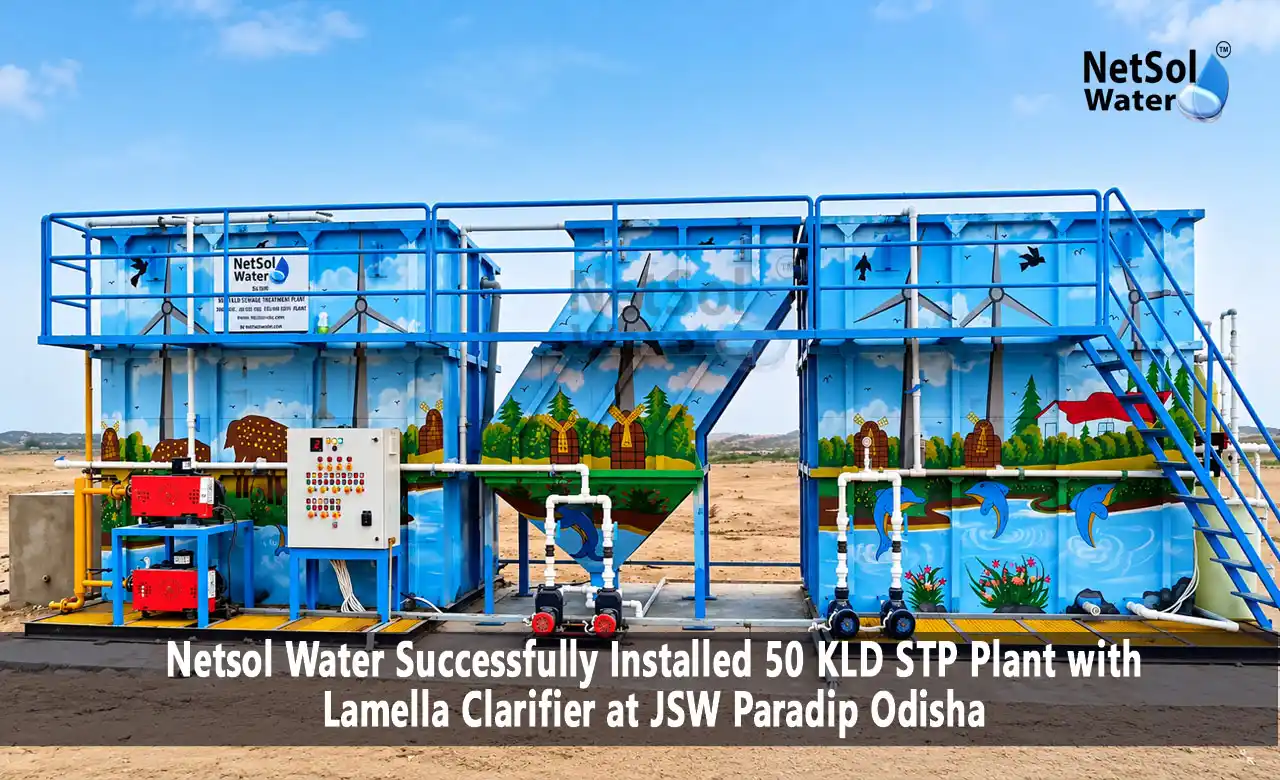
Case Study: Installed 50 KLD STP Plant with Lamella Clarifier JSW Paradip
In February 2026, Netsol Water installed a 50 KLD MBBR-based Package STP Plant with Lamella Clarifier at JSW Paradip Port Terminal, Odisha. The plant treats sewage water so that the treated water can be reused at the site.
This case study explains what the project needed, how the treatment process works and how the installation was completed in about 15 days. It also covers the main site challenge, which was unloading the plant.
The plant at JSW Paradip is a 50 KLD package STP with MBBR biological treatment, a Lamella Clarifier, chlorination, PLC control and MSFRP construction. It was installed above ground on a civil platform in 15 days.
| Detail | Information |
|---|---|
| Client | JSW Paradip Port Terminal |
| Project Location | Paradip, Odisha, India |
| Installation Date | February 2026 |
| Capacity | 50 KLD |
| Technology | MBBR |
| Clarifier | Lamella Clarifier |
| Plant Type | Package STP |
| Construction | MSFRP |
| Installation Type | Above Ground |
| Control System | PLC |
| Disinfection | Chlorination |
| Installation Duration | 15 Days |
| Wastewater Type | Sewage Water |
| Main Challenge | Plant Unloading |
| Main Purpose | Treatment of sewage water and making the treated water reusable |
Project Requirement at JSW Paradip Port Terminal
A port terminal works every day, with staff, visitors, offices and support facilities. All of this creates sewage. The site needed a dependable sewage treatment plant that could treat this sewage water regularly, without needing too much attention from operators.
The second need was water reuse. The aim was not only to treat the sewage but also to make the treated water reusable. Reuse reduces the dependence on fresh water for the purposes the site decides.
Space and time also matter at a working terminal. A package plant comes as a ready system, so only a platform and the connections have to be completed at site.
Clarification was the last point. After biological treatment, the water still carries fine solids, so a good clarification stage was needed before disinfection.
Wastewater and Treatment Challenge
The wastewater at this site was sewage water, and oil and grease was the main concern. We are not quoting laboratory values here.
Oil and grease need attention for a simple reason. They float on the surface and stick to tank walls, screens and pipes. In the biological stage, they can also coat the media and the microorganisms, which makes it harder for them to get oxygen and food.
So the plant has to be planned with this in mind. The early stages, which are the collection tank, screen and equalization tank, even out the incoming sewage and remove coarse material before the biological stage. Floating oil and grease also need regular attention during operation. A separate grease trap at the source is sometimes considered in general, but it is not part of the confirmed flow here.
Why MBBR Technology Was Used?
MBBR stands for Moving Bed Biofilm Reactor. It is a biological process used in an MBBR STP plant, and the biological stage of this project is an MBBR-based process. A general explanation is available in our article on MBBR technology in STP.
Microorganisms do the main work here. They feed on the organic matter in sewage and convert it into simpler matter. In MBBR, small carrier media move freely inside the tank. The microorganisms grow as a thin film on this media. More surface area means more microorganisms in the same tank volume.
Operation and maintenance need some thought too. MBBR suits a package plant because the biological stage stays compact. The air supply should run properly, the media should be checked from time to time, the screen should be kept clean and settled sludge removed on schedule. Media type and design values are not part of this case study.
Role of the Lamella Clarifier in This STP
A Lamella Clarifier is a settling unit that uses a set of inclined plates. It helps solids settle out of water in a smaller space than a plain settling tank would need.
Why clarification is needed after biological treatment?
In the MBBR stage, microorganisms break down the organic matter in sewage. After this, the water carries fine biological solids and suspended particles. If they are not separated well, they move on to the disinfection stage and the treated water tank. That is why this stage is important in every STP.
How the inclined plates help?
Inside the clarifier, plates are fixed at an angle. Water moves through the gaps between them. Solid particles only have to settle a short distance onto a plate surface, instead of falling to the bottom of a deep tank. Once settled, they slide down and collect in the lower sludge zone, and the clearer water leaves from the top.
Why it suits a package STP?
A package plant has a limited footprint. Inclined plates give a large settling area in a small space, so a Lamella Clarifier STP can stay compact. This is useful at a working site where space has value.
At JSW Paradip, better clarification is one of the confirmed benefits. We are not quoting removal figures, as no test data is part of this case study.
Complete Treatment Process
The confirmed treatment flow is: Inlet → Collection Tank → Screen → Equalization Tank → Biological Treatment → Lamella Clarifier → Chlorination → Treated Water Tank. Each stage is explained below.
. Inlet
Sewage from the site enters the plant through the inlet line.
. Collection Tank
The collection tank receives the sewage first. It works as a holding point, so the plant is not hit directly by every change in incoming flow.
. Screen
The screen stops large and floating items such as plastic pieces and rags. This protects the equipment ahead.
. Equalization Tank
Sewage flow and strength change during the day. The equalization tank stores and mixes the screened sewage, so the biological stage gets a steadier feed.
. Biological Treatment (MBBR)
This is the core of the plant. In the MBBR-based biological stage, microorganisms growing on moving media break down the organic matter in the sewage. After this stage, the water carries biological solids, so it goes to the clarifier.
. Lamella Clarifier
Here the inclined plates help biological solids and suspended particles settle. The settled sludge collects at the bottom and the clearer water moves ahead.
. Chlorination
The clarified water is disinfected with chlorine. Clear water is easier to disinfect than cloudy water, which is one more reason why the clarifier stage matters.
. Treated Water Tank
The disinfected water is collected in the treated water tank, from where it is available for reuse.
Plant Configuration and Key Features
This 50 KLD STP Plant with Lamella Clarifier is a good example of a compact STP plant in Odisha. The main features are:
. 50 KLD capacity: the plant is sized for 50 kilolitres, or 50,000 litres, of sewage per day.
. MBBR technology: biological treatment on moving media.
. Lamella Clarifier: compact, inclined plate clarification after the biological stage.
. Package configuration: a ready unit, so site work is mainly the platform, connections and commissioning.
. MSFRP construction: the plant body is built with MSFRP.
. Above ground installation: the plant sits on a civil platform above ground.
. PLC control: central control and monitoring of plant operation.
. Chlorination: disinfection of the clarified water.
. Water reuse: treated water is collected for reuse.
PLC-Based Control System
PLC stands for Programmable Logic Controller. In this plant, the PLC works as the control system. It is used to control and monitor how the plant runs from a central panel.
For operators, the main use is convenience and consistency. They get one place to run and check the plant instead of managing every part separately. A control panel does not replace routine checks, though. Trained staff still need to look after the screen, tanks and chlorination.
The list of equipment connected to the PLC is not part of this case study.
Installation Process
Every STP plant installation needs a clear sequence of work. This plant was installed in February 2026, and the full installation was completed in 15 days. The work went in the following order.
. Site Preparation
The installation area was prepared before the plant arrived. The plant location, the inlet line and the electrical supply point had to be settled in advance.
. Civil Platform Construction
A civil platform was constructed to support the above ground package STP. It gives the plant a firm and level base, and it was made ready before the plant reached the site.
. Plant Unloading
The plant was unloaded at the site and moved towards the platform. This was the main challenge, explained in the next section.
. Plant Positioning
After unloading, the plant was placed on the platform and aligned with the inlet and outlet points.
. Process Connections
The process lines were then connected, so that sewage can move through each stage in the confirmed flow.
. Electrical and PLC Work
Electrical connections were completed and the PLC panel was connected and checked.
. Testing and Commissioning
The plant was run and checked stage by stage before it was started for regular use. The total installation was completed in 15 days.
Installation Challenge: Plant Unloading
Plant unloading was the main challenge at this site. A package STP reaches the site as a large and heavy unit, and rough handling can damage the tank body, pipe connections and fittings.
Because of this, unloading needs planning before the vehicle arrives:
. A clear access route for the transport vehicle up to the site.
. Enough free space for unloading and turning.
. A ready civil platform, so the plant can go straight to its final place.
. Coordination between the transport, site and installation teams.
At JSW Paradip, this planning and coordination helped the plant to be unloaded and positioned on the platform. Lifting equipment details are not part of this case study.
Project Outcome
The confirmed outcomes of this project are:
. Faster installation: the plant was installed in 15 days.
. Low maintenance: the package design supports simple operation.
. Better clarification: the Lamella Clarifier gives a dedicated settling stage after biological treatment.
. Treated water reuse: sewage water is treated so that it can be reused.
We have not added numerical results, as test figures are not part of this case study.
Benefits of the Installed STP
. Faster Installation
The plant was installed in 15 days. A package plant helps here, because most of the site work is the platform, connections and commissioning.
. Better Clarification
The Lamella Clarifier gives a compact settling stage after the biological treatment. This helps the plant separate settled sludge and suspended solids before chlorination.
. Low Maintenance
Low maintenance was one of the confirmed benefits of this plant. The package design, MBBR process and PLC based control all support simple operation. Every plant still needs routine care, such as cleaning the screen and removing sludge. We make no claim on maintenance cost.
. Water Reuse
The treatment system was meant to make treated sewage water reusable. How the treated water is used is decided by the site.
Watch the 50 KLD STP Plant Installation at JSW Paradip
The video below is from this project. It supports the details given in this case study.
Frequently Asked Questions (FAQs)
Q1. What was the capacity of the STP installed at JSW Paradip?
The plant capacity is 50 KLD, which means 50 kilolitres of sewage per day.
Q2. Where was the 50 KLD STP installed?
It was installed at JSW Paradip Port Terminal, Paradip, Odisha, in February 2026.
Q3. Which technology was used in the STP?
MBBR (Moving Bed Biofilm Reactor) is used for biological treatment, followed by a Lamella Clarifier and chlorination.
Q4. Why was a Lamella Clarifier used?
It helps settle sludge and suspended solids after biological treatment, in a compact arrangement. Better clarification is one of the benefits of this project.
Q5. What type of STP was installed?
A package STP with MSFRP construction, installed above ground and controlled by a PLC.
Q6. How long did the installation take?
The full installation took 15 days.
Q7. What was the main installation challenge?
Plant unloading. A civil platform was constructed for the plant, and the unloading needed careful planning and coordination.
Q8. Can treated sewage water be reused?
Yes. Treating sewage water to make it reusable was the main purpose of this plant. How the water is used depends on the needs of the site.
Conclusion
At JSW Paradip Port Terminal, Odisha, Netsol Water installed a 50 KLD MBBR-based package STP with a Lamella Clarifier in February 2026. The plant has MSFRP construction, sits above ground on a civil platform and is controlled by a PLC. The treated water is disinfected by chlorination so that it can be reused.
The installation was completed in 15 days, with plant unloading as the main challenge. It needed good planning and coordination between the teams. The project shows how a compact package plant can be put in place quickly.
Netsol Water has practical experience in sewage and wastewater treatment projects. If you are looking for a sewage treatment plant manufacturer or an STP plant in Paradip or elsewhere in Odisha, you are welcome to talk to our team about your requirement.