

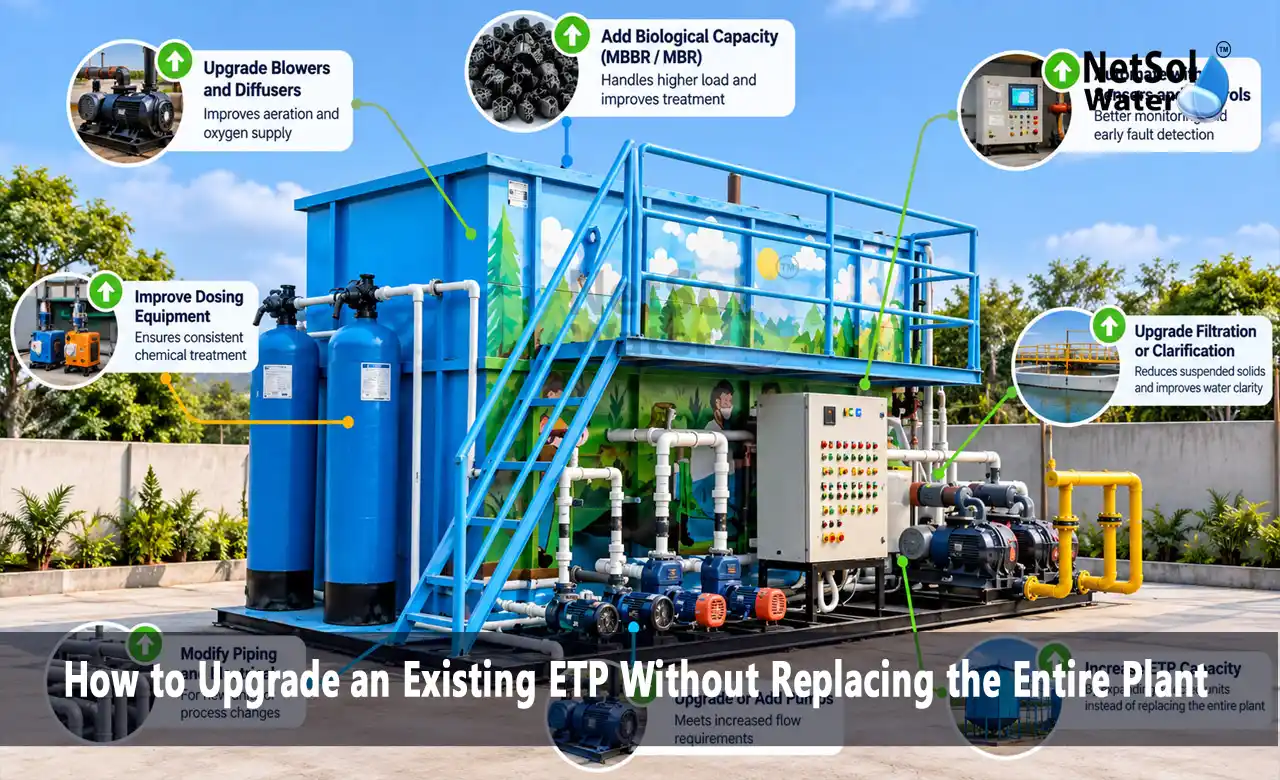
Upgrade Existing ETP Without Replacing Plant
Most factories do not need a brand new plant when their wastewater system starts struggling. In many cases, the existing effluent treatment plant still has sound tanks, pipelines and civil work. What has changed is the load, the wastewater quality or the condition of a few key units. A planned ETP upgrade fixes exactly those gaps and keeps the useful parts of the plant working.
This is a common situation across the industrial belts of Noida and Greater Noida. Production grows, new products are added, cleaning routines change, and the plant that was designed years ago is asked to do more. Netsol Water works as an ETP plant manufacturer and regularly helps industries decide what to repair, what to improve and what, if anything, needs to be replaced.
Why an ETP Starts Underperforming?
An ETP rarely fails overnight. The usual causes build up slowly, and they are easier to fix when caught early.
· Production has increased, so the plant now receives more wastewater than it was designed for.
· The raw materials or processes changed, so the wastewater has a different pollution load.
· Pumps, blowers, valves and dosing units have worn out with age.
· Sludge is not being handled properly, which affects the whole treatment train.
· Discharge or reuse norms have become stricter than when the plant was commissioned.
Step 1: Audit the Existing Plant First
Before buying any equipment, the plant needs a proper ETP audit. The aim is simple: find out which stage is actually the bottleneck. Replacing a whole plant to solve a problem in one tank is the most expensive way to find that out.
Check Flow and Wastewater Quality
Compare the daily inlet flow with the original design capacity of the plant. Then test the main parameters: pH, COD and suspended solids, and BOD where a biological stage is used. If the load is within design limits, the plant may only need tuning or better equipment. If the load is higher, the equalisation or biological stage usually needs attention first.
Inspect Equipment and Structures
Walk through every unit with the technical team. Look at pumps and blowers for lost efficiency, pipes and valves for leaks, filters for blockages, and electrical panels and dosing systems for faults. Confirm that tanks and pipelines are structurally fit to carry the changes you plan. If they are, they can stay in service while only the weak equipment is replaced. Include the sludge handling system in this check.
A good audit also separates minor repairs from real technical limits. That gives you honest cost estimates and a clear order of work.
Step 2: Upgrade Only the Units That Need It
Not every plant needs new technology. Some need better equipment, some need a change in process, and some need better controls. The right choice depends on what the audit shows.
Common Upgrade Options
| Problem Found in Audit | Possible Upgrade | What It Improves |
|---|---|---|
| Weak aeration | Better blowers and diffusers | Oxygen supply and biological treatment |
| Poor chemical treatment | Improved dosing equipment | Consistent chemical dosing |
| High suspended solids | Better filtration or clarification | Clarity of treated water |
| Biological stage overloaded | Added biological capacity, MBBR or MBR | Treatment of higher organic load in limited space |
| Manual, unstable operation | Flow meters, sensors and automated controls | Early fault detection and energy use |
| Higher flow than design | ETP capacity expansion of selected units | Ability to handle increased wastewater volume |
When the present process cannot reach the required water quality, engineers can consider an MBBR or an MBR system. The choice depends on the wastewater characteristics, the space available and the running cost. You can read more about the membrane option in this guide on the benefits of MBR technology.
Improved controls also help in daily operation. Flow meters and sensors let operators watch the process closely, and automated controls adjust equipment as conditions change. Every proposed change should be checked by engineers for suitability before installation.
Step 3: Work in Phases Without Stopping Treatment
Replacing every unit at once can disturb factory operations and wastewater handling. A phased ETP retrofit is safer. Start with urgent repairs on pumps and pipelines, then add new filters or controls as per the approved plan. If treatment must run continuously, arrange a safe temporary method so that untreated effluent is never released while work is on.
Step 4: Test, Train and Document
After installation, run the equipment and check the treatment results against the plant's targets. Train operators on the new system and on record keeping. Repeat the water quality tests to confirm that the plant now meets the required discharge or reuse standards. This final check proves that the upgraded plant works as designed.
When Replacement Is the Better Choice?
An upgrade is not always the answer. If tanks are structurally damaged, the site layout has changed completely, or the wastewater has become so different that the old design cannot be adapted, a new plant may be more sensible. The audit decides this, not assumption. An honest assessment protects the budget in both directions.
Frequently Asked Questions (FAQs)
Q1. Can an old ETP be upgraded instead of replaced?
Yes, in many cases. If the civil structures are sound, selected units can be repaired, replaced or improved to raise performance.
Q2. How do I know which unit is the problem?
A detailed plant audit that checks inlet flow, COD, BOD, pH, suspended solids and equipment condition will show the weak stage.
Q3. Is MBBR or MBR always needed for an upgrade?
No. These are options when the biological stage cannot meet the required quality. Many plants only need better equipment or controls.
Q4. Will the factory need to shut down during the upgrade?
Not necessarily. Work can be planned in phases with safe temporary treatment so that operations continue.
Q5. What should be done after the upgrade?
Test the treated water, train the operators and keep proper records.
Conclusion
Many existing ETPs can be brought back to full performance through careful inspection and targeted improvements. A well planned ETP upgradation lets industries handle higher flows, improve effluent quality and make better use of what they already own, without unnecessary expense. If your plant is under pressure, a proper audit is the right first step.
To discuss your plant with our team, visit the Netsol Water contact page or reach us directly:
Phone: +91-9650608473, Email: enquiry@netsolwater.com