

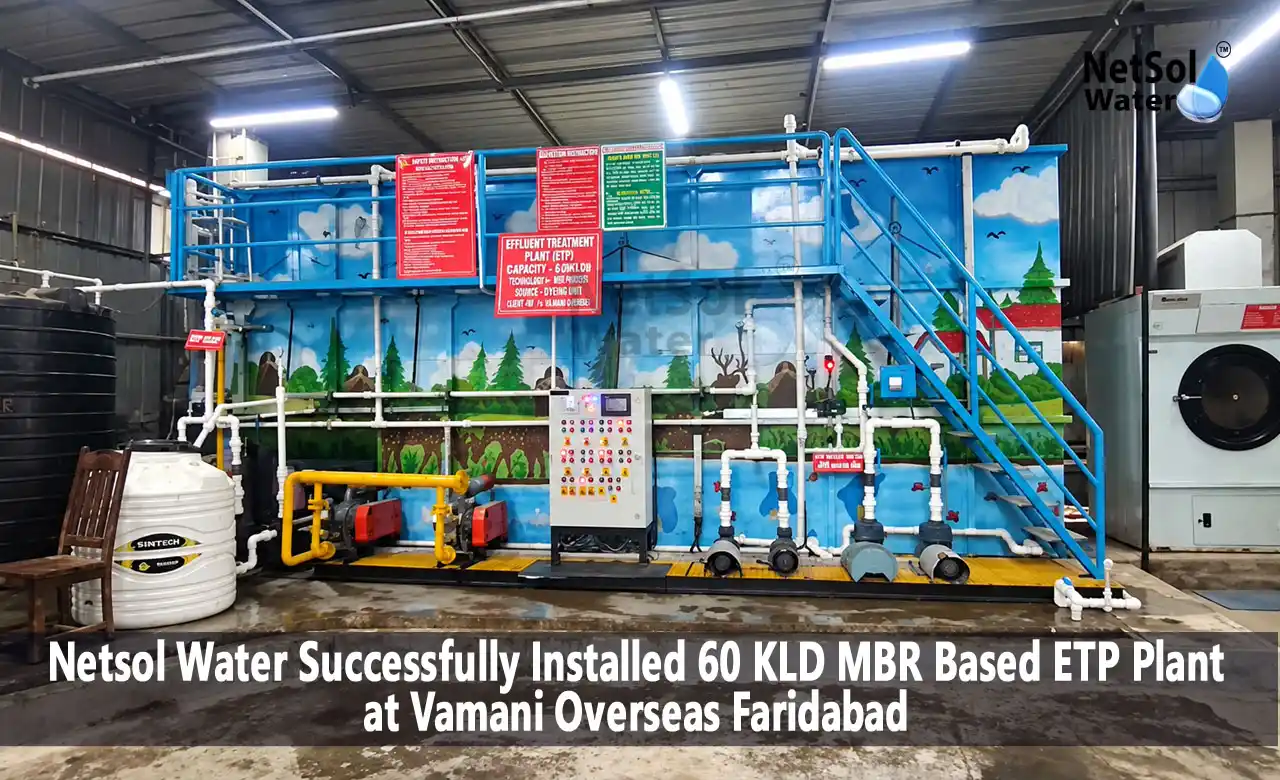
Case Study: Installed 60 KLD MBR Based ETP Plant at Vamani, Faridabad
Project Overview
In September 2026, the Netsol Water team installed a new 60 KLD MBR based ETP plant at Vamani Overseas in Faridabad, Haryana. The plant treats washing and dyeing wastewater generated at the site. It is a package type unit with MSFRP construction, and the project did not involve integrating it with any existing treatment plant.
Installation took 7 days, and the trial run and commissioning were completed by the Netsol Water team. Limited space at the site was an important consideration throughout the project, and the compact package configuration was implemented with the available area in mind.
This case study records what was installed, how the treatment flow works and how the installation was carried out. Detailed laboratory data was not available for this case study, so no inlet or outlet test values are quoted. Project facts come from the verified project record. General technical explanations are marked as general, so readers can tell the two apart.
About the Vamani Overseas ETP Project
Vamani Overseas is located in Faridabad, Haryana. Washing and dyeing activities at the site generate wastewater, and this wastewater is the input to the new plant. Netsol Water handled both the installation and the commissioning.
The project is a 60 KLD effluent treatment plant using Membrane Bioreactor technology. It is a fresh installation. The project did not involve tying the plant into an older treatment system, so the unit runs as a standalone treatment plant for the site. Original project photographs and a project video are available and are used in this write-up.
Why a 60 KLD ETP Was Required?
.Wastewater from washing and dyeing
KLD means kilolitres per day. A 60 KLD ETP plant is rated for 60,000 litres of wastewater per day. The verified project record confirms the wastewater source, which is washing and dyeing activity, and the plant capacity of 60 KLD.
In general, washing and dyeing operations can produce water that carries textile fibres, residual dyes, process chemicals and organic matter. Dyeing wastewater treatment and washing wastewater treatment are planned around the actual process, and no specific contaminant data was provided for this site.
.What the project record does and does not say
The project information does not include the site's water balance or the design basis behind the 60 KLD figure, so this case study does not try to reconstruct that reasoning. What can be said is that an ETP plant sized for the site's daily flow gives the unit a defined route for washing and dyeing wastewater treatment on site.
Why MBR-Based Treatment Was Used?
.What MBR means?
MBR stands for Membrane Bioreactor. It combines two steps in one system. In the biological step, microorganisms break down biodegradable pollutants. In the membrane step, filtration separates the treated water from the biological solids. In many conventional layouts, that separation happens in a separate settling tank. In an MBR, the membrane does the separation.
.Relevance to a space-limited site
This matters where space is limited. Combining biological treatment and solid-liquid separation in one compact arrangement can reduce the number of separate tanks a plant needs. MBR technology also holds back suspended solids at the membrane, which helps keep them out of the treated water.
MBR is not automatically the smallest or the lowest cost option for every project. Its suitability depends on the wastewater, the treated water quality required and the site. At Vamani Overseas, the documented site condition was limited space, and a package type MBR configuration suited that condition.
The project information provided does not include the membrane manufacturer, pore size, module count, flux or transmembrane pressure. None of these are stated here.
60 KLD MBR ETP Treatment Process
The plant follows this treatment flow: Collection, Screening, Equalization, Biological Treatment, MBR, Disinfection and Treated Water Tank. Each stage below is explained in general terms, since stage level design data was not part of the project information.
.Collection
Washing and dyeing wastewater from the site is gathered and directed toward the treatment system. The drain layout and collection arrangement at the site were not described in the project record.
.Screening
Screening removes larger unwanted solids before the wastewater enters downstream units. In washing and dyeing operations, this can include textile fibres, threads and floating debris.
.Equalization
Wastewater flow and characteristics rarely stay constant through the day, especially where washing and dyeing work happens in batches. Equalization holds and mixes the wastewater so that it reaches the biological stage at a steadier rate and with less variation. This reduces shock to the biological process.
.Biological Treatment
In the biological stage, microorganisms use the biodegradable pollutants in the wastewater as food and convert them into biomass and other by-products. This stage targets organic matter that can be broken down biologically. Not every pollutant in dyeing wastewater is biodegradable, and no site specific contaminant data was available for this case study.
.MBR
The MBR stage combines the biological process with membrane based solid-liquid separation. The membrane acts as a barrier that lets water pass and holds back biomass and suspended solids. It replaces the gravity settling step used in many conventional systems, which is why it suits a compact package configuration.
.Disinfection
Disinfection follows the main treatment stage. Its role is to reduce microorganisms in the treated water before storage and use. This is relevant where treated water is used for purposes such as flushing and gardening. The disinfection method and dosing details were not provided.
.Treated Water Tank
The treated water tank stores the water that leaves the plant. It acts as a holding point from which treated water is managed for flushing, gardening and discharge, as covered in Section 10.
Plant Design and Configuration
The plant is a package type unit built in MSFRP. In general, a package plant is a fabricated treatment unit, so less of the plant has to be built on site compared with a plant constructed in place. MSFRP generally refers to mild steel with fibre reinforced plastic protection. Lining details and material thicknesses were not provided.
As an industrial effluent treatment plant, it is sized for the wastewater flow of one site. The verified technical details are listed below. No further specifications have been added.
| Parameter | Details |
|---|---|
| Capacity | 60 KLD |
| Plant Type | ETP |
| Technology | MBR |
| Wastewater | Washing and dyeing wastewater |
| Construction | MSFRP |
| Configuration | Package Type |
| Installation | New |
| Location | Faridabad, Haryana |
| Installation Duration | 7 Days |
| Commissioning | Completed |
| Existing Plant Integration | No |
Installation at Vamani Overseas, Faridabad
This ETP plant installation in Faridabad was completed by the Netsol Water team in 7 days. The project record does not include a day wise schedule, manpower details or lifting arrangements, so the account below stays with what is verified.
.Site preparation
Site preparation covered getting the installation area ready to receive the package plant. Foundation and civil work specifications were not part of the project information provided.
.Consideration of available space
Available space was reviewed as part of placement, and the package configuration was implemented with the site area in mind.
.Placement of the package unit
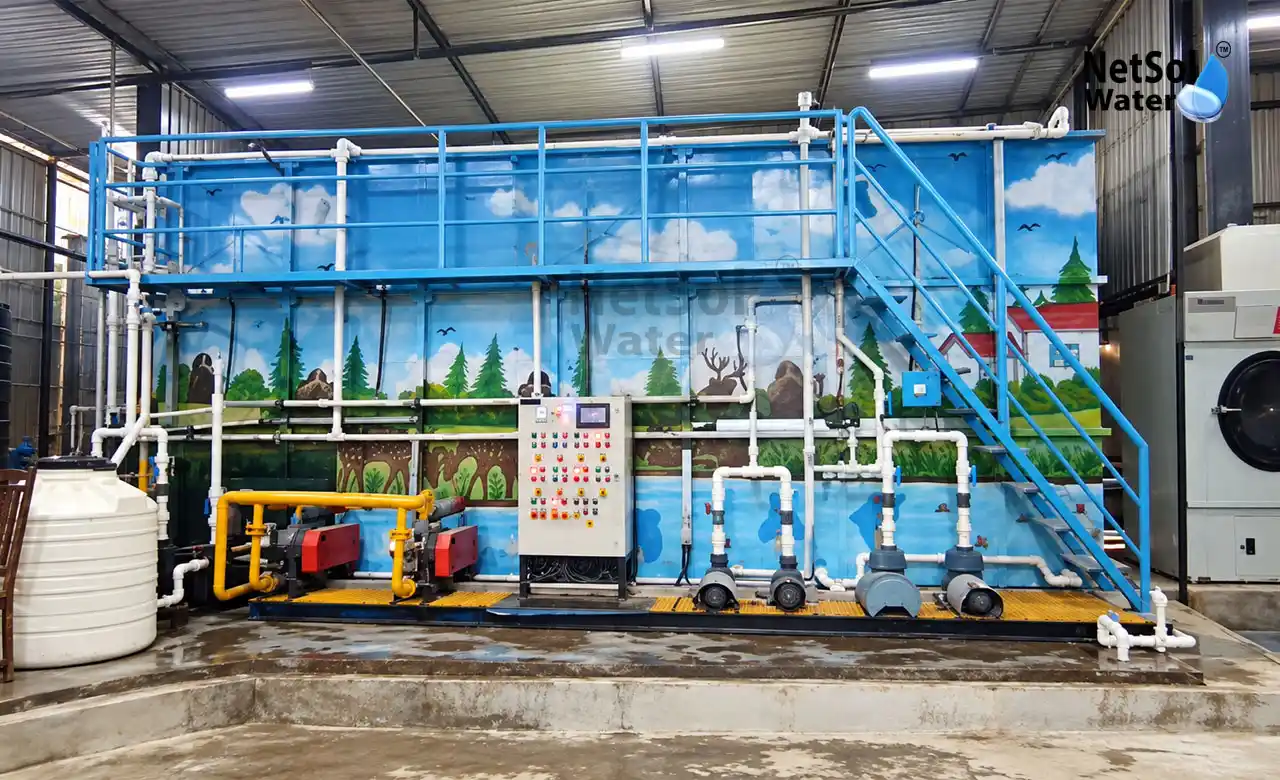
The MSFRP package ETP was placed at the installation area at Vamani Overseas. Because the plant is a package type unit, the treatment stages sit together in a compact arrangement instead of being spread across separately built tanks.
Figure 3 (place here, as the installation photograph): Installation of the package ETP plant at Vamani Overseas, Faridabad
.Process connections
The plant was connected so that wastewater moves through the sequence from collection to the treated water tank. The inlet takes the washing and dyeing wastewater from the site, and the outlet leads to the treated water tank.
.Piping and equipment connections
Piping and equipment connections link the screening, equalization, biological, membrane and disinfection stages. Pipe sizes, equipment ratings and instrument lists were not provided, so they are not listed.
.Electrical and operational connections
Electrical and operational connections were made so that the plant equipment could run during the trial run. In general, this covers power supply to the equipment, control arrangements and a check of the operating sequence. Panel and control specifications were not part of the project information.
.Final operational verification
Final operational verification followed the trial run and commissioning. Detailed verification records and test values were not included in the project information.
Managing the Site Space Constraint
Limited available space was an important consideration at Vamani Overseas. Treatment plants need room for tanks, equipment and access for operation. When the area is limited, the arrangement of the plant matters as much as the treatment process.
The package type MBR configuration was implemented with the available site area in mind. A package unit brings the treatment stages together in a fabricated arrangement. MBR technology combines biological treatment and membrane separation, so this arrangement does not need a separate settling stage.
This does not mean MBR is always the smallest or the most economical option. Footprint and cost depend on the wastewater, the capacity, the treated water requirement and the site. Plant dimensions and the site area were not part of the project information, so no footprint figures are given.
Trial Run and Commissioning
The trial run was completed, and commissioning was completed by the Netsol Water team. In general, a trial run checks that wastewater passes through each stage, that the equipment runs as intended and that connections hold. Commissioning then brings the plant to operating condition at the site.
The project record confirms that both were completed. It does not include trial run logs, observation records or laboratory test values, so this case study does not report performance figures. No specific inlet or outlet test values were provided.
Treated Water Management
Treated water from the plant is managed for three applications, subject to applicable quality requirements, site practices and permissions:
.Flushing: treated water used for flushing purposes at the site.
.Gardening: treated water used for gardening at the site.
.Discharge: treated water discharged after treatment, as permitted.
Treated water laboratory results were not available for this case study. For that reason, this page does not state that the treated water meets any specific standard or that it suits every application. Before treated water is reused or discharged, the applicable requirements and permissions should be confirmed, and water quality should be checked through testing.
Project Outcomes
The verified outcomes of this project are:
.60 KLD treatment capacity installed.
.New MBR-based ETP installed, with no existing plant integration.
.Package type configuration in MSFRP construction.
.Installation completed in 7 days.
.Trial run completed.
.Commissioning completed.
.Space constraint addressed through the selected package configuration.
.Treated water managed for flushing, gardening and discharge, subject to applicable requirements.
Detailed laboratory performance data was not provided for this case study, so no treatment efficiency or compliance claims are made.
Project Video
Project Video: 60 KLD MBR-Based ETP Plant at Vamani Overseas
The video shows the 60 KLD MBR based ETP plant at Vamani Overseas, Faridabad. It gives readers a visual reference for the installed plant and its package configuration.
Role of Netsol Water
Netsol Water handled the installation and commissioning of the plant at Vamani Overseas. That included placement of the package unit, process and equipment connections, electrical and operational connections, the trial run and commissioning. Installation was completed in 7 days.
For an industrial client studying a similar project, three points from this job are useful. It was a new installation with no existing plant integration. The compact package configuration responded to a site with limited space. The trial run and commissioning were completed by the same team that carried out the installation.
Frequently Asked Questions (FAQs)
Q1. What is the capacity of the ETP installed at Vamani Overseas?
The plant has a capacity of 60 KLD, which is 60 kilolitres per day.
Q2. Where was the 60 KLD ETP installed?
It was installed at Vamani Overseas in Faridabad, Haryana.
Q3. What type of wastewater does the plant treat?
It treats washing and dyeing wastewater. Detailed laboratory data on this wastewater was not available for this case study.
Q4. What technology is used in the ETP?
The plant uses Membrane Bioreactor (MBR) technology, which combines biological treatment with membrane based solid-liquid separation.
Q5. Is the plant a new installation?
Yes. It is a new installation, and it was not integrated with any existing plant.
Q6. What type of construction was used?
The plant is built in MSFRP and has a package type configuration.
Q7. How long did the installation take?
Installation was completed in 7 days.
Q8. Did Netsol Water handle commissioning?
Yes. Installation and commissioning were both completed by the Netsol Water team.
Q9. Where is the treated water used?
Treated water is managed for flushing, gardening and discharge, subject to applicable quality requirements, site practices and permissions.
Q10. Is a project video available?
Yes. The video 60 KLD MBR Based ETP Plant – Vamani Overseas, Faridabad is available on YouTube and is embedded in this page.
Conclusion
The Vamani Overseas project is a 60 KLD MBR effluent treatment plant, installed as a new, package type unit in MSFRP for washing and dyeing wastewater. Installation took 7 days, and the Netsol Water team completed the trial run and commissioning. The limited site space was addressed through the selected package configuration.
Laboratory data was not available, so performance and compliance claims have been left out on purpose. Industries planning ETP installation in Haryana can contact Netsol Water to discuss capacity, site space and treated water requirements for their own wastewater.