

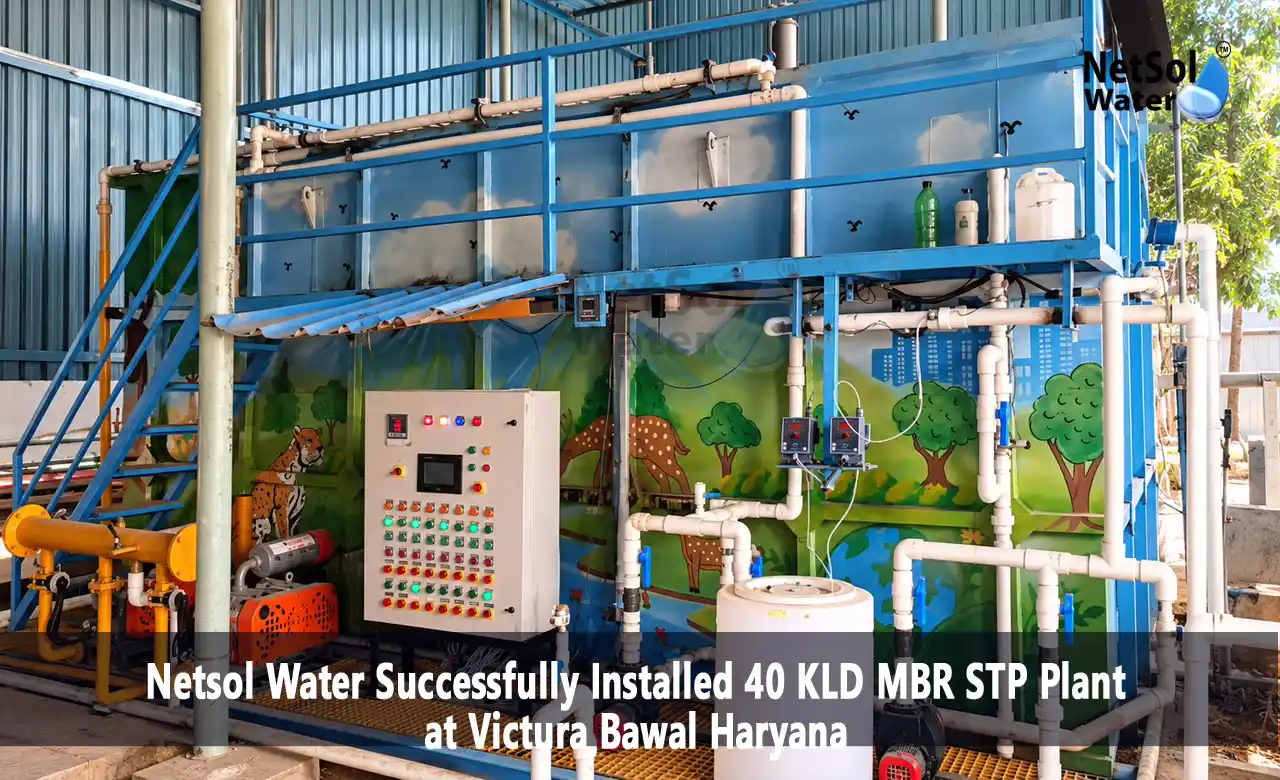
Case Study: Installed 40 KLD MBR STP Plant at Victura, Bawal, Haryana
Netsol Water installed a 40 KLD MBR STP Plant at Victura, Bawal, Haryana, in 2026. The unit is a package type plant built in MSFRP. It treats industrial wastewater with Membrane Bioreactor (MBR) technology, and its confirmed treatment stages are screening, equalization, MBR treatment and disinfection.
The treated water is intended for gardening and landscaping. Space was the main installation challenge, and the installation took 4 to 7 days. This case study covers what was installed and why MBR suits a tight site. It also lists the documents still needed before any performance claim can be made.
Introduction
Industrial sites with little free land face a familiar problem. Production, storage and vehicle movement take priority, and the wastewater plant gets whatever space is left. A conventional MBR Sewage Treatment Plant alternative with a separate settling tank can be hard to fit into such a layout.
The Victura project is a practical example. A 40 KLD package plant went in under space pressure, with garden and landscape use planned for the treated water. KLD means kilolitres per day, so 40 KLD is a nominal capacity of 40,000 litres a day.
This page sticks to confirmed project facts. General engineering explanations are labelled as general. Where proof is missing, we say so instead of filling the gap with numbers.
Project Background and Wastewater Treatment Requirement
The Victura site in Bawal needed a treatment plant for its industrial wastewater, and that description matters. Industrial wastewater can carry oil, grease, chemicals, dissolved salts or process residues that ordinary domestic sewage does not. Two factories can produce very different effluent even when their daily volumes match.
For that reason, capacity alone cannot fix a design. The right Industrial Wastewater Treatment Plant depends on wastewater testing, the process that generates the effluent, the intended reuse and the standards that apply to the site. What we can confirm here is narrower: a 40 KLD plant, MBR technology, a package format and a footprint suited to limited space.
No influent or effluent test data has been supplied for this case study, so none is quoted. Gardening and landscaping is the plan for the treated water. Actual reuse, and compliance with any standard, still need records to confirm.
Project Specifications
| Parameter | Value |
|---|---|
| Project | 40 KLD MBR STP Plant at Victura |
| Location | Bawal, Haryana |
| Installation Year | 2026 |
| Capacity | 40 KLD (40,000 litres per day nominal capacity) |
| Plant Type | Package Type |
| Construction | MSFRP |
| Wastewater Type | Industrial Wastewater |
| Treatment Technology | Membrane Bioreactor (MBR) |
| Treatment Stages | Screening, Equalization, MBR Treatment and Disinfection |
| Intended Reuse | Gardening and Landscaping |
| Installation Duration | 4–7 Days |
Why MBR Technology Was Selected?
The project record confirms MBR as the technology but does not include a design basis document. The points below are therefore general engineering reasons for choosing MBR, and they are not statements from the site.
A conventional activated sludge plant treats wastewater with bacteria in an aeration tank, then sends the mixture to a clarifier where sludge settles. A Membrane Bioreactor replaces that clarifier with membranes. The membranes hold back solids and sludge physically, so the biological tank can run with a higher concentration of microorganisms.
That matters on a small plot. The biological tank can be smaller, and no separate clarifier is needed. Membrane separation also tends to give a clearer treated stream than gravity settling, which helps when the water is meant for visible use such as landscaping.
MBR brings its own conditions. Membranes can foul when solids, oil or biological film build up on the surface, and they need regular cleaning. Aeration energy and sludge handling also need attention. Industrial wastewater adds another factor, since some contaminants can damage membranes or upset the biology. Good screening, equalization and testing upstream decide how well an MBR performs. Netsol Water has covered the wider comparison in its article on whether MBR can replace traditional STP systems.
Treatment Process and Plant Configuration
The plant follows four confirmed stages. The descriptions below explain what each stage does in general. Equipment details for this unit are not part of the confirmed record.
1. Screening
Screening is the first barrier. Bars or meshes remove coarse solids such as plastic pieces, fibres and debris. Solids that reach the membrane tank can block or scratch the membranes, so this stage protects everything after it.
2. Equalization
Industrial wastewater rarely arrives at a steady rate or strength. An equalization tank collects it and evens out those swings, so the biological stage gets a more uniform feed. Mixing or aeration inside the tank keeps solids suspended and limits odour.
3. MBR treatment
This is the core stage. Microorganisms break down dissolved and suspended organic matter in an aerated tank. Membranes then separate clean water from the sludge. Air supply feeds the biology and, in many designs, also scours the membrane surface to slow fouling. Excess sludge is drawn off periodically, and membranes go through cleaning cycles. The membrane type, pore size and arrangement for this plant are not confirmed.
4. Disinfection
Disinfection adds a final step of microbial control. Depending on the design, it may use chlorine, ultraviolet light or another method. The installed method for this plant is not confirmed, so none is stated and no dose is given.
Netsol Water has also worked on a similar technology elsewhere, such as the 90 KLD MBR STP installation at LAVA International in Noida.
Package-Type MSFRP Plant and Space Constraints
A package STP plant is built and assembled at the manufacturer's works and delivered as a unit, ready for positioning and connection. This reduces civil work at the site compared with a plant built in place from brick or concrete tanks. Package plants are common where land is limited or where work must finish quickly.
This plant uses MSFRP construction. In industry usage, MSFRP generally means mild steel with a fibreglass reinforced plastic layer, a combination used to resist corrosion in wastewater service. The exact layer specification for this unit is not part of the confirmed details.
Space was the main installation challenge at Victura. With limited room, the layout has to allow for tank placement, pipe routes, and access for operators and cleaning crews. MBR is a compact technology, though a compact plant still needs clear access for maintenance. Dimensions and footprint for this unit have not been confirmed and are not quoted.
Installation Process at Victura
The confirmed installation duration is 4 to 7 days. No day by day record is available, so this section describes installation in general terms and does not assign tasks to specific days.
Site readiness comes first. The location needs a prepared, level base and enough room to bring the unit in. Space planning follows: access for lifting equipment, routes for pipes and cables, and working room around the plant for later maintenance.
Next comes positioning of the package unit and connection of the treatment stages. Flow has to move from screening through equalization and the MBR stage to disinfection, so pipes, pumps and electrical points must be joined correctly. Inspection then covers leaks, fittings, connections and the general condition of the unit.
Installation completion and commissioning are different milestones. Completion means the plant is in place and connected. Commissioning means it has been started up, tested and brought to stable operation, and that needs records. This page reports installation only. The installation video is the only project evidence available, and this write-up does not describe individual frames.
Watch the 40 KLD MBR STP Plant Installation at Victura
Direct link: https://www.youtube.com/watch?v=vSuMRd_a7OQ
Treated Water Reuse for Gardening and Landscaping
Gardening and landscaping is the intended use for the treated water. Landscape reuse is common for treated wastewater because it does not need drinking quality water. Whether a given plant's output suits that use depends on its tested quality.
Before reuse, a facility generally checks treated water against the applicable standard or guideline. Parameters usually reviewed include suspended solids, organic load, microbial indicators and salinity. Salinity deserves attention because dissolved salts largely pass through MBR membranes and can affect soil and plants over time. This is relevant for industrial wastewater, where dissolved solids may be high.
The irrigation method matters too. Sprinkler spray raises different exposure concerns than drip lines. For Victura, no treated-water report has been supplied, so no quality claim is made.
Installation Challenges and Practical Considerations
Space was the confirmed challenge. In practice, a tight site affects more than tank placement. Crane or trolley access, working room for installers, pipe bends, drainage and future membrane removal all compete for the same area.
Other points apply to any MBR installation of this kind: reliable power for blowers and pumps, a safe route for sludge removal, ventilation around the unit and a trained operator. None of these are confirmed details for Victura. They are general questions a buyer should put to any supplier.
Project Outcomes and Verification
1. 40 KLD capacity, package type, MSFRP construction and MBR technology
2. Screening, equalization, MBR treatment and disinfection stages
3. Gardening and landscaping as intended reuse, with space as the main challenge
4. Installation duration of 4 to 7 days
Maintenance and Operational Considerations
An MBR plant needs routine attention. Operators typically watch flow, aeration, membrane pressure and sludge levels, and schedule membrane cleaning as the supplier recommends. Screens need regular clearing, and the equalization tank needs inspection for settled solids. Disinfection equipment has its own checks. A written operating routine and trained staff matter as much as the equipment. No maintenance schedule has been confirmed for this project.
Conclusion and Enquiry CTA
The Victura installation shows a package MBR plant fitted on a space-limited site. Performance data is not yet part of the record, so this case rests on its installation facts. Planning an MBR STP for an industrial site? Share your wastewater details and space limits with Netsol Water on +91-9650608473 or at enquiry@netsolwater.com.
Frequently Asked Questions (FAQs)
Q1. What is the capacity of the MBR STP plant installed at Victura, Bawal?
The nominal capacity is 40 KLD, or 40,000 litres per day. Actual daily flow has not been confirmed.
Q2. Which wastewater treatment technology is used in the Victura project?
It uses Membrane Bioreactor (MBR) technology in a package type MSFRP plant. The confirmed stages are screening, equalization, MBR treatment and disinfection.
Q3. How does MBR technology work in an STP?
Bacteria in an aerated tank break down organic matter. Membranes then separate treated water from sludge, replacing the settling tank of a conventional plant.
Q4. How long did the 40 KLD plant installation take?
The confirmed duration is 4 to 7 days. Installation completion is separate from commissioning.
Q5. Can treated wastewater be reused for gardening and landscaping?
It can be, once the treated water is tested and meets the requirement that applies to that use. At Victura this is the intended use, and no test report has been supplied.
Q6. What information is required to select an MBR STP for an industrial facility?
Suppliers usually need the wastewater source, test results, daily and peak flow, available space, power supply, reuse goal and the standard that applies.