

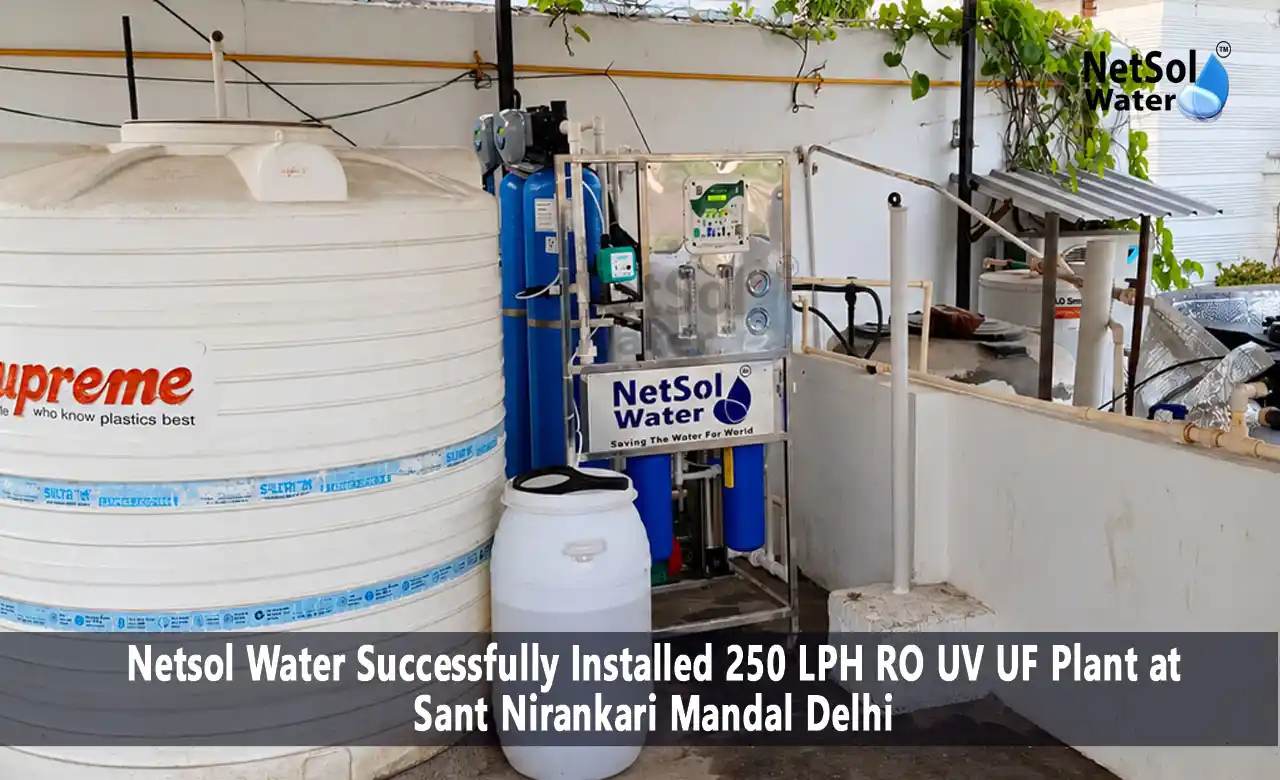
Case Study: 250 LPH RO Plant at Sant Nirankari Mandal, Delhi
In June 2026, Netsol Water installed a 250 LPH RO+UV+UF Water Plant at Sant Nirankari Mandal in Burari, Delhi. The site needed treated water for drinking. The raw water came from groundwater and had a TDS of 3,000 mg/L. The approximate daily requirement was 5,000 litres.
To meet this need, we installed a 250 LPH RO Plant with UV and UF stages after the RO. The biggest challenge was not the water quality alone. The installation space was very compact, and the existing plumbing had to be handled carefully. With proper planning, the full installation was completed in one day. This case study explains the project details, the treatment process, the plant specifications and how the work was done on site.
Project Overview
| Project Detail | Specification |
|---|---|
| Client | Sant Nirankari Mandal |
| Location | Burari, Delhi |
| Installation | June 2026 |
| Plant Capacity | 250 LPH |
| Daily Requirement | Approx. 5,000 L/day |
| Raw Water Source | Groundwater |
| Raw Water TDS | 3,000 mg/L |
| RO Membrane | LG |
| Number of Membranes | 1 |
| Membrane Housing | FRP |
| RO Recovery | 60% |
| Raw Water Pump | 0.5 HP |
| High Pressure Pump | 1.5 HP |
| UV | After RO |
| UF | After RO |
| Construction | MSFRP |
| Control | Automatic |
| Application | Drinking Water |
| Installation Time | 1 Day |
This is a drinking water RO plant project built around a 250 LPH system. The raw water is high-TDS groundwater, so RO is the main treatment stage. UV and UF are installed after the RO. The plant has MSFRP construction and runs on automatic control. It was installed at a site with very little space, and the work was finished in one day.
Drinking Water Requirement at Sant Nirankari Mandal
Sant Nirankari Mandal in Burari, Delhi, needed treated water for drinking purposes. The raw water source at the site was groundwater. The raw water TDS was 3,000 mg/L, which is high for drinking use. The approximate daily requirement was 5,000 litres. Raw water at this TDS level needs treatment to reduce the dissolved salts. So the site needed a proper treatment system before the water could be used for its intended application.
Space was the other major point. The area available for the plant was very compact, and the existing plumbing also had to be considered. A system for this site had to do two things. It had to treat high-TDS groundwater for drinking, and it had to fit in the small space available. Plant size, equipment layout and pipe routing all depended on this limited space. So the plant could not be planned by capacity alone. The site conditions were equally important, and they guided our planning from the start.
Why RO+UV+UF Was Selected for the Project
This RO UV UF Water Plant uses three treatment technologies, and each one has its own role.
. RO
Groundwater with 3,000 mg/L TDS has a high amount of dissolved salts. RO reduces these dissolved salts and TDS, so it is the main stage of this plant.
. UV
UV is installed after the RO. It works as an additional disinfection stage for the RO water.
. UF
UF is also installed after the RO. It works as an additional filtration and polishing stage.
Why the combination suited this project?
For a drinking water RO plant, this combination makes sense. RO handles the dissolved solids. UV adds disinfection. UF adds one more filtration step before the water goes to the treated water tank. Together, they give a more complete treatment than RO alone. Each stage has its own job. UV and UF do not reduce TDS, so RO stays the main stage for the 3,000 mg/L groundwater.
Technical Specifications of the 250 LPH RO+UV+UF Water Plant
The plant capacity is 250 LPH. The RO section uses one LG membrane, kept in an FRP membrane housing. The RO recovery is 60%.
Two pumps are used. A 0.5 HP raw water pump supplies water to the treatment process. A 1.5 HP high-pressure pump feeds the RO stage, where pressure is needed to push water through the membrane. After the RO, the plant has UV and UF stages. The whole system has MSFRP construction and works on automatic control.
The 250 LPH figure is the plant capacity. The 60% recovery is a separate RO figure. It tells us how much of the feed water becomes RO permeate, and it does not reduce the capacity of this 250 LPH water treatment plant.
Treatment Process of the Water Plant
The plant works in the following order:
Raw Water Tank → Raw Water Pump → PSF → ACF → Micron Filter → RO → UV → UF → Treated Water Tank
. Raw Water Tank
The raw water tank holds the groundwater before treatment. It gives the plant a steady supply of feed water.
. Raw Water Pump
The 0.5 HP raw water pump moves the water from the tank into the treatment process.
. PSF
The Pressure Sand Filter is the first pretreatment stage. It removes suspended particles such as silt and sand.
. ACF
The Activated Carbon Filter is also a pretreatment stage. It helps to reduce organic matter, odour and chlorine, which can affect the RO membrane.
. Micron Filter
The micron filter gives fine filtration just before the RO. It catches small particles that passed through the earlier stages and helps to protect the membrane.
. RO
The LG RO membrane is the main stage. It reduces dissolved salts and TDS in the groundwater.
. UV
UV comes after the RO. It works as an additional disinfection stage.
. UF
UF also comes after the RO. It works as an additional filtration stage for the RO water.
. Treated Water Tank
The treated water is collected here after the full treatment process, ready for drinking use.
Treating Groundwater with 3,000 mg/L TDS
The raw water TDS at this site was 3,000 mg/L. High TDS was one of the main water-quality points for this project. So RO was used as the main stage to reduce dissolved solids. This is a typical use of RO plant for groundwater, and also of RO plant for 3000 TDS water. For larger groundwater treatment needs, an industrial RO plant is also an option.
RO recovery is the percentage of feed water that is converted into RO permeate. The rest of the water leaves as reject, also called concentrate. In this plant, the recovery is 60%. So 60% of the feed water becomes permeate and the remaining 40% goes out as reject.
Pretreatment is important before RO. The PSF, ACF and micron filter remove particles and other matter that can foul or damage the membrane. A well-protected membrane works more steadily and needs less cleaning.
Installation Challenge: Very Compact Space and Plumbing
. The challenge
The site had very little space, and the existing plumbing was already in place. A plant with pretreatment, RO, UV and UF has many connections. All of them had to fit in a small area, and they had to join properly with the site plumbing.
. Planning
Before placing any equipment, the team looked at the available space and the plumbing. We decided where each part would go and how the pipes would run. The pipe routing was planned so that the stages connect in the correct order, from the raw water tank to the treated water tank. We also kept some space around the plant so that the equipment can be reached for checking and maintenance.
. Installation
The plant was positioned in the available area, and the connections were made stage by stage. Every part of the space had to be used carefully. The team connected the pretreatment, RO, UV and UF sections one after the other, and then completed the electrical and control connections.
. Result
The plant was installed in the compact space within one day, with practical access around it. The work was done without changing the treatment flow.
Automatic Operation and MSFRP Construction
The plant works on automatic control. In daily use, automatic operation means less manual handling, so the plant is easier to run. The operator can spend time on regular checking of the plant instead of handling every stage by hand.
The plant has MSFRP construction. A compact package-type build is useful where space is limited, because the equipment is arranged together in a small footprint. Package-type construction also keeps the plant together in one place, which helps when the plumbing is already fixed. This mattered at Sant Nirankari Mandal, where the available space was very limited.
Overall, this is an Automatic RO Water Plant. The water moves through the stages in order and finally reaches the treated water tank.
How the Plant Was Installed in One Day
The installation took one day. This RO plant installation in Delhi followed this order:
1.Site assessment: the team checked the available space and the existing plumbing.
2.Plant positioning: the plant was placed in the compact area with space kept for access.
3.Plumbing connection: the plant was connected with the site plumbing.
4.Pretreatment connection: the PSF, ACF and micron filter were connected in order.
5.RO connection: the LG RO membrane section and the high-pressure pump were connected.
6.UV and UF connection: the UV and UF stages were connected after the RO.
7.Electrical and control connection: power and control connections were completed for automatic operation.
8.Testing and commissioning: the plant was tested and commissioned.
Project Outcome
At Sant Nirankari Mandal, Burari, a 250 LPH plant was installed for a drinking-water application. The raw water source is groundwater with a TDS of 3,000 mg/L. The plant uses an LG RO membrane with 60% recovery, and UV and UF are installed after the RO. It has MSFRP construction and works on automatic control. The approximate daily requirement at the site is 5,000 L/day.
This 250 LPH RO Plant in Delhi was installed in a very compact space, and the installation was completed in one day. Careful planning of the layout and the plumbing made this possible. For anyone planning a similar RO plant for groundwater, the main points from this project are the high raw water TDS, the need for pretreatment before RO, and the care needed in a compact layout.
Watch the 250 LPH RO+UV+UF Water Plant Installation
We have a video of this project on YouTube. It gives a visual view of the installed plant, so you can see the plant and how it sits in the compact space at Sant Nirankari Mandal. It is a useful reference if you want to understand how RO, UV and UF plant can be arranged in a small area. It can also help site engineers and facility managers who want a visual idea before planning a similar installation.
Watch the video here:
Key Highlights of the Project
. Client: Sant Nirankari Mandal, Burari, Delhi
. Installed in June 2026 for drinking water
. Plant capacity: 250 LPH
. Approximate daily requirement: 5,000 L/day
. Groundwater source with 3,000 mg/L TDS
. One LG RO membrane in FRP housing, 60% recovery
. 0.5 HP raw water pump and 1.5 HP high-pressure pump
. UV and UF installed after the RO
. MSFRP construction with automatic control
. Main challenge: very compact space and plumbing
. Installation time: 1 day
Frequently Asked Questions (FAQs)
Q1. What was the capacity of the RO+UV+UF water plant installed at Sant Nirankari Mandal?
The plant capacity was 250 LPH.
Q2. Where and when was the plant installed?
It was installed at Sant Nirankari Mandal, Burari, Delhi, in June 2026.
Q3. What was the raw water source and TDS?
The source was groundwater. The raw water TDS was 3,000 mg/L.
Q4. Which RO membrane was used?
The plant uses one LG RO membrane in an FRP membrane housing.
Q5. What was the RO recovery?
The RO recovery was 60%. It means 60% of the feed water becomes RO permeate and the rest goes out as reject. It does not reduce the 250 LPH plant capacity.
Q6. What was the treatment process?
Raw Water Tank → Raw Water Pump → PSF → ACF → Micron Filter → RO → UV → UF → Treated Water Tank.
Q7. Why were UV and UF installed after RO?
UV works as an additional disinfection stage, and UF works as an additional filtration and polishing stage after the RO.
Q8. What was the main installation challenge, and how long did installation take?
The main challenge was the very compact space and the plumbing. The installation took one day.
Q9. What was the application of the treated water?
The treated water is for drinking purposes.
Conclusion
The Sant Nirankari Mandal project in Burari, Delhi, was about treating groundwater with 3,000 mg/L TDS for drinking use. A 250 LPH RO+UV+UF plant was installed in June 2026, with UV and UF after the RO and automatic operation. The main challenge was the very compact space and the plumbing, and both were handled through careful planning. The installation was completed in one day. If you are planning a commercial RO plant in Delhi, you can contact the Netsol Water team to discuss your requirement. This project shows that a plant of this type can be installed with proper planning even when space is tight.