

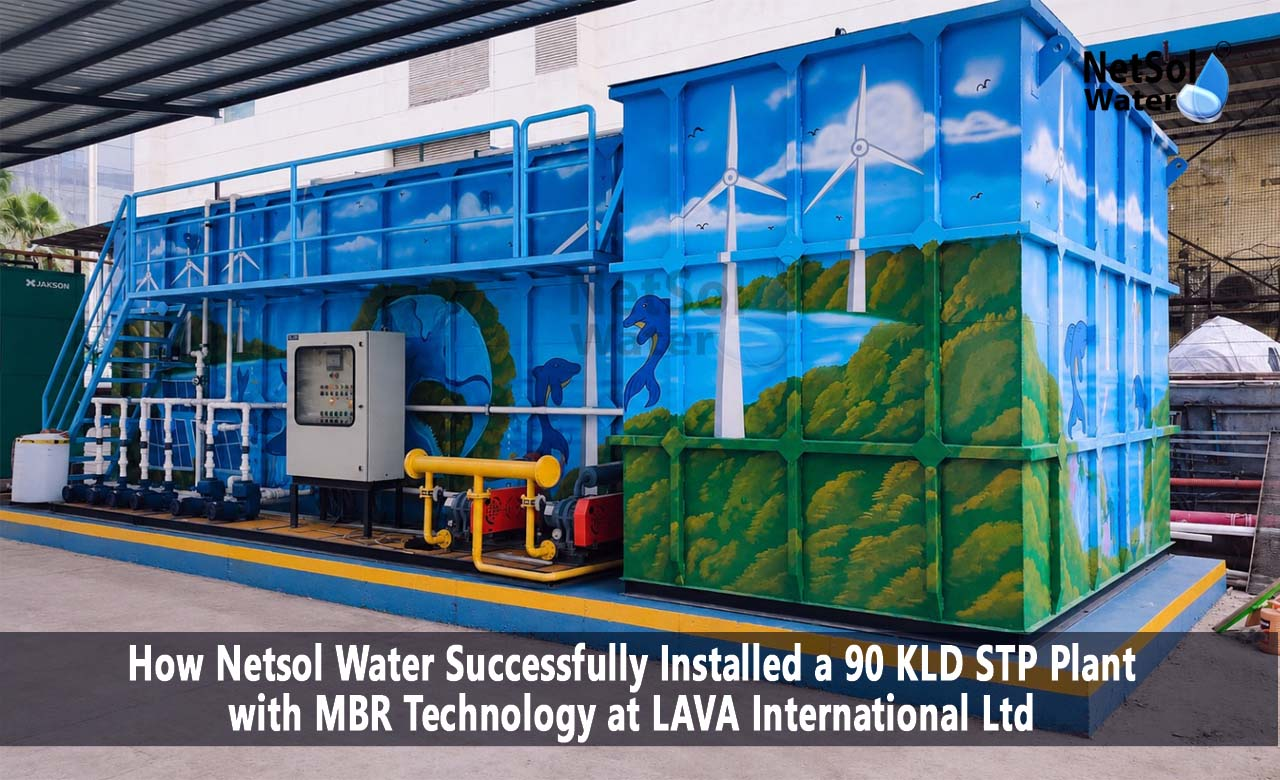
Case Study: 90 KLD MBR STP Installation for LAVA International, Noida
Netsol Water successfully designed, engineered, and installed a 90 KLD Sewage Treatment Plant (STP) based on Membrane Bio-Reactor (MBR) Technology at LAVA International's manufacturing facility in Noida Sector-63. The project was undertaken to address the facility's growing wastewater treatment needs while operating within a limited industrial footprint. The resulting plant was engineered to meet CPCB (Central Pollution Control Board) and SPCB (State Pollution Control Board, Uttar Pradesh) discharge norms, giving LAVA International a dependable, low-maintenance system that supports both regulatory compliance and internal water reuse initiatives.
This case study outlines the client background, the operational challenges that shaped the project brief, the technology and design rationale behind the chosen MBR system, the implementation methodology followed by Netsol Water, and the outcomes achieved after commissioning.
Client Overview - LAVA International
LAVA International is a well-established name in the mobile phone and electronics manufacturing industry, with a significant operational presence in Noida, Uttar Pradesh. The Sector-63 facility functions as a high-activity manufacturing and assembly unit, employing a large on-site workforce across multiple shifts.
Facilities of this scale typically generate a continuous and fluctuating stream of domestic-type wastewater from washrooms, canteens, and utility areas throughout the working day. For an operation of this nature, a sewage treatment system is not a peripheral requirement — it is a core piece of infrastructure that has a direct bearing on daily operations, statutory compliance, and the facility's environmental footprint. This made the selection of the right treatment technology and the right execution partner a critical decision for LAVA International.
About Netsol Water
Netsol Water is a trusted name in the water and wastewater treatment industry, offering end-to-end solutions including Sewage Treatment Plants (STP), Effluent Treatment Plants (ETP), Water Treatment Plants (WTP) and Reverse Osmosis (RO) systems - spanning design, manufacturing, installation, and after-sales operation and maintenance (O&M).
With deep expertise across modern biological treatment technologies — including MBR, MBBR, and SBR — Netsol Water specializes in delivering customized, compliance-ready water treatment solutions for industrial, commercial, and residential clients across India. The team's approach typically combines site-specific engineering with a strong focus on long-term operability, ensuring that each plant is not only compliant on day one but remains easy to run and maintain for years afterward.
Netsol Water's involvement with LAVA International reflects this approach — a plant designed around the client's actual space, load, and compliance constraints rather than a one-size-fits-all template.
The Challenge
Before engaging Netsol Water, LAVA International's Sector-63 facility faced a set of interconnected challenges common to large manufacturing sites operating in dense industrial zones:
. Handling a substantial and continuous daily wastewater load generated by a large manufacturing workforce across multiple shifts
. Fitting a treatment system within the limited space typically available at an established industrial facility, where floor area is already allocated to production and utilities
. Ensuring treated water quality consistently met CPCB and SPCB (Uttar Pradesh) discharge norms, with no margin for non-compliance given the facility's scale of operations
. Enabling treated water reuse for non-potable applications — such as flushing, gardening, and cooling — to reduce dependence on freshwater and support the facility's broader sustainability goals
. Minimizing sludge generation and odour, both of which are ongoing operational concerns for conventional STPs located close to working and administrative areas
A conventional Activated Sludge Process (ASP) based STP would have required a considerably larger footprint to achieve comparable treated water quality, and would still have carried a higher risk of effluent quality fluctuating with variable daily loads. This combination of space constraints and compliance requirements made conventional technology an unsuitable fit for this site.
The Solution - 90 KLD MBR STP
Netsol Water proposed and installed a 90 KLD Sewage Treatment Plant based on Membrane Bio-Reactor (MBR) Technology, selected specifically for its ability to deliver consistently high-quality treated water within a compact footprint — directly addressing LAVA International's core constraints.
Why MBR Technology?
MBR technology combines conventional biological (activated sludge) treatment with membrane-based filtration, effectively replacing the secondary clarifier and, in many designs, the tertiary filtration stage used in conventional STPs. The membranes — typically ultrafiltration hollow-fibre or flat-sheet modules — physically block suspended solids, bacteria, and most pathogens from passing into the treated water stream, regardless of how the biological process is performing on a given day.
For a site like LAVA International's Sector-63 facility, this translates into several practical advantages:
. Superior and consistent effluent quality — near-complete removal of suspended solids and pathogens, largely independent of influent load fluctuations
. Significantly smaller plant footprint compared to conventional ASP or SBR-based systems, since the membrane unit removes the need for a large secondary clarifier
. Greater operational stability, with the system able to absorb variation in daily wastewater volume and organic load without a proportional drop in output quality
. Treated water quality suitable for direct reuse in non-potable applications, without needing extensive additional tertiary treatment
. Lower sludge generation over time due to the extended sludge retention time typical of MBR systems, reducing sludge handling and disposal frequency
Design Basis & Technical Approach
The 90 KLD capacity was sized to the facility's estimated daily wastewater generation, factoring in occupancy patterns typical of a multi-shift manufacturing unit. The plant design incorporated standard engineering safeguards expected in an industrial MBR installation:
. Adequate equalization capacity to buffer flow and load variation across shifts and peak usage hours
. Fine screening ahead of the bioreactor to protect the membrane modules from fibrous and coarse solids
. Aeration and biological treatment sized for reliable organic load reduction ahead of membrane filtration
. Membrane flux and cleaning cycles designed for the specific characteristics of the influent, to support long-term membrane life
. Provision for treated water storage and reuse distribution, and for residual sludge handling and disposal
Typical Process Flow
. Screening and Bar Filtration — removal of large solids and debris entering the system
. Equalization Tank — flow and organic load balancing ahead of biological treatment
. Biological Treatment (Bioreactor) — breakdown of organic matter by activated sludge microorganisms
. MBR Membrane Filtration — physical separation of solids, bacteria, and pathogens from the treated stream
. Disinfection — final polishing stage before water is released for reuse or discharge
. Sludge Handling — thickening, storage, and periodic disposal of residual biological sludge
The plant design was aligned with CPCB guidelines and SPCB (UP) norms from the outset, so that the facility would remain compliant on commissioning without requiring future retrofitting or capacity upgrades to meet regulatory thresholds.
Implementation Process
Netsol Water followed a structured, multi-stage execution approach typical of its industrial STP projects, adapted to the specific conditions of the LAVA International site:
. Site Assessment & Survey — Evaluation of available space, existing utilities, wastewater load estimation, and site-specific constraints at the Noida Sector-63 facility
. Engineering & Design — Development of a customized 90 KLD MBR plant design, including civil, mechanical, and electrical scope, tailored to LAVA International's operational layout and compliance requirements
. Procurement & Installation — Sourcing of MBR membrane modules, tanks, blowers, pumps, and allied equipment, followed by on-site civil work and equipment installation
. Commissioning & Testing — System startup, biological seeding of the bioreactor, membrane integrity checks, and performance testing across multiple operating cycles to validate treated water quality against design parameters
. Handover & Training — Operational training for facility staff on day-to-day plant operation, and handover of technical documentation, O&M guidelines, and compliance records
Throughout execution, coordination between Netsol Water's design and site teams was structured to minimize disruption to LAVA International's ongoing manufacturing operations — a key consideration for any utility installation on a live industrial site.
Results & Benefits
Treated Water Quality — Typical MBR STP Performance vs CPCB/SPCB Norms
Note: The figures below represent general, typically achievable MBR performance ranges as commonly reported for this technology. Actual plant performance should be confirmed against Netsol Water's site-specific lab test reports before being used in any published or client-facing material.
| Parameter | CPCB/SPCB Discharge Norm | Typical MBR Achieved Range |
|---|---|---|
| BOD (mg/L) | ≤ 10 | 2 – 5 |
| COD (mg/L) | ≤ 50 | 20 – 30 |
| TSS (mg/L) | ≤ 10 | < 5 |
| pH | 5.5 – 9.0 | 6.5 – 7.5 |
| Oil & Grease (mg/L) | ≤ 10 | < 5 |
| Fecal Coliform (MPN/100ml) | ≤ 100 (for reuse) | < 100 (near-absent) |
| Turbidity (NTU) | Not specified (reuse dependent) | < 2 |
Key Benefits Achieved
. Regulatory Compliance: Consistent adherence to CPCB and SPCB discharge norms, reducing compliance risk for the facility
. Water Reuse: Treated water quality suitable for reuse in flushing, gardening, and cooling tower applications, cutting down freshwater dependence
. Space Efficiency: A compact MBR footprint suited to the constraints of an established industrial site, avoiding the larger civil footprint a conventional STP would have required
. Sustainability: Reduced freshwater withdrawal and a measurable contribution to LAVA International's environmental responsibility and water stewardship goals
. Operational Reliability: Stable, consistent treated water output even with variable daily wastewater loads across shifts
. Lower Long-Term Maintenance Burden: Reduced sludge handling frequency and simplified operation compared to conventional ASP-based systems
Environmental & Compliance Impact
Beyond meeting immediate discharge norms, the plant supports LAVA International's longer-term environmental positioning in a few concrete ways. By enabling on-site treated water reuse, the facility reduces its net freshwater consumption, which has a direct bearing on regional groundwater stress in the National Capital Region (NCR) — an area where industrial water use is under increasing regulatory scrutiny.
Consistent compliance with CPCB and SPCB norms also positions the facility favourably for statutory inspections and audits, reducing the operational and reputational risk associated with effluent non-compliance.
Ongoing Operation & Maintenance Support
As with its other industrial STP installations, Netsol Water's engagement with LAVA International extends beyond commissioning. Typical post-installation support for an MBR system of this scale includes:
. Periodic membrane cleaning and integrity checks to preserve treated water quality and extend membrane life
. Routine monitoring of key process parameters (MLSS, DO, pH, flux) to catch performance drift early
. Scheduled preventive maintenance of blowers, pumps, and electrical components
. Support with statutory water quality testing and compliance documentation as required by SPCB
Conclusion
The successful installation of the 90 KLD MBR-based STP at LAVA International's Noida Sector-63 facility highlights Netsol Water's expertise in delivering compact, compliant, and sustainable wastewater treatment solutions for large industrial clients. By combining advanced MBR technology with a design aligned to CPCB and SPCB standards from the outset, Netsol Water enabled LAVA International to meet its regulatory obligations while advancing its water sustainability initiatives — without compromising on the space and operational constraints of a live manufacturing facility.
Looking for a customized STP, ETP, or WTP solution for your facility? Contact Netsol Water to discuss your wastewater treatment requirements.