

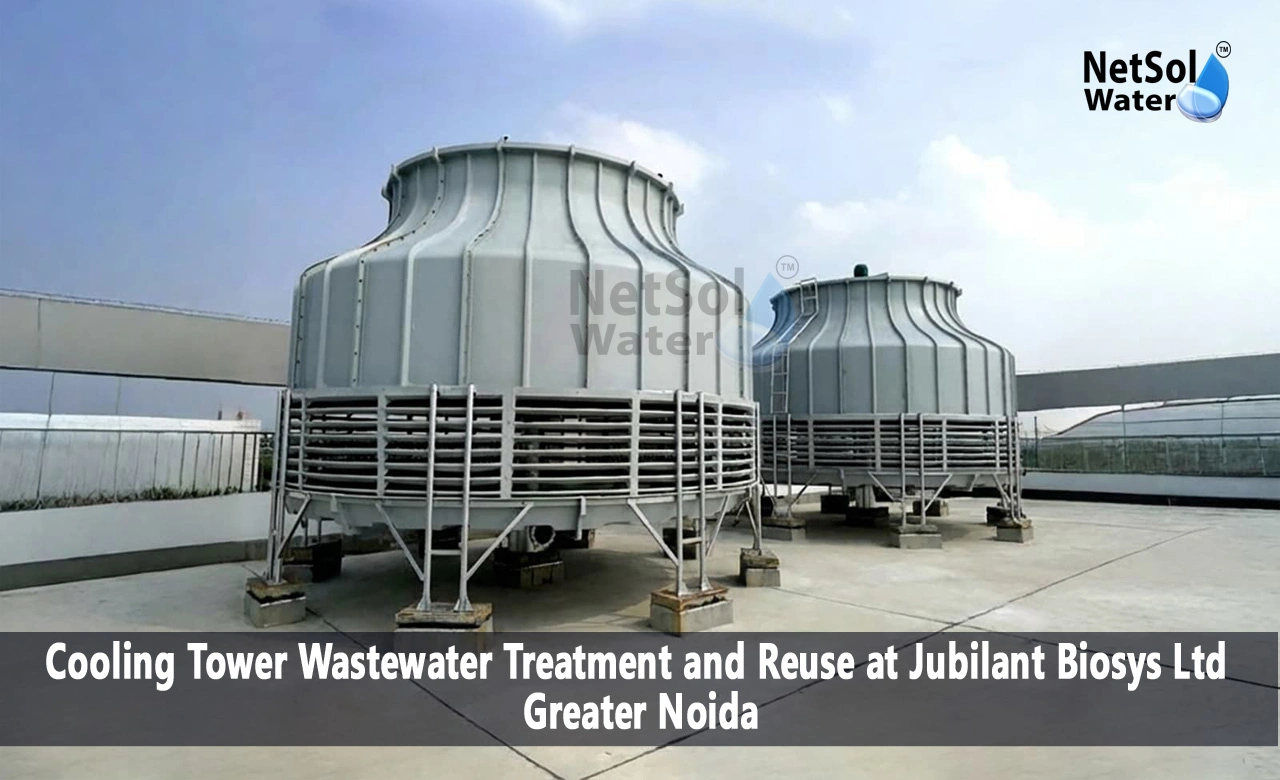
Case Study: Cooling Tower Wastewater Treatment and Reuse at Jubilant Biosys Ltd, Greater Noida by Netsol Water
Cooling towers play a critical role in industrial facilities such as pharmaceutical plants, chemical industries, and manufacturing units. These systems remove excess heat generated during production processes and help maintain operational efficiency. However, cooling towers also generate a significant amount of wastewater known as cooling tower blowdown water.
This blowdown water contains dissolved solids, suspended particles, chemicals, and scaling agents that accumulate during the cooling cycle. Traditionally, many industries discharge this wastewater, which leads to high freshwater consumption, increased wastewater disposal costs, and environmental concerns.
To address this challenge, Jubilant Biosys Ltd., Greater Noida, partnered with Netsol Water Solutions Pvt. Ltd. to implement a Cooling Tower Wastewater Treatment Plant (ETP) designed specifically to treat and recycle cooling tower reject water.
The installed treatment system allows the facility to treat blowdown water and reuse it repeatedly within the cooling tower system. As a result, the project has achieved more than 95% water savings, significantly reducing freshwater consumption and supporting sustainable industrial water management.
About the Jubilant Biosys Ltd
Jubilant Biosys Ltd. is a leading pharmaceutical research and development organization and a part of Jubilant Pharmova Limited, a globally recognized life sciences company.
The company provides a wide range of services including:
. Drug discovery and development
. Pharmaceutical research services
. Contract research for global pharmaceutical companies
. Advanced laboratory and manufacturing operations
Due to the nature of its operations, the facility requires efficient cooling systems to maintain temperature control for various equipment and processes. Cooling towers are therefore an essential component of the plant’s infrastructure, resulting in substantial water consumption.
Project Background
Cooling towers operate by circulating water to absorb heat from industrial processes. A small portion of the circulating water evaporates to remove heat, which increases the concentration of dissolved solids and contaminants in the remaining water.
To prevent excessive buildup of these impurities, a portion of the water is periodically discharged as cooling tower blowdown.
At the Jubilant Biosys facility, this blowdown water represented a significant volume of wastewater. This created two major operational challenges:
High Freshwater Consumption
Freshwater had to be continuously added to compensate for water lost through blowdown and evaporation.
Wastewater Disposal
The blowdown water contained:
. High Total Dissolved Solids (TDS)
. Suspended solids
. Chemical additives such as corrosion inhibitors and biocides
. Organic contaminants
Discharging this water without proper treatment could lead to environmental impact and regulatory compliance issues.
To solve these challenges, Netsol Water Solutions Pvt. Ltd. designed and installed a customized Effluent Treatment Plant (ETP) specifically for cooling tower wastewater recycling.
Objectives of the Project
The primary objectives of installing the ETP system were:
. Treat cooling tower blowdown wastewater effectively
. Enable maximum reuse of treated water
. Reduce dependency on freshwater sources
. Minimize wastewater discharge
. Achieve sustainable water management within the facility
. Reduce operational costs related to water procurement and disposal
The overall goal was to convert cooling tower reject water into reusable process water.
Challenges in Cooling Tower Wastewater Treatment
Cooling tower wastewater presents several technical challenges that must be addressed before reuse.
1: High TDS Concentration
Continuous evaporation in cooling towers increases dissolved salt concentration in the circulating water.
2: Scaling Potential
Calcium and magnesium salts can lead to scaling in pipes and heat exchangers.
3: Chemical Residues
Cooling towers often use chemicals such as corrosion inhibitors, biocides, and anti-scalants that remain present in blowdown water.
4: Suspended Solids
Dust particles, corrosion products, and biological growth contribute to turbidity.
These characteristics make direct reuse of blowdown water impossible without proper treatment.
Solution Provided by Netsol Water
To address these challenges, Netsol Water designed and installed a Cooling Tower Wastewater Treatment System based on advanced clarification technology.
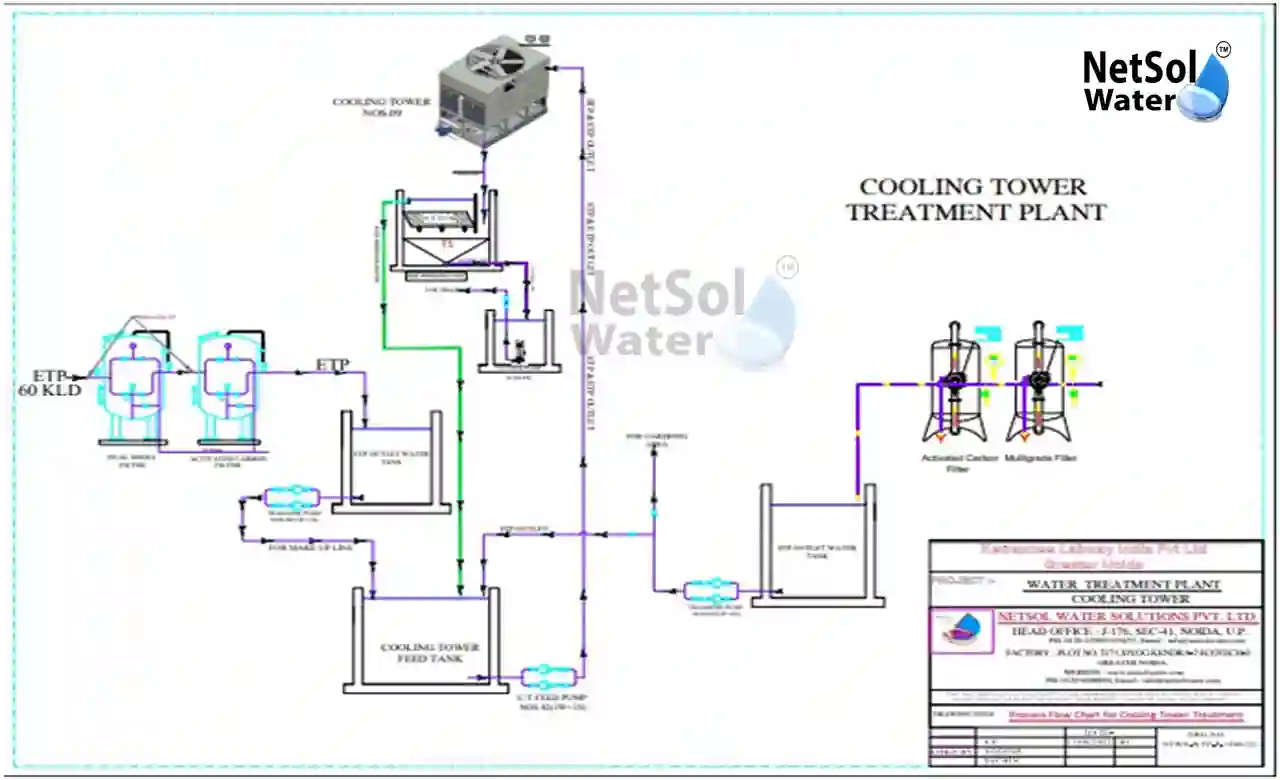
The system uses a tube settler based ETP plant combined with chemical treatment and filtration to efficiently remove suspended solids and impurities from cooling tower wastewater.
The treated water is then reused within the cooling tower system, creating a closed-loop water recycling process.
Technology Used in the Treatment System
The installed treatment plant incorporates several advanced components to ensure efficient wastewater treatment.
Key components include:
. Reaction Tank
. Flocculation Tank
. Tube Settler Clarifier
. Chemical Dosing System
. Sludge Collection System
. Pressure Filtration Units
The tube settler technology improves the settling process by increasing the effective surface area for particle separation, allowing suspended solids to settle faster than conventional clarification systems.
Cooling Tower Wastewater Treatment Process
The treatment plant follows a multi-stage treatment process to ensure effective removal of contaminants.
1: Collection and Equalization
Cooling tower blowdown water is first collected in a collection tank where flow equalization occurs. This helps maintain stable operating conditions for the treatment system.
2: Chemical Dosing
Coagulants and flocculants are added to destabilize fine suspended particles and promote the formation of larger flocs that settle easily.
3: Reaction and Flocculation
In the reaction and flocculation tanks, chemicals react with impurities and form heavier flocs.
4: Tube Settler Clarification
The water then enters the tube settler tank where inclined plates allow suspended solids to settle rapidly due to gravity.
The sludge collects at the bottom of the clarifier and is removed for safe disposal.
5: Filtration
The clarified water passes through filtration units such as:
. Multi Grade Sand Filter (MGF)
. Activated Carbon Filter (ACF)
These filters remove remaining turbidity, suspended solids, and organic impurities.
6: Treated Water Reuse
The treated water is stored in a treated water tank and pumped back into the cooling tower system for reuse.
Technical Highlights of the Installed System
The treatment system was designed based on the cooling tower blowdown flow rate and operational requirements.
Key technical parameters include:
. Cooling tower wastewater flow capacity: 27 m³/day
. Tube settler tank volume: 5.6 KL
. Chemical dosing system capacity: 0–10 LPH
. Tube deck media inclination: 60°
. Fabricated MS reaction and flocculation tanks
These design parameters ensure efficient solid-liquid separation and reliable treatment performance.
Water Reuse Strategy
One of the most important outcomes of this project is the implementation of a circular water reuse strategy.
Instead of discharging blowdown water as waste, the ETP plant treats it and returns it to the cooling tower system.
This creates a closed-loop water recycling system, where water is reused multiple times.
Results and Performance
The installation of the cooling tower wastewater treatment plant delivered significant operational and environmental benefits.
Key Achievements
1: More than 95% water savings
Cooling tower reject water is treated and reused repeatedly, significantly reducing freshwater requirements.
2: Reduced freshwater consumption
The facility now relies much less on fresh water sources.
3: Lower wastewater discharge
Wastewater disposal has been minimized through recycling.
4: Improved sustainability
The plant now operates with a highly efficient water reuse system.
5: Reduced operating costs
Savings in water procurement and wastewater disposal costs.
Environmental Benefits
Industrial water recycling plays an important role in sustainable water management.
The ETP system provides several environmental advantages:
. Conservation of groundwater resources
. Reduced industrial wastewater discharge
. Improved environmental compliance
. Promotion of circular water use in industries
This project demonstrates how wastewater can be transformed from a waste stream into a valuable resource.
Importance of Cooling Tower Wastewater Recycling
Industries such as:
. Pharmaceuticals
. Chemical manufacturing
. Power generation
. Food processing
. General manufacturing
. depend heavily on cooling tower systems.
Recycling cooling tower blowdown water through ETP plants helps industries:
. Reduce water consumption
. Improve operational efficiency
. Meet environmental compliance standards
. Achieve sustainability goals
About Netsol Water
Netsol Water Solutions Pvt. Ltd. is a leading Sewage Treatment Plant Manufacturer in India and provider of advanced water and wastewater treatment solutions.
The company specializes in:
. Effluent Treatment Plants (ETP)
. Sewage Treatment Plants (STP)
. Industrial RO Plants
. Cooling Tower Water Treatment Systems
. Zero Liquid Discharge (ZLD) Systems
With strong engineering expertise and extensive industry experience, Netsol Water delivers customized solutions that help industries manage water resources efficiently.
Related Water Treatment Solutions
1: Sewage Treatment Plant Manufacturer in India
2: Effluent Treatment Plant Manufacturer in India
3: Industrial RO Plant Manufacturer in India
4: Commercial RO Plant Manufacturer in India
Conclusion
The Cooling Tower Wastewater Treatment Plant installed at Jubilant Biosys Ltd., Greater Noida represents a successful example of industrial water recycling and sustainable resource management.
By treating and reusing cooling tower reject water, the facility has achieved:
. More than 95% water savings
. Significant reduction in freshwater consumption
. Lower wastewater discharge
. Improved environmental performance
This project demonstrates how advanced wastewater treatment technologies can help industries improve efficiency while conserving valuable water resources.
Through innovative engineering and sustainable solutions, Netsol Water Solutions Pvt. Ltd. continues to support industries in achieving responsible and efficient water management.