

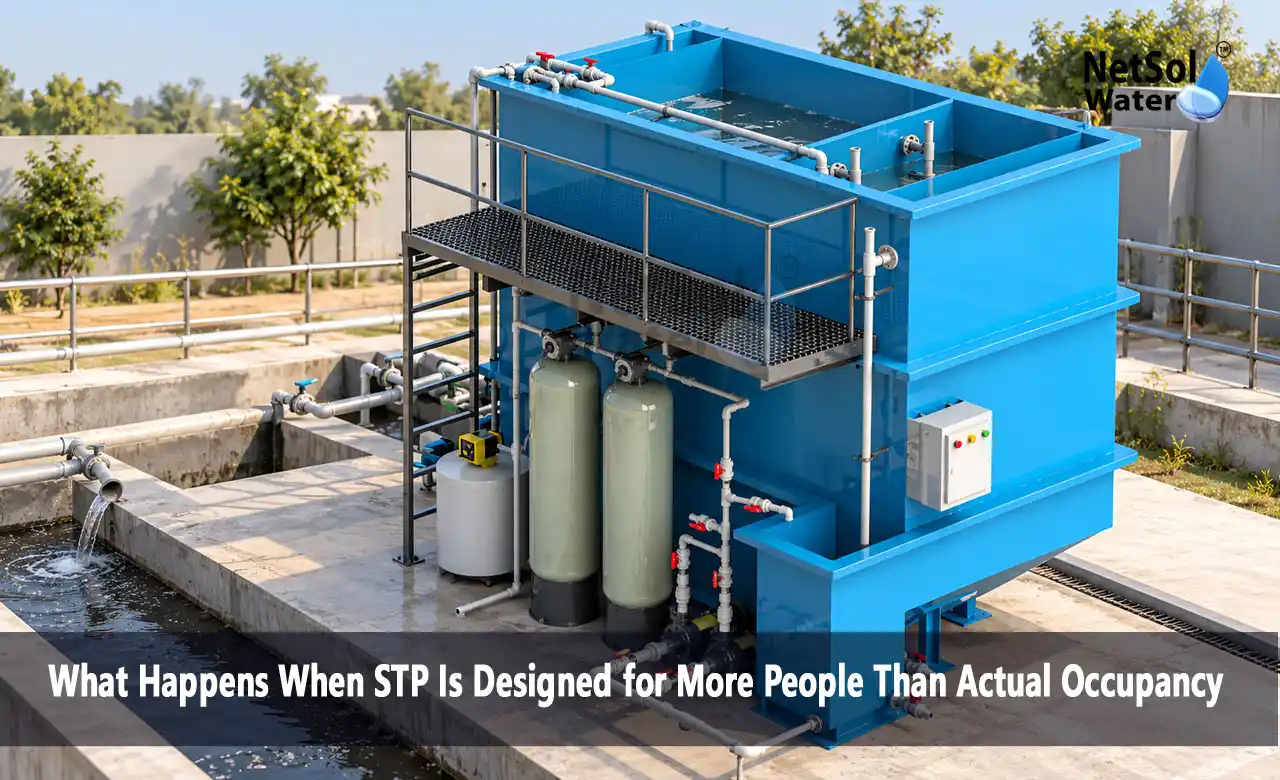
What Happens When STP Is Oversized for Actual Occupancy?
A sewage treatment plant is normally sized around the wastewater flow and organic load a project is expected to produce. In practice, many residential societies, hotels, offices and commercial complexes take years to fill up, and some never reach the occupancy they were planned for. The result is an STP built for a large crowd that serves only a small one.
When far less wastewater reaches the plant than it was designed for, the plant no longer works under design conditions. Low flow can affect equipment efficiency, sludge settling, biological activity, aeration and hydraulic retention time. Owners and facility managers who understand these effects can adjust operations early and protect treated water quality. If you are new to the basics, our guide on how a sewage treatment plant works walks through each treatment stage.
What Happens If an STP Is Designed for More People Than Actual Occupancy?
. Lower Wastewater Flow
The first and most visible change is a drop in the flow passing through the plant. Suppose an STP is designed for 500 people, but only 150 people use the building. The design flow is then far higher than the real flow. Tanks stay underfilled, and wastewater ends up staying in some sections longer than it should.
. Biological Treatment Can Become Unstable
Biological treatment depends on a steady balance of wastewater, microorganisms, oxygen and nutrients. When the organic load is much lower than the design load, the microorganisms do not get enough food. The biological population can shrink or shift, and the sludge characteristics change with it.
In MBBR technology and in SBR based sewage treatment plants, operators may need to change aeration and operating cycles to match the actual load rather than the design load.
. Excessive Aeration Wastes Energy
Aeration equipment is usually selected for the expected oxygen demand and organic loading. If the plant is only partly loaded but the blowers still run at full capacity, the plant draws more electricity than it needs. Over-aeration can also disturb dissolved oxygen levels and make biological process control harder.
Variable frequency drives, blower control and sensible operating schedules help match aeration to the real load. For more ideas, read how to maximize energy utilization in a sewage treatment plant.
. Sludge Production May Decrease
Lower flow and lower organic loading mean less biological sludge is produced. That does not mean sludge management can be ignored. Sludge that stays in the system for a long time can change in quality, which affects settling and treatment efficiency.
Keep sludge levels in a proper range and follow a controlled sludge wasting schedule based on the actual condition of the plant.
. Settling Performance Can Change
Clarifiers need the right hydraulic and solids loading to work well. At very low flow, the effective retention time of the settling tank goes up. This can look like an advantage, but without proper upkeep it can lead to sludge build-up and septic conditions. Clarifiers and sludge levels should be checked on a regular basis.
. Pumps and Equipment May Run Below Their Design Point
Pumps, blowers, mixers and other equipment are selected for one original design capacity. When flow falls well below the intended range, they can operate outside their best efficiency zone. Frequent start and stop cycles also add mechanical and electrical stress. Operators should review how each unit actually runs instead of keeping every machine on continuously.
. Odour Can Become a Problem
Low flow increases the time wastewater sits in tanks and pipelines. Where mixing and aeration are weak, stagnant zones form. Under low oxygen conditions, organic matter starts to break down anaerobically and gives off unpleasant odours. Good circulation, adequate aeration and proper sludge handling keep this risk low.
Does the STP Need to Be Modified?
Physical changes are not always required for a low occupancy STP. The first step is to compare the measured flow and pollution load with the original design. Operators can then adjust aeration, sludge wasting, pump operation and treatment cycles wherever the equipment allows it.
If under-utilisation is expected to continue for a long time, a technical evaluation can show whether process improvement or equipment re-sizing makes sense. Options such as maintenance and upgrade of existing STPs or an MBBR based revamp are worth studying at that stage.
How to Operate an Oversized STP?
The operator should work to the actual wastewater flow, not just the original design capacity. These parameters give a clear picture of how the biological and mechanical systems are coping with the lower load:
. Flow and pH
. Dissolved oxygen (DO)
. BOD or COD
. TSS and MLSS
. Sludge levels and settling characteristics
. Treated water quality
A structured approach to monitoring and tuning is covered in our article on how to optimize the performance of STP plants.
Conclusion
An STP designed for a larger occupancy than it actually serves runs with low hydraulic and organic loading. This can affect biological activity, aeration demand, sludge handling, settling, equipment operation and odour control.
The good news is that an oversized STP can still run efficiently when operators adjust the process to the real wastewater conditions. Regular monitoring is the key. Matching aeration, pumping, sludge wasting and treatment cycles to the actual load protects treated water quality and cuts unnecessary energy and operating costs.
Netsol Water can audit your existing STP and suggest changes to operations or process based on actual occupancy, wastewater flow and treatment efficiency. Explore our sewage treatment plant manufacturer and service range or talk to our team directly.
Do you need advice or assistance on selecting the best water and wastewater treatment unit? We have solutions for all your problems!
Tell us your problem, and our experts will make sure it goes away.
For assistance or a related query,
Call on +91-9650608473 Or write to us at enquiry@netsolwater.com