
Case Study: Installed 1000 LPH RO Plant at ITC Hotel, Ranthambore
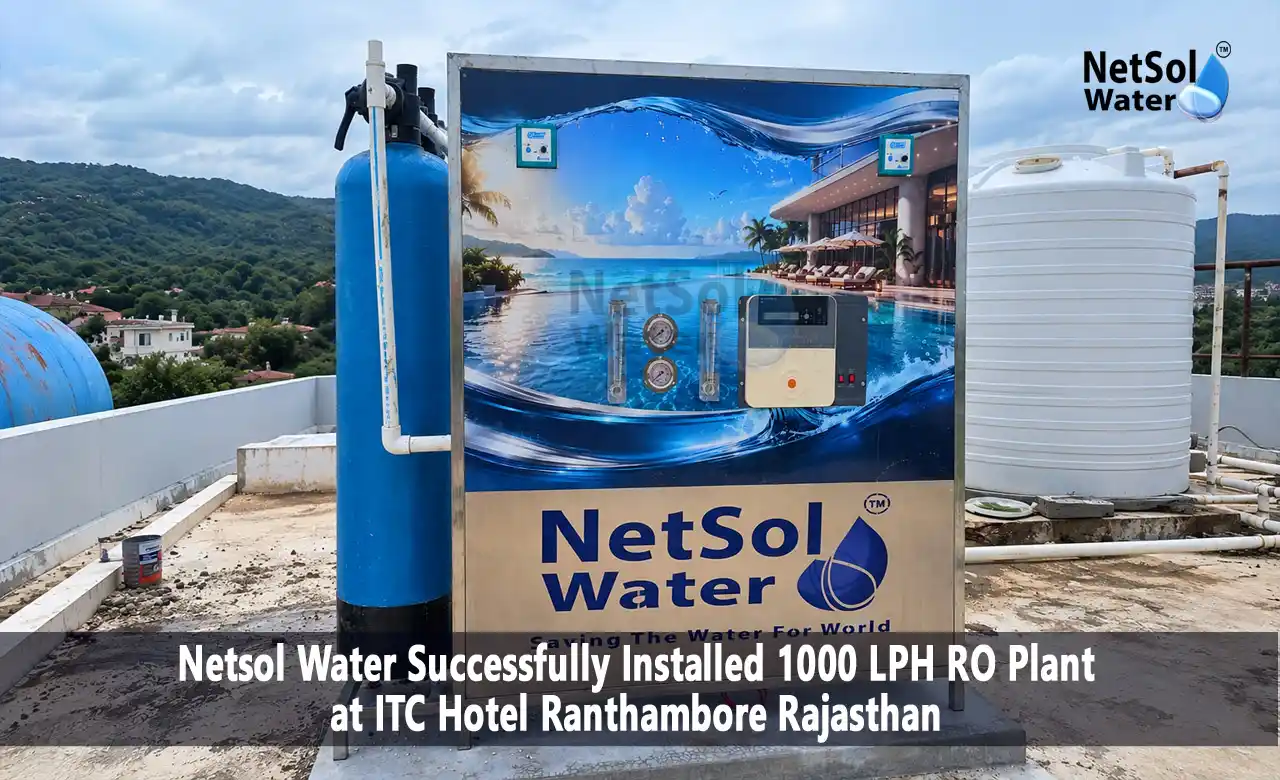
In 2026, Netsol Water completed a 1000 LPH RO plant installation at ITC Hotel, Ranthambore, Rajasthan, to treat borewell water for drinking use. The incoming water had a TDS of 3600 mg/L, and the treated water was recorded at 90 mg/L. The plant works at a 60% recovery rate and uses four LG RO membranes.
The main challenge was not the treatment process. It was lifting and shifting the RO plant to the building rooftop, which needed careful handling and planning. The installation was completed in three days, and the plant is operational. This case study explains the project details, the treatment process, the recorded results and the practical lessons for hotels and commercial buildings planning a similar installation.
Project Overview and Installation Details
This was a commercial RO plant installation for drinking water at a hotel in Rajasthan. The plant treats borewell water and supplies treated water with a much lower TDS. The table below lists the confirmed project specifications.
| Client | ITC Hotel, Ranthambore |
|---|---|
| Location | Ranthambore, Rajasthan, India |
| Installation Year | 2026 |
| Plant Capacity | 1000 LPH |
| Raw Water Source | Borewell |
| Raw Water TDS | 3600 mg/L |
| Treated Water TDS | 90 mg/L |
| RO Membrane Brand | LG |
| Number of RO Membranes | 4 |
| Treatment Components | PSF, ACF, Micron Filter, High-Pressure Pump, RO Membranes |
| Plant Construction | SS and MSFRP |
| RO Recovery Rate | 60% |
| Treated Water Application | Drinking Water |
| Main Installation Challenge | Lifting and shifting the plant to the rooftop |
| Installation Duration | 3 Days |
| Operating Status | Operational |
Understanding the Borewell Water Treatment Requirement
TDS stands for total dissolved solids. It is the combined amount of dissolved salts and minerals in water, measured in milligrams per litre (mg/L). The borewell water at this site was recorded at 3600 mg/L. This is a high value, and water at this level generally needs treatment that removes dissolved salts before it is used for drinking.
Reverse osmosis is widely used for such water. In an RO system, water is pushed at high pressure through semi-permeable membranes. The membranes hold back most of the dissolved salts, and the cleaner water, called permeate, passes through.
Before choosing any RO system, the feed water should be assessed. A TDS reading is a useful starting point, but a complete water analysis helps in selecting suitable pretreatment and membranes. This case study reports only the TDS values supplied from the project. It does not state hardness, specific contaminants or microbial conditions, because laboratory evidence for these has not been provided.
The Main Installation Challenge: Lifting and Shifting the Plant to the Rooftop
An RO plant is simpler to install when it can be placed at ground level. At ITC Hotel, Ranthambore, the plant had to be lifted and shifted to the building rooftop. This made equipment handling the most demanding part of the project.
A rooftop move needs planning before the first lift. In general, the team has to consider the weight and size of each unit, the route from the delivery point to the roof, access through or around the building, safe positioning of the equipment and coordination with the site staff. Piping and electrical points also need to be planned so that work on the roof continues smoothly once the equipment arrives.
The confirmed facts are that lifting and shifting the plant to the rooftop was the main challenge and that the installation was completed in three days. The lifting method, lifting equipment and any structural work are not described here, because those details are not part of the verified project records.
1000 LPH RO Plant Configuration and Equipment
Netsol Water, an RO plant manufacturer, installed this plant, which uses SS and MSFRP construction. The material used for each individual component has not been confirmed, so it is not assigned here. The confirmed treatment components are explained below.
. Pressure Sand Filter (PSF): removes suspended particles and turbidity from the raw water before it reaches the finer stages.
. Activated Carbon Filter (ACF): uses activated carbon to reduce chlorine, organic matter and odour-causing compounds that can harm RO membranes.
. Micron Filter: a fine filter that catches small particles which escape the earlier stages, acting as a safeguard for the pump and membranes.
. High-Pressure Pump: raises the water pressure to the level needed for reverse osmosis to work.
. Four LG RO membranes: the stage where dissolved salts are separated from the water.
Each stage has a clear job. The filters protect the pump and membranes, the pump creates the pressure, and the membranes do the actual salt separation. Skipping or under-sizing any of these stages can shorten membrane life, which is why the full sequence matters in a drinking-water plant. The membrane model, housing configuration and pump rating have not been supplied, so they are not stated here.
How the RO Plant Treatment Process Works?
The confirmed treatment sequence is:
Borewell Water → PSF → ACF → Micron Filter → High-Pressure Pump → RO Membranes → Treated Water
The first three stages are pretreatment. Raw borewell water passes through the Pressure Sand Filter, which removes suspended particles. The Activated Carbon Filter follows and reduces substances that can damage the membranes over time. The Micron Filter then removes fine particles before the water reaches the pump. Good pretreatment protects the membranes and supports stable plant operation. Larger industrial RO plant systems follow the same basic principle, with the design sized to the water and the load.
The High-Pressure Pump then pushes the pretreated water into the four LG RO membranes. Here, membrane separation takes place. Most dissolved salts are held back by the membranes, and the water that passes through is the permeate. This is the treated water used for drinking. The water that carries the rejected salts is the reject stream, and it leaves the system separately.
Pretreatment deserves attention in any RO project. Membranes are sensitive, and particles or chemicals that reach them can reduce permeate flow and shorten their working life. This is why filtration stages sit ahead of the pump and membranes in the sequence above.
Actual performance depends on feed-water chemistry, operating conditions, membrane condition and system design. Only the confirmed stages are described in this case study, and no other equipment is claimed for this plant.
RO Plant Performance: From 3600 TDS to 90 TDS
The raw borewell water was recorded at 3600 mg/L TDS, and the treated water at 90 mg/L. Based on these two readings, the TDS reduction is approximately 97.5%. This percentage is calculated from the supplied readings. It is not a separately measured result.
The confirmed RO recovery rate is 60%. In simple terms, recovery shows how much of the feed water becomes treated water. At 60% recovery, about 60 litres of every 100 litres of feed water is recovered as treated water, and the remaining water leaves as reject. Reject flow rate and operating pressure have not been supplied, so they are not stated here.
A low TDS value does not by itself confirm that water is safe to drink. TDS measures dissolved solids only. Drinking-water safety also depends on chemical and microbiological parameters, which need laboratory testing. No laboratory report is cited here, so this case study does not claim compliance with any drinking-water standard.
Rooftop Installation, Positioning and Commissioning
Placing an RO plant on a rooftop needs more preparation than a ground-level installation, because every item has to be carried up and then connected in a limited space. The confirmed facts for this project are that the plant was lifted and shifted to the rooftop, installation took three days, and the plant is now operational.
The points below are standard considerations for rooftop RO installations. They are general recommendations, not a record of work done at this site.
. Equipment placement: the plant should sit on a level surface that a qualified person has checked for load suitability.
. Maintenance access: enough space should be kept around the filters, pump and membranes for inspection, servicing and replacement.
. Piping: feed, treated water and reject lines should be planned to avoid sharp bends and leakage points.
. Electrical connections: power supply and control connections should be installed safely and protected from weather.
Original project photographs would make this section more useful. Add images showing equipment handling, rooftop placement and the completed installation, as listed in the image recommendations below.
Plant Operation, Maintenance and Water Quality Monitoring
The RO plant at ITC Hotel, Ranthambore, is operational. No maintenance schedule, service history or long-term performance figures have been supplied, so none are stated. The following practices are commonly recommended for plants of this type.
. Monitor feed-water and treated-water TDS regularly.
. Check filter pressure drops and maintain the filtration media.
. Watch RO membrane performance and permeate flow for any decline.
. Follow the membrane manufacturer's maintenance and cleaning instructions.
. Arrange periodic drinking-water quality testing.
Keeping simple written records of TDS readings, filter pressures and permeate flow helps the operating team spot changes early. A slow drop in permeate flow or a rise in treated water TDS can be an early sign that the filters or membranes need attention. The right checking interval depends on the site and the water, so it should be set with the plant supplier rather than copied from another installation.
Drinking-water testing should be done through a suitable laboratory and should cover chemical and microbiological parameters, not TDS alone. Results from such tests can then be added to this case study if the client agrees to share them.
Client Feedback on the RO Plant Installation
“We needed a drinking water RO plant for our borewell water, and the plant had to be installed on our building rooftop. The Netsol Water team coordinated the work well and handled the lifting and shifting of the plant to the rooftop. The installation was completed in three days, and the plant is now running. The treated water TDS is 90 mg/L, compared to 3600 mg/L in our borewell water. We are glad to have worked with Netsol Water on this project.”
ITC Hotel, Ranthambore
Project Outcome and Key Takeaways
The confirmed outcomes of this project are:
. A 1000 LPH RO plant installed in 2026.
. Borewell feed water TDS of 3600 mg/L and treated water TDS of 90 mg/L.
. Four LG RO membranes and a confirmed RO recovery of 60%.
. Rooftop lifting and shifting as the main installation challenge.
. Installation completed in three days.
The project shows that planning matters as much as the treatment design when commercial water treatment equipment is installed inside buildings. If you need a commercial RO plant for a hotel or similar site in Rajasthan, see our commercial RO plant manufacturer in Rajasthan page or contact Netsol Water to discuss your requirement.
Watch the 1000 LPH RO Plant Installation Video
A video of this project is available on YouTube. Readers can watch it to see the installation evidence available in the footage. This page does not describe specific activities in the video beyond what is confirmed in the project details. If you are planning a rooftop RO plant for a hotel, resort or other commercial building, the video can help you picture the scale of the equipment and the setting in which it was installed. For more detail on your own requirement, you can contact the Netsol Water team directly.
Frequently Asked Questions About the ITC Hotel RO Plant
Q1. What is the capacity of the RO plant installed at ITC Hotel, Ranthambore?
The plant has a capacity of 1000 LPH.
Q2. What was the raw water TDS?
The borewell raw water TDS was 3600 mg/L.
Q3. What was the treated water TDS?
The treated water TDS was 90 mg/L.
Q4. Which membrane brand was used?
The plant uses four LG RO membranes.
Q5. What was the RO recovery rate?
The confirmed RO recovery rate is 60%.
Q6. How long did installation take?
The installation was completed in three days.
Q7. What was the main installation challenge?
Lifting and shifting the RO plant to the building rooftop was the main challenge.
Q8. Is low TDS alone sufficient to confirm drinking-water safety?
No. TDS shows only the level of dissolved solids. Drinking-water safety also depends on chemical and microbiological parameters, which need laboratory testing.