

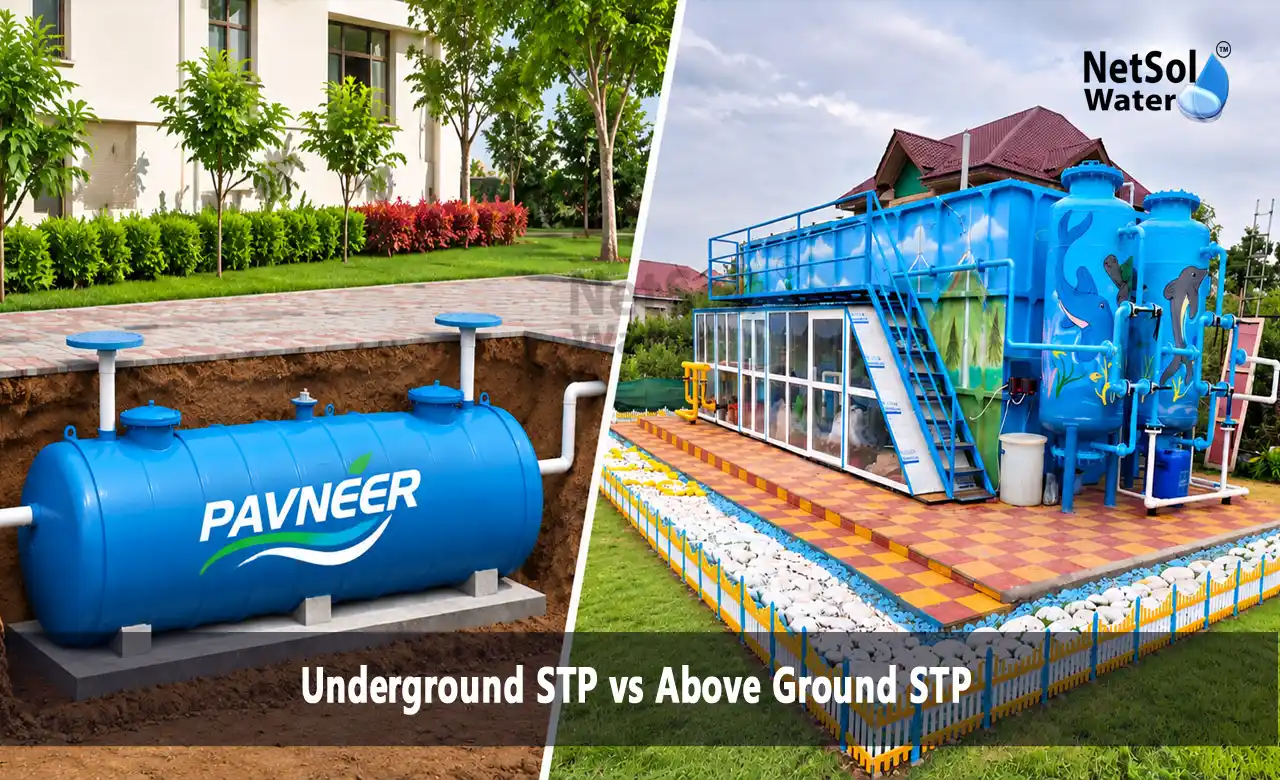
Underground STP vs Above-Ground STP: Which Is Better?
Treated sewage can be reused for flushing, gardening and cooling, which makes a Sewage Treatment Plant (STP) an essential part of most residential and commercial projects. One of the first decisions is where to put it: below ground or on the surface. The choice affects land use, construction cost, maintenance, safety and even how the property looks. This guide compares the two options and helps you decide which suits your site.
Neither option is better in every case. An underground STP suits properties with limited space where the surface above is valuable. An above-ground STP suits properties with enough land, easy access and a tighter construction budget. In both cases, treatment quality depends mainly on the technology and the plant design, not on where the tank sits.
What Is an Underground STP?
An underground STP is installed below ground level, usually in a basement, under a parking area or under a landscaped zone. Compact systems such as the PavNeer underground STP series are built for exactly this kind of installation.
Benefits
. Saves surface space. The area above the plant can be used for a garden, parking or a common area.
. Better appearance. No visible tanks or equipment, which helps in residential societies, hotels and offices.
. Less noise and smell at ground level. When properly designed and ventilated, the plant is largely out of sight and earshot.
. Good fit for costly land. In dense urban areas, every square metre of surface is valuable.
The Central Public Health and Environmental Engineering Organisation (CPHEEO) makes a similar point at the municipal level. Its November 2024 Advisory on Multi-Storey Sewage Treatment Plants promotes multi-storey and underground plants for urban areas with land constraints, citing savings in land and pipeline investment. The advisory is aimed at urban local bodies, so treat it as supporting context for building-level decisions rather than a direct design rule.
Limitations
. More excavation and structure. Digging, shoring and waterproofing usually increase construction cost and time.
. Harder access. Inspection and repairs need planned access points.
. Safety requirements. Enclosed spaces need ventilation, lighting and gas detection (see the safety section below).
. Site sensitivity. A high water table or flood-prone location can complicate design.
What Is an Above-Ground STP?
An above-ground STP is built on the surface, either in the open or inside a covered shed or enclosure. Tanks and equipment sit at ground level or on a raised platform.
Benefits
. Easy access. Operators can inspect, clean and repair equipment without going into a confined space.
. Simpler construction. Less excavation means a faster build and fewer groundwater problems.
. Easier expansion. When there is spare land, adding capacity later can be straightforward.
. Lower safety risk during maintenance. No routine entry into enclosed tanks or chambers.
Limitations
. Needs dedicated land. The plant takes up space that could serve another purpose.
. Visible. It can affect the look of the property if not screened or enclosed.
. Noise and odour risk. Poor siting or maintenance can cause complaints, especially near homes or recreation areas.
. Needs drainage and safe access. The site must handle rainwater and allow safe movement around the plant.
Underground vs Above-Ground STP: Side-by-Side
| Factor | Underground STP | Above-Ground STP |
|---|---|---|
| Land use | Minimal surface footprint; area above can be reused | Needs dedicated surface area |
| Construction cost | Usually higher (excavation, shoring, waterproofing) | Usually lower (less excavation) |
| Construction time | Generally longer | Generally shorter |
| Maintenance access | Needs planned manholes and entry points | Direct, easy access |
| Safety | Confined-space risks; needs ventilation and gas detection | Lower risk during routine work |
| Noise and odour | Contained, if designed with ventilation and odour control | Depends on siting, enclosure and upkeep |
| Appearance | Hidden from view | Visible unless screened |
| Groundwater and flooding | Needs checking; affects design and waterproofing | Less sensitive |
| Future expansion | Needs to be planned in advance | Often easier if land is available |
| Treatment quality | Same, if the same technology and design are used | Same, if the same technology and design are used |
Costs vary widely by site, capacity and design, so ask for a comparison of total lifecycle cost (construction, operation, maintenance and replacement) rather than comparing set-up cost alone.
Treatment Quality: Technology Matters More Than Location
A common misconception is that underground plants treat water differently. They do not. Both types can use the same processes, such as MBBR and other technologies or MBR. Treated water quality depends on the process selected, the plant design, correct sizing and good operation. Choose the technology based on the volume of sewage, the output quality you need, the space available and your reuse plan, and make sure the plant meets the standards set by the CPCB and your state pollution control board.
Tank Material: RCC or FRP
Underground and above-ground plants can both be built in site-cast reinforced concrete (RCC) or as prefabricated units. Prefabricated fibre-reinforced plastic (FRP) tanks are factory-made, corrosion-resistant and quicker to install, which is useful when an underground plant has to be fitted into a tight site. RCC is common for larger capacities and for plants built into the building structure. The right choice depends on capacity, site conditions and structural requirements.
Site Factors to Check Before Deciding
. Soil type and bearing capacity for excavation and foundations.
. Water table level and the risk of buoyancy, which can lift an empty underground tank if it is not designed for it.
. Flood and waterlogging history, especially in monsoon months.
. Structural loads. Check what will sit above an underground plant (vehicles, buildings, landscaping).
. Access for equipment and desludging by tanker or vehicle.
. Distance from occupied areas, which matters most for an above-ground plant.
. Local approvals and pollution control requirements.
Safety in Underground STPs
Underground plants are safe when designed and operated properly, but enclosed spaces can collect hazardous gases and lack oxygen. Good practice includes:
. Adequate ventilation and lighting in all chambers and equipment rooms.
. Gas detection and alarms where people may need to work.
. Top-side access points so that routine checks do not require entering tanks.
. A written confined-space entry procedure, with trained operators and safety equipment.
. Odour control to keep air quality acceptable near the plant.
How to Choose: A Simple Decision Guide
Choose an underground STP if:
. Land is limited or expensive and you want to keep the surface for other uses.
. Appearance matters, as in a residential society, hotel or commercial campus.
. The soil and water table suit excavation, and you can plan for ventilation and safe access.
. You are comfortable with a higher construction budget in return for space savings.
Choose an above-ground STP if:
. You have enough land, and it will not be needed for something more valuable.
. Easy access and lower construction cost are the priority.
. The water table is high or the site floods, making excavation difficult.
. You expect to expand capacity later and have room to do it.
If you are unsure, ask for a site-specific assessment. A designer can compare both options for your capacity, soil and budget.
Frequently Asked Questions (FAQs)
Q1. Is an underground STP better than an above-ground STP?
Not in every case. It is better when space is limited and the surface is valuable. An above-ground plant can be the better choice when land is available and easy maintenance and lower construction cost matter more.
Q2. Do underground STPs treat water better?
No. Treatment quality depends on the technology and design, not on whether the plant is above or below ground.
Q3. Are underground STPs more expensive?
Their construction cost is usually higher because of excavation, support structures and waterproofing, though the saved land can offset part of this. Compare total lifecycle cost, not only the initial cost.
Q4. Can an underground STP smell?
A well-designed, well-maintained plant with proper ventilation and odour control should not cause nuisance. Odour problems usually come from poor design or maintenance.
Q5. What capacity range is available for underground STPs?
Netsol Water offers underground STPs from 1 KLD to 500+ KLD. Not sure which size you need? See our guide on how to calculate STP capacity for a building.
Conclusion
The underground versus above-ground decision comes down to your site and priorities. Underground plants save surface space and keep the property looking clean, but they need careful design for excavation, groundwater and safety. Above-ground plants are easier to build and maintain but need land and good siting. Whichever you choose, focus on the treatment technology, correct sizing, long-term operating cost and compliance with pollution control norms.
Need help choosing the right STP? Netsol Water, based in Noida, designs and manufactures STPs for residential and commercial properties, including underground systems based on MBBR and MBR technology. Share your site details and the team can recommend a suitable option.
Phone: +91-9650608473, Email: enquiry@netsolwater.com