

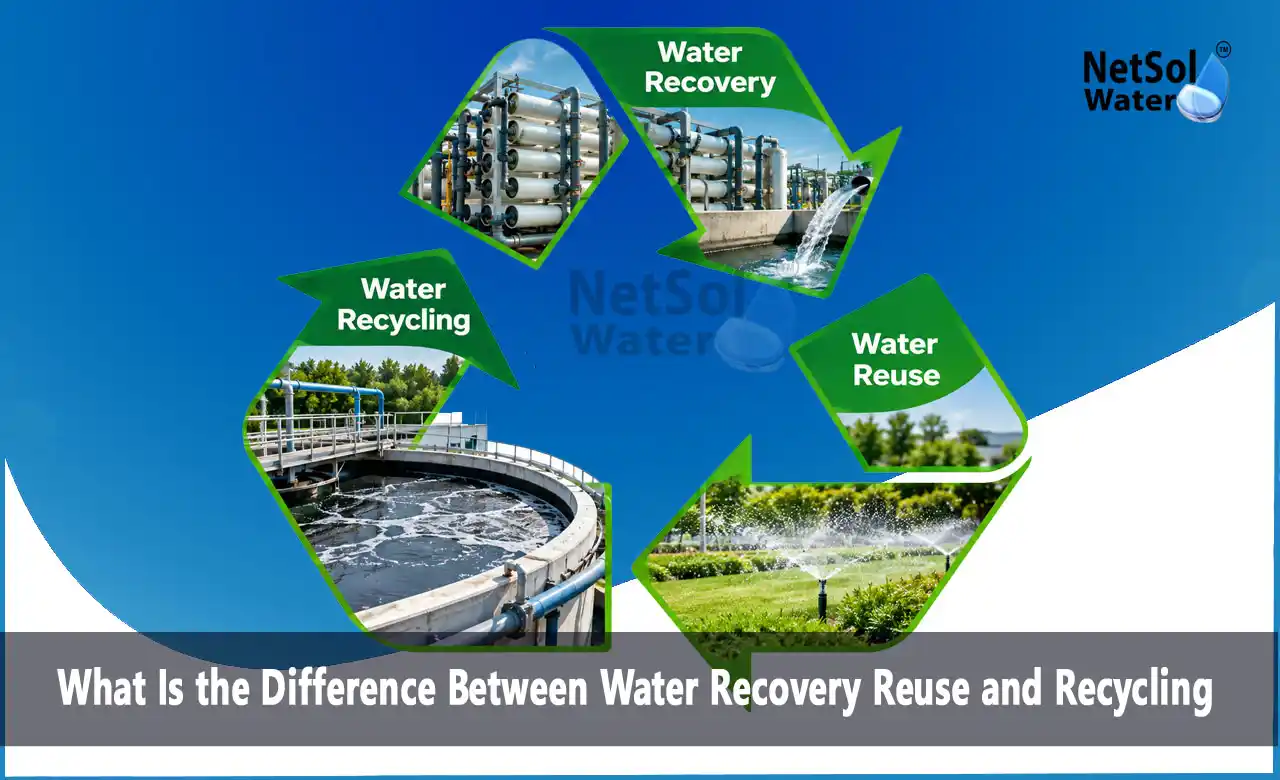
Water Recovery vs Reuse vs Recycling: Key Differences
Water recovery, reuse and recycling sound alike, and many plant owners use them as if they mean the same thing. They do not. Each term describes a different step in how used water is handled. Mixing them up can lead to the wrong plant design, the wrong treatment choice and money spent on equipment that does not fit the job.
Quick answer: Recovery is about getting usable water out of a stream. Reuse is about using that water again for a new purpose. Recycling is about treating used water and sending it back into the same process. The three often work together in one plant, but they are not the same thing.
What Is Water Recovery?
Water recovery is the process of getting usable water out of wastewater, an industrial process stream or any source that would otherwise be discharged or lost. Recovery tells you how much water you managed to save, not where that water goes next.
The easiest place to see this is an RO system. Feed water enters the membranes and splits into two streams. Clean permeate comes out on one side, and a reject stream with a higher salt concentration comes out on the other. The recovery rate is the permeate flow divided by the feed flow, multiplied by 100.
Example: If an RO plant takes in 100 m3 of water per day and produces 75 m3 of permeate, the recovery rate is 75 percent. The remaining 25 m3 leaves as reject.
The recovery rate you can reach depends on feed water quality, scaling tendency, membrane type, pretreatment and operating pressure. Pushing recovery too high without proper design can cause scaling and fouling, so the number should be set after a water analysis, not by guesswork.
One more point matters here. Recovered water is not automatically safe to drink. It only needs to be good enough for its next use, and that may need further treatment.
Plants that want to push recovery to the maximum and avoid liquid discharge altogether often move to a zero liquid discharge (ZLD) system, which concentrates the reject further so that almost all the water is recovered.
What Is Water Reuse?
Water reuse means using water more than once, usually for a different purpose than the first one. The second use does not have to be in the same process, or even in the same building.
Common examples include:
. Treated sewage from an STP used for garden and park irrigatio
. Treated water used for toilet flushing in large residential and commercial buildings
. Treated wastewater used for road washing, dust control and construction work
. Treated effluent used for cooling tower make-up or floor washing in industry
The guiding rule for reuse is "fit for purpose". Water that is fine for irrigation may be completely unsuitable for a boiler or a process that needs low dissolved solids. The more likely it is that people will come into contact with the water, the stricter the treatment needs to be.
The main goal of reuse is to stretch existing water supplies and reduce the demand for fresh water.
What Is Water Recycling?
Water recycling means treating used water and returning it to the same facility or process where it came from. It is a planned loop, designed so that the same water can do its job again and again.
Example: A manufacturing unit collects wastewater from equipment washing, passes it through filtration and other suitable treatment, and sends it back to the washing line. A cooling system can likewise treat and return part of its blowdown water instead of sending it to drain.
Recycling cuts both freshwater intake and wastewater discharge. The catch is build-up. Every cycle, dissolved salts, suspended solids and chemicals stay behind and slowly increase in concentration. A recycling loop needs a way to remove them, such as a controlled bleed, membrane treatment or a properly sized effluent treatment plant.
Water Recovery vs Reuse vs Recycling: Comparison Table
| Aspect | Water recovery | Water reuse | Water recycling |
|---|---|---|---|
| Core idea | Get usable water out of a stream | Use water again for another purpose | Treat used water and send it back to the same process |
| Where it happens | At the treatment step, such as RO or filtration | At the point of new use, such as irrigation or cooling | Inside one facility or production loop |
| Treatment need | Depends on the source stream | Depends on the new use and human contact | Almost always needed before return |
| Simple example | RO plant producing 75 m³ of permeate from 100 m³ of feed water | Treated sewage used for gardening | Washing water treated and sent back to the washing line |
| Key measure | Recovery percentage | Quality fit for the end use | Share of water returned to the loop |
These terms overlap in real plants. Water recovered from an effluent stream can be recycled into production or reused for cooling make-up. The label depends on what you are focusing on: getting the water out, using it again elsewhere, or closing a loop.
How the Three Work Together in One Plant
Take a typical industrial unit that treats its effluent and wants to cut freshwater use. A simple flow might look like this:
1. ffluent is collected and treated in an ETP to remove suspended solids, organics and other contaminants.
2. The treated water goes to an RO system. This is recovery, since usable water is separated from the salts.
3. RO permeate goes back to the production process. This is recycling, since the water returns to where it came from.
4. Part of the treated water that does not need RO quality is sent to gardening or cooling make-up. This is reuse.
5. The reject stream is handled through further concentration or safe disposal.
One plant, three practices, each doing a different job.
How to Choose the Right Approach?
Before deciding what your plant needs, work through these questions:
. What is the source? Know the flow, the contaminants and how the quality changes through the day and the season.
. What quality does the next use need? Set targets for TDS, turbidity, hardness, COD or any other parameter that matters for that use.
. What treatment is needed to reach that quality? This could be filtration, biological treatment, softening, UF, RO or a combination.
. What happens to the reject? Every recovery system produces a concentrate. Plan for it from day one.
. What will it cost to run? Look at energy use, membrane replacement, chemicals, storage and monitoring, not only the purchase price.
Common Mistakes to Avoid
. Using the three terms as one and writing unclear project requirements
. Setting a recovery target without a proper water analysis
. Ignoring salt and contaminant build-up in a recycling loop
. Reusing water for a purpose that needs a higher quality than the treatment delivers
. Forgetting storage, monitoring and routine maintenance in the plan
Frequently Asked Questions (FAQs)
Q1. Is water recovery the same as water recycling?
No. Recovery is about extracting usable water from a stream, while recycling is about treating used water and returning it to the same process. Recovered water may or may not be recycled.
Q2. Is reused water safe to drink?
Not by default. Most reuse applications are non-potable, such as irrigation, flushing and cooling. Drinking water use needs far stricter treatment and approval.
Q3. What is a good RO recovery rate?
There is no single number. It depends on feed water quality, scaling potential and system design. A water test and a proper design study should set the target.
Q4. Can one plant do recovery, reuse and recycling together?
Yes. Many industrial and municipal plants combine all three, as shown in the flow above.
Conclusion
Recovery gets usable water out of a stream, reuse puts it to work in a new place and recycling closes the loop inside one process. Knowing the difference helps you write clear project requirements, pick the right treatment system and cut freshwater use without risking quality.
If you want a system designed around your own water, a treatment partner can study your source water and end-use needs and suggest the right combination of effluent treatment, RO and ZLD.
Do you need advice or assistance on selecting the best water and wastewater treatment unit? We have solutions for all your problems!
Let us know your problem, our experts will make sure that it goes away.
For assistance or related queries,
Call on +91-9650608473 Or write us at enquiry@netsolwater.com