

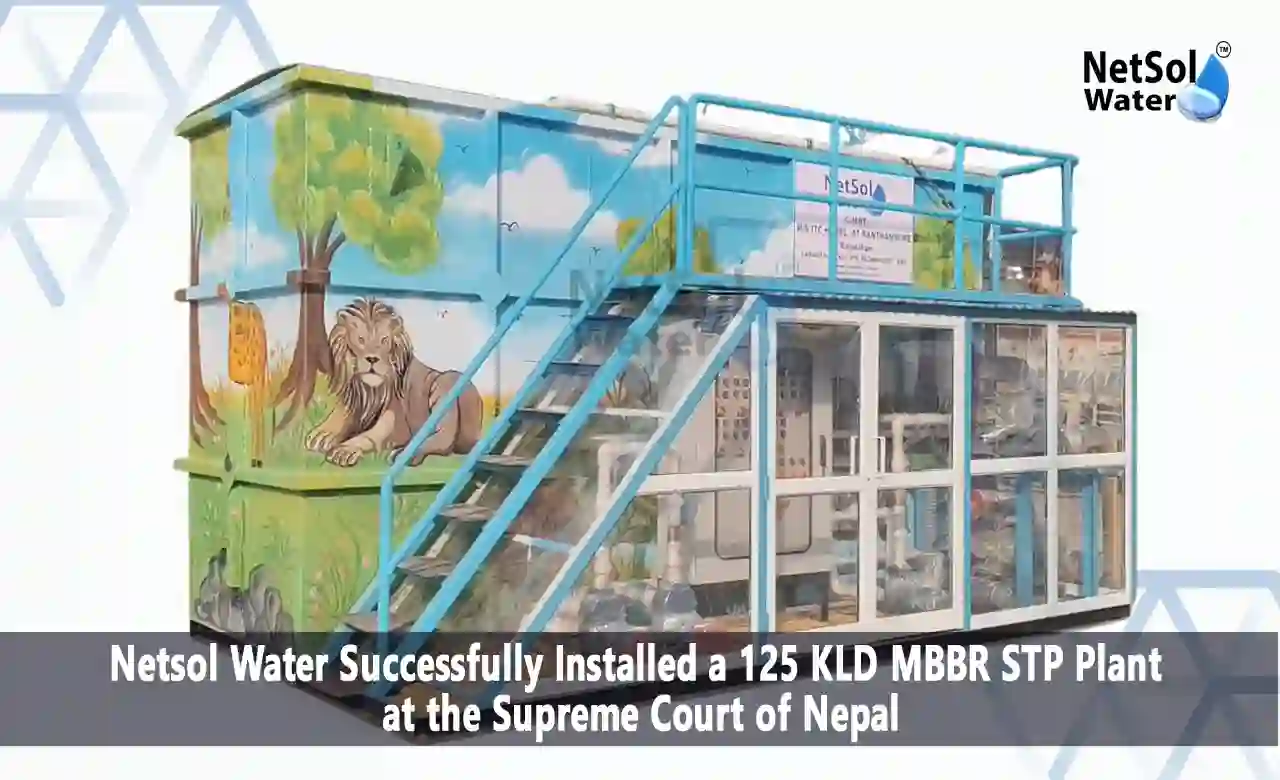
Case Study: 125 KLD MBBR STP Installed at Supreme Court of Nepal
When the Supreme Court of Nepal needed a reliable sewage treatment solution for its Kathmandu building complex, the institution turned to Netsol Water - and what followed was one of our most meaningful projects to date.
This case study tells the full story: the problem the court was facing, why we recommended a 125 KLD MBBR Sewage Treatment Plant, how we planned and executed the project across borders and what the results have looked like since commissioning.
If you're evaluating wastewater treatment options for an institutional, government or commercial facility in Nepal - this is worth reading carefully.
About Netsol Water
We are not a distributor. We design, manufacture, and commission every plant we install.
Netsol Water is headquartered in Greater Noida, India, and has spent over a decade building sewage and effluent treatment systems for clients across South Asia. As a leading Sewage Treatment Plant Manufacturer, our team includes process engineers, civil and mechanical designers, site supervisors, and after-sales specialists who work as one unit from the first consultation through the final handover.
Over the years, we have served hospitals, housing societies, industrial facilities, five-star hotels, and government complexes across India, Nepal, and Bangladesh. Our core technologies include MBBR, MBR, SBR, and FAB - each chosen based on what the site actually needs, not what is easiest to sell.
The Supreme Court of Nepal project sits among our most significant government assignments to date. It demanded cross-border logistics, precise engineering under space constraints, and a level of institutional sensitivity that pushed our team to perform at their best.
Why clients choose us: End-to-end ownership of the project - design, manufacture, transport, install, commission, and train. One team, full accountability.
Project Overview
. Client: Supreme Court of Nepal
. Location: Supreme Court Building Complex, Ramshahpath, Kathmandu, Nepal
. Technology: MBBR (Moving Bed Biofilm Reactor) Sewage Treatment Plant
. Plant Capacity: 125 KLD - 125,000 litres of sewage treated every single day
. Application: Domestic sewage treatment with treated water reuse for toilet flushing and horticulture
. Executing Partner: Netsol Water - STP Plant Manufacturer & Supplier in Kathmandu, Nepal
This project addressed one of the most consistent infrastructure gaps in large South Asian government buildings: the absence of on-site wastewater treatment. The Supreme Court generates sewage around the clock. Without a system to treat it, that sewage had nowhere safe to go.
About the Client - Supreme Court of Nepal
The Supreme Court is not just another office building. It is the nerve centre of Nepal's judicial system.
The Supreme Court Building Complex in Kathmandu serves as the highest judicial authority of the Federal Democratic Republic of Nepal. Every day, the campus sees thousands of people moving through it - judges, lawyers, litigants, staff, clerks, and visitors. The building houses courtrooms, administrative wings, legal libraries, residential quarters for judicial staff, and canteens.
What that translates to, practically, is a large and continuous generation of domestic wastewater. Flush water from washrooms, kitchen wastewater from the canteens, drainage from the residential quarters - all of it adds up to well over 100,000 litres per day. And for a long time, none of it was being treated on-site.
For an institution that upholds the rule of law, operating without a compliant wastewater system was not just an environmental issue - it was a reputational one. When the court's facility management team decided to fix it properly, they needed a partner who could deliver without cutting corners.
What Was the Problem?
The core issue was straightforward: 125,000 litres of sewage being generated daily, and no system to treat it.
But the implications of that gap ran deeper than just a plumbing issue. Here is what the facility management team was actually dealing with:
. No on-site treatment infrastructure. The complex was entirely dependent on the overloaded Kathmandu municipal sewer network. During peak periods, the network struggled to handle the additional load, causing sewage to back up within the complex.
. Risk of groundwater contamination. With parts of the compound lacking proper drainage lining, untreated sewage was seeping into the ground, potentially contaminating the local water table.
. Rising regulatory pressure. Nepal's environmental authorities have been tightening enforcement of discharge norms, particularly for large government and institutional complexes. Non-compliance was no longer a risk the institution could afford to carry.
. Total dependence on fresh water for secondary uses. Without treated water available for recycling, the complex was using potable water for toilet flushing, garden maintenance, and cleaning - a significant and entirely avoidable waste.
. Odour and hygiene concerns. Untreated or inadequately drained sewage contributed to hygiene challenges within the complex, particularly in warm months.
The institution needed a treatment system that could handle the full daily load, fit within the available space inside the complex, operate reliably without requiring a large skilled maintenance team, and produce water clean enough to reuse. Those requirements shaped every decision we made.
Our Solution - Why We Chose MBBR
MBBR was the obvious choice. It was not a default - it was a deliberate decision based on what the site actually needed.
After visiting the Supreme Court complex, reviewing the sewage flow data, mapping the available space, and talking to the facility team about their operational capacity, our engineers concluded that a Moving Bed Biofilm Reactor system was the right fit. Here is the thinking behind that:
1. Space was limited - MBBR works in compact footprints
A conventional activated sludge plant of the same capacity would have demanded significantly more land. The court complex could not offer that. MBBR packs its biological treatment into a smaller tank volume because the biofilm media does the work that large settlement tanks do in older systems.
2. The team on-site had no dedicated water treatment staff
MBBR systems, once stabilised, run with minimal manual intervention. The biofilm establishes itself and maintains its own microbial balance. We configured the plant with automated blower controls, flow sensors, and a simple dashboard - meaning the facility's general maintenance staff could monitor it without any specialist training.
3. Load fluctuations were expected
Court days are different from weekends. Seasonal hearings, major cases, public holidays - occupancy at the complex varies considerably. MBBR handles these fluctuations gracefully. The biofilm community self-adjusts to changes in organic load, so treatment quality stays consistent even on days when the court is running well below or above average attendance.
4. Treated water reuse was a must
The client specifically wanted to reduce dependence on municipal water supply. MBBR produces effluent that, after filtration and disinfection, is clean enough for toilet flushing and garden irrigation. This was a design goal we built toward from the very beginning.
In short: MBBR gave us high treatment efficiency, compact design, low operator dependency, and reuse-grade output. That combination is exactly what this project demanded.
How We Executed the Project
Cross-border projects have their own rhythm. You cannot rush them, but you cannot afford to lose time either.
Here is how the project actually unfolded, from the drawing board to the day the plant went live:
Phase 1 - Engineering Design & Process Finalisation
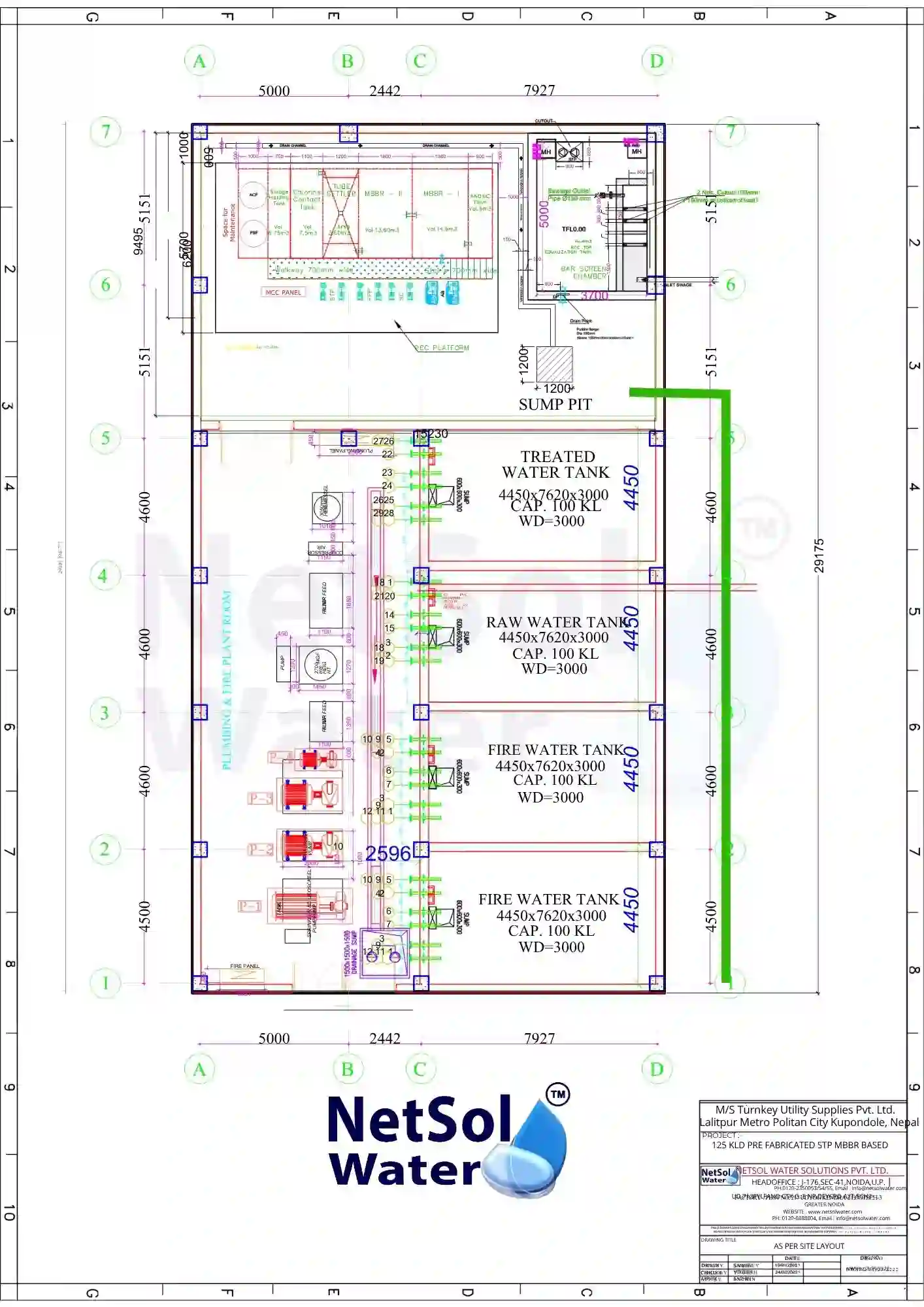
Our in-house design team prepared detailed process flow diagrams, hydraulic calculations, equipment layout drawings, and civil construction plans specific to the Supreme Court complex. Every drawing was reviewed against the site dimensions and the client's operational brief before a single component was manufactured.
Phase 2 - Manufacturing & Factory Quality Testing
All components - the MBBR reactor tank, aeration diffusers, blowers, clarifier, filter vessels, sludge handling system, and control panels - were manufactured at our facility in Greater Noida. Before dispatch, every unit went through a documented factory acceptance test. We do not dispatch equipment that has not been tested under load conditions.
Phase 3 - Cross-Border Transportation to Kathmandu
Shipping a full 125 KLD STP plant from India to Nepal involves customs documentation, border crossing logistics, and last-mile coordination with local freight partners in Kathmandu. Our logistics team handled all of this - including proper packaging to protect sensitive instrumentation during the road journey - and delivered the consignment to the Supreme Court complex on schedule.
Netsol Water - 125 KLD MBBR STP Plant: Supply, Transportation & Unloading at the Supreme Court of Nepal, Kathmandu
The video above documents the transportation, arrival, and unloading process at the site - showing exactly how the plant reached the Supreme Court complex and how our team managed the handover from transit to site.
Phase 4 - Site Unloading & Mobilisation
Once the trucks arrived at the complex, our site supervisors coordinated the unloading using appropriate rigging equipment. Heavy components were moved carefully to avoid damage and positioned in the allocated storage area. Netsol Water managed the entire unloading process - the court's facilities team did not need to arrange separate lifting contractors.
Phase 5 - Civil Infrastructure & Groundwork
Our civil team worked alongside the complex's maintenance department to prepare the plant's foundation - laying the concrete plinths, digging pipe trenches, setting up the underground sump tanks, and routing electrical conduits. All civil work was done to the approved drawings without disrupting the court's functioning areas.
Phase 6 - Mechanical & Electrical Installation
With civil work complete, the mechanical installation phase began. Pumps, blowers, diffusers, filter vessels, and the MBBR media were installed and interconnected. The automated control panel - equipped with PLC logic and online sensors - was wired, tested, and integrated with the plant's instruments.
Phase 7 - Commissioning & Staff Training
Commissioning is the phase most suppliers rush. We do not. We seeded the MBBR media with activated sludge, allowed the biofilm to establish over the proper acclimatisation period, ran the plant through its full design flow, collected water samples, and verified that all output parameters were within spec before signing off.
We then spent two full days training the facility staff - walking them through daily checks, monthly maintenance routines, how to read the control panel, what to do if an alarm triggers, and when to call our after-sales team. They received a printed operations manual in both English and Nepali.
Inside the Plant - How 125 KLD of Sewage Gets Treated
Understanding the process helps you trust the output. Here is what happens to the sewage from the moment it enters the plant to the moment the treated water goes back into use.
1. Screening & Grit Removal - Raw sewage from the building complex arrives first at a bar screen, which physically blocks and removes floating debris: rags, plastic scraps, food waste, and any solid material that has found its way into the drain. The water then passes through a grit chamber where heavier particles - sand, small stones - sink and are removed. These two steps protect every piece of downstream equipment from blockages and abrasion.
2. Equalisation Tank - Sewage flow from a large complex is not constant. Morning hours in any busy institution produce sharp spikes. The equalisation tank absorbs these peaks and releases a smooth, steady flow into the treatment reactor. Without this buffer, the biological stages would be subjected to shock loads that stress the microbial community and reduce treatment efficiency.
3. MBBR Aeration Reactor (The Core Treatment Stage) - This is where the actual treatment happens. The reactor tank is filled with thousands of small HDPE carriers - roughly the size of a large coin - that provide an enormous surface area for the growth of a dense biofilm of aerobic bacteria. Fine-bubble diffusers at the base of the tank push air continuously through the water, keeping the media in constant motion and supplying oxygen to the microorganisms. These bacteria consume the organic pollutants in the sewage - the BOD and COD - converting them into harmless carbon dioxide and water. The process is rapid, efficient, and self-sustaining once the biofilm is established.
4. Secondary Clarifier - After biological treatment, the water flows into the clarifier, where residual biomass and suspended solids settle to the bottom under gravity. The clear, treated water rises to the surface and overflows into the next stage. Settled sludge is returned to the reactor or withdrawn for disposal.
5. Sludge Management - The biological process generates sludge. In an MBBR system, sludge generation is naturally lower than in conventional activated sludge plants. The excess sludge is collected in a holding tank, thickened, and then either transported to a designated disposal facility or, in some cases, used as a soil conditioner after drying.
6. Pressure Sand Filtration - The clarified water passes through a pressure sand filter that removes any residual fine particles that escaped the clarifier. This step is critical for producing visually clear, non-turbid output water.
7. Activated Carbon Filtration - The ACF stage adsorbs trace organic compounds, residual colour, and odour-causing substances. After this stage, the water looks, smells, and behaves like clean water.
8. Chlorination & Disinfection - In the final stage, a calibrated dose of chlorine is added to eliminate any remaining pathogens and bacteria, ensuring the treated water is microbiologically safe for reuse.
9. Treated Water Storage & Distribution - Fully treated effluent is stored in a dedicated reuse tank, from where it is pumped to toilet flush cisterns across the complex and to the garden irrigation system. Fresh municipal water consumption for these secondary uses has dropped significantly as a result.
Key Components in the Plant
Every component in this plant was selected for performance, longevity, and ease of servicing in the Kathmandu context. Here is what makes up the 125 KLD MBBR STP:
. Bar Screen Chamber and Grit Removal Unit
. Equalization Tank with submersible sewage pumps
. MBBR Aeration Reactor with high-density HDPE biofilm media carriers
. Fine-bubble membrane disc diffuser aeration system
. High-efficiency centrifugal blowers for continuous aeration
. Secondary clarifier with sludge return and waste sludge withdrawal system
. Sludge holding and thickening tank
. Pressure Sand Filter (PSF) for tertiary polishing
. Activated Carbon Filter (ACF) for odour and colour removal
. Sodium hypochlorite dosing system for disinfection
. Treated water storage tank and distribution pump set
. PLC-based automated control panel with SCADA-ready architecture
. Online instruments: pH meter, dissolved oxygen probe, flow meters, level sensors
. All interconnecting pipework, valves, bends, and structural supports
Results - What the Numbers Actually Show
The plant was evaluated over a 30-day performance monitoring period after commissioning. The results were consistent across every measurement cycle.
| Parameter | Design Target | Achieved Result | Status |
|---|---|---|---|
| Plant Capacity | 125 KLD daily | 125 KLD (consistent) | Met |
| Technology | MBBR Biofilm Reactor | Fully operational | Active |
| BOD (outlet) | < 10 mg/L | < 8 mg/L | Exceeded standard |
| COD (outlet) | < 50 mg/L | < 42 mg/L | Within limit |
| TSS (outlet) | < 20 mg/L | < 15 mg/L | Excellent clarity |
| Treated Water Reuse | Flushing + irrigation | Daily reuse active | Operational |
| Regulatory Compliance | Nepal DWSSM + CPCB | Fully compliant | Zero violations |
| Plant Uptime | > 95% | ~98% uptime | Above target |
| Odour & Nuisance | Nil / controlled | Zero complaints | Controlled |
| Sludge Generation | Low (design target) | Below projected | Efficient |
| Energy Consumption | Optimised design | Within budget | On target |
| Application | Domestic sewage treatment | 100% operational | Live |
Key outcome: The plant not only met all design parameters - it consistently exceeded them. BOD dropped below 8 mg/L against a target of 10. TSS came in at under 15 mg/L. Uptime held at approximately 98%. Zero regulatory violations were recorded in the post-commissioning period.
The treated water is now actively used for toilet flushing and horticultural irrigation across the entire Supreme Court complex. The direct reduction in fresh municipal water consumption has been significant - and measurable on the utility bills.
What This Project Delivered?
Beyond the technical metrics, this project changed how the Supreme Court complex relates to its own environmental footprint.
1. For the Environment
. Untreated sewage no longer enters the municipal network or the surrounding soil. Full stop.
. Treated water reuse means significantly less draw on fresh water supply - a genuine contribution to Kathmandu's increasingly stressed urban water system.
. Lower sludge volumes mean less burden on the city's solid waste disposal infrastructure.
2. For Operations
. The complex now runs a fully automated, reliable treatment system with minimal staff involvement. A general maintenance technician can handle daily checks without specialist training.
. No more odour complaints from the facility. No more sewage backup incidents.
. The facility management team has real-time visibility into plant performance through the control panel dashboard.
3. For Finances
. Treated water reuse has meaningfully reduced the complex's potable water bill.
. No regulatory fines. No enforcement notices. Zero legal exposure on the wastewater front.
. Reduced sludge hauling costs relative to conventional treatment alternatives.
4. For Institutional Standing
. The Supreme Court of Nepal now operates a certified, compliant wastewater treatment facility - a detail that matters for an institution whose reputation is built on upholding standards.
. The project has attracted attention from other government departments exploring similar solutions, positioning the court as a quiet leader in institutional sustainability.
Conclusion
This was not a complicated project in concept. It was a challenging one in execution - and that is exactly what Netsol Water is built for.
Designing the right system for a constrained institutional campus, managing cross-border logistics to deliver a full STP plant to Kathmandu, installing and commissioning it without disrupting one of Nepal's most active government buildings, and training a non-technical team to operate it confidently - that combination is what makes this project genuinely meaningful to us.
The 125 KLD MBBR STP Plant at the Supreme Court of Nepal is now treating sewage reliably, every single day. The treated water is going back into the building. The environment is better for it. The institution is compliant. And the facility team has the tools, the knowledge, and the support to keep it running for years to come.
If you're a facility manager, a government administrator, or an infrastructure planner dealing with a similar wastewater challenge in Nepal or the broader South Asian region - this project is proof that the right solution exists, and that it can be delivered well.
Looking for an MBBR STP Plant Supplier in Kathmandu or anywhere in Nepal? Netsol Water offers end-to-end wastewater treatment solutions - from feasibility studies to after-sales support. Get in touch for a no-obligation consultation.
Frequently Asked Questions
These are the questions we get asked most often by facility managers, government procurement teams, and infrastructure consultants evaluating MBBR STP solutions in Nepal.
What is an MBBR Sewage Treatment Plant, and is it suitable for institutional buildings?
MBBR stands for Moving Bed Biofilm Reactor. It is a biological sewage treatment technology in which microorganisms grow as a dense biofilm on small plastic media carriers suspended in an aerated tank. The biofilm breaks down the organic pollutants in the sewage. MBBR is particularly well-suited for institutional buildings like courts, hospitals, and office complexes because it offers high treatment efficiency in a compact footprint, handles variable loads gracefully, and requires minimal skilled operator involvement day-to-day.
What capacity MBBR STP plant does a large government building complex typically need?
Capacity depends on the daily occupancy and the nature of the water use. A rough planning figure for institutional buildings is 45 litres per person per day for sewage generation. For the Supreme Court of Nepal complex, with its thousands of daily occupants across courtrooms, offices, canteens, and residential areas, the daily load came to approximately 125,000 litres (125 KLD). Netsol Water conducts a detailed site-specific flow assessment before recommending any capacity.
Can the treated water from an MBBR STP be reused inside the building?
Yes - and this is one of the strongest arguments for installing an on-site STP. At the Supreme Court of Nepal, treated water from the MBBR plant is used for toilet flushing across the entire complex and for watering the building's gardens and landscaped areas. After filtration through pressure sand and activated carbon filters, followed by chlorination, the output water meets quality standards for these non-potable secondary uses. This reuse meaningfully reduces the building's dependence on municipal fresh water supply.
How long does it take Netsol Water to install a 125 KLD MBBR STP Plant?
For a 125 KLD plant including design, manufacturing, cross-border transportation to Nepal, civil work, installation, and commissioning, the typical timeline is 10 to 16 weeks from confirmed order. The exact schedule depends on site readiness, civil work complexity, and logistics. Netsol Water provides a detailed project timeline at the proposal stage, with milestones tracked throughout execution.
Is an MBBR STP plant compliant with Nepal's environmental regulations?
Yes. The 125 KLD MBBR STP installed at the Supreme Court of Nepal fully meets the wastewater discharge standards set by Nepal's Department of Water Supply and Sewerage Management (DWSSM) and aligns with CPCB norms applicable to similar facilities. The plant's treated effluent parameters - BOD, COD, TSS, and pH - are consistently within permissible limits, and the facility has had zero regulatory violations since commissioning.
Does Netsol Water provide after-sales support for STP plants in Nepal?
Yes. After-sales support is a standard part of every Netsol Water project, not an add-on. Following commissioning, we provide operations and maintenance manuals, on-site staff training, a defined warranty period, access to our technical support team, and scheduled preventive maintenance visits. For clients in Nepal, we work with our local coordination network to ensure prompt support without dependence on cross-border travel for routine service needs.
Talk to Us About Your Project
If you're managing a building, campus, or facility in Nepal - or anywhere in South Asia - that does not yet have a proper sewage treatment system, we'd genuinely like to hear from you. Not to give you a sales pitch, but to understand your site and tell you honestly whether a solution like this makes sense for your situation.
We have done it for the Supreme Court of Nepal. The process is repeatable, the technology is proven, and our team knows how to deliver in this region.
Got a Wastewater Problem? Let's Solve It Together.
Whether you manage a government building, a housing society, a hospital, or an industrial site - if you are dealing with sewage or effluent that has no proper treatment system, Netsol Water can step in. We have done it for the Supreme Court of Nepal. We can do it for you.
Call / WhatsApp: +91-9650608473
Email: info@netsolwater.com
www.netsolwater.com | Greater Noida, India | Serving Nepal, Bangladesh & South Asia