

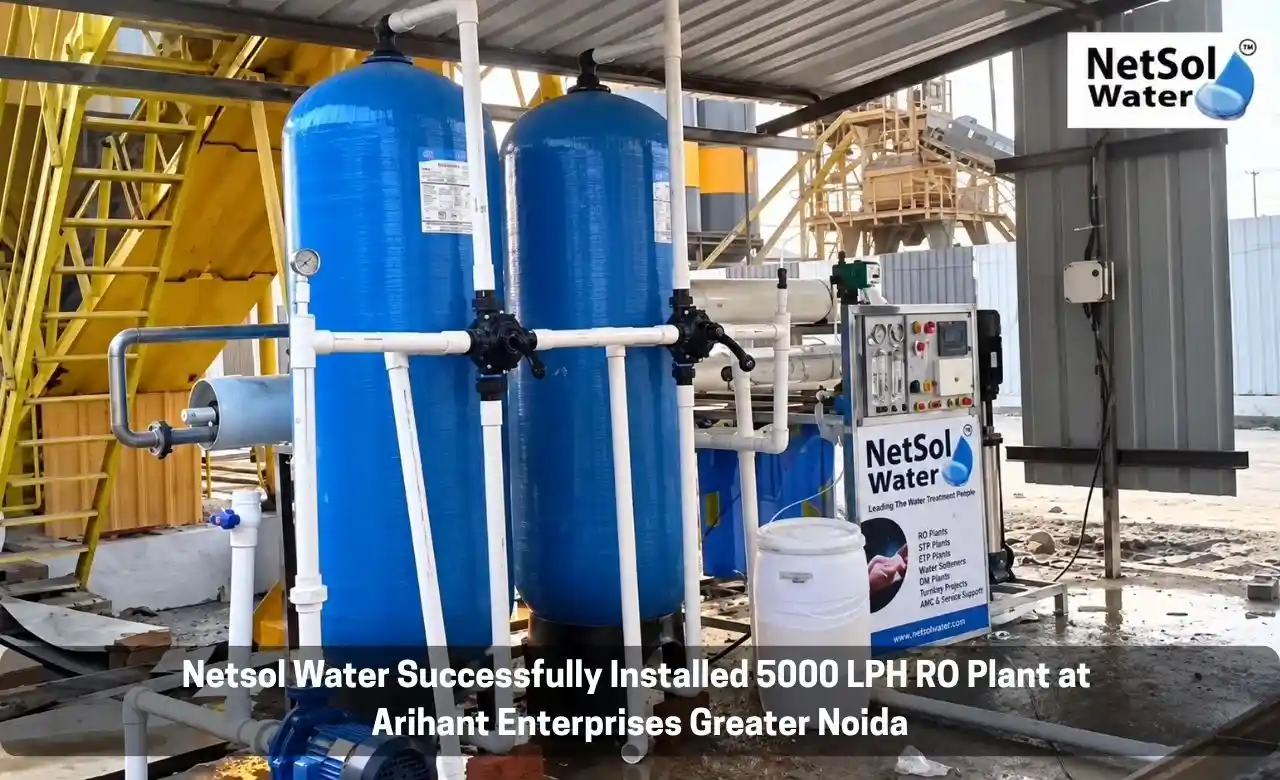
Case Study: 5000 LPH RO Plant Installation at Arihant Enterprises, Greater Noida
Arihant Enterprises, based in Greater Noida, Uttar Pradesh, needed a dependable source of treated water to support its regular operations. Raw water in the region, whether from municipal supply or borewell sources, commonly carries dissolved salts, total dissolved solids (TDS) and suspended impurities that affect water quality if left untreated. To meet this requirement, Arihant Enterprises engaged Netsol Water to design, supply, install and commission a 5000 LPH RO Plant suited to its site conditions.
This case study documents the requirement identified at the Greater Noida facility, the RO-based solution proposed by Netsol Water, and the installation and commissioning process that brought the plant into operation.
Project Snapshot
| Client | Arihant Enterprises |
| Location | Greater Noida, Uttar Pradesh |
| Plant Capacity | 5000 LPH (Litres Per Hour) |
| Plant Type | Industrial/Commercial RO Plant |
| Treatment Technology | Reverse Osmosis with suitable pre-treatment |
| Project Scope | Supply, Installation and Commissioning |
| Application | Industrial/commercial treated water requirement |
| Executed/Supplied By | Netsol Water |
About Arihant Enterprises and Its Water Treatment Requirement
Arihant Enterprises required a consistent supply of treated water for its facility in Greater Noida. Like most industrial and commercial establishments, the concern was not simply water availability but water quality: raw water sources can carry variable levels of TDS, hardness-forming salts and suspended solids, and these impurities do not remain constant throughout the year.
A RO-based system was identified as a suitable route because reverse osmosis is widely used to reduce dissolved salts and impurities from raw water to levels suited to operational use. Rather than depending on inconsistent raw water quality, Arihant Enterprises needed a system that could treat water in-house and deliver it at a defined capacity, which is where the requirement for a 5000 LPH RO Plant originated.
Project Challenge: Requirement for Consistent Treated Water
The core challenge at the Greater Noida site was ensuring a steady, dependable supply of treated water rather than relying on raw water of fluctuating quality. This meant the solution had to address a few connected needs at once: reduction of dissolved solids, protection of downstream systems from scale and fouling where applicable, and a plant that could be operated and monitored without specialised technical staff on hand at all times.
It is worth clarifying what the plant capacity actually represents. 5000 LPH means the plant is designed to treat 5,000 litres of water per hour under specified operating and feed-water conditions. Actual output can vary with raw water quality, temperature and other site-specific factors, so the figure should be read as a design capacity rather than a fixed output guaranteed under all conditions.
Alongside the water-quality challenge, the project also had to account for site-specific factors: available installation space, proximity to the water source, drainage for reject water, and electrical supply, all of which needed to be assessed before the plant could be finalised for the Greater Noida location.
Netsol Water's Solution: 5000 LPH Industrial RO Plant
Netsol Water proposed a 5000 LPH RO Plant built around a standard, proven treatment sequence, with pre-treatment stages selected to suit the raw water conditions typically found at industrial and commercial sites in the region. The overall process can be summarised as follows:
Raw Water → Pre-Treatment → Micron Filtration → High-Pressure Pump → RO Membrane → Treated Water
. Pre-treatment: removes larger suspended particles, sediment and, where required, chlorine or organic matter, protecting the RO membranes from fouling.
. Micron filtration: provides a finer level of filtration ahead of the RO stage to guard the membranes against fine particulate matter.
. High-pressure pumping: raises feed water to the pressure required to push water through the semi-permeable RO membranes.
. RO membrane treatment: separates dissolved salts and impurities from the feed water, producing permeate (treated water) and a reject stream.
. Permeate and reject water: permeate is the treated output used for the intended application, while reject water carries away the concentrated impurities.
. Control and monitoring: instrumentation allows the plant to be operated and checked without constant manual intervention.
Only the equipment and process stages confirmed for this project are described here; specific membrane models, pump brands, exact recovery percentages and detailed technical specifications are not included unless verified for the Arihant Enterprises installation.
5000 LPH RO Plant Installation and Commissioning Process
Step 1: Site Assessment
Netsol Water's team assessed the available space at the Greater Noida site, along with the water inlet point, drainage arrangement for reject water, electrical supply and general installation conditions before finalising the plant layout.
Step 2: Feed Water Assessment
Raw water at the site was evaluated to understand its characteristics, since feed water quality directly influences the choice and sequence of pre-treatment stages ahead of the RO system.
Step 3: Plant Installation
The RO plant and its associated equipment were positioned at the site, followed by piping connections, plumbing and integration with the electrical and control systems.
Step 4: System Flushing and Testing
Before commissioning, the system was flushed to clear the piping and membranes of any residue from installation, along with pressure checks and a general inspection of all connections.
Step 5: Commissioning
The plant was run on trial operation to verify that it was functioning as designed, with treated water quality checked as part of this process.
Step 6: Handover
On completion, Netsol Water briefed the Arihant Enterprises team on basic operation and maintenance practices to support smooth day-to-day running of the plant.
Key Components of the RO Plant
The table below describes the typical/representative components found in a 5000 LPH RO system of this type.
| Component | Function |
|---|---|
| Feed water system | Supplies raw water to the plant for treatment |
| Pre-treatment filtration | Removes sediment and larger suspended particles |
| Micron filtration | Provides fine filtration ahead of the RO stage |
| High-pressure pump | Delivers water to the RO membranes at required pressure |
| RO membrane system | Separates dissolved salts and impurities from feed water |
| Control panel | Enables operation and monitoring of the plant |
| Flow and pressure instruments | Track plant performance during operation |
| Permeate collection/storage | Holds treated water ready for use |
How a 5000 LPH RO Plant Works?
A 5000 LPH RO Plant works by pushing raw water, after pre-treatment, through semi-permeable RO membranes under high pressure, separating dissolved salts and impurities from the water. The process generally follows this sequence:
Raw Water → Pre-Treatment → Fine Filtration → High-Pressure Pump → RO Membranes → Permeate/Treated Water → Storage/Application
. Raw water: the untreated input water drawn from the source at the site.
. Pre-treatment: removes suspended solids and other contaminants that could damage the RO membranes.
. Fine filtration: adds a further layer of protection before the water reaches the membranes.
. High-pressure pump: pressurises the water so it can pass through the RO membranes.
. RO membranes: the core treatment stage, where dissolved salts and impurities are separated out.
. Permeate/treated water: the treated output, ready for its intended application.
. Storage/application: treated water is stored and drawn on as required.
Project Video: 5000 LPH RO Plant at Arihant Enterprises
The video below offers a visual look at the installed 5000 LPH RO Plant at Arihant Enterprises, Greater Noida, showing the equipment layout and general setup at the site. It is intended as a supporting visual reference alongside the written project details covered in this case study, rather than a repeat of the information already discussed.
Project Outcomes and Benefits
Following installation and commissioning, the 5000 LPH RO Plant gives Arihant Enterprises access to a dependable, in-house source of treated water instead of relying on raw water of variable quality. Key benefits of the system include:
. Reliable access to treated water at the site, supporting day-to-day operational needs.
. Improved and more consistent water quality compared with untreated raw water.
. Reduction of dissolved salts and TDS through the RO treatment process.
. Better protection for downstream equipment where treated water is used in operational processes.
. A centralised water treatment setup that is easier to monitor and manage.
. A system sized to support ongoing industrial/commercial water requirements at the facility.
Exact figures for cost savings, recovery percentage or water-quality improvement are not included here, as such data has not been provided for this project.
Why Choose Netsol Water for Industrial RO Plant Installation?
Netsol Water works with industrial and commercial clients on the design, supply, installation and commissioning of RO plants, including systems like the 5000 LPH RO Plant installed at Arihant Enterprises. The company's role on projects of this kind typically covers:
. Assessment of site and feed water conditions before finalising a plant design.
. Engineering of RO systems suited to the required capacity and application.
. Supply and installation of equipment, along with commissioning support.
. Guidance on operation and maintenance following handover.
. Customised industrial water treatment solutions based on project-specific requirements.
Netsol Water's approach on this project was to match the plant design to the water quality and capacity requirements identified at the Greater Noida site, rather than applying a standard configuration without site-specific assessment.
Conclusion
The 5000 LPH RO Plant installed at Arihant Enterprises in Greater Noida addressed a clear requirement for consistent, treated water at the facility. Netsol Water carried out the assessment, supply, installation and commissioning of the system, following a structured process from site evaluation through to handover.
Reliable water treatment remains an important requirement for industrial and commercial facilities managing variable raw water quality, and a properly designed RO system is one route to addressing this dependably. Businesses evaluating an industrial RO plant for their own site are welcome to contact Netsol Water to discuss a system suited to their specific water quality and capacity requirements.
FAQs
Q1. What is the capacity of the RO plant installed at Arihant Enterprises?
The RO plant installed at Arihant Enterprises in Greater Noida has a capacity of 5000 LPH (5,000 litres of treated water per hour).
Q2. What does 5000 LPH mean in RO plant?
5000 LPH means the plant is designed to treat 5,000 litres of water per hour under specified operating and feed-water conditions; actual output can vary with raw water quality and site conditions.
Q3. Where was the 5000 LPH RO plant installed?
The plant was installed at the Arihant Enterprises facility in Greater Noida, Uttar Pradesh.
Q4. How does a 5000 LPH industrial RO plant work?
Raw water passes through pre-treatment and fine filtration, is pressurised by a high-pressure pump, and then passes through RO membranes, which separate dissolved salts and impurities to produce treated water.
Q5. Why is pre-treatment required before RO?
Pre-treatment removes suspended solids, sediment and other contaminants that could foul or damage the RO membranes, helping the system operate reliably over time.
Q6. What factors should be considered before installing an industrial RO plant?
Key factors include raw water quality, required treated water capacity, available installation space, drainage for reject water, electrical supply and the intended application of the treated water.
Q7. How is the right RO plant capacity selected?
Capacity is generally selected based on the facility's daily treated water requirement, feed water quality, and operating hours, matched against the design output of available RO plant configurations.
Q8. Who supplied and installed the RO plant at Arihant Enterprises?
Netsol Water supplied, installed and commissioned the 5000 LPH RO Plant at Arihant Enterprises, Greater Noida.