

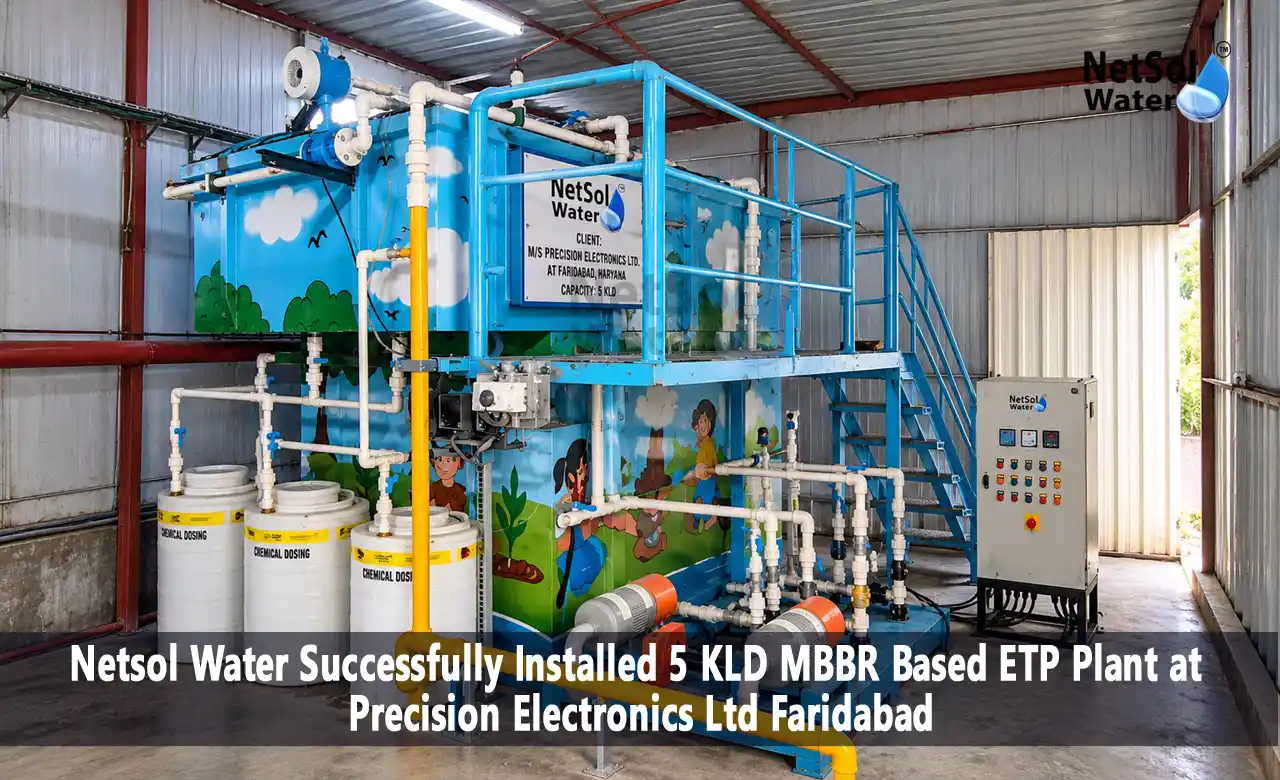
Case Study: Installed 5 KLD ETP Plant at Precision Electronics in Faridabad
Netsol Water installed a 5 KLD ETP plant at Precision Electronics Ltd in Faridabad, Haryana, in 2026. It is a package effluent treatment plant (ETP) based on MBBR (Moving Bed Biofilm Reactor) technology, installed for chemical wastewater. After treatment, the water is discharged. This ETP plant installation in Faridabad took four days. The two main challenges at the site were limited space and unloading of the plant.
This case study explains the confirmed project details, the technology used and the practical points that matter in a project of this kind. It also states clearly which details have not been confirmed, such as the detailed process flow, the equipment list and the treated water test results. General explanations of MBBR, installation planning and discharge requirements are technical information. They are not statements about specific conditions at this site.
| Item | Confirmed Detail |
|---|---|
| Client | Precision Electronics Ltd |
| Location | Faridabad, Haryana, India |
| Installation Year | 2026 |
| Plant Capacity | 5 KLD (5,000 litres per day) |
| Plant Type | Package Effluent Treatment Plant (ETP) |
| Technology | MBBR (Moving Bed Biofilm Reactor) |
| Wastewater Type | Chemical wastewater |
| Treated Water Destination | Discharge after treatment |
| Installation Duration | 4 days |
| Installation Challenges | Space constraints and equipment unloading |
About the Project and Wastewater Treatment Requirement
Industrial units in India are expected to treat their wastewater before it leaves the premises. Untreated or poorly treated chemical wastewater can harm soil, groundwater, surface water bodies and municipal sewerage systems. It can also create legal and operational problems for the industry that generates it. An industrial effluent treatment plant is the usual way to bring industrial wastewater to a condition suitable for discharge.
The suitability of any treatment system depends on the nature of the wastewater. Chemical wastewater is a broad term. Two units can both produce chemical wastewater and still have very different pollutant loads, pH ranges, dissolved solids levels and biodegradability. For that reason, sound chemical wastewater treatment starts with understanding the wastewater itself, along with the quantity generated and the discharge requirement.
In this project, Netsol Water installed an ETP for Precision Electronics Ltd in Faridabad. This article does not describe the client's manufacturing process or the composition of its wastewater, because these details have not been confirmed for publication. What is confirmed is that the wastewater is chemical in nature and that the treated water is discharged after treatment.
Why a 5 KLD Package ETP Plant?
KLD stands for kilolitres per day. One kilolitre is 1,000 litres, so a 5 KLD ETP plant has a nominal treatment capacity of 5,000 litres in a day. This figure is a design value. It does not by itself describe how the plant performs in every condition.
A package effluent treatment plant is a compact, factory-assembled treatment system. Most of its components are fabricated and fitted before the plant reaches the site. This approach suits smaller flows and sites where space for civil construction is limited. It can also reduce the amount of work that has to be done at the installation location. Netsol Water offers effluent treatment plants in different capacities and technologies, including MBBR-based ETPs.
When a capacity is selected, several factors are normally checked. These include the daily wastewater quantity, peak flow, how the flow varies through the day, the pollutant load and the expected growth in production. Operating hours and the discharge requirement also matter. Capacity chosen only on average flow can lead to an undersized plant.
The actual flow data and load assessment for this project have not been confirmed. This article therefore does not explain why 5 KLD was chosen for Precision Electronics Ltd. It only describes how capacity suitability is generally assessed for a package plant.
Understanding MBBR Technology
MBBR is a biological wastewater treatment process. The reactor tank contains small plastic carriers that move freely in the water. Microorganisms grow on the surface of these carriers and form a thin layer called a biofilm. As wastewater passes through the tank, the biofilm feeds on biodegradable organic matter and breaks it down.
In an aerobic MBBR, air is supplied through diffusers, usually with blowers. The air provides oxygen for the microorganisms and also keeps the carriers in motion. The movement helps the biofilm stay active and in contact with the wastewater. Because the biomass is attached to carriers, the system can hold a large amount of active biomass in a relatively small tank. This is one reason an MBBR ETP plant is often considered for compact installations.
The process is generally followed by a step that separates solids from the treated water, such as a clarifier. Pretreatment and polishing steps may be added depending on the wastewater. The exact arrangement varies from project to project. Netsol Water has used MBBR in other projects too, for example a 100 KLD MBBR-based compact modular STP at Lemon Tree Premier Hotel, Kathmandu, which treats sewage rather than industrial effluent.
MBBR also has limits, and it cannot treat every chemical wastewater stream on its own. Biological treatment works on biodegradable pollutants. Streams with toxic or inhibitory compounds, very high dissolved solids, extreme pH, heavy metals, or a large share of non-biodegradable organic matter may need pretreatment or additional treatment stages. Sudden changes in load can also upset the biological process.
The stages used in this project have not been confirmed, so the description above is a general explanation of the technology.
Project Challenges: Space and Unloading
Two challenges are confirmed for this project: space constraints and unloading. Both are common in industrial installations, and both deserve planning before the plant arrives.
Space constraints matter because an ETP needs more than the footprint of its tanks. Room is also needed for operator access, piping, electrical connections, aeration equipment, chemical handling and future maintenance. If the available area is tight, careful placement is required so that the plant can be operated and serviced safely after installation. A package design helps here, because it keeps the treatment system compact.
Unloading matters because a package plant arrives as fabricated equipment that is heavy or bulky. Safe unloading depends on the approach route, the access width, the ground condition and the availability of suitable lifting arrangements. Poor planning can delay the project, risk damage to the equipment or create safety concerns for people on site.
The exact site layout, the unloading equipment, the methods used and any incidents during unloading have not been confirmed, so they are not described here. The point to note is that space and unloading are not minor details. A site visit before dispatch helps to identify these constraints early. It lets the supplier and the client agree on access, positioning and unloading arrangements before the plant reaches the gate.
Four-Day Installation Process
The installation of the 5 KLD ETP plant at Precision Electronics Ltd was completed in four days. This is the confirmed duration for the project. The day-wise record of work at this site has not been verified with the project team, so the sequence below is a general guide to how a package ETP installation is usually organised. It is not a record of what was done on each day at this site.
Day 1: Unloading and positioning. The plant is unloaded and moved to its location. Access route, lifting arrangement and ground condition are checked first. The units are then placed on the prepared base and aligned.
Day 2: Mechanical installation. Tanks and modules are levelled and fixed. Interconnecting pipes, valves, blowers, pumps and aeration lines are fitted. Inlet and outlet connections are marked and prepared.
Day 3: Electrical and control work. The control panel is connected to the power supply and to the motors and instruments. Cable laying, earthing and basic safety checks are completed.
Day 4: Checks and handover preparation. The connections are checked for leaks. Pumps and blowers are run on water to confirm rotation and operation. The operating team is briefed on the basic operation of the plant.
A short installation is possible when the plant is largely assembled before it reaches the site. The actual activities, their order and the time each one needed will depend on the site and the plant design. Installation time also does not include biological stabilisation, which is a separate stage for MBBR systems. The commissioning status of this project has not been confirmed, and this article makes no claim about it.
Treatment Flow and Equipment Configuration
The treatment flow and the equipment list are among the most useful details in any ETP case study. They show how the plant is arranged, what each unit does and how the system is expected to handle the incoming wastewater. Readers who are planning their own plant often look for this information first.
For this project, the detailed process flow and the equipment configuration have not been confirmed. This article therefore does not list tanks, pumps, blowers, filters, dosing systems, control panels or any other specific equipment. It also does not state dimensions, materials of construction or ratings.
What can be said is limited to what is confirmed. The plant is a package ETP, and its biological treatment technology is MBBR. Other stages that may be included in an ETP of this type, such as equalisation, pretreatment, clarification or filtration, are not confirmed for this site.
Once the project team shares the approved flow diagram and equipment list, this section can be updated with accurate information. Until then, readers who need a flow suited to their own wastewater should treat the general discussion of MBBR above as background and ask Netsol Water for a site-specific proposal.
Treated Effluent and Discharge Considerations
Treated water from this project is discharged after treatment. Discharge of industrial effluent in India is regulated, and the plant is only one part of meeting the requirement.
In general, an industry needs consent from the State Pollution Control Board under the Water (Prevention and Control of Pollution) Act, 1974. The consent conditions usually specify the parameters to be monitored and the limits that apply. Standards can differ based on the industry category and on where the treated water is discharged, such as a sewer, a surface water body or land. The applicable requirement should be confirmed with the Haryana State Pollution Control Board and the relevant authority for the site.
Effluent testing is how compliance is checked. Samples should be collected properly and tested for the parameters named in the consent, preferably by a laboratory recognised for this work. Records of results should be kept.
No test results for this project have been provided. This article therefore does not state that the plant meets any discharge standard, and it makes no claim about regulatory compliance. Such a statement would require documented test results and the applicable consent conditions.
Installation Video and Project Evidence
The installation video is the project evidence currently available for this case study. It gives readers a direct view of the installation instead of relying only on written description.
Watch the video below. Observations about the footage should be added only after the project team has reviewed it and confirmed what it shows.
Client Feedback
The installation of the 5 KLD MBBR-based Effluent Treatment Plant at Precision Electronics Ltd, Faridabad, was completed in 2026 over a period of four days. The project involved addressing site-related challenges, including space constraints and equipment unloading.
At Netsol Water, we understand that successful ETP installation requires proper coordination, careful planning and attention to site conditions. Our team focuses on providing wastewater treatment solutions based on the project's requirements and available site conditions.
GM, Precision Electronics Ltd.
Operation, Maintenance and Practical Lessons
The points below are general considerations for ETP plants. They do not describe maintenance work carried out at this site, and no such work has been confirmed.
A plant performs best when it is operated within the conditions it was designed for. Sending wastewater of a very different quality or quantity from the design basis can reduce treatment performance. For biological systems such as MBBR, sudden shocks in load or the entry of toxic substances can affect the biofilm.
Routine monitoring is important. Operators usually check aeration, pump and blower operation, pH and visible changes in the water. Periodic laboratory testing confirms whether the treated water remains within the required limits. Equipment such as blowers, pumps and dosing units needs scheduled inspection, and sludge needs to be handled and disposed of properly.
Trained operators and a clear operating procedure make a real difference. Keeping simple daily records helps to spot problems early.
The practical lesson from this project is that space and unloading should be assessed early. A site visit before dispatch reduces surprises during installation. For another Faridabad project that used a different technology, see the 60 KLD MBR ETP plant at Vamani Overseas, Faridabad.
Frequently Asked Questions (FAQs)
Q1. What is the capacity of the ETP plant installed at Precision Electronics Ltd?
The plant has a capacity of 5 KLD, which is 5,000 litres per day.
Q2. Which technology was used in the project?
The plant uses MBBR (Moving Bed Biofilm Reactor) technology.
Q3. Where was the ETP plant installed?
It was installed at Precision Electronics Ltd in Faridabad, Haryana, in 2026.
Q4. How long did the installation take?
The installation took four days.
Q5. What were the main installation challenges?
The confirmed challenges were space constraints and unloading.
Q6. Can MBBR technology treat every type of chemical wastewater?
No. MBBR works on biodegradable pollutants. Some chemical wastewater streams need pretreatment or additional treatment stages.
Q7. What should be checked before discharging treated industrial wastewater?
Check the consent conditions from the State Pollution Control Board, the applicable limits for the discharge point and recent laboratory test results for the required parameters.
Conclusion and Contact CTA
Netsol Water installed a 5 KLD ETP plant based on MBBR technology at Precision Electronics Ltd in Faridabad in 2026 for chemical wastewater. The installation took four days, and the main challenges were space constraints and unloading. The treated water is discharged after treatment.
If you are planning an effluent treatment plant for your unit, Contact Netsol Water for a site-specific assessment of your wastewater, space and discharge requirements. You can also visit netsolwater.com.