

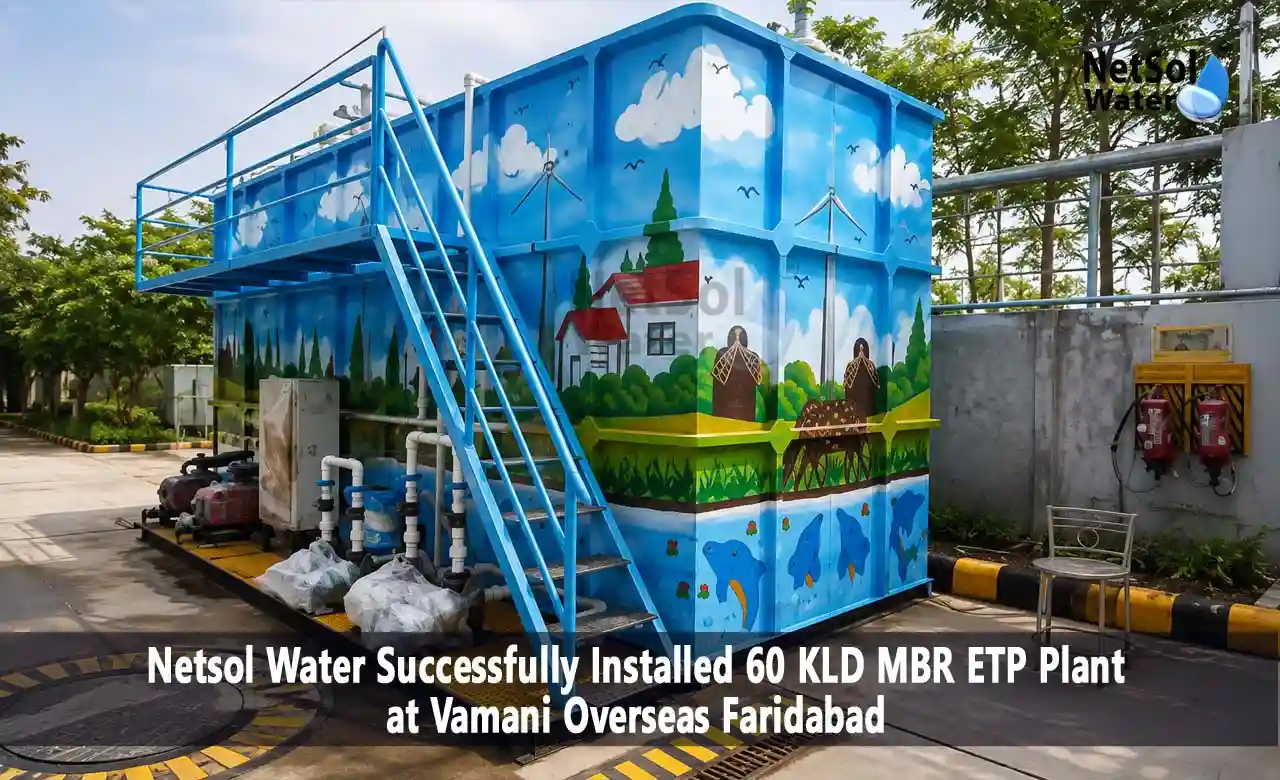
Case Study: 60 KLD MBR ETP Plant Installed at Vamani Overseas, Faridabad
Netsol Water has successfully engineered and installed a 60 KLD MBR ETP Plant at Vamani Overseas Pvt. Ltd., a garment and apparel manufacturing facility located in Faridabad, Haryana. The project was undertaken to provide the client with a dependable, technically sound effluent treatment system capable of handling the facility's daily industrial wastewater load using Membrane Bioreactor (MBR) technology. As an experienced effluent treatment plant manufacturer, Netsol Water was responsible for the process design, engineering, supply, installation and commissioning of the treatment system. This case study documents the actual project: the client's requirement, the treatment configuration adopted, and the engineering approach used to deliver a functional 60 KLD MBR ETP Plant suited to Vamani Overseas' operational needs in Faridabad.
About Vamani Overseas
Vamani Overseas Pvt. Ltd. is a garment and apparel manufacturing company operating out of Faridabad, Haryana, an established industrial hub in the National Capital Region. Like most manufacturing units operating in this belt, the facility generates wastewater as part of its routine operations, and this wastewater needs to be collected, treated and managed in a structured manner before it can be discharged or reused. For an apparel manufacturing unit, having a properly functioning effluent treatment system is not just an operational requirement but also a matter of regulatory compliance and responsible facility management. Systematic wastewater treatment allows a facility such as Vamani Overseas to manage its water footprint, avoid uncontrolled discharge of untreated effluent, and maintain consistent operational practices around water use. This is the broader context in which Vamani Overseas approached Netsol Water for a dedicated effluent treatment solution designed around the facility's daily wastewater generation.
Project Requirement and Wastewater Treatment Challenge
The core requirement from Vamani Overseas was straightforward on paper but demanding in execution: a treatment system capable of reliably handling 60 KLD of industrial wastewater from the Faridabad facility, on a consistent day-to-day basis, without requiring constant manual intervention. The treatment challenge centred on three practical needs: first, a biological treatment process capable of breaking down biodegradable organic load in the wastewater stream; second, a filtration stage that could consistently deliver treated water of stable quality, regardless of normal day-to-day variation in influent characteristics; and third, a treatment configuration compact enough to fit within the space realistically available at an operating industrial facility. Translating this into an engineering requirement meant selecting a treatment configuration that combined dependable biological treatment with a filtration barrier tighter than what conventional secondary clarification offers. This is where Netsol Water proposed a Membrane Bioreactor based treatment configuration, engineered specifically around a 60 KLD design flow for the Vamani Overseas facility.
Why MBR Technology Was Selected for the Project?
For a facility such as Vamani Overseas, where consistent treated-water quality and a compact treatment footprint were both important considerations, MBR technology was the logical fit. The following explains what an MBR ETP Plant is and why it made sense for this particular project.
What is an MBR ETP?
An MBR ETP Plant combines conventional biological treatment with membrane filtration in a single integrated process. In a conventional effluent treatment plant, biologically treated wastewater is separated from the biomass using gravity settling in a secondary clarifier. In an MBR Effluent Treatment Plant, this settling step is replaced with membrane filtration: ultrafiltration or microfiltration membranes physically retain the biomass inside the bioreactor while allowing only the treated permeate to pass through. This distinction matters because membrane separation is not dependent on the settling characteristics of the biological sludge, which can vary with load and operating conditions. Instead, the membrane acts as an absolute physical barrier, which is what allows an MBR system to consistently produce treated water with very low suspended solids.
Advantages of MBR Technology
For the 60 KLD MBR ETP Plant installed at Vamani Overseas, this MBR configuration offered several practical advantages relevant to the client's operating context:
. Consistently clear, low-turbidity treated water, since the membrane physically retains suspended solids and biomass
. Strong biomass retention inside the bioreactor, supporting stable and dependable biological treatment
. A more compact treatment footprint compared to a conventional clarifier-based ETP of similar capacity, relevant for an operating facility with limited additional space
. Higher achievable biomass concentration in the bioreactor, which supports robust treatment of the biodegradable organic load
. Stable day-to-day treatment performance, since membrane filtration is not affected by sludge settleability the way a clarifier is
. Treated water quality suitable for further polishing and disinfection where water reuse within the facility is being considered
These advantages were the basis on which Netsol Water recommended and engineered an MBR-based configuration for the Vamani Overseas project, rather than a conventional activated sludge system with a secondary clarifier.
Technical Specifications of the 60 KLD MBR ETP Plant
| Parameter | Project Details |
|---|---|
| Client | Vamani Overseas Pvt. Ltd. |
| Location | Faridabad, Haryana |
| Plant Type | Effluent Treatment Plant |
| Capacity | 60 KLD |
| Technology | MBR (Membrane Bioreactor) |
| Industry | Garment / Apparel Manufacturing |
| Application | Industrial Wastewater Treatment |
| Solution Provider | Netsol Water |
Treatment Process of the 60 KLD MBR ETP Plant
The treatment sequence adopted for the Vamani Overseas facility follows a logical progression from raw effluent collection through to treated-water delivery, with each stage engineered by Netsol Water to work together as a single integrated system.
1. Effluent Collection
Wastewater generated across the Vamani Overseas facility is first directed into a collection system that gathers the effluent stream before it enters the treatment process. This collection stage ensures that wastewater from across the facility is channelled into the treatment plant in a controlled manner rather than being discharged directly.
2. Preliminary Treatment
Before the wastewater enters the biological stage, it passes through preliminary screening to remove coarse solids, fibres, and other extraneous material that could otherwise interfere with downstream equipment, particularly the membrane modules. This preliminary step protects the pumps, blowers and membranes further along the treatment train.
3. Equalization
Industrial wastewater generation rarely occurs at a constant rate or with constant characteristics throughout the day. An equalization tank buffers this variability, allowing the wastewater to be dosed into the biological treatment stage at a controlled, steady flow rate. This equalization step is important for maintaining stable biological treatment performance and for protecting the downstream membrane system from sudden hydraulic or organic shock loads.
4. Biological Treatment
Equalized wastewater then enters the biological treatment stage, where microorganisms break down the biodegradable organic content present in the effluent. This is the same fundamental biological process used in conventional activated sludge systems, except that in an MBR configuration the biomass is retained at a higher concentration, since it is not limited by the settling constraints of a conventional clarifier.
5. MBR Process
From the biological reactor, mixed liquor is directed to the MBR tank, where submerged membrane modules carry out the filtration step. Air is continuously supplied at the membrane surface through fine bubble diffusers, which helps scour the membrane surface and limit fouling while also supplying oxygen to support the biological process. Only treated permeate passes through the membrane pores, while the biomass is retained within the system.
6. Treated Water Collection
Permeate drawn through the membrane modules is collected in a treated water tank. Depending on the intended end use, this treated water can undergo further polishing or disinfection before reuse within the facility, or be directed for discharge in line with applicable requirements. Project-specific data on the final disposal or reuse pathway adopted at Vamani Overseas has not been disclosed.
7. Sludge Management
As with any biological treatment process, excess biomass is generated over time and needs to be periodically wasted from the system to maintain a stable sludge age within the bioreactor. This surplus sludge is managed through the plant's sludge handling arrangement as part of routine operation.
Output Parameters After Treating the Effluent
MBR-treated effluent is generally characterized by low suspended solids, low turbidity and reduced biodegradable organic content, since the membrane barrier retains biomass and particulate matter that would otherwise pass through a conventional clarifier. The table below lists the parameters typically assessed for treated effluent from an MBR ETP Plant. These values reflect the discharge standards prescribed by the Central Pollution Control Board (CPCB) and enforced by the State Pollution Control Board (SPCB).
| Parameter | General / Typical Output |
|---|---|
| pH | 5.5 to 9.0 |
| BOD | 30 mg/L |
| COD | 250 mg/L |
| TSS | 100 mg/L |
| Oil & Grease | 10 mg/L |
| Colour / Turbidity | Colourless and free from objectionable colour/odour |
Engineering, Installation and Commissioning by Netsol Water
Netsol Water's role in the Vamani Overseas project extended across the full project lifecycle, from initial assessment through to plant handover, reflecting the company's approach as an end-to-end effluent treatment plant manufacturer.
1. Site Assessment
The project began with an assessment of the Vamani Overseas facility in Faridabad to understand the space available for the treatment plant, the point of effluent generation, and the practical constraints of installing a treatment system within an operating manufacturing unit.
2. Process Design
Based on the 60 KLD design flow, Netsol Water's engineering team developed the process configuration for the MBR ETP Plant, sequencing the equalization, biological treatment and membrane filtration stages to work as a coordinated system suited to the client's facility.
3. Equipment Engineering
Individual process units, including the equalization system, biological reactor, MBR tank, blower system and treated water tank, were engineered around the confirmed 60 KLD capacity, ensuring each component was sized appropriately to work together as a single treatment system.
4. Manufacturing and Supply
As an MBR ETP Plant manufacturer, Netsol Water managed the fabrication and supply of the treatment equipment for the project, coordinating delivery to the Faridabad site in line with the installation schedule.
5. Installation
Netsol Water's installation team carried out the mechanical, electrical and piping work required to bring the treatment system online at the Vamani Overseas facility, integrating the plant with the site's existing effluent collection arrangement.
6. Testing and Commissioning
Following installation, the plant underwent testing and commissioning, during which the biological process was established, the membrane system was brought into operation, and the treatment sequence was verified to function as designed before handover to the client.
7. Operator Guidance
Netsol Water provided the client's operating personnel with guidance on running and maintaining the 60 KLD MBR ETP Plant, covering routine monitoring and the basic upkeep required to sustain stable treatment performance.
Major Components of the MBR ETP Plant
A typical MBR ETP Plant of this type is built around a defined set of process components, including an equalization system, a biological treatment reactor, an MBR tank housing the membrane modules, air blowers with fine bubble diffusers, feed and permeate pumps, a treated water tank, a sludge handling arrangement, an electrical control panel, and the associated piping, valves and instrumentation required to operate and monitor the system. These components work together as an integrated treatment train rather than as standalone units.
Project Benefits and Treatment Outcomes
The MBR-based treatment configuration installed at Vamani Overseas delivers a number of practical benefits consistent with how MBR systems are known to perform. The membrane filtration stage provides effective separation of suspended solids from the treated stream, supporting consistently low-turbidity output. Strong biomass retention within the bioreactor contributes to stable and dependable biological treatment of the facility's daily wastewater load. The overall configuration is more space-efficient than a conventional clarifier-based system of comparable capacity, which is a meaningful advantage for a facility operating within a defined industrial footprint. Together, these characteristics support improved day-to-day wastewater management at the Faridabad facility, provide a treated water stream that can be considered for reuse subject to appropriate polishing, and contribute to more responsible environmental management practice at the site.
About Netsol Water
Netsol Water is an effluent treatment plant manufacturer with experience delivering wastewater and water treatment systems across a range of industrial sectors. The company's areas of expertise include Effluent Treatment Plants, Sewage Treatment Plants, MBR-based treatment systems, Industrial RO Plants, general Water Treatment Plants, and advanced treatment configurations including Zero Liquid Discharge (ZLD) systems where required. Netsol Water's scope of work typically spans process design and engineering, equipment manufacturing, on-site installation, testing and commissioning, and continued after-sales support through Annual Maintenance Contracts. This end-to-end capability is reflected in how the Vamani Overseas project in Faridabad was executed, from the initial site assessment through to plant commissioning and operator handover.
Project Video: 60 KLD MBR ETP Plant at Vamani Overseas
Watch the 60 KLD MBR ETP Plant at Vamani Overseas, Faridabad
For a visual overview of the installed system, watch the project video here:
This video offers a visual walkthrough of the 60 KLD MBR ETP Plant installed at the Vamani Overseas facility in Faridabad, giving viewers a practical look at the treatment system on site. It is a useful reference for facility managers, procurement teams and consultants who want to see how an MBR ETP Plant of this capacity is configured in a real industrial setting, in addition to the technical description provided in this case study.
Conclusion
The 60 KLD MBR ETP Plant installed at Vamani Overseas in Faridabad reflects a treatment approach built around the client's actual requirement: a compact, dependable system capable of handling the facility's daily wastewater load using Membrane Bioreactor technology. From process design through installation and commissioning, Netsol Water was responsible for engineering and delivering the treatment system to the Vamani Overseas facility. The project reinforces a broader point relevant to any industrial facility: reliable wastewater treatment is not incidental to operations, it is a core part of running a responsible manufacturing facility.
Looking for a customized MBR ETP Plant for your industrial facility? Contact Netsol Water for a site-specific wastewater treatment solution.
Frequently Asked Questions (FAQs)
Q1. What is the capacity of the ETP installed at Vamani Overseas?
The effluent treatment plant installed at Vamani Overseas in Faridabad has a design capacity of 60 KLD, meaning it is engineered to treat 60 kilolitres of industrial wastewater generated at the facility on a daily basis.
Q2. Which technology is used in the Vamani Overseas ETP?
The plant uses Membrane Bioreactor (MBR) technology, which combines biological treatment with membrane filtration in place of a conventional secondary clarifier, giving the system its identity as an MBR ETP Plant.
Q3. Where is the 60 KLD MBR ETP Plant located?
The plant is installed at the Vamani Overseas Pvt. Ltd. facility in Faridabad, Haryana, an established garment and apparel manufacturing hub in the National Capital Region.
Q4. Why was MBR technology selected for this project?
MBR technology was selected because it delivers consistently low-turbidity treated water, strong biomass retention and a more compact footprint than a conventional clarifier-based system, all of which suited the operational context at Vamani Overseas.
Q5. How does an MBR ETP work?
Wastewater passes through screening, equalization and biological treatment before entering an MBR tank, where submerged membranes filter the treated water away from the retained biomass, producing consistently clear permeate.
Q6. What are the major components of an MBR ETP?
Major components typically include an equalization tank, a biological reactor, an MBR tank with membrane modules, air blowers with fine bubble diffusers, feed and permeate pumps, a treated water tank, and a control panel with associated instrumentation.
Q7. Who designed and installed the ETP at Vamani Overseas?
Netsol Water was responsible for the process design, engineering, manufacturing, installation and commissioning of the 60 KLD MBR ETP Plant at the Vamani Overseas facility in Faridabad.