

Case Study: Installed 40 KLD MBBR STP Installation at KG Spirits, Dhanbad
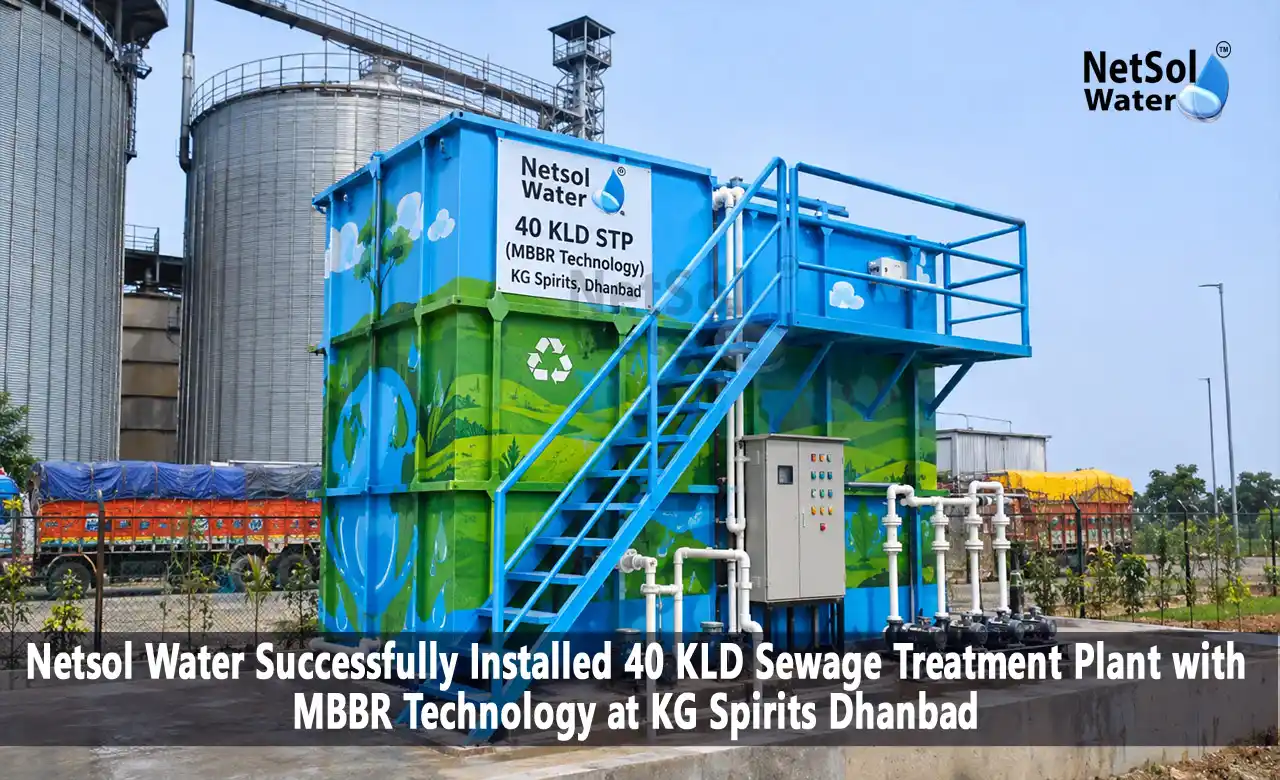
Netsol Water installed a 40 KLD STP plant at KG Spirits in Dhanbad, Jharkhand, in 2026. It is a package sewage treatment plant that treats industrial wastewater with MBBR (Moving Bed Biofilm Reactor) technology. We built it in MSFRP, so it reached the site as a compact, factory-fabricated unit rather than a structure cast on location.
The biological stage uses two MBBR tanks filled with MBBR bio media. Air blowers, pumps, diffusers, filter pumps, a dosing system and a control panel support the process. The plant runs on semi-automatic operation, and the full installation took 7 days.
The goal was simple. KG Spirits wanted to treat its wastewater inside the premises and use the treated water for gardening and flushing. This case study covers why the plant was built this way, how each treatment stage works and what our team handled at site.
About the Project and Wastewater Treatment Requirements
KG Spirits operates in Dhanbad and needed a dependable on-site system for its industrial wastewater. Before looking at the plant, it helps to know how engineers judge such water.
Four parameters matter most. BOD (biochemical oxygen demand) shows how much oxygen bacteria need to break down the organic matter in water. COD (chemical oxygen demand) measures the oxygen needed to oxidise organic matter chemically, including material that bacteria cannot easily digest. TSS (total suspended solids) tells you how much particulate matter is floating in the water. pH shows whether the water is acidic or alkaline, and it decides whether the microorganisms in a biological plant can stay active.
These four shape the design. Organic load decides how much aeration and biological capacity the plant needs. Suspended solids decide how much settling and filtration is required before the water can be reused. This case study does not quote inlet or outlet readings for KG Spirits. Measured values belong in laboratory test reports, and we do not want to put numbers on a web page that a report has not backed.
Why KG Spirits Required a 40 KLD Industrial STP?
Untreated industrial wastewater carries organic matter, solids and dissolved pollutants. Released into drains, soil or nearby water bodies, it pollutes them. For any manufacturing unit, treating that water before it leaves the premises is both a responsibility and a practical need.
A 40 KLD plant can handle 40 kilolitres of wastewater a day. That gave KG Spirits a way to deal with its flow at the source instead of passing the problem downstream.
Reuse was the second reason. Gardening and flushing do not need drinking quality water, yet they consume water every single day. Sending treated water to these uses means fresh water is not spent where it is not needed.
A package STP suits this kind of requirement. We fabricate and assemble the tanks and equipment in advance, so site work is limited to placing the units, making connections and commissioning. That keeps disruption to the premises low. For an industrial STP plant of this size, a short and orderly site programme is often as valuable as the treatment process itself.
Why MBBR Technology Was Selected for the STP?
MBBR technology is a biological treatment method in which microorganisms grow on small plastic carriers that move freely inside an aerated tank. These carriers are the MBBR bio media. Bacteria attach to the surface and form a thin layer called a biofilm. Because the biomass is attached to the media, it stays in the tank and keeps working on the incoming organic matter.
Aeration drives the whole process. Air from the blowers is released through diffusers at the bottom of the tank. It does two jobs at once. It supplies the oxygen the bacteria need to break down organic pollutants, and it keeps the media in constant motion so that every carrier stays in contact with the wastewater.
This plant has two MBBR tanks. Splitting the biological stage across two tanks spreads the biofilm and the aeration over more than one volume, which suits a package layout where each unit has to stay compact.
MBBR also fits an industrial site for a practical reason. The media does not need to be returned from a clarifier to keep the biomass in the system, so the process is simpler to operate and the footprint stays small. For a plant that is installed in days and run by a site team, that matters.
Technical Specifications of the 40 KLD MBBR STP Plant
The table below lists the confirmed details of the 40 KLD MBBR installation. We have kept it to project facts only, so engineers, consultants and buyers comparing package STP options can read the configuration at a glance.
| Parameter | Details |
|---|---|
| Client | KG Spirits |
| Location | Dhanbad, Jharkhand, India |
| Installation Year | 2026 |
| Plant Capacity | 40 KLD |
| Plant Type | Package STP |
| Construction Material | MSFRP |
| Technology | MBBR |
| Wastewater Type | Industrial Wastewater |
| MBBR Tanks | 2 |
| MBBR Media | MBBR Bio Media |
| Installed Equipment | Air Blowers, Pumps, Diffusers, Filter Pumps, Dosing System, Control Panel |
| Automation | Semi Automatic |
| Installation Duration | 7 Days |
| Treated Water Application | Gardening and Flushing |
| Main Installation Challenges | Civil Work Coordination and Pipeline Connection |
| Main Project Outcomes | Treated Water Reuse and Reduced Wastewater Pollution |
Detailed Treatment Process of the 40 KLD STP Plant
Wastewater moves through ten stages in sequence, and each stage prepares the water for the next one.
1. Bar Screen Chamber
The first stage catches large floating and solid material before it reaches the pumps and tanks. This protects the downstream equipment from blockage.
2. Equalization Tank
Wastewater flow and strength change through the day. This tank holds the water and evens out those changes, so the biological stage receives a steadier feed.
3. Anoxic Tank
The anoxic tank holds water under low oxygen conditions. Here bacteria use nitrate as an oxygen source, which supports nitrogen removal and prepares the water for aerobic treatment.
4. MBBR Tank
The main biological stage. In the two MBBR tanks, biofilm on the bio media breaks down organic pollutants with the help of air from the blowers.
5. Tube Settler / Clarifier
Water from the MBBR tanks carries detached biological solids. The tube settler lets these solids settle out so that clearer water moves forward.
6. Filter Feed Tank
The clarified water collects here. The tank acts as a buffer, and the filter pumps draw from it to feed the filtration stages at a steady rate.
7. Pressure Sand Filter
The filter pushes water through a bed of sand under pressure and removes fine suspended particles that the clarifier did not capture.
8. Activated Carbon Filter
Activated carbon adsorbs dissolved organic matter, colour and odour. It polishes the water before disinfection.
9. Chlorination
The dosing system adds chlorine to the filtered water to disinfect it before storage.
10. Treated Water Tank
The final stage is storage. The tank holds the treated water until the site needs it for gardening and flushing.
Major Equipment Installed in the KG Spirits STP
1. Air blowers supply the air for the MBBR tanks. Without steady aeration, the biofilm cannot do its work and the media would not move.
2. Diffusers sit inside the tanks and release the blower air as fine bubbles, spreading oxygen through the water.
3. Pumps move wastewater and treated water between stages, so the flow continues through the plant.
4. Filter pumps draw water from the filter feed tank and push it through the pressure sand filter and the activated carbon filter with the pressure those filters need.
5. The dosing system feeds treatment chemicals in measured quantity. At this plant it supports the chlorination stage.
6. The control panel is where the equipment is started, stopped and monitored. With semi-automatic operation, the panel gives the site team control over the plant without constant manual handling.
Installation and Commissioning Process: Completed in 7 Days
The plant was installed and commissioned in 7 days. That speed comes from the package design. We build the tanks in MSFRP before dispatch, so the work at site is about placement and connection.
Our team positioned the units at the planned location and checked that the base and levels suited each tank. Equipment placement followed. The team set the blowers, pumps, filter pumps, dosing system and control panel in position and fitted the diffusers inside the tanks.
Next came the pipeline work. The team joined the units in the correct treatment sequence, from the bar screen chamber through to the treated water tank, and matched the inlet and outlet lines to the site. Electrical connections tied each piece of equipment to the control panel, so the panel could start and stop the blowers and pumps.
Commissioning followed the connections. The team checked the pipelines and fittings, ran the pumps and blowers and confirmed that air reached the MBBR tanks and that water moved through the stages in order. As with any biological plant, the biofilm on the media needs time to develop after start-up, so the early running period is part of the process and not a defect.
Challenges Faced During STP Installation at KG Spirits
Two challenges stood out at this site: civil work coordination and pipeline connection.
1. Civil work coordination. A package STP still depends on civil work at the site. The base on which the plant sits has to be ready, level and located correctly before the units arrive. If civil work and equipment delivery are not aligned, installation stops until the gap is closed. Coordinating the two with the site team kept the 7 day schedule realistic.
2. Pipeline connection. Ten treatment stages mean many joints, and each one must be correct. Pipes must follow the process sequence, line up with the tank inlets and outlets and match the existing site arrangement. A mistake here shows up later as leakage or poor flow, which is much harder to fix after commissioning. Careful checking during installation prevents that.
Both challenges are common in industrial STP projects. We treat them as planning items and settle them with the client before the equipment reaches site. That habit is what keeps a package installation on schedule, and it is a point worth raising with any STP manufacturer you are comparing.
Treated Water Reuse and Project Outcomes
The main outcome of this project is that KG Spirits can now reuse treated water for gardening and flushing. The water goes through screening, biological treatment, settling, filtration and disinfection before it reaches the treated water tank, so it is ready for non-drinking uses on the premises.
The second outcome is reduced wastewater pollution. Treating industrial wastewater before reuse or disposal lowers the load that would otherwise reach the surrounding environment. A plant that is sized and installed correctly keeps that load under control day after day, which is why the sizing, layout and connections matter as much as the equipment list.
If you are planning a similar plant, you can speak to Netsol Water, a sewage treatment plant manufacturer in India that supplies package MBBR systems.
We have not published treatment efficiency figures, laboratory results or regulatory claims for this plant. Those need supporting test reports, and this case study sticks to what the installation itself confirms: we built the plant, installed it in 7 days and now it supplies treated water for reuse.
Watch the 40 KLD MBBR STP Installation at KG Spirits
The video below comes from the actual installation at KG Spirits. It shows the MSFRP package plant, the tanks and equipment at site and how the units are arranged. Watching it will give you a clearer picture of how a 40 KLD MBBR plant looks on location and how a package installation proceeds.
Frequently Asked Questions (FAQs)
Q1. What is the capacity of the STP installed at KG Spirits, Dhanbad?
The plant has a capacity of 40 KLD, meaning 40 kilolitres of wastewater per day.
Q2. Which technology is used in the 40 KLD STP plant?
It uses MBBR (Moving Bed Biofilm Reactor) technology, supported by aeration, settling, filtration and chlorination.
Q3. Why was MBBR technology used for this industrial wastewater treatment project?
MBBR keeps biomass attached to media inside the tank, which makes the biological stage compact and practical to operate. That suits a package plant on an industrial site.
Q4. How many MBBR tanks are installed in the KG Spirits STP?
The plant has two MBBR tanks, and both use MBBR bio media.
Q5. How long did it take to install the 40 KLD STP plant?
Our team completed the installation in 7 days.
Q6. Where can treated water from the KG Spirits STP be reused?
KG Spirits can reuse the treated water for gardening and flushing.
Q7. What type of construction was used for this STP plant?
It is a package STP, and Netsol built it in MSFRP.