
Case Study: Installed 3000 LPH RO Plant at Advance International Hospital
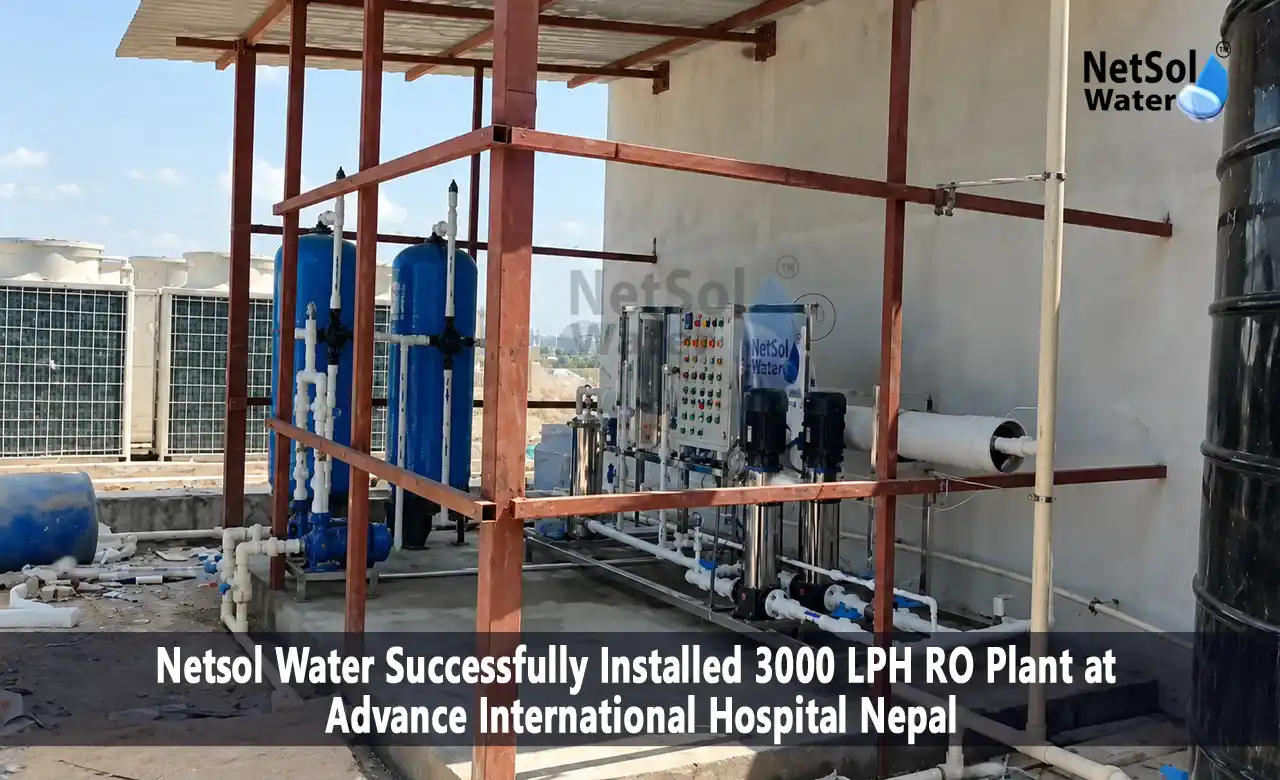
Netsol Water installed a 3000 LPH RO plant at Advance International Hospital in Nepal in 2026. The plant treats groundwater drawn from a borewell. The reported raw water TDS is 1300 mg/L and the reported treated water TDS is 75 mg/L. The plant is built in MSFRP construction, and the installation took 4 days.
Two site conditions shaped the work: unloading the equipment and fitting it into a limited shed space. Both are common on hospital and institutional sites, where utility rooms are rarely designed around the plant that eventually goes in.
This case study covers the confirmed project facts, what the TDS figures mean, how a groundwater RO plant of this size is built and looked after and why unloading and layout planning deserve as much attention as membranes and pumps.
Project Overview and Installation Details
The table below lists the confirmed specifications of the project.
| Project name | 3000 LPH RO Plant Installation at Advance International Hospital, Nepal |
| Client | Advance International Hospital |
| Location | Nepal |
| Installation year | 2026 |
| Plant capacity | 3000 LPH |
| Raw water source | Groundwater / borewell |
| Raw water TDS | 1300 mg/L |
| Treated water TDS | 75 mg/L |
| Plant construction type | MSFRP |
| Components listed | LG, CIP |
| Installation challenges | Unloading and limited shed space |
| Installation duration | 4 days |
| Project evidence | YouTube installation video |
LPH stands for litres per hour. A 3000 LPH reverse osmosis plant is rated to produce 3,000 litres, or 3 cubic metres, of treated water every hour. If it ran for 24 hours, that would add up to 72,000 litres a day. Real daily volume depends on how many hours the plant operates.
Rated capacity is a design figure, set for specific conditions such as feed water TDS, temperature and operating pressure. Actual production moves with those conditions. Cold feed water slows output, and membranes that have picked up fouling produce less. Treat the rated figure as a starting point when planning storage tanks and operating hours.
Understanding Water Treatment Requirements in Hospitals
Hospitals use water in many places, from plant utilities and housekeeping to areas closer to patient care. Each use carries its own quality target, so treatment requirements depend on the intended use.
The work starts with source water assessment. Borewell water changes with location, depth and season, so a current analysis is the basis of any design. It typically covers TDS, hardness, iron, silica, turbidity and microbiological quality. The results decide what pretreatment is needed and how much salt the membranes must remove.
Dissolved salts are the main reason groundwater is sent to RO. High salt levels leave scale on boilers and heat exchangers and shorten equipment life. Pretreatment such as media and cartridge filtration protects the membranes from suspended solids, iron and other fouling matter.
Good selection starts from the water quality needed and works back to the treatment steps. Capacity is only one input. Readers comparing options can start with Netsol Water's range of commercial RO plants.
Raw Water Quality and TDS Analysis
TDS stands for total dissolved solids. It is the combined concentration of dissolved minerals, salts and small amounts of organic matter in water, usually expressed in mg/L. A TDS meter estimates it by reading how well the water conducts electricity.
| Parameter | Raw Water | Treated Water |
|---|---|---|
| Water Source | Groundwater / Borewell | RO-Treated Water |
| TDS | 1300 mg/L | 75 mg/L |
| Approximate TDS Reduction | Not Applicable | 94.2% |
The reduction is worked out with the standard formula: TDS reduction (%) = [(Raw water TDS - Treated water TDS) / Raw water TDS] × 100. Putting in the project values gives [(1300 - 75) / 1300] × 100 = 94.2% approximately. These are the reported project values.
At 1300 mg/L, groundwater carries enough dissolved salt to cause scaling and to affect taste. A groundwater RO plant exists to bring that figure down, and a reading of 75 mg/L shows a large drop in dissolved salts.
TDS has limits, though. It measures dissolved ions only. Bacteria, viruses and many organic compounds sit outside what a TDS meter reads, so a low TDS value is one indicator of water quality and leaves microbiological safety to other barriers such as disinfection and hygienic storage and distribution.
3000 LPH RO Plant Design and Equipment
Reverse osmosis removes dissolved salts by applying pressure to feed water against a semi-permeable membrane. Water molecules pass through. Most dissolved salts stay behind and leave the system in a reject stream. Netsol Water's guide to how commercial RO plants work covers the principle in more detail.
This plant is an MSFRP RO plant. MSFRP stands for mild steel and fibre reinforced plastic. In water treatment equipment, mild steel provides structural strength and FRP provides resistance to corrosion, which matters in wet plant rooms where salts and chemicals are present.
The component details listed for the project include LG and CIP. LG is a recognised name in RO membrane manufacturing. CIP stands for clean-in-place, an arrangement that lets operators flush and chemically clean membranes using a dedicated tank, pump and piping, without removing the membranes from the plant.
Beyond those items, a groundwater RO plant of this size rests on five design considerations. Pretreatment removes particles, iron and scale-forming minerals before water reaches the membranes. Membrane protection, such as cartridge filtration, guards against fouling. Pressure management through a correctly sized high-pressure pump and control valves keeps operation within safe limits. Monitoring with TDS meters, flow meters and pressure gauges shows how the plant is performing. Cleaning arrangements such as CIP keep membranes productive over time.
As an industrial RO plant manufacturer, Netsol Water builds each plant around the feed water analysis of the site it will serve.
Installation Challenges: Unloading and Limited Shed Space
Unloading and limited shed space were the two confirmed challenges on this site. They look like small items on a project checklist. In practice they shape how smoothly the rest of the installation goes.
Unloading comes first. A 3000 LPH plant arrives as heavy, awkward components: frames, vessels, pumps, panels and piping. Each needs a clear approach path for the vehicle, a stable unloading point and enough trained hands. The route from the gate to the shed matters too, since narrow lanes, ramps and door widths can all slow movement. Careful handling protects FRP parts, instruments and connection points from knocks that only show up later as leaks or alignment problems.
Then comes the shed. When space is tight, every item competes for the same floor area. Operators need room to open panels and read gauges. Technicians need clearance to reach pumps, valves and membrane housings. Pipes need routes that stay clear of walkways. Future membrane replacement needs free length at the end of each pressure vessel, which is easy to forget until a membrane has to come out.
Safe movement is the last piece. A cramped plant room with pressurised lines, electrical panels and wet floors calls for clear walking paths, good lighting and a planned exit route.
Layout planning before the equipment arrives keeps these problems manageable. A site measurement, a marked floor plan and a fixed unloading sequence cost little and save hours on the day. For anyone planning RO plant installation in Nepal, or at any site with a tight utility shed, the lesson is the same: check the access route and the available space before the order is finalised.
Installation Process and Four-Day Timeline
The installation was completed in 4 days. For a plant of this capacity, that is a compact schedule, and compact schedules usually rest on planning done well before the crew reaches the site.
RO plant installations generally move through a familiar set of stages. Site preparation comes first: clearing the area, marking positions and confirming utility points for raw water, power and drain. Equipment positioning follows, with the frame set level and secured. Mechanical work then connects vessels, pumps and membrane housings, and piping links the feed, permeate and reject lines along with any cleaning connections. Electrical and instrument connections come next. Before water is introduced, installers inspect joints, supports and valve positions. Operational checks follow, covering pump rotation, flow paths, pressure behaviour and water quality readings.
These stages describe standard practice. The confirmed facts for this project are the 4-day duration, the unloading effort and the limited shed space.
Four days leaves little room for rework, so coordination matters. Access permissions, power availability and a ready raw water line need to be settled with the hospital's facility team before work starts. A cleared shed, a live power point and an open unloading route let installers spend their time on the plant and not on waiting.
Watch the Installed RO Plant Video at Advance International Hospital
Installation Outcome and Treated Water Quality
The project delivered a 3000 LPH RO plant in MSFRP construction at Advance International Hospital, Nepal. It was installed in 4 days, with unloading and limited shed space as the site challenges. The reported TDS moved from 1300 mg/L in the raw water to 75 mg/L in the treated water, a reduction of about 94.2%.
In practical terms, 75 mg/L is a small fraction of the salt load in the borewell source. Lower dissolved salts mean less scaling in downstream equipment such as boilers and heat exchangers, fewer mineral deposits on fittings, and a cleaner starting point for any further polishing or disinfection a facility adds.
RO Plant Operation, Maintenance and Cleaning
A plant performs well over the years when operators watch it every day. Check feed water and treated water quality routinely. A rising treated water TDS or a shift in feed water TDS is an early signal worth looking into.
Track feed pressure, differential pressure across filters and membrane stages, permeate flow and reject flow. A steady rise in the pressure needed to produce the same flow usually points to fouling or scaling.
Pretreatment needs regular attention because it protects everything downstream. Cartridge filters are replaced when differential pressure climbs, and media filters are backwashed as their design requires. Netsol Water's note on the effectiveness of RO pretreatment explains why this stage affects cleaning frequency.
Fouling is the build-up of particles, biological matter or organic material on the membrane surface. Scaling is the crystallisation of dissolved minerals such as calcium carbonate as water becomes more concentrated inside the system. Both reduce output and raise energy use. Signs that point to a need for RO membrane cleaning include lower permeate flow at the same pressure, a noticeable rise in differential pressure and a fall in salt rejection. Waiting too long can make deposits harder to remove.
CIP exists for this purpose. A cleaning tank, pump and filter circulate a cleaning solution through the membranes, followed by flushing. The right chemicals depend on whether the problem is scale, organic fouling or biological growth, and on the membrane manufacturer's guidance. Netsol Water's article on RO membrane cleaning and maintenance best practices goes further.
Keep operating records. A daily log of pressures, flows, TDS readings, cleaning dates and filter changes turns RO plant maintenance into a data exercise. It makes gradual changes easier to spot and membrane replacement easier to plan.
Frequently Asked Questions (FAQs)
Q1. What is the capacity of the RO plant installed at Advance International Hospital, Nepal?
The Advance International Hospital Nepal RO plant has a rated capacity of 3000 LPH, which is 3 cubic metres of treated water per hour at design conditions.
Q2. What was the raw water source for this project?
The raw water source was groundwater drawn from a borewell, with a reported TDS of 1300 mg/L.
Q3. What was the reported treated water TDS?
The reported treated water TDS was 75 mg/L, down from 1300 mg/L in the raw water. That is a reduction of about 94.2%.
Q4. How long did the installation take?
The installation took 4 days, with unloading and limited shed space as the site challenges.
Q5. What is the construction type of the installed RO plant?
The plant is built in MSFRP construction, which combines mild steel and fibre reinforced plastic.
Q6. What factors determine the design of an RO plant for a hospital?
Design follows the intended use of the treated water and its quality target, the source water analysis (TDS, hardness, iron and microbiological quality), the volume and operating hours needed, the pretreatment required, the space and access available for installation and service, and the monitoring and cleaning arrangements. Capacity is only one input.