

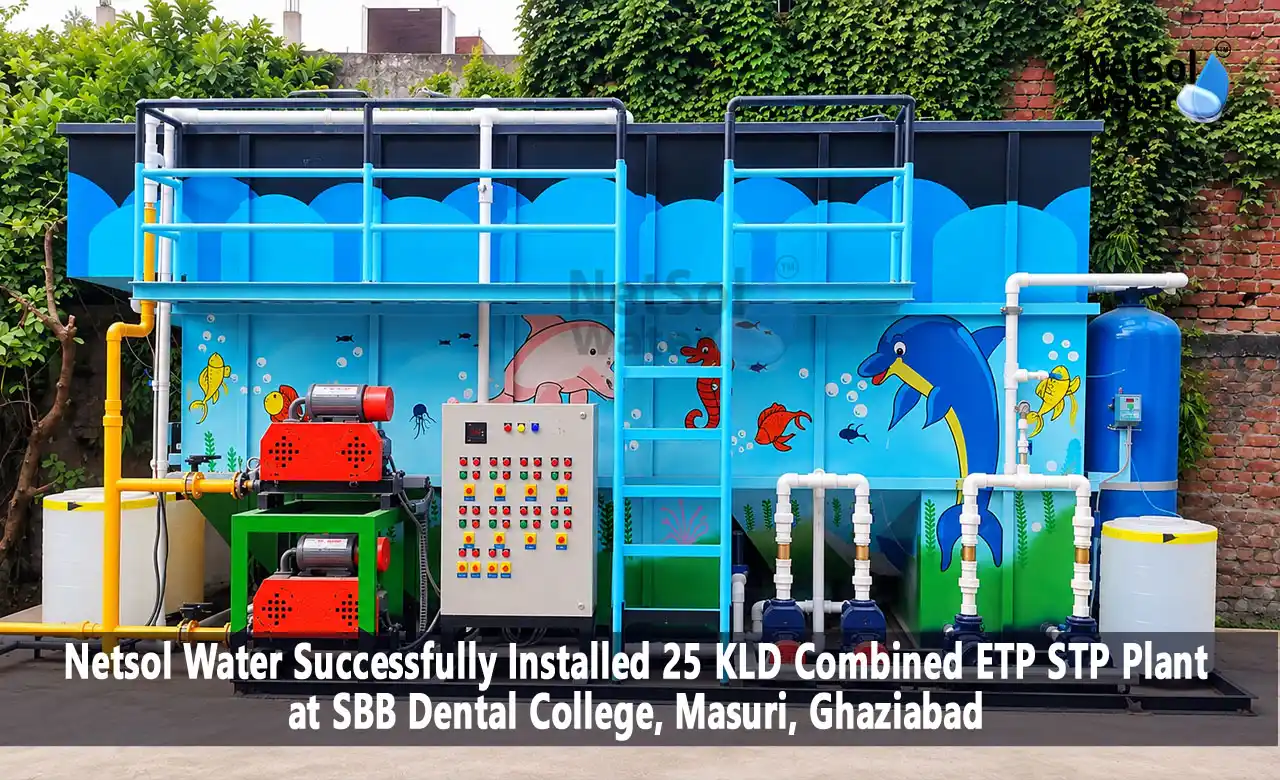
Case Study: Installed 25 KLD Combined ETP STP at SBB Dental College, Ghaziabad
Wastewater management is a basic operating requirement for any institution that hosts students, faculty, patients and support staff every day. Educational and healthcare-related campuses generate a steady flow of wastewater, and it must be collected, treated and handled in an organised way.
SBB Dental College in Masuri, Ghaziabad, Uttar Pradesh, required a dedicated wastewater treatment system for its campus. Netsol Water Solutions Pvt. Ltd. was responsible for the installation of a 25 KLD Combined ETP STP at the facility. The plant is intended to handle sewage and facility-related effluent through one centralised treatment system.
This case study covers the project background, the reasons for choosing a combined plant, the treatment approach, the installation sequence and the commissioning checks. It also explains why a 25 KLD Combined ETP STP Plant suits dental colleges and similar institutional buildings. A project video is included for readers who want to see the installation.
Project Overview
| Project Detail | Information |
|---|---|
| Project Name | 25 KLD Combined ETP STP Installation |
| Client | SBB Dental College |
| Location | Masuri, Ghaziabad, Uttar Pradesh |
| Plant Capacity | 25 KLD |
| Plant Type | Combined ETP STP |
| Application | Dental College / Healthcare Facility |
| Installation | Netsol Water Solutions Pvt. Ltd. |
About SBB Dental College, Masuri, Ghaziabad
SBB Dental College is a dental education and healthcare institution located in Masuri, Ghaziabad. Like most institutions of this type, it combines teaching areas, clinical departments, laboratories, hostels or staff areas and general campus facilities.
Each of these areas contributes to the wastewater load. Typical sources include washroom and toilet discharge, hand washing, floor and equipment cleaning, and wastewater from clinical and laboratory activities. The volume and character of the flow can change through the day depending on academic hours and patient activity.
This is why a dental college wastewater treatment plant needs to be planned around the actual campus and not copied from a generic design. A centralised wastewater treatment plant gives the institution one controlled point for treatment instead of scattered or unmanaged discharge.
Why a Combined ETP STP Was Required?
Sewage and Effluent in a Dental College
Sewage is the domestic wastewater from toilets, washrooms and general sanitation, which a sewage treatment plant is designed to handle. Effluent generally refers to wastewater from process or service activities, which in a dental college may include clinical, laboratory and cleaning operations. An effluent treatment plant addresses this second category. The two streams can differ in their character, and that affects how they should be handled.
The Case for a Combined System
A Combined ETP STP Plant brings both streams into one treatment scheme. Wastewater is collected, conditioned and treated together in a planned sequence, so the facility does not need to operate two completely separate plants. For a campus of this size, a 25 KLD ETP STP Plant offers a compact and manageable arrangement.
Any combined system still depends on good practice at the source. Separate collection lines, proper screening and sensible design of the inlet arrangement help the plant receive wastewater in a form it can treat.
Collection, treatment and responsible disposal or reuse of the treated water are all part of the same chain. A weak link at any stage reduces the value of the others.
Project Challenges
The points below are installation considerations that commonly apply to a plant of this type at an operating institution.
. Space availability: Treatment tanks and equipment need a suitable footprint, and campus space is usually limited.
. Wastewater collection: Existing drains and sewer lines must be traced and directed to the plant inlet.
. Varying wastewater characteristics: Flow and load change with campus activity through the day.
. Piping and levels: Inlet, process and outlet lines must be connected at workable levels.
. Electrical requirements: Pumps, blowers and the control panel need a reliable power supply and safe cabling.
. Existing infrastructure: Work must be coordinated with buildings, roads, drains and utilities already in place.
. Operating campus: Installation should avoid disturbing classes, clinics and patient movement.
. Trial operation: The plant needs a proper trial period before it is put into regular service.
Design and Treatment Approach
The plant follows the general logic of a combined sewage and effluent treatment plant, where wastewater passes through a series of stages. The table below describes the purpose of each step in a plant of this kind.
| Stage | General Purpose |
|---|---|
| Collection and screening | Collects wastewater and removes larger solids |
| Equalisation | Balances flow and load before treatment |
| Biological treatment | Reduces organic matter using microorganisms |
| Clarification | Separates suspended solids from treated water |
| Filtration | Reduces remaining suspended impurities |
| Disinfection | Reduces microorganisms before reuse or disposal |
| Sludge management | Handles solids generated during treatment |
The exact configuration of the 25 KLD STP Plant and 25 KLD ETP Plant sections follows the approved design for the site.
Installation Process of the 25 KLD Combined ETP STP
. Site Inspection
The team assesses the installation area, inlet and outlet points, available space and existing drainage. This sets the basis for the layout.
. Plant Placement
Treatment units are positioned according to the approved site layout, with attention to access for operation, maintenance and sludge removal.
. Piping Work
Wastewater inlet lines, internal process piping and treated-water outlet lines are connected. Joints, slopes and valve positions are checked as the work progresses.
. Mechanical Installation
Applicable equipment such as pumps, blowers and filtration units is installed and aligned. Each item is fixed securely and connected to the process piping.
. Electrical Installation
Electrical connections are made for pumps, blowers, motors and the control panel. Cabling, earthing and protection devices are checked before power is applied.
. Testing and Trial Run
Water flow, pump and blower operation, valves and pipeline connections are checked with the plant running.
. Commissioning
After testing, the plant is put into operational service, and the operating staff are guided on routine use.
Major Components of the Plant
The table below lists the major components of the plant and the purpose of each.
| Component | Purpose |
|---|---|
| Collection and screening system | Removal of larger solids |
| Equalisation tank | Flow and load balancing |
| Biological treatment unit | Biological treatment of wastewater |
| Clarifier | Separation of suspended solids |
| Sludge handling system | Management of generated sludge |
| Filtration system | Reduction of remaining suspended impurities |
| Disinfection system | Reduction of microorganisms |
| Pumps | Wastewater and treated-water transfer |
| Blower | Supply of air for aeration |
| Control panel | Plant operation and control |
Testing, Trial Run and Commissioning
After installation, the plant goes through a series of checks before regular use. These include:
. Pump operation and blower operation
. Water flow through the system
. Air supply to the aeration section
. Pipeline connections and leakage checks
. Electrical panel and control system
. Trial operation with wastewater
Treated-water quality is normally confirmed through laboratory testing of inlet and outlet samples.
Benefits of the 25 KLD Combined ETP STP
. Centralised treatment of wastewater from the campus
. Better organisation of wastewater management
. Reduced discharge of untreated wastewater
. Improved handling of both sewage and effluent
. Organised sludge management
. Potential reuse of treated water where appropriate
. Support for environmental management requirements
. A practical solution for institutional facilities
Actual performance depends on proper operation, maintenance and the quality of wastewater entering the plant.
Watch the 25 KLD Combined ETP STP Installation
The project video shows the 25 KLD Combined ETP STP at SBB Dental College and gives a visual view of the installed plant.
Watch it here:
Importance of Wastewater Treatment in Dental and Healthcare Facilities
Dental and healthcare facilities produce wastewater every day, and it should not be released without control. Proper treatment protects the surrounding environment, drains and groundwater from untreated discharge. Where laboratory or process streams are present, the same principles used in industrial wastewater treatment apply.
Controlled treatment also gives the institution a documented and organised way to manage wastewater. Sludge produced during treatment needs safe handling and removal. Treated water, where suitable, can be used for purposes such as gardening or flushing, subject to applicable requirements.
A well-run plant supports environmental responsibility, which matters for any institution that serves the public.
Conclusion
The installation of a 25 KLD Combined ETP STP at SBB Dental College in Masuri, Ghaziabad, addressed the campus need for organised wastewater treatment. Netsol Water carried out the installation, covering site inspection, plant placement, piping, mechanical and electrical work, testing and commissioning.
A combined system allows sewage and facility-related effluent to be treated in one centralised setup, which suits the varied wastewater sources of a dental college. Responsible wastewater management remains an ongoing task, and the plant works best with regular operation and maintenance.
As a STP plant manufacturer in Ghaziabad and ETP plant manufacturer in Ghaziabad, Netsol Water designs and installs wastewater treatment solutions for institutions, industries and commercial facilities, with each plant planned around the needs of the site.
Frequently Asked Questions (FAQs)
Q1. What is the capacity of the Combined ETP STP installed at SBB Dental College?
The plant installed at SBB Dental College has a capacity of 25 KLD, which means it is designed to treat about 25 kilolitres of wastewater per day. This is a suitable size for a compact institutional facility with mixed wastewater sources.
Q2. Where was the 25 KLD Combined ETP STP installed?
The plant was installed at SBB Dental College in Masuri, Ghaziabad, Uttar Pradesh. Netsol Water Solutions Pvt. Ltd. carried out the installation. It serves as the wastewater treatment system for the college campus and its facilities.
Q3. Why was a Combined ETP STP required at SBB Dental College?
A dental college generates domestic sewage along with wastewater from cleaning and other facility activities. A combined plant treats these streams through one centralised system, which is easier to manage than scattered disposal and supports responsible wastewater handling on campus.
Q4. What is the difference between a STP and ETP?
A STP treats sewage, which is domestic wastewater from toilets, bathrooms and kitchens. An ETP treats effluent, which comes from industrial, laboratory or process activities. Their design differs because the wastewater differs, and a combined plant covers both in one arrangement.
Q5. What type of wastewater can a Combined ETP STP treat?
A combined plant can treat domestic sewage along with suitable facility-related effluent. The design depends on the wastewater characteristics, so a detailed assessment of the source and flow is needed before deciding whether a particular stream can be handled.
Q6. How does a 25 KLD wastewater treatment plant work?
Wastewater is collected and screened, balanced in a tank, then treated biologically to reduce organic matter. Solids are separated, and the water may be filtered and disinfected. Sludge is removed and managed. The exact stages depend on the approved design.
Q7. What are the benefits of a Combined ETP STP for a dental college?
It provides centralised treatment, reduces untreated discharge, and organises sludge handling. It also gives the college an option to reuse treated water where suitable. A single plant is simpler to operate and maintain than several separate systems.
Q8. Can treated wastewater be reused?
Treated wastewater can often be reused for non-drinking purposes such as gardening, flushing or cleaning, depending on its quality and local requirements. Laboratory testing should confirm that the water is suitable before reuse is planned.