

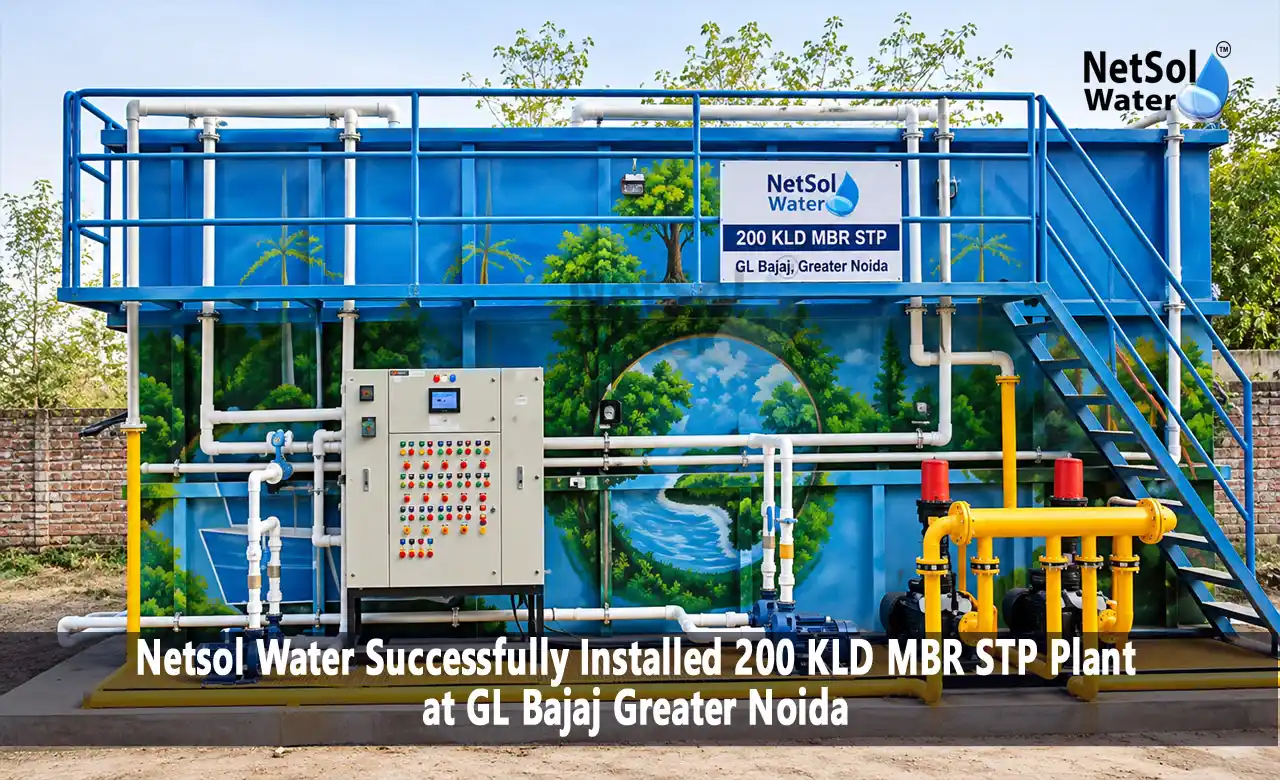
Case Study: Installed 200 KLD MBR STP Plant at GL Bajaj, Greater Noida
Netsol Water installed a 200 KLD MBR STP plant at GL Bajaj in Greater Noida, Uttar Pradesh, in 2026. The plant treats college sewage and returns the water to the campus for gardening, landscaping and toilet flushing. Installation took 15 days.
This page covers what was built, how each stage works and where the installation got difficult. It sticks to what we can confirm. Where a number would be a guess, we leave it out.
Project Overview
The plant is an above ground package STP with a capacity of 200 KLD, or 200,000 litres of sewage a day. The tanks use MSFRP, a mild steel body with FRP lining. Treatment runs on Membrane Bioreactor (MBR) technology with a HOLLOWBRANE MEMBRANE TECHNOLOGY.
A PLC control panel runs the plant. Air blowers supply oxygen to the biological stages, a sludge handling system manages surplus solids, and a chlorination system disinfects the water before storage.
“Package” means the plant arrives as ready units that are assembled on site. That cuts construction work, which helps explain the 15-day installation.
About the Project and GL Bajaj
A large institution has to plan for the water going out as well as the water coming in. A campus has many people using washrooms through the day, and all that wastewater needs a proper path to treatment.
We do not describe GL Bajaj’s internal operations here, since that is the client’s information to share. This case study covers the plant and the kind of site it serves: a college campus in Greater Noida with a steady sewage load and a use for treated water on its own grounds.
Campuses suit onsite treatment and reuse. The sewage is mostly domestic, the daily pattern is predictable, and the grounds usually have gardens and lawns that can take reused water.
Wastewater Treatment Requirements
Institutional sewage comes mainly from toilets and washrooms, with some wastewater from cleaning and other facilities depending on the site. It carries organic matter, suspended solids and microorganisms, including bacteria that can cause illness.
The flow is uneven. It rises between classes, drops in the afternoon and falls close to nothing at night or on holidays. A plant that cannot absorb these swings will struggle, so an equalization tank sits near the front.
Treatment before reuse is not optional. Water used for flushing and gardening reaches people through splashes, spray and contact with surfaces. Poorly treated water can smell, stain and carry pathogens.
Why MBR Technology Was Selected for the 200 KLD STP Plant?
An MBR plant combines two jobs in one process. Microorganisms break down the organic matter in the sewage, and a membrane then separates clean water from the biological mass. A conventional plant uses a settling tank for that separation, which depends on the sludge settling well.
The membrane changes the picture. Water passes through it and the solids stay behind. The plant needs no large secondary clarifier and can hold more biomass in a smaller tank. That gives a compact arrangement, which matters on campuses where land is needed for buildings and playgrounds.
MBR also suits reuse. The membrane is a physical barrier, so treated water carries very little suspended solids, which makes disinfection easier.
GL Bajaj’s own selection criteria are not part of the information available for this write-up. The points above are the general reasons MBR works well for institutional wastewater.
Technical Specifications of the 200 KLD MBR STP Plant
| Parameter | Details |
|---|---|
| Client | GL Bajaj |
| Location | Greater Noida, Uttar Pradesh, India |
| Project year | 2026 |
| Plant capacity | 200 KLD |
| Plant type | Above Ground Package STP |
| Construction material | MSFRP |
| Treatment technology | Membrane Bioreactor (MBR) |
| Membrane configuration | Hollow Fibre |
| Membrane brand | Hollowbrane Membrane |
| Wastewater source | College / Institutional Sewage |
| Installation duration | 15 Days |
| Control system | PLC Control Panel |
| Major systems | Air Blowers, Sludge Handling System, Chlorination System |
| Treated water use | Gardening, Landscaping, Toilet Flushing |
Detailed MBR STP Treatment Process at GL Bajaj
Sewage moves through seven stages in this order: screen chamber, equalization tank, anoxic tank, aeration tank, MBR tank, disinfection and treated water tank.
1. Screen Chamber
Raw sewage first passes through a screen that catches rags, plastic, sanitary waste and other large objects. This protects the pumps downstream. It matters even more for the membrane, since debris that reaches the MBR tank can damage the fibres.
2. Equalization Tank
This tank collects the screened sewage and evens out the flow. Peaks from a busy morning and the quiet hours of the night get blended, so the biological stages receive a steadier load.
3. Anoxic Tank
The anoxic tank has little free oxygen. Bacteria here use nitrate, which MBR plants usually carry back from a later stage, and convert it to nitrogen gas. This reduces nitrogen in the sewage.
4. Aeration Tank
The air blowers push air into this tank, and aerobic bacteria use the oxygen to consume organic matter. Most BOD removal happens here. The bacteria form a living mass, often called mixed liquor.
5. MBR Tank
The HOLLOWBRANE MEMBRANE modules sit in this tank. Treated water is drawn through the membrane walls while bacteria and suspended solids stay behind. This replaces the settling stage of a conventional plant. The sludge handling system removes surplus biomass so the bacterial population stays in balance.
6. Disinfection
The membrane output is very clear, but it still goes through the chlorination system. Chlorine inactivates remaining microorganisms and makes the water safer for flushing and landscape use. Dosing needs care, since too little leaves a risk and too much can harm plants.
7. Treated Water Tank
Disinfected water is stored here until needed. The tank acts as a buffer, so demand for flushing and gardening does not have to match the plant’s output minute by minute.
How the stages fit together
Each stage prepares the water for the next. The screen protects equipment, the equalization tank steadies the flow, the anoxic and aeration tanks do the biological work, the membrane separates the solids and chlorination covers the final safety step. Remove one and the others have to work harder.
Role of Hollowbrane Membrane Technology
A hollow fibre membrane is a bundle of very thin tubes with microscopic pores in their walls. Water passes through the pores. Suspended solids and the bacterial flocs that do the treatment are too large to pass and stay in the tank.
Here the membrane modules sit submerged in the MBR tank. Gentle suction draws treated water through the fibres. Operators normally supply air under the modules to keep surfaces from clogging, and the membranes go through regular cleaning cycles.
Because the membrane does the separation, the quality of the treated water does not depend on how well the sludge settles. The plant can also run with more bacteria per litre than a conventional system, which keeps tanks small. Many fibres fit into one module, which gives a large filtering area in a small space.
Membranes do need care. They should be protected from rags, oil and grease, and cleaned as the manufacturer’s manual says. We have not listed the membrane model, pore size or quantity, since those details were not confirmed for this write-up.
Installation Process of the 200 KLD MBR STP Plant at GL Bajaj
The work followed a practical sequence, documented in installation photographs, photographs of the completed plant and control panel, and an installation video.
1. Transportation: The team moved the plant equipment, including the MBR system, to Greater Noida. The MBR equipment needs the most care here.
2. Shifting at site: The equipment then had to travel from the unloading point to its final location. This is separate from transport and often harder.
3. Positioning: This is an above ground plant, so the tanks sit on the ground rather than below it. Tanks and the MBR system go into the planned layout so piping runs stay short and operators can reach every unit.
4. Mechanical installation: This covers piping between the tanks, setting up the MBR system in its tank and connecting the sludge handling and chlorination systems.
5. Blower arrangement: The air blowers feed the aeration tank and the membrane. Installers fit air lines and place them for easy access.
6. Electrical integration: Motors, blowers and instruments are cabled to the PLC control panel, which was installed and photographed on this project. The panel lets the operator run programmed sequences rather than switch everything by hand.
The whole installation took 15 days. Commissioning and laboratory results are outside the scope of this write-up, so we do not describe them as completed here.
Major Installation Challenges and Their Solutions
The biggest challenges on this project were practical ones. They came from moving and placing the MBR equipment.
1. Transporting the MBR equipment
Membrane modules and their frames have to travel secured and protected, since a knock in transit can damage costly components. The route matters too, because height, width and road condition limit what a vehicle can carry safely.
2. Shifting the MBR system at the site
Reaching the gate is only half the job. Inside a working campus, the path from the unloading area to the plant location may have narrow lanes, kerbs, gates or building corners. Equipment has to move slowly, with enough hands and the right lifting arrangements.
We do not describe a specific incident here, since none is recorded in the project information. The point is that this step needs planning before the truck arrives.
3. Safe handling and positioning
Handling is where careless work costs the most. Lifting points, load balance and the order of placement all need attention. Moving the MBR system twice doubles the risk.
4. Installation coordination
A package plant involves mechanical and electrical crews, and sometimes civil work. In a small area, one team can block another. Good coordination puts delivery, lifting, piping and cabling in a sequence the site can hold.
5. A practical note for other sites
Planning a similar plant? Check the access route and unloading area before delivery. Confirm who arranges lifting, and keep the plant area clear on the day the MBR system arrives.
Inlet and Outlet Water Quality Parameters
Four parameters tell you how a STP is performing.
1. BOD (Biochemical Oxygen Demand) measures how much oxygen bacteria need to break down organic matter in water. A high value means a heavy organic load. A low value in treated water shows the biological stages are working.
2. COD (Chemical Oxygen Demand) measures the oxygen needed to oxidise organic and some inorganic matter chemically. It is always equal to or higher than BOD, since it also counts material bacteria cannot digest.
3. TSS (Total Suspended Solids) is the amount of solid particles carried in the water. MBR has a visible advantage here, because the membrane holds solids back physically.
4. pH shows whether the water is acidic or alkaline. The bacteria in the aeration tank work best within a limited pH range, and chlorine disinfection also depends on it.
Treated Water Reuse and Project Benefits
Treated water from this plant goes to gardening, landscaping and toilet flushing. Neither use needs drinking quality water, yet both take a lot of water on a campus. Reusing treated water reduces the freshwater the campus has to draw for them.
The campus also gets a second use from water it already paid for. We put no figure on the saving, since no measured data has been shared.
Reuse works only when managed properly. Treated water lines should be clearly marked and kept separate from drinking water lines. Treated water is not for drinking.
Watch the GL Bajaj 200 KLD MBR STP Installation Video
The original installation video shows the plant coming together on site, including the equipment, the MBR system and the control panel. It gives a better feel for the size of the equipment than any description can.
Why Choose Netsol Water for MBR STP Projects?
Netsol Water manufactures sewage treatment plants and installs them across India. Its work includes MBR sewage treatment plants, package STPs and institutional STPs for sites such as colleges and hotels.
A supplier’s job goes beyond building tanks. It covers choosing the technology, fabricating the plant, transporting it, installing it and connecting the electrical system. The GL Bajaj plant, installed in 15 days with a PLC panel and a Hollowbrane Membrane, shows that scope.
When comparing suppliers, ask for installation photographs from real sites, ask who handles delivery and placement, and ask for lab reports from running plants. For similar work, see the 90 KLD MBR STP at LAVA International, Noida and the 60 KLD MBR STP at Club Mahindra, Virajpet.
Frequently Asked Questions (FAQs)
Q1. What is the capacity of the STP installed at GL Bajaj, Greater Noida?
The plant has a capacity of 200 KLD, or 200,000 litres of sewage per day.
Q2. Which technology is used in the GL Bajaj STP plant?
It uses Membrane Bioreactor (MBR) technology, which combines biological treatment and membrane filtration in one process.
Q3. What type of membrane is used in the 200 KLD MBR STP?
The plant uses a HOLLOWBRANE MEMBRANE system.
Q4. How long did the installation take?
The installation took 15 days.
Q5. What is the treatment process of the GL Bajaj MBR STP?
Sewage passes through a screen chamber, equalization tank, anoxic tank, aeration tank and MBR tank. It is then disinfected and stored in the treated water tank.
Q6. Where is treated water reused?
Treated water is reused for gardening, landscaping and toilet flushing on the campus.
Q7. What is the difference between MBR and conventional STP technology?
A conventional plant uses a settling tank to separate treated water from biological sludge. An MBR plant uses a membrane for this step. That gives a more compact plant and cleaner water, though membranes need regular cleaning and careful operation.
Q8. What are the advantages of hollow fibre membranes in MBR plants?
Hollow fibre modules pack a large filtering area into a small space. They hold back suspended solids and suit compact plants.