

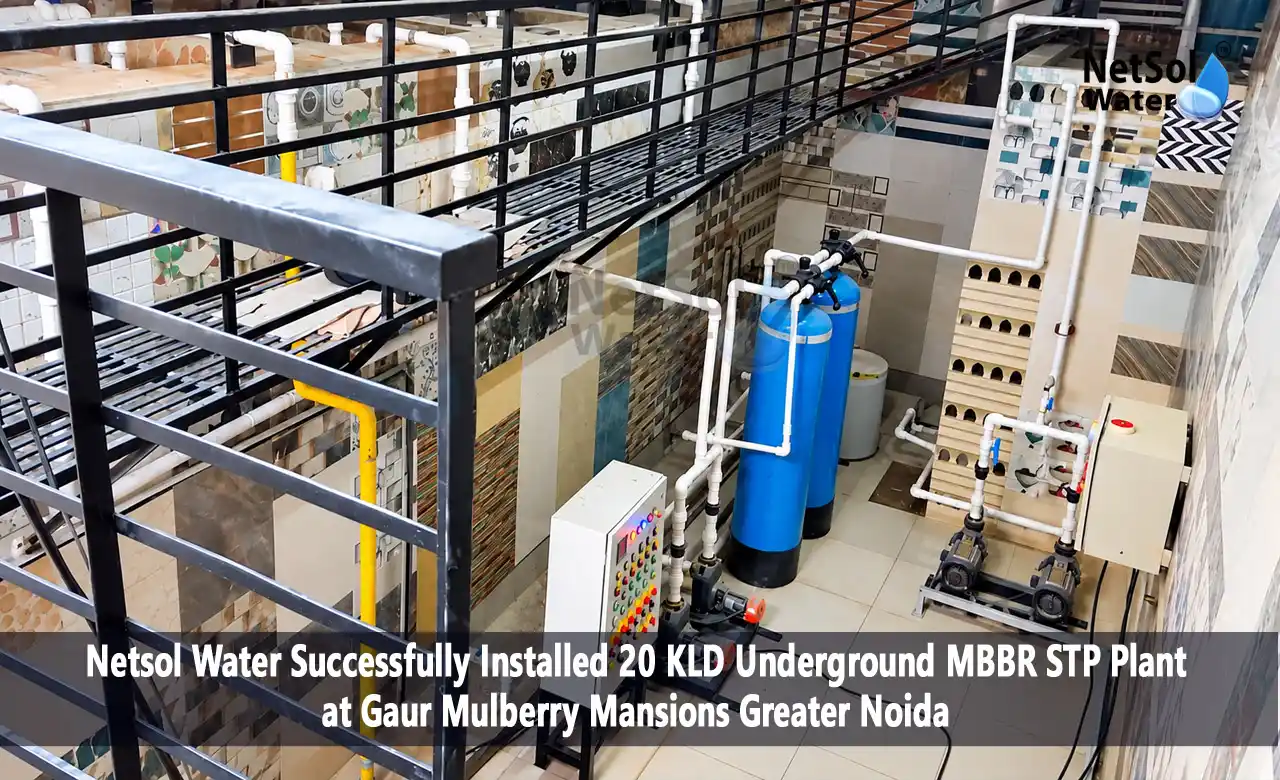
Case Study: Installed 20 KLD Underground MBBR STP Plant at Gaur Mulberry Mansions
Netsol Water installed a 20 KLD sewage treatment plant at Gaur Mulberry Mansions, a residential project in Greater Noida, Uttar Pradesh. The plant uses Moving Bed Biofilm Reactor (MBBR) technology and is built underground with RCC civil construction.
Every housing society produces sewage every day. Kitchen, bathroom and toilet wastewater has to be treated before it goes anywhere else. Treating it on site protects groundwater, keeps odour away from the premises and gives the society water it can reuse.
MBBR fits this work well. Bacteria grow on small plastic carriers inside the tank and break down the organic pollution in the sewage. Building the plant underground leaves the surface free for parking, lawns or driveways.
This case study explains the project, the technology and the construction approach. General engineering explanations are marked as general, and confirmed project facts are kept separate.
Project background and client requirements
A residential society works like a small town. Hundreds of people share one site and use water at similar times, so flows peak in the morning and evening and drop in the afternoon.
The wastewater is domestic sewage. It carries food waste, soap, detergent, oil and human waste, with a heavy load of organic matter. Untreated, it turns septic within hours, smells bad and pollutes soil and groundwater.
Rules apply too. Housing projects in India are generally expected to treat sewage before disposal or reuse, and the exact requirements depend on the state, the local authority and the size of the project.
A good STP answers all of this. It needs the right capacity, a suitable technology, a layout that fits the available land, and a plan for operation and upkeep. A plant that is under-designed or badly built causes trouble for years, so planning matters as much as equipment.
Project requirements and key challenges
These are general engineering considerations for a plant of this type. They are not a record of problems faced at this site.
1. Capacity planning. A 20 KLD plant treats about 20,000 litres of sewage a day. The design starts from the number of users and the water used per person. Undersizing overloads the tanks. Oversizing wastes money and makes the biology harder to stabilise.
2. Underground space. The tanks sit below ground, so footprint, depth and position must suit the site, nearby buildings and the water table.
3. Pipelines. Inlet sewage should arrive at the right level, ideally by gravity. Treated water must leave towards storage or the reuse line without back flow.
4. Flow variation. Sewage comes in peaks, not a steady stream. The system needs a buffer to handle that.
5. Maintenance access. Operators should reach screens, blowers, pumps and valves without difficulty.
6. Civil quality. A crack or leak in an underground tank is expensive to repair later, so construction must be planned and supervised properly.
Why MBBR technology was selected for this STP?
MBBR stands for Moving Bed Biofilm Reactor. The tank holds small plastic carriers with a large protected surface. Air from diffusers at the bottom keeps the carriers moving through the sewage.
Microorganisms attach to the carriers and form a thin biofilm. These bacteria feed on dissolved organic matter, which is measured as BOD and COD, and convert it into carbon dioxide, water and more biomass. Aeration supplies the oxygen they need.
For residential sewage, MBBR has practical advantages:
. Compact design. Biofilm holds many bacteria in a small volume, so the tank is smaller than in a conventional activated sludge plant.
. Handles load swings. Attached growth stays stable when flows rise and fall through the day.
. Simple operation. The media stays inside the reactor, so no sludge return from the clarifier is needed.
. Room to adjust. Media quantity can be tuned within limits as loads change.
For a society that wants an underground plant run by a small team, these points matter.
Design of the 20 KLD underground STP plant
The points below describe general design practice. Dimensions, retention times and structural details come from approved project drawings, and we haven't listed them here.
A typical underground STP is one RCC structure divided into chambers by internal walls. Each chamber has one job, such as screening, equalisation, aeration, settling or storage.
. Hydraulic flow. Water moves between chambers by gravity or by pumps. Levels are set so water doesn't short-circuit or leave dead zones.
. Tank design. Depth, shape and liquid volume per stage are chosen to suit the load. The positions of diffusers and media retention screens affect mixing and oxygen transfer.
. Waterproofing. Water shouldn't leak out, and groundwater shouldn't seep in. Common methods are waterproof concrete, crystalline coatings and sealed joints with water stops.
. Structural strength. The structure carries soil pressure, water load and anything above it, such as soil cover or vehicles.
. Access. Each chamber needs manholes large enough for inspection and for lifting equipment out.
. Ventilation and safety. Sewage tanks produce gases such as hydrogen sulphide and methane. Vent pipes, safe covers and confined-space rules protect workers.
Complete MBBR STP treatment process
The sequence below is the typical flow for an MBBR STP. The actual process at Gaur Mulberry Mansions must be verified against the project drawings or installation record, since designs differ from site to site.
1. Preliminary screening
Raw sewage first passes through a bar screen. It catches plastic, rags, hair and other solids that would clog pumps and pipes. Screenings are removed by hand or mechanically and disposed of separately.
2. Equalization tank
Sewage doesn't arrive at an even rate. The equalization tank holds it and smooths out the peaks. Mild aeration stops solids from settling and keeps the sewage fresh. Pumps then feed the next stage at a steady rate.
3. MBBR biological treatment tank
This is where the main treatment happens. Plastic media moves freely in the aerated tank while bacteria on its surface consume dissolved organic matter. Blowers and diffusers supply oxygen and keep the media moving. BOD and COD fall sharply here.
4. Secondary clarification
Where the design includes one, a clarifier follows the MBBR tank. Water flows slowly so that biological sludge shed from the media settles at the bottom. Clear water leaves from the top, and settled sludge is drawn off for handling.
5. Pressure sand filter (PSF)
The PSF pushes water through a bed of graded sand under pressure. Fine suspended particles stay in the bed and the water leaves clearer. The filter is cleaned by backwashing at intervals.
6. Activated carbon filter (ACF)
The ACF polishes the water. Carbon adsorbs colour, odour and traces of organic matter that survive earlier stages. It needs periodic backwashing and eventual replacement.
7. Disinfection
Disinfection kills remaining pathogens. Chlorine dosing is common, and UV systems are another option. The method depends on the design and the reuse requirement.
8. Treated water storage tank
Treated water collects in a storage tank, from where it can be pumped for approved reuse. The tank is also a convenient point to take samples for testing.
Underground civil construction and installation
Underground STP work follows a fixed order. This is the general methodology for plants of this type.
1. Site preparation and excavation. The area is marked, cleared and dug to depth. Soil type and groundwater level decide how the sides are supported, and dewatering may be needed.
2. RCC foundation and reinforcement. A levelled base slab is cast with steel reinforcement and concrete of the specified grade.
3. Treatment chambers. Walls and partitions are raised, with sleeves left for pipes.
4. Waterproofing and finishing. Waterproof treatment goes on, joints are sealed and the interior is finished. Tanks are then filled with water to check for leaks.
5. Equipment installation. Screens, diffusers, media, pumps, blowers and filters are placed.
6. Pump, blower, piping and electrical work. Pipes are laid and tested, and the control panel and cabling are connected.
7. Testing and commissioning. The system is flushed and trial run. MBBR media then needs time to grow its biofilm before treatment reaches full effect.
Civil and mechanical teams must work together on an underground plant. Levels, pipe sleeves and equipment positions need agreement before concrete is poured. A missed sleeve means cutting through cured concrete, which can weaken the structure and damage waterproofing.
Major equipment used in an MBBR STP plant
The table lists equipment typically used in MBBR STP designs. It is not a confirmed inventory of the Gaur Mulberry Mansions plant.
| Equipment | Function | Importance |
|---|---|---|
| Bar Screen | Removes coarse solids from raw sewage | Protects pumps and pipes from blockage |
| Air Blower | Supplies air to the aeration system | Provides oxygen and keeps media moving |
| MBBR Media | Plastic carriers where biofilm grows | Gives bacteria a large surface area in a small tank |
| Air Diffusers | Release fine air bubbles in the tank | Distribute oxygen evenly through the tank |
| Transfer Pumps | Move water between treatment stages | Maintain steady flow between treatment units |
| Pressure Sand Filter | Removes fine suspended solids | Improves water clarity before polishing |
| Activated Carbon Filter | Adsorbs colour, odour and organic impurities | Improves the appearance and smell of treated water |
| Disinfection System | Reduces pathogens using chlorine or UV | Makes treated water safer for suitable reuse |
Installation challenges and engineering considerations
These are common considerations in underground sewage treatment projects. They are not confirmed experiences from this site.
Excavation needs planning around soil type, depth, groundwater and the support of nearby structures. Space is usually limited, so tank layout has to be compact without blocking access.
Pipeline alignment affects hydraulics. Pipes need the correct slope, and poor joints or sags cause blockages and leaks. Waterproofing needs the same attention, since repairs after backfilling are difficult.
Pumps, blowers and valves must be reachable for service. Aeration needs even air distribution, because dead zones let media settle and treatment suffers. Hydraulic levels also have to be right, or water can short-circuit or overflow.
Treated wastewater quality and reuse applications
Treated water is only useful if its quality is known. Four parameters matter most.
. BOD reduction. BOD shows how much oxygen bacteria need to break down organic matter. Lower BOD means less pollution load.
. COD reduction. COD measures the total chemically oxidisable matter, including material bacteria digest slowly.
. TSS removal. Suspended solids make water cloudy and can clog pumps and drip lines. Settling and filtration remove them.
. Disinfection. It reduces pathogens such as coliform bacteria.
Quality should be monitored by regular sampling at the outlet, preferably through an NABL-accredited laboratory, and compared with the norms of the pollution control authority.
Possible reuse includes gardening, landscaping and toilet flushing, subject to applicable quality standards and project requirements. We haven't published inlet or outlet test values in this case study.
For a similar project in the same city, see our 125 KLD MBBR STP at Sarvottam International School, Greater Noida.
Project outcome and key highlights
. Capacity: 20 KLD
. Technology: Moving Bed Biofilm Reactor (MBBR)
. Construction: Underground, civil (RCC)
. Application: Residential sewage treatment
. Location: Gaur Mulberry Mansions, Greater Noida, Uttar Pradesh
Watch the 20 KLD Underground MBBR STP Plant Installation at Gaur Mulberry Mansions
Our project video shows the plant and its installation on site. It gives a clearer picture of the underground structure and the work involved than text alone.
Video: https://www.youtube.com/watch?v=iUqDqtK0-ck
Frequently asked questions (FAQs)
1. What is the capacity of the STP plant installed at Gaur Mulberry Mansions?
It is a 20 KLD plant, meaning it is rated for about 20,000 litres of sewage per day.
2. Which technology is used in the Gaur Mulberry Mansions STP project?
Moving Bed Biofilm Reactor (MBBR) technology, in an underground civil plant for residential sewage.
3. What is an underground sewage treatment plant?
Its treatment tanks are built below ground level, usually in RCC. The surface above can be used for parking or landscaping.
4. How does MBBR technology work in STP?
Bacteria grow as a biofilm on plastic carriers moving in an aerated tank. They consume organic pollutants, reducing BOD and COD.
5. What are the advantages of an underground MBBR STP?
It saves surface space and keeps equipment and odour out of sight. MBBR adds a compact reactor that copes with load swings. Ventilation and access need good planning.
6. Can treated sewage water be reused for gardening and flushing?
Yes, if it meets applicable quality norms. It is not for drinking. Test the water regularly.
7. How often does MBBR STP require maintenance?
Check blowers, pumps and flow daily. Clean screens, backwash filters and monitor disinfection regularly. Follow the plant's O&M schedule.
8. What factors affect the cost of a 20 KLD STP plant?
Civil scope, excavation conditions, equipment selection, automation, treated water target and O&M terms. A site visit gives a reliable quote.