

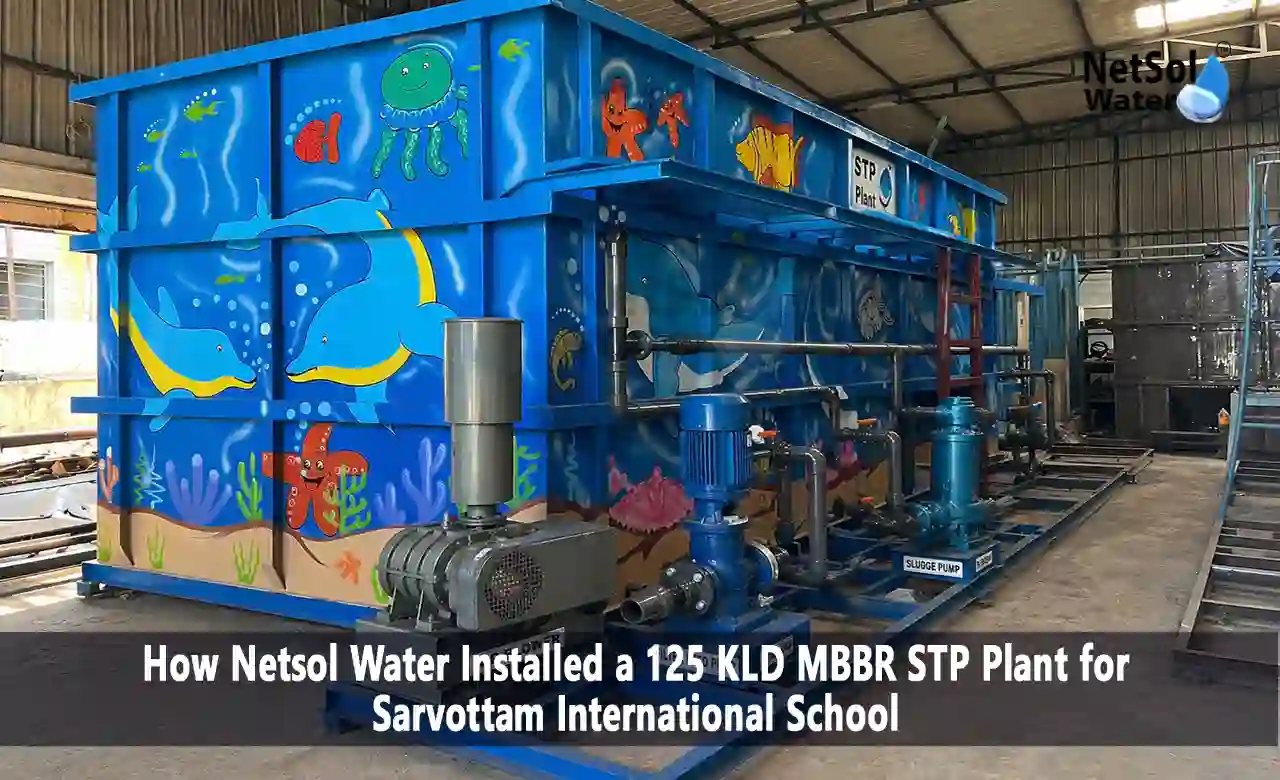
Case Study: 125 KLD MBBR STP at Sarvottam School, Greater Noida
When Sarvottam International School in Greater Noida needed a reliable solution to manage its growing wastewater load, they didn't want a quick fix. They wanted a system built to last - one that would treat sewage effectively, comply with pollution board standards, and recycle treated water for everyday campus use.
They turned to Netsol Water, a leading Sewage Treatment Plant Manufacturer in Noida, known for engineering practical, compliant, and cost-efficient wastewater solutions across Delhi-NCR and beyond.
The result? A fully operational 125 KLD MBBR STP Plant that treats 100% of the school's daily sewage and reuses treated water for gardening and toilet flushing - saving thousands of litres of freshwater every single day.
This case study breaks down every aspect of that project: the problem, the engineering approach, the technology used, and the measurable outcomes. If you're evaluating an STP solution for a school, institution, or commercial property in Greater Noida or nearby areas, this is worth reading carefully.
About the Client: Sarvottam International School, Greater Noida
Sarvottam International School is a reputed educational institution located in Greater Noida, Uttar Pradesh - one of the fastest-growing urban regions in India's National Capital Region (NCR). The school serves a large student and staff population, operating across multiple academic blocks, administrative areas, hostels, and landscaped outdoor spaces.
Like most large schools in NCR, the campus generates substantial volumes of domestic wastewater from washrooms, canteens, and other day-to-day activities. With Greater Noida's infrastructure growing rapidly, the local pollution control authority mandates that any institution above a certain capacity must treat its sewage on-site before discharging or reusing it.
Sarvottam International School recognized early that managing wastewater wasn't just a compliance checkbox - it was an opportunity to build a greener, more self-sufficient campus.
Project Overview
| Parameter | Details |
|---|---|
| Client | Sarvottam International School |
| Location | Greater Noida, Uttar Pradesh, India |
| Project Type | Sewage Treatment Plant (STP) Installation |
| Technology Used | Moving Bed Biofilm Reactor (MBBR) |
| Plant Capacity | 125 KLD (Kilolitres Per Day) |
| Implementing Company | Netsol Water Solutions |
| Primary Objective | Treat campus wastewater and reuse for gardening & flushing |
| Compliance Target | CPCB/UPPCB Effluent Discharge Standards |
| Project Status | Successfully Commissioned |
Problem Statement: Why Did the School Need an STP?
Core Problem
The school was generating approximately 125,000 litres (125 KLD) of wastewater daily. Sending all of that untreated into the municipal drain was neither legally permissible nor environmentally responsible.
There were three specific problems that made this urgent:
1. Regulatory Pressure
The Uttar Pradesh Pollution Control Board (UPPCB) has tightened its norms for institutional complexes in Greater Noida. Schools and colleges above a certain capacity are required to install on-site STPs and meet prescribed treated water quality standards before any discharge or reuse. Non-compliance can lead to notices, fines, or operational restrictions - a risk no school can afford.
2. High Freshwater Consumption
The school was using potable water for activities like garden irrigation and toilet flushing - activities that don't require drinking-quality water at all. This was a costly and wasteful use of a precious resource, especially in a region where groundwater depletion is a well-documented problem.
3. No On-Site Treatment Infrastructure
The campus had no existing wastewater treatment facility. All sewage was flowing directly into municipal infrastructure, increasing load on an already strained system.
The school needed a solution that was compact, cost-effective, low-maintenance, and capable of producing consistently high-quality treated water suitable for reuse.
Challenges Faced During Project Planning and Execution
Challenge 1: Limited Installation Space
Schools are busy places - not industrial facilities. The campus didn't have a large dedicated zone for a treatment plant. The STP had to fit within a compact footprint without disrupting daily school operations, foot traffic, or aesthetics. A large conventional STP was simply not viable here.
Challenge 2: Varied and Unpredictable Flow Rates
School wastewater generation is highly uneven. Peak flows happen during morning hours, lunch breaks, and after sporting activities. The treatment system had to handle these daily surges without compromising effluent quality or requiring constant manual intervention.
Challenge 3: Strict Treated Water Quality Requirements
The treated water was intended for direct reuse on the school campus - in gardens that children play in and toilets that students use daily. This meant effluent standards couldn't just be 'acceptable.' They had to be genuinely safe, odour-free, and visually clear.
Challenge 4: Minimal Operational Complexity
Schools don't have dedicated wastewater engineers on staff. The STP had to be simple enough for maintenance staff to operate with basic training - no complex chemistry adjustments, no daily calibration requirements.
Solution Provided by Netsol Water
Netsol Water recommended and installed a 125 KLD MBBR-based Sewage Treatment Plant - a technology specifically suited to the school's constraints and goals. The MBBR (Moving Bed Biofilm Reactor) process was chosen over alternatives like SBR or MBR for practical, engineering-backed reasons.
Here's why MBBR made the most sense for this project:
• Compact Design: MBBR systems pack more biological treatment capacity into a smaller footprint compared to conventional activated sludge processes - ideal for space-limited institutional sites.
• Resilience to Load Fluctuations: The biofilm carriers maintain active microbial populations even during low-flow periods, enabling the system to bounce back quickly when peak loads arrive.
• Low Sludge Generation: Compared to many other biological treatment methods, MBBR generates less excess sludge - reducing disposal costs and handling complexity.
• Ease of Operation: Once the biofilm is established and the system is commissioned, day-to-day operation is largely automated - manageable for non-specialist maintenance staff.
• Proven Track Record: MBBR technology has been extensively used in institutional, commercial, and residential STPs across India's urban landscape, with well-documented performance data.
The packaged STP plant was designed, fabricated, and installed end-to-end by Netsol Water's engineering team, including all civil integration, electrical connections, and commissioning support.
Detailed Treatment Process:
Understanding how the treatment works helps explain why the output is safe enough for campus reuse. Here is the complete treatment train implemented by Netsol Water:
| Step | Stage | What It Does |
|---|---|---|
| 01 | Inlet Chamber & Screening | Removes large solids like rags, paper, and plastic before biological treatment. |
| 02 | Oil & Grease Trap | Separates fats and oils from wastewater to prevent reactor issues. |
| 03 | Equalization Tank | Balances flow and load for consistent treatment in the MBBR system. |
| 04 | MBBR Reactor | Biological treatment using biofilm carriers to remove 85–95% BOD/COD. |
| 05 | Secondary Clarifier | Separates biomass from treated water efficiently. |
| 06 | Sludge Holding Tank | Stores sludge for safe disposal or dewatering. |
| 07 | Pressure Sand Filter | Removes suspended solids and turbidity. |
| 08 | Activated Carbon Filter | Eliminates odor, color, and residual organics. |
| 09 | Chlorination / Disinfection | Kills pathogens before reuse. |
| 10 | Treated Water Reuse | Used for gardening and flushing applications. |
MBBR Reactor - A Closer Look at the Core Stage
The MBBR reactor contains thousands of small, high-density polyethylene (HDPE) biofilm carriers suspended in the wastewater. These carriers have a specially engineered surface structure that allows colonies of aerobic bacteria to attach and grow as a biofilm.
As wastewater flows through the reactor and air is continuously diffused from the bottom via fine bubble diffusers, the bacteria on the media consume dissolved organic matter - measured as BOD (Biochemical Oxygen Demand) and COD (Chemical Oxygen Demand). The turbulence keeps the media in constant motion, maximizing contact between wastewater, oxygen, and microbial populations.
The result: biological degradation of 85–95% of dissolved organics within the reactor itself.
Results and Benefits:
| Outcome Area | Result |
|---|---|
| Wastewater Treated | 125 KLD of raw sewage treated daily – 100% of campus sewage handled on-site |
| Freshwater Savings | Estimated 40,000–50,000 litres saved per day by using recycled water |
| Regulatory Compliance | Fully compliant with UPPCB effluent discharge norms |
| Sewage to Municipal Drain | Zero – no untreated discharge outside campus |
| Odour Impact | No noticeable odour due to advanced MBBR process |
| Water Reuse Points | Used for garden irrigation and toilet flushing across campus |
Environmental and Cost Impact
1. Environmental Impact
This project directly contributes to two of India's most pressing urban sustainability goals:
• Reducing freshwater extraction: Replacing potable water with recycled effluent reduces pressure on Greater Noida's groundwater table and municipal supply network.
• Preventing water pollution: Eliminating raw sewage discharge protects local soil, groundwater, and eventually river systems from organic and nutrient loading.
The school's green areas now thrive on recycled water - making the campus not just compliant, but genuinely sustainable.
2. Cost Impact
The financial case is equally compelling. While the initial capital investment is real, operational savings from reduced water purchasing and lower sewage disposal costs typically achieve payback within 3–5 years for institutional plants of this scale. After payback, the school effectively generates water savings indefinitely.
Additionally, MBBR's low sludge production means lower sludge handling costs compared to conventional processes - a recurring operational saving that adds up annually.
Why Netsol Water?
Netsol Water isn't just a vendor - they're a wastewater engineering company with deep domain expertise and a track record of delivered projects across residential, commercial, and institutional sectors.
Here's what specifically set them apart for this project:
• Technology Depth: Netsol Water's engineering team evaluated multiple treatment technologies, assessed site constraints, flow patterns, and reuse requirements before recommending MBBR as the optimal solution.
• End-to-End Execution: From initial site assessment and system design to fabrication, civil work, installation, and commissioning - Netsol Water handled everything.
• Compliance Knowledge: Their team understands UPPCB and CPCB norms in detail and designs systems to meet these consistently - not just on day one, but throughout the plant's operational life.
• Post-Commissioning Support: After installation, Netsol Water provided operational training to the school's maintenance staff and offers ongoing AMC (Annual Maintenance Contract) services.
• Regional Presence: As an established Sewage Treatment Plant Manufacturer in Noida, Netsol Water's proximity to Greater Noida ensures faster site response, better logistical coordination, and easier ongoing support.
Conclusion:
The 125 KLD MBBR STP Plant installed at Sarvottam International School is more than just a compliance project. It's a working model for how educational institutions in Greater Noida can responsibly manage their water footprint - treating every litre of wastewater, reusing a significant portion, saving freshwater, and operating in full regulatory compliance. For any school, college, or institutional complex looking to install a reliable sewage treatment system, Netsol Water - a proven Sewage Treatment Plant Manufacturer in Noida - delivers solutions built on real engineering, not promises.
Frequently Asked Questions (FAQs)
These FAQs are optimized for featured snippet targeting and AI-based answer engines.
Q1. What is an MBBR STP Plant and how does it work?
An MBBR (Moving Bed Biofilm Reactor) STP Plant is a biological wastewater treatment system that uses small plastic media carriers on which bacteria grow as a biofilm. As wastewater flows through the aerated reactor, these bacteria break down dissolved organic pollutants. The moving media ensures continuous contact between wastewater, oxygen, and microorganisms - making the process highly efficient even in a compact footprint. MBBR is widely used for wastewater treatment for schools, commercial buildings, and residential complexes.
Q2. Why is MBBR technology preferred for school STP plants?
MBBR is preferred for schools and educational institutions because it offers a compact design that fits within limited campus space, handles variable flow rates effectively, generates low sludge, and operates with minimal manual intervention. These characteristics make it ideal for sites where space is constrained and dedicated operations staff are not available.
Q3. Can treated STP water be safely reused for gardening and flushing?
Yes - treated water from a properly designed and operated STP, after passing through secondary clarification, sand filtration, carbon filtration, and chlorination, meets quality standards suitable for non-potable reuse. This includes garden irrigation and toilet flushing. In this project, the treated water is clear, odour-free, and pathogen-safe - fully appropriate for both reuse applications on the school campus.
Q4. What is the cost of a 125 KLD STP Plant installation in Greater Noida?
The cost of a 125 KLD STP Plant in Greater Noida depends on several factors including the technology selected (MBBR, SBR, or MBR), site conditions, civil construction requirements, and level of automation. MBBR-based plants are generally considered cost-effective for this capacity range due to lower civil requirements and reduced sludge handling costs. Contact Netsol Water directly for a detailed, site-specific project estimate.
Q5. How do I find a reliable Sewage Treatment Plant Manufacturer in Noida?
When choosing a Sewage Treatment Plant Manufacturer in Noida, look for companies with demonstrated project experience in institutional and commercial segments, in-house engineering and fabrication capabilities, knowledge of UPPCB and CPCB compliance requirements, and proven after-sales support. Netsol Water checks all these criteria and has successfully delivered multiple STP projects across Greater Noida and the broader Delhi-NCR region.