

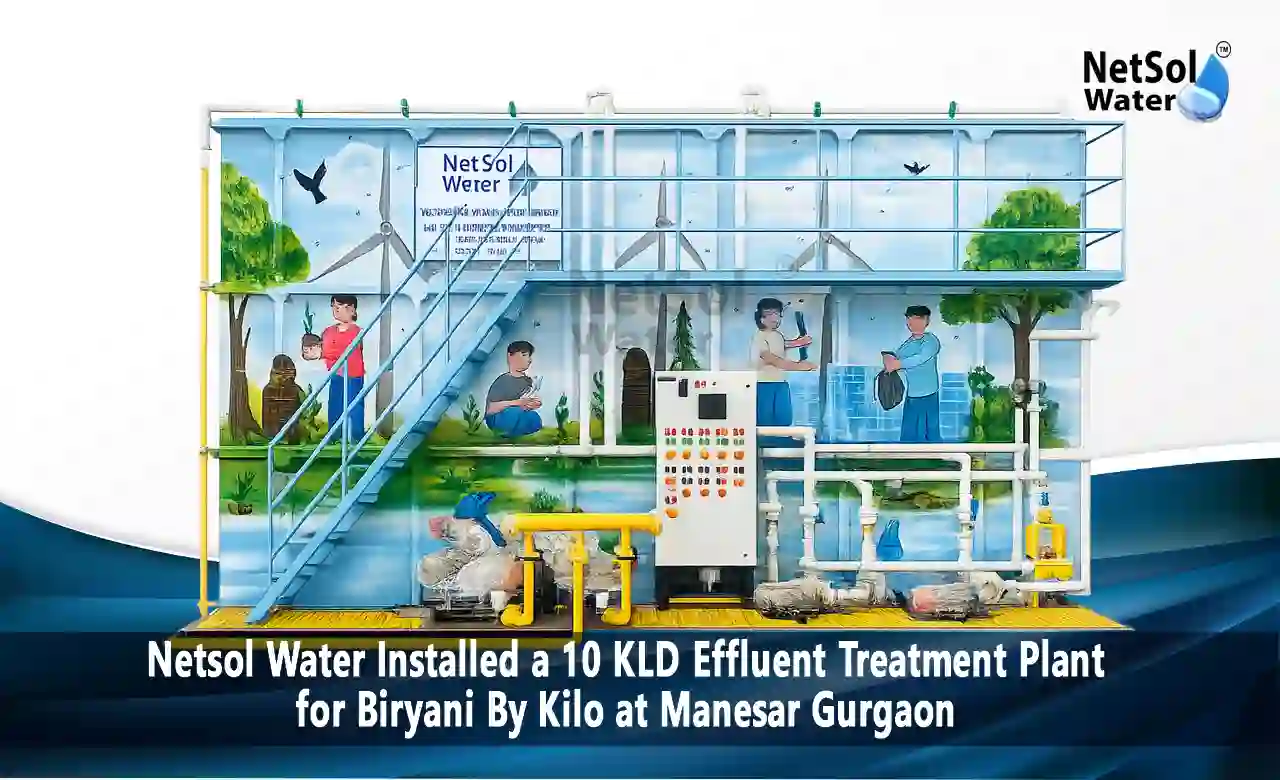
Case Study: 10 KLD ETP Plant for Biryani By Kilo, Manesar, Gurgaon
A commercial kitchen produces more wastewater than most people realize. Every plate of biryani comes with liters of oily, detergent-laced, food-residue water heading straight into the drain. In most cloud kitchens, that drain connects to a municipal sewer that's simply not built to handle this kind of load.
Gurgaon's Manesar industrial zone operates under Haryana's strict pollution control norms. The Haryana State Pollution Control Board (HSPCB) mandates that food processing units treat their effluent before discharge. For a high-volume cloud kitchen like Biryani By Kilo, ignoring this isn't just an environmental risk. It's a compliance risk that can shut operations down, especially when working with an Effluent Treatment Plant Manufacturer for Food Industry.
This case study covers how Netsol Water designed and installed a compact 10 KLD effluent treatment plant for Biryani By Kilo's Manesar facility. The solution was built to handle the specific wastewater profile of a commercial biryani kitchen: high oil content, strong odours, and fluctuating daily volumes.
About the Client
Biryani By Kilo is one of India's fastest-growing biryani chains. The brand operates on a cloud kitchen model where food is cooked fresh in large quantities and delivered directly to customers. No dine-in. All production.
That model works brilliantly for scale. But it creates a concentrated wastewater problem. A single production kitchen can generate 8 to 12 kiloliters of wastewater daily, loaded with:
• Cooking oils and animal fats from large-batch biryani preparation
• Detergents and cleaning agents from multiple wash cycles
• Food solids like rice starch, meat residue, and spice oils
• High BOD (Biochemical Oxygen Demand) and COD (Chemical Oxygen Demand) loads
Without proper treatment, this wastewater causes blockages in municipal drains, soil contamination, and potential regulatory action.
Project Overview
| Parameter | Details |
|---|---|
| Plant Capacity | 10 KLD (Kiloliters per Day) |
| Industry | Food & Beverage |
| Client | Biryani By Kilo |
| Location | Manesar, Gurgaon, Haryana |
| Application | Restaurant / Cloud Kitchen Wastewater Treatment |
| Installed By | Netsol Water |
| Plant Type | Effluent Treatment Plant (ETP) |
| Treatment Stages | Screening, Oil & Grease Trap, Equalization, Aeration, Clarification, Filtration |
Challenges Faced
1: Oil and grease overload
Biryani preparation involves ghee, refined oil, and rendered animal fat in large quantities. The kitchen's wastewater carried a significant floating oil layer. Standard treatment systems can't handle this without a dedicated pre-treatment stage. Unchecked, grease clogs pipes and kills biological treatment bacteria downstream.
2: High organic load
The BOD of incoming wastewater tested well above standard municipal discharge limits. Meat particles, starch, and spice extracts contribute organic matter that creates high oxygen demand in water bodies. Without aeration and biological treatment, this load can't be reduced to acceptable levels.
3: Odour
Untreated kitchen wastewater smells bad within hours. Manesar's climate accelerates bacterial decomposition, intensifying hydrogen sulphide and ammonia odours. The facility needed treatment that controlled odour at every stage, not just at the final outlet.
4: Compliance with HSPCB norms
Haryana's pollution control norms specify outlet parameters for BOD, COD, total suspended solids, and oil and grease. Non-compliance triggers notices, penalties, and potential closure orders. The ETP had to consistently meet these parameters with support from an experienced Effluent Treatment Plant Manufacturer for Food Industry.
5: Irregular wastewater flow
Cloud kitchens don't produce wastewater at a steady rate. Peak cooking hours generate surges while prep and cleaning periods produce different compositions. The treatment system needed to handle these flow variations without performance drops.
Solution Provided by Netsol Water
Netsol Water engineered a custom 10 KLD ETP specifically for Biryani By Kilo's Manesar kitchen. The design prioritized 3 things: compact footprint, consistent compliance, and low day-to-day operational overhead.
The system uses a multi-stage treatment sequence tuned to the high-fat, high-organic profile of food service wastewater. Each stage was sized for actual measured flow rates, not generic estimates. Netsol Water's team conducted an on-site wastewater characterization before finalizing the design as a trusted Effluent Treatment Plant Manufacturer for Food Industry.
The installation uses durable materials built for long service life in a warm, humid kitchen environment. The control panel allows kitchen staff to monitor system status without needing specialized technical knowledge.
Treatment Process
1: Screening
Wastewater from the kitchen first passes through a bar screen. This removes solid food particles like rice, meat chunks, and vegetable waste. Removing these early protects downstream equipment and prevents blockages.
2: Oil and grease trap
A purpose-built oil and grease trap separates floating fats, oils, and grease from the water. This is the most critical pre-treatment step for any commercial kitchen ETP. The recovered grease is collected separately for disposal in compliance with waste management rules.
3: Equalization tank
Flow from the kitchen isn't steady. The equalization tank buffers these fluctuations, holding wastewater and releasing it at a controlled, consistent rate. This protects the biological treatment stages from shock loads during peak cooking hours.
4: Aeration
In the aeration tank, air is pumped through the wastewater to support aerobic bacteria. These bacteria consume the dissolved organic matter, dramatically reducing BOD and COD. This biological treatment stage is what does the heavy lifting on organic load reduction.
5: Clarification
After biological treatment, wastewater moves to a clarifier where suspended solids and biomass settle out. The settled sludge is periodically removed and managed as per waste handling norms. Clarified water moves to the next stage.
6: Filtration
A final filtration stage polishes the treated water, removing any residual suspended particles. The outlet water meets HSPCB standards for BOD, COD, suspended solids, and oil and grease before discharge.
See How the 10 KLD ETP Works at Biryani By Kilo, Manesar
Watch how the 10 KLD Effluent Treatment Plant was installed and operates at Biryani By Kilo, Manesar.
Installation Highlights
• Complete installation completed with minimal disruption to kitchen operations
• Compact modular design installed within the facility's existing utility space
• All components constructed with corrosion-resistant materials suited for kitchen environments
• Control panel with simple visual indicators for non-technical staff
• Netsol Water's team conducted on-site operator training before handover
Results Achieved
Post-commissioning water quality tests confirmed the ETP performs within all HSPCB discharge parameters. Specific outcomes include:
• BOD reduced from inlet levels exceeding 800 mg/L to outlet levels below 30 mg/L
• Oil and grease in treated outlet water brought well below permissible limits
• Odour at the discharge point eliminated
• Facility received clean compliance status from the pollution control authority
• Zero drain blockage incidents since installation
Benefits to Biryani By Kilo
• Easy to operate: kitchen staff manage the system with minimal training
• Low maintenance: Netsol Water's design minimizes moving parts and consumables
• Cost-effective: energy-efficient aeration and gravity-driven clarification keep running costs low
• Eco-friendly: treated water meets standards before it leaves the facility
• Regulatory peace of mind: consistent compliance means no surprise notices
• Scalable: the modular design can be expanded if kitchen capacity increases
Why Restaurants Need Effluent Treatment Plants?
A lot of food businesses still treat wastewater as someone else's problem. It isn't. Here's why ETPs matter for commercial kitchens specifically, and why choosing the right Effluent Treatment Plant Manufacturer for Food Industry is critical.
Why is ETP required for restaurants?
Municipal sewage systems are designed for domestic wastewater. Restaurant and cloud kitchen wastewater carries 10 to 20 times the organic load and fat content of household water. Pumping it untreated into sewers degrades treatment plant performance across the entire system. Regulatory bodies in Haryana and most Indian states now require food businesses above a certain production threshold to pre-treat their wastewater.
What happens if wastewater is untreated?
Grease accumulates in drains and causes blockages. High BOD water depletes oxygen in receiving water bodies, killing aquatic life. Regulators issue notices, then fines, then closure orders. In Gurgaon's Manesar zone, HSPCB enforcement has been active. The cost of an ETP is a fraction of the cost of a regulatory shutdown.
About Netsol Water
Netsol Water is an India-based manufacturer and installer of water and wastewater treatment systems. The company designs ETPs, STPs (Sewage Treatment Plants), and RO systems for industrial, commercial, and municipal clients.
The Manesar project reflects Netsol Water's approach: site characterization first, custom design second, standardized components third. The team doesn't sell off-the-shelf systems and call them custom. Each project starts with actual measured data from the client's wastewater.
Netsol Water provides post-installation service support including maintenance contracts, annual performance audits, and operator training. The company has installed systems across food and beverage, pharmaceuticals, textiles, and municipal sectors.
Conclusion
Biryani By Kilo's Manesar facility now operates with a treatment system that handles the real wastewater profile of a commercial biryani kitchen. The 10 KLD ETP for Biryani By Kilo at Manesar Gurgaon is proof that compact, food-industry-specific treatment systems work when they're designed from actual site data instead of generic specs, especially when delivered by an Effluent Treatment Plant Manufacturer for Food Industry.
If your restaurant, cloud kitchen, or food processing unit is generating wastewater without treating it, the compliance window is narrowing. Haryana's pollution control enforcement is active, and the cost of proactive compliance is significantly lower than the cost of reactive crisis management.
Contact Netsol Water today to get a site assessment and customized ETP proposal for your food service facility. call: 9650608473 or Email: enquiry@netsolwater.com for a free consultation.
Frequently Asked Questions (FAQs)
Q1. What is a 10 KLD ETP plant?
A 10 KLD ETP (Effluent Treatment Plant) treats 10,000 liters of wastewater per day. For a cloud kitchen or mid-size restaurant, this capacity covers typical daily wastewater generation from cooking, washing, and cleaning operations.
Q2. How does an ETP work in restaurants?
Restaurant ETPs typically run wastewater through screening (to remove food solids), an oil and grease trap, an equalization tank to manage flow surges, biological aeration to break down organic matter, clarification to settle solids, and final filtration. The treated water meets regulatory discharge standards.
Q3. Is ETP mandatory in Gurgaon?
Yes. The Haryana State Pollution Control Board requires food processing units and commercial kitchens above specified production thresholds to install and operate effluent treatment systems. Manesar is an industrial zone with active HSPCB enforcement.
Q4. What is the cost of a 10 KLD ETP?
Costs vary based on wastewater composition, space constraints, automation level, and local civil work. A 10 KLD ETP for a food industry application typically ranges from INR 8 to 20 lakhs for supply and installation. Contact Netsol Water for a site-specific quotation.
Q5. Can treated water from an ETP be reused?
Yes, with appropriate treatment stages. Treated ETP outlet water can be reused for toilet flushing, landscaping, or industrial cleaning depending on quality. Adding a tertiary treatment stage like sand filtration plus UV disinfection allows reuse in non-potable applications, reducing freshwater consumption.
Q6. How much space does a 10 KLD ETP need?
A compact modular 10 KLD ETP can be installed in roughly 25 to 40 square meters depending on design configuration. Netsol Water's Manesar installation was designed to fit within Biryani By Kilo's existing utility footprint without major civil modifications.
Q7. What is the difference between ETP and STP?
An ETP (Effluent Treatment Plant) treats industrial or commercial process wastewater, which often carries high organic loads, oils, chemicals, or heavy metals. An STP (Sewage Treatment Plant) treats domestic sewage. Food industry wastewater requires an ETP because its composition differs significantly from household sewage.
Q8. How long does ETP installation take?
For a 10 KLD system like the Biryani By Kilo project, installation typically takes 3 to 5 weeks depending on civil preparation and equipment lead times. Netsol Water coordinates all stages including civil, mechanical, electrical, and commissioning.