

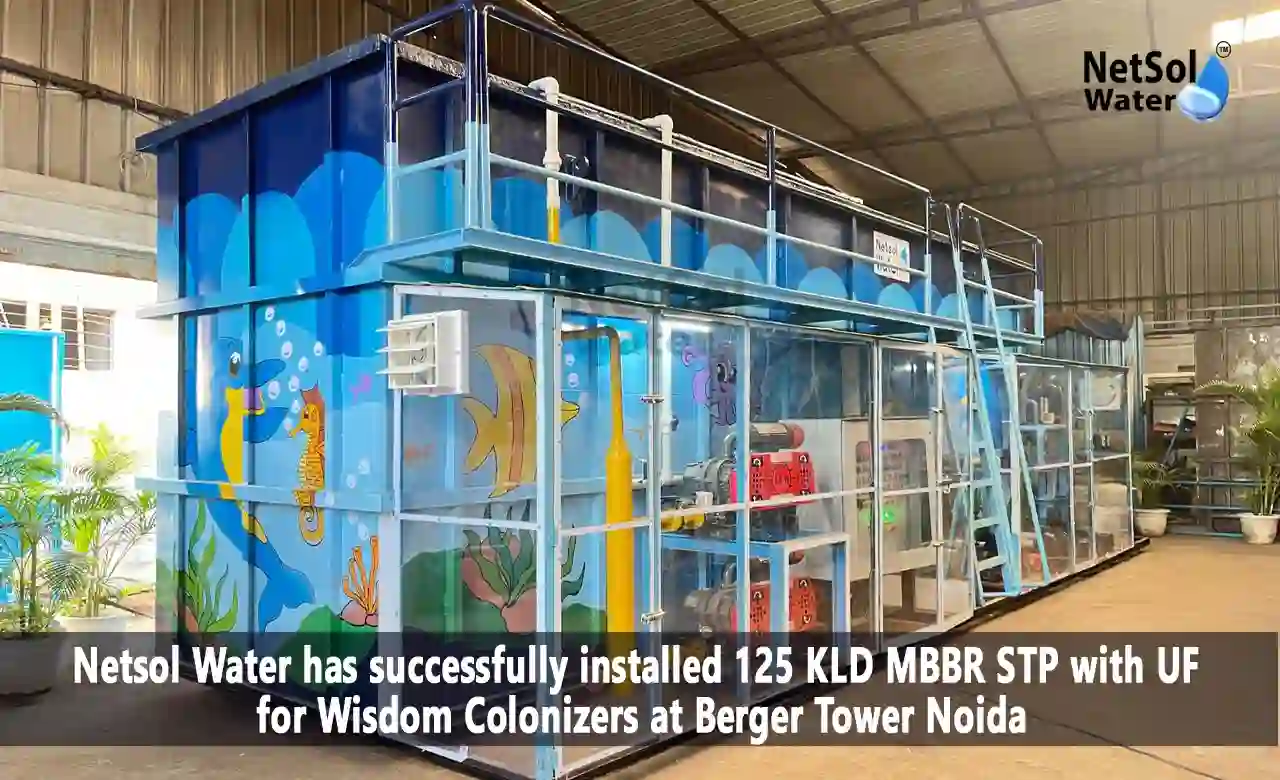
Case Study: 125 KLD MBBR STP with UF at Berger Tower Noida
Project Overview
When Wisdom Colonizers Private Limited was developing Berger Tower in Sector-16B, Noida, they knew that managing wastewater the right way wasn't just a legal checkbox. It was the responsible thing to do.
They reached out to Netsol Water to build a proper Sewage Treatment Plant for their commercial complex. What followed was a full-scope project where our team handled everything from the initial design to the final commissioning handover - a 125 KLD STP plant using MBBR technology paired with an Ultrafiltration system.
In this case study, we walk you through the whole journey: what the client was dealing with, why we chose MBBR + UF, how the treatment process works, and what the plant has achieved since it went live.
About the Client - Wisdom Colonizers Pvt. Ltd. (Berger Tower)
Wisdom Colonizers Private Limited is a well-known real estate developer in the NCR region. Berger Tower, their commercial project in Sector-16B, Noida, is a multi-floor complex that brings together corporate offices, retail shops, food outlets, and other support services all under one roof.
A busy building like this uses a lot of water every day. Between restrooms, pantry areas, housekeeping and cooling systems, Berger Tower generates close to 1,25,000 litres of wastewater daily. That's 125 KLD - and it needs to go somewhere responsibly.
Earlier, like many commercial buildings in urban India, this wastewater had nowhere to go except the municipal drain. That's a problem on two levels. First, it's environmentally harmful. Second, the Central Pollution Control Board (CPCB) and Uttar Pradesh Pollution Control Board (UPPCB) have clear rules: buildings of this size must treat their sewage on-site. Running without a proper STP meant real legal and operational risk for the client.
Beyond compliance, there was another compelling reason to act. A lot of the water used in the building - for flushing, gardening, cooling towers - doesn't need to be drinking-quality water. If wastewater could be treated and recycled for these uses, the building could cut down significantly on its municipal water bill. That's a win for the environment and the balance sheet both.
Client Problem Statement
Before we came in, Wisdom Colonizers (Berger Tower) had a handful of real problems that needed solving:
1. No proper wastewater treatment on-site
Raw sewage from the building was going directly into municipal drains without any treatment. Apart from the environmental damage this causes, it also put the client at risk of regulatory action. Wastewater from a building this size contains high levels of organic matter, suspended solids, and harmful microorganisms. That simply can't be discharged untreated.
2. Regulatory pressure was building up
The UPPCB and CPCB are increasingly strict about commercial buildings meeting on-site treatment standards. Without an approved and functioning STP, the client was exposed to notices, fines, and in worst cases, forced shutdowns. They needed a compliant solution quickly.
3. High freshwater bills for non-drinking uses
A significant portion of Berger Tower's water consumption goes into toilet flushing, landscaping, and HVAC cooling. All of it was being sourced from the municipal supply. That's expensive, and in an NCR context where freshwater availability is already under pressure, it's also unnecessary. Treated water can do this job perfectly well.
4. Very limited space for a treatment plant
Like most commercial buildings in Noida, Berger Tower doesn't have the luxury of open land to dedicate to a treatment plant. Whatever solution we designed had to be compact, basement-friendly, and quiet enough that it wouldn't disturb the day-to-day functioning of the building above.
What We Recommended and Why?
We looked at a few different technologies for this project - conventional Activated Sludge Process, Sequential Batch Reactors and Membrane Bioreactors (MBR) - before settling on MBBR combined with Ultrafiltration. As a leading Sewage Treatment Plant Manufacturer and Supplier in India, here’s our thinking:
1. MBBR fits well in tight spaces
Moving Bed Biofilm Reactor systems pack a lot of treatment capacity into a small footprint. The biological reactor works at higher concentrations than conventional systems, so you need less physical space. For a basement installation in a commercial building, that matters a lot.
2. It's a robust, proven technology
MBBR has been used in hundreds of projects across India and globally. The biofilm that grows on the plastic carrier media inside the tank is very effective at breaking down organic pollutants. Even when the building's wastewater loads fluctuate during peak hours, MBBR handles it well.
3. Less sludge to manage
One of the hidden costs of some STP technologies is sludge disposal. MBBR generates significantly less sludge than older systems. Less sludge means less headache for the facility team and lower disposal costs over time.
4. UF takes treated water to the next level
The Ultrafiltration membranes we added after the MBBR stage act like a very fine filter. They remove whatever suspended particles, bacteria, and fine matter might still be present after biological treatment. The result is clear, clean water that's well within reuse standards for flushing and irrigation.
5. The system can grow with the building
If Berger Tower's water generation ever increases - say, because of new tenants or expanded operations - the modular MBBR design makes it straightforward to add capacity without tearing apart the existing setup.
Once the technology was decided, our engineering team prepared a detailed design specific to Berger Tower. This included process flow diagrams, equipment layouts, civil drawings, electrical specs, and P&IDs. All the equipment was manufactured at our own facility in-house and tested before it ever reached the site.
How the Treatment Works - Stage by Stage
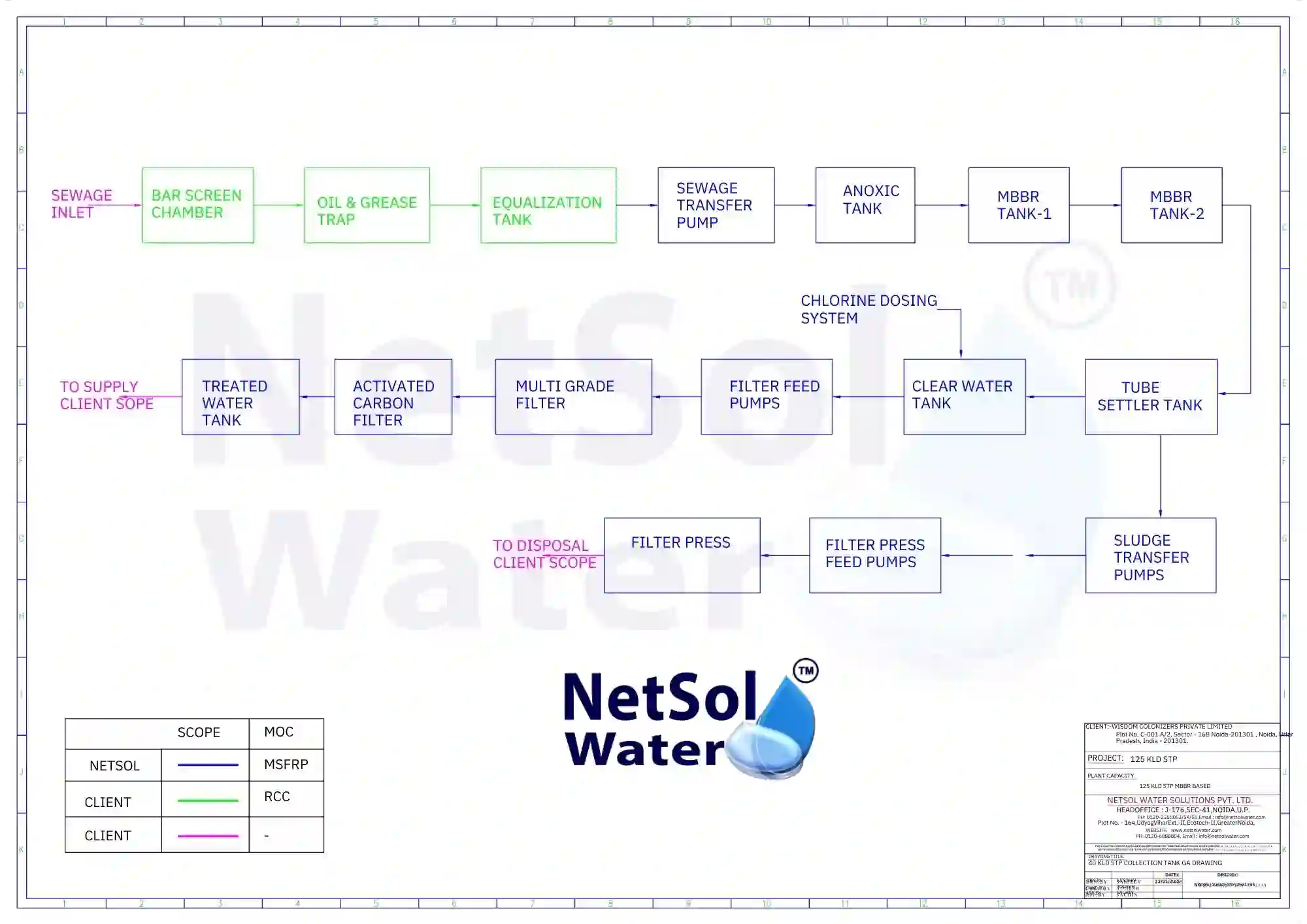
The STP at Berger Tower runs wastewater through six stages, each one doing a specific job. Here's what happens at each step:
a) Bar Screen Chamber
The first thing raw sewage hits when it enters the plant is the bar screen. This is essentially a physical filter made of steel bars that catches large solids - things like rags, plastic wrappers, food scraps, and other debris that would otherwise damage pumps or clog pipes downstream. It's a simple but essential first step. The screened-out material is cleared regularly and disposed of properly.
b) Equalization Tank
Wastewater doesn't arrive at a steady rate. During office hours, especially mornings and lunchtimes, the flow spikes. At night, it drops right down. If we fed this uneven flow directly into the biological treatment stage, it would stress the system and affect performance.
The Equalization Tank buffers this. It collects the incoming wastewater, mixes it to keep everything in suspension, and releases a steady, consistent flow forward. Think of it as a holding room that keeps the rest of the plant from being overwhelmed.
c) MBBR Tank
This is the core of the plant. The MBBR tank is filled with thousands of small plastic carrier media - each one shaped to maximise surface area. On the inside protected surfaces of these carriers, billions of microorganisms grow and form what's called a biofilm.
As wastewater flows through the tank and air is pumped in from below through fine-bubble diffusers, these microorganisms feed on the dissolved organic matter in the water. They break it down, dramatically reducing the BOD, COD, and ammonia levels. The aeration system keeps the carriers tumbling and ensures there's always enough oxygen for the biology to work.
What makes MBBR special is that the biofilm stays attached to the media even as the water flows through. There's no need to recirculate sludge back into the tank, which simplifies the whole process and saves energy.
d) Secondary Clarifier
After the MBBR stage, the water still carries some biological solids and detached biofilm fragments. The Secondary Clarifier is a calm, wide tank where the water slows down and these particles sink to the bottom under gravity. The settled sludge collects at the bottom and is periodically removed, while the cleaner water at the top flows forward to the UF system. A mechanical scraper at the bottom helps move the sludge efficiently.
e) Ultrafiltration (UF) System
The UF membranes are the quality checkpoint. These hollow-fibre membranes have incredibly fine pores - between 0.01 and 0.1 microns - that physically block any remaining suspended particles, bacteria, and even most viruses. Water passes through; contaminants stay behind.
The output at this stage is noticeably clear water with turbidity well below 1 NTU. That's clean enough for toilet flushing, garden watering, and cooling towers. The membranes are set to automatically backwash at regular intervals to maintain consistent throughput, and they're built to last for years with proper care.
f) Disinfection
Before the treated water goes into storage for reuse, it passes through the disinfection stage. A measured dose of sodium hypochlorite (the same active ingredient as common bleach, used at safe concentrations) is added to kill any remaining pathogens. The dosing is automated and proportional to the flow rate, so it's always the right amount regardless of how much water is moving through at that moment.
The treated and disinfected water then fills the Treated Water Storage Tank, from where it gets pumped to wherever it's needed across the building - primarily the flushing systems and landscaping.
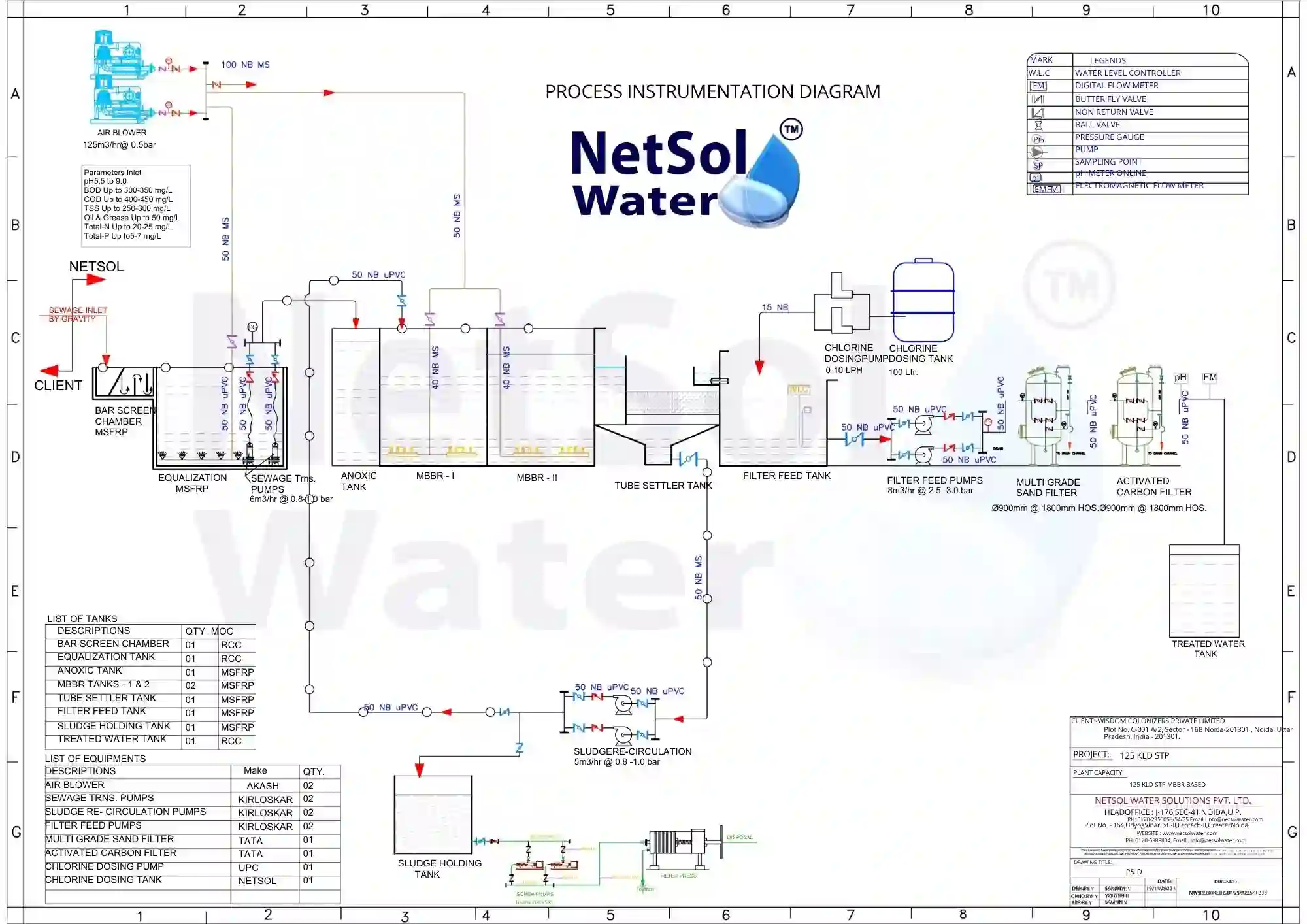
Technical Specifications at a Glance
Here's a quick summary of the key technical details for this project:
| Parameter | Detail |
|---|---|
| Plant Capacity | 125 KLD (1,25,000 litres per day) |
| Core Technology | Moving Bed Biofilm Reactor (MBBR) |
| Tertiary Treatment | Hollow-Fibre Ultrafiltration (UF) Membranes |
| Carrier Media | HDPE biofilm carriers with high internal surface area |
| Aeration System | Fine-bubble diffusers with energy-efficient blowers; automated DO control |
| Disinfection | Sodium Hypochlorite (NaOCl) dosing, flow-proportional and automated |
| Sludge Handling | Gravity thickener and sludge drying bed; low sludge yield |
| Control System | PLC-based panel with automatic start/stop, level-based controls, and alarms |
| Treated Water Quality | BOD < 10 mg/L, TSS < 10 mg/L, Turbidity < 1 NTU - meets CPCB reuse norms |
| Scope of Work | Design, Engineering, Manufacturing, Supply, Installation, Testing & Commissioning |
A few other things worth mentioning:
• All equipment was built and tested at our own manufacturing facility before it was shipped to site. Nothing arrives untested.
• The plant was largely installed underground to avoid taking up usable floor space in the building.
• We used corrosion-resistant materials throughout - FRP tanks, stainless steel pipework, and HDPE media - so the plant holds up well over the years.
• Before handing over, our team trained the on-site operators on daily operation, UF membrane cleaning, and basic troubleshooting so they could run the plant confidently on their own.
What's Changed Since the Plant Went Live?
The plant has been running well since commissioning, and the results speak for themselves. Here's what Wisdom Colonizers is seeing on the ground:
1. They're compliant - and staying that way
The treated water consistently meets CPCB discharge and reuse standards. The client no longer has to worry about regulatory notices or surprise inspections turning into a problem. Real-time monitoring data means any regulatory reporting is straightforward.
2. A lot less freshwater being purchased
Between 100 and 115 KLD of treated water is recycled daily for toilet flushing alone. That's over 90% of the flushing demand met by treated water, not municipal supply. Additional reuse in landscaping and the cooling system pushes the savings even higher. Over a year, that adds up to more than 35 million litres of freshwater saved - which is genuinely significant for a water-stressed region like the NCR.
3. The numbers make financial sense too
Buying less municipal water means lower utility bills every month. Factor in the low maintenance costs of the MBBR system and the minimal sludge disposal expenses, and the plant pays for itself faster than most people expect. A payback period of around 3 to 4 years is realistic for a project like this.
4. No more untreated discharge
This might sound like a basic point, but it matters. Berger Tower is no longer contributing to Noida's drain and water body pollution. That's a real environmental win. And for a developer that cares about its reputation, it also supports any green building certification goals they might be working toward.
5. Day-to-day operation is simple
The automated control system means the plant runs largely on its own. Staff don't need deep technical expertise to manage it, and Netsol Water's team is always reachable for support if something unexpected comes up. The plant has shown high uptime since it was commissioned.
Watch Project Overview Video
Watch how this 125 KLD MBBR STP with UF works in real conditions at Berger Tower, Noida.
Conclusion
When Wisdom Colonizers came to us with the brief for Berger Tower's STP, the goal was simple: build something that works, lasts, and doesn't cause headaches. We think we delivered on that.
A 125 KLD STP with MBBR + UF plant is now quietly doing its job in the basement of a busy commercial tower in Noida. It's treating sewage, producing reuse-quality water, keeping the client compliant, and saving money - all at the same time.
For us at Netsol Water, this is what good engineering looks like. Not just ticking compliance boxes, but building something that genuinely makes the building run better and lighter on resources.
If you're managing a commercial property, a housing society, an industrial facility, or any building that generates significant wastewater, we'd love to talk. Whether it's a Sewage Treatment Plant in Noida or anywhere across India, our team will work with you to find the right solution for your specific situation.
Reach out to us today for a free site assessment. No pressure, just a conversation about what you need.
FAQs
Q1. What exactly is a 125 KLD STP?
A 125 KLD Sewage Treatment Plant is designed to handle 1,25,000 litres of sewage every day. That's roughly the wastewater output of a medium to large commercial complex or a mid-sized residential society. The treated water that comes out is clean enough to use for flushing, gardening, and cooling purposes, so you end up buying much less freshwater.
Q2. Why do so many commercial STPs use MBBR technology?
MBBR has become popular because it solves several problems at once. It's compact, which matters in urban buildings where space is tight. It handles fluctuating loads well, which is important in commercial buildings where water use peaks and drops throughout the day. It produces less sludge than older technologies, keeping operational costs lower. And it's been used in enough real-world projects that the performance is well-proven.
Q3. How much does an STP cost in Noida?
It depends on the capacity, technology, and how much civil work is involved. For a 125 KLD MBBR + UF plant like the one at Berger Tower, a ballpark range would be somewhere between INR 30 and 60 lakhs for the full turnkey project. That said, every site is different, so we always do a proper assessment before quoting. Get in touch and we'll give you a realistic number.
Q4. Can you actually reuse the water that comes out of an STP?
Yes, and it's one of the main reasons to invest in a good STP. At Berger Tower, the treated water goes straight to the flushing systems and landscaping. The UF membranes ensure the water is clear and pathogen-reduced, and after disinfection it's well within the quality limits set by the CPCB for non-potable reuse. It's not drinking water, but for flushing and irrigation it's perfectly suitable.
Q5. How much day-to-day work does running an STP involve?
Not as much as people often fear. Routine tasks include a quick daily check of equipment, watching a few key readings like pH and dissolved oxygen, and topping up chemical dosing systems. The UF membranes need a backwash cycle regularly, but that's automated. More detailed servicing - like mechanical checks and membrane testing - happens monthly or annually. We offer AMC (Annual Maintenance Contract) packages so clients don't have to manage this themselves.
Q6. How long does it take to get an STP up and running?
For a 125 KLD plant, you're typically looking at 10 to 16 weeks from when we get the order to when the plant is fully commissioned. That covers design, manufacturing, installation, and the biological startup period where the microorganisms in the MBBR get established. We stick closely to our timelines because we know delays on a construction project have knock-on effects for the client.
Netsol Water
Sewage Treatment Plants Designed and Built Right, Across India
+91-9650608473 | info@netsolwater.com