

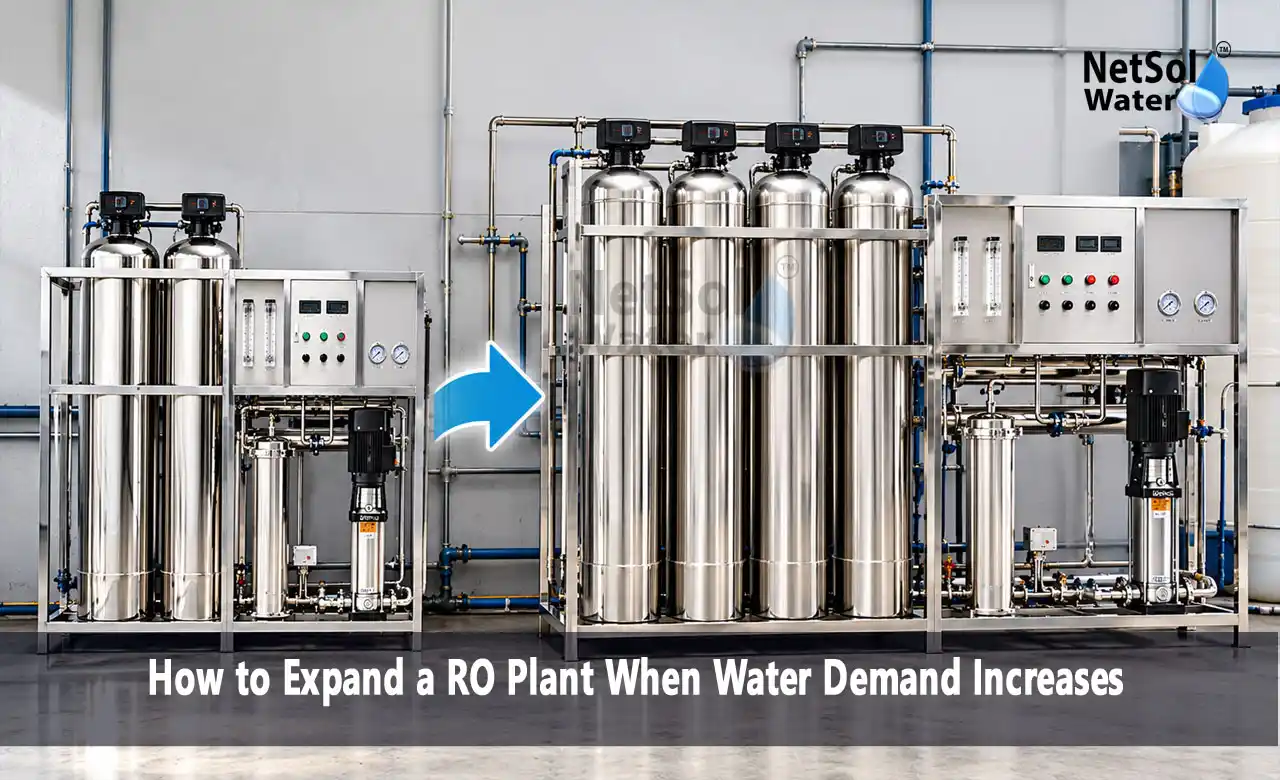
How to Expand a RO Plant When Water Demand Increases?
Water needs inside a factory rarely stay fixed. A new production line, a higher output target or a bigger share of recycled water can quickly push demand beyond what your present RO plant can deliver. When permeate output falls short, simply running the plant for more hours is only a temporary fix, and it often wears out membranes and pumps faster.
A smarter approach is a planned expansion. Study how the plant performs today, estimate what you will need tomorrow, and then upgrade in a way that does not overload the membranes, pumps or pretreatment. If you are new to the subject, it helps to first understand how an industrial RO plant works and how each stage supports the next.
Steps to Expand a RO Plant When Water Demand Increases
1. Assess the Existing RO Plant
Before adding any capacity, find out how the current plant is really performing. Note down permeate flow, recovery, feed pressure, permeate TDS or conductivity, membrane condition, operating hours and reject flow.
If the plant is already producing less than its design output, find the reason first instead of building a bigger system. Low production usually points to membrane fouling or scaling, weak pretreatment or a pump problem. Our guide on how to identify scaling and fouling in RO membranes can help you spot the difference early.
2. Estimate Your Future Water Demand
Size the expansion for the demand you will have after growth, not just for today's demand. Include process water, utilities, cleaning needs, boiler and cooling water and any other planned use. Keep peak demand and future production growth in mind as well.
For example, if your plant now needs 100,000 litres per day and the production plan will raise this to 150,000 litres, the additional 50,000 litres must be built into the capacity you select.
3. Check Whether Existing Equipment Can Handle More Flow
You do not always have to replace every part of the RO system. Check whether the feed pumps, cartridge filters, multimedia filters, softeners, dosing systems, pipelines, electrical panels and storage tanks can take the extra flow.
Weak pretreatment is a common reason why performance drops after a capacity increase. Filters such as multigrade and carbon units must be able to handle the new design flow. You can read more about the role of activated carbon filters in water treatment to see why this stage matters.
4. Choose the Right Expansion Method
The best method depends on your current plant layout and the space available.
One option is to add membrane pressure vessels or membrane elements, provided the high pressure pump and other equipment can manage the additional flow. Another option is to install a parallel RO train, which adds capacity while the existing system keeps running. In larger installations, a modular RO arrangement makes future capacity additions simpler.
A clear understanding of how an industrial RO plant is designed makes it easier to compare these options.
5. Review Recovery and Reject Flow
When more RO water is produced, more reject water is produced too, unless the recovery rate is improved. For instance, a plant running at 75% recovery gives about 75 litres of permeate from every 100 litres of feed, and the other 25 litres leaves as reject. If you increase output without reviewing recovery, you may end up with a much larger volume of reject water to handle.
Recovery should be decided on the basis of feedwater quality, scaling risk, membrane limits and the chance of reusing reject water. Proper antiscalant dosing in RO plants often allows safer and higher recovery.
6. Recheck Feedwater Quality
Higher production or new wastewater sources can change the quality of the feedwater. Shifts in TDS, hardness, silica, suspended solids, organic matter or other contaminants can affect how the membranes behave, so fresh feedwater testing should be a part of every expansion study.
If the feedwater has become harder to treat, the pretreatment may need to be adjusted before the new RO capacity is installed.
7. Upgrade Storage and Utilities
Higher RO output needs enough storage and support utilities behind it. Inspect permeate and reject storage, electrical supply, chemical storage, drainage, piping and water transfer pumps. The site should also have enough room for the new equipment and safe access for maintenance.
Overlooking these basics can delay an otherwise well planned RO expansion.
8. Add Automation and Monitoring
A larger RO plant benefits greatly from better monitoring and control. Flow meters, pressure sensors, conductivity monitors, tank level controls and automatic shutdowns all help operators manage the expanded system with confidence.
Good monitoring also lets you compare the performance of the old and the new RO capacity side by side.
9. Plan the Expansion Without Disrupting Production
Schedule the installation around your production calendar. New capacity can be built as a parallel RO train while the existing plant stays in operation. If a shutdown is unavoidable, decide its duration in advance and arrange temporary water storage where needed.
Careful planning keeps production interruptions to a minimum during the upgrade.
Conclusion
Expanding an industrial RO plant is not only about adding more membranes. Industries should first measure current performance and then define future demand, pretreatment and utility needs, and recovery and reject water requirements.
Depending on the situation, the expansion may involve extra membrane vessels, a parallel RO train, larger pretreatment or a combination of these upgrades. The final choice should reflect your water demand, feedwater quality, available space and existing plant design. To see what is possible, you can explore our range of RO plants or read about a commercial RO plant manufacturer who can customise a system for your site.
A well designed expansion delivers additional treated water without hurting RO performance or raising operating costs.
Do you need advice or assistance in selecting the best water and wastewater treatment unit? We have solutions for all your problems!
Share your problem with us and our experts will make sure it goes away.
For assistance or related queries,
Call on +91-9650608473 Or write to us at enquiry@netsolwater.com