

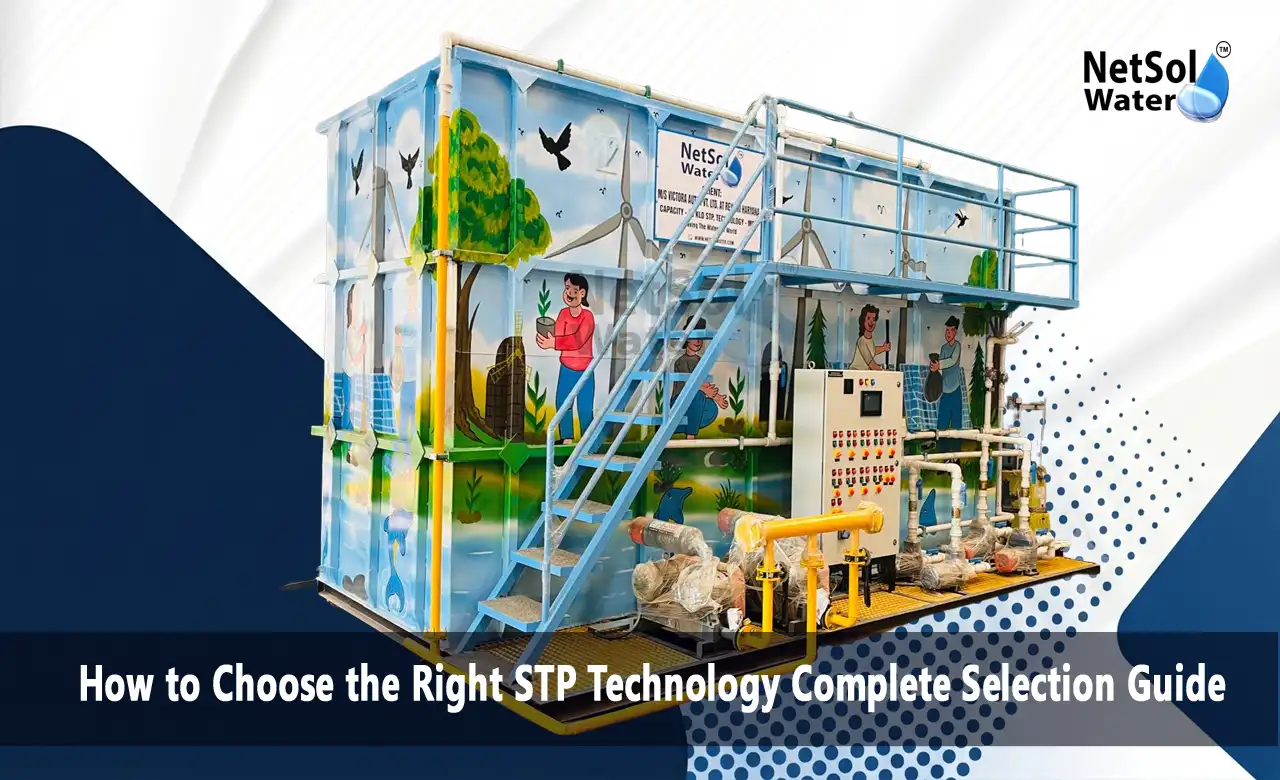
STP Technology Selection Guide: MBBR vs MBR vs SBR vs ASP vs IFAS vs FAB
Picking a sewage treatment technology is one of those decisions that seems straightforward until you actually sit down with three vendor quotations and realize they're not even comparing the same thing. It's also a decision that quietly shapes a project for the next fifteen to twenty years. Choose poorly, and you end up with a plant that blows the monthly budget, chokes during peak load, or sits there half-working because nobody on-site knows how to run it properly.
Membrane Bioreactor (MBR), Integrated Fixed-Film Activated Sludge (IFAS), and Fluidized Aerobic Bed (FAB). Each one earns its place depending on land availability, budget structure, whether treated water needs to be reused, and something people tend to forget until it's too late: how skilled the person operating the plant actually needs to be.
This guide walks through all six in real depth, looking at capital cost, O&M cost, power consumption, footprint, effluent quality, operator skill requirement, sludge production, and where each one genuinely makes sense.
What Each Technology Actually Does?
Before jumping into comparisons, it helps to understand the basic working of each system, because almost every difference in cost and performance traces back to this.
. Activated Sludge Process (ASP) is the oldest and most familiar biological treatment method still around. Wastewater mixes with a suspended culture of microorganisms inside an aeration tank, where continuous air keeps the biomass active. This mixture then moves to a secondary clarifier, where the biological floc settles and clear water rises to the top. Some settled sludge gets returned to the aeration tank to keep biomass levels steady, and the rest is wasted out for disposal.
. Sequencing Batch Reactor (SBR) is really ASP rearranged around time instead of space. Rather than having separate tanks for aeration and settling, one single tank cycles through phases: fill, react, settle, decant, idle. Since everything happens in the same tank, there's no separate clarifier needed, which saves on civil work. The trade-off is that SBR leans heavily on automation, timers, sensors, and decanting equipment, to keep the cycle running correctly.
. Moving Bed Biofilm Reactor (MBBR) adds free-floating plastic media into the aeration tank. Bacteria grow on the surface of this media as a biofilm and treat the wastewater passing through. Because a good chunk of biomass is attached to media instead of just floating around, MBBR tanks hold more active biomass per cubic meter, so tanks can be smaller for the same load. The air used for treatment also keeps the media tumbling around, so it's doing two jobs at once.
. Integrated Fixed-Film Activated Sludge (IFAS) is basically a hybrid of ASP and MBBR. It keeps the suspended growth biomass of ASP but adds media inside the same tank for an attached growth component too. This bumps up biomass density without needing a whole new system design, which is exactly why it's popular for upgrading existing ASP plants that need more capacity but don't have room to expand.
. Fluidized Aerobic Bed (FAB) uses a bed of inert media (sand, activated carbon, or specialized plastic carriers) kept suspended by upward air and water flow. Like MBBR, biomass grows as a biofilm on the media, but fluidization creates a lot more surface contact between wastewater and biomass, which makes FAB good at handling loads that swing around a lot. You'll see this often in industrial effluent treatment.
. Membrane Bioreactor (MBR) pairs biological treatment with membrane filtration, and this replaces the secondary clarifier entirely. After biological treatment in the aeration tank (similar to ASP), the mixed liquor passes through ultrafiltration or microfiltration membranes. This membrane acts as a physical barrier, blocking suspended solids, bacteria, and most pathogens, and the result is exceptionally clean water, often good enough for direct reuse without much further polishing.
Capital Cost (CAPEX)
Capital cost is usually the first thing a project gets filtered through, mostly because it's the number that has to get approved before anything else even gets discussed.
ASP comes in cheapest upfront. It's a conventional technology, the tanks are basic rectangular or circular structures, and the equipment (blowers, diffusers, clarifiers) is widely manufactured and reasonably priced. There's no membrane or proprietary media sitting in the bill of quantities, which is a big part of why ASP is still the default pick for large municipal jobs where every rupee of capital cost gets scrutinized line by line.
SBR sits at a moderate cost. Skipping the separate clarifier tank saves on civil work, but that saving gets partly offset by the automation package, control panels, sensors, decanters, that SBR needs to function.
MBBR usually lands slightly above ASP, mainly because of the biomedia itself, which isn't cheap depending on the brand and surface area required. That said, since MBBR tanks are often smaller, the civil cost savings can offset the media cost, especially where land or excavation is expensive.
IFAS tends to sit a notch above MBBR. Because it combines suspended growth infrastructure (like ASP) with a media system (like MBBR), you're essentially paying for both, even if the media portion is scaled down.
FAB costs roughly the same as MBBR, though it varies depending on whether the media is fixed or fully fluidized, and how strong the aeration or circulation system needs to be.
MBR is, without much argument, the most expensive option here. The membrane modules alone drive up cost significantly, since these are precision-manufactured components. MBR also needs finer pre-treatment screening (usually 1 to 3mm) to protect the membranes, which adds further equipment cost that the other five don't really need.
Cost ranking, low to high: ASP, then SBR/MBBR/FAB roughly together, then IFAS, then MBR clearly on top.
O&M Cost (Operations & Maintenance)
This is where the real financial story unfolds, and it's the number that catches a lot of buyers off guard once year two rolls around.
. ASP: Low to moderate. Main recurring costs are sludge handling and periodic clarifier upkeep.
. SBR: Moderate, mostly because of the automation system needing regular servicing and calibration.
. MBBR: Low relative to what it delivers. Media is inert and doesn't need frequent replacing, and sludge production is lower than ASP.
. IFAS: Moderate, since it inherits both ASP's sludge handling and MBBR's media upkeep.
. FAB: Moderate and fairly predictable, mostly tied to energy for maintaining fluidization.
. MBR: Highest by a good margin. Membranes need regular chemical and physical cleaning, periodic replacement (commonly every 5 to 10 years depending on usage), and the fine screens ahead of them need consistent attention too.
MBR's cost here is worth sitting with for a moment, because it's the one people underestimate the most. The technology's excellent output quality really depends on it being maintained properly, which is why a lot of MBR installations come with a formal AMC arrangement rather than being handed to an untrained in-house team.
Power Consumption
Aeration and mechanical equipment drive most of the electricity bill for any biological STP, but the intensity really varies across these six.
| Technology | Power Level | Why |
|---|---|---|
| ASP | Moderate | Continuous aeration blowers running round the clock |
| SBR | Moderate to high | Intensive aeration cycles plus decanter and mixer load |
| MBBR | Moderate | Aeration does double duty, treating water and moving media |
| IFAS | Moderate to high | Needs to aerate both suspended and attached biomass |
| FAB | Moderate to high | Higher air/water velocity needed to keep media fluidized |
| MBR | Highest | Continuous membrane scouring plus permeate pump load |
MBR's power draw deserves a specific mention. Along with regular biological aeration, MBR systems need continuous membrane scouring, essentially a steady stream of air bubbles across the membrane surface to stop solids from clogging it up. That runs almost non-stop during operation, and permeate pumps (which pull treated water through the membrane) add even more load on top. For any project where electricity cost is a real long-term concern, this is one of the biggest trade-offs to weigh against MBR's water quality.
Footprint (Land Requirement)
For urban plots, hotels, hospitals, and residential towers, footprint often decides the technology before cost is even seriously discussed, mainly because there's just no extra land to negotiate with.
The larger footprint end:
. ASP needs a separate aeration tank, secondary clarifier, and sludge handling area, none of which compress well without hurting performance. Fine for sites with room to spare, a dealbreaker for tight urban plots.
. SBR is moderate, smaller than ASP since there's no separate clarifier, but it still needs enough volume to run a full batch cycle.
The compact end:
. MBBR is genuinely compact. Because biomedia raises the biomass density per cubic meter, tanks can often shrink by 30 to 50% compared to ASP for the same load.
. IFAS is compact to moderate, smaller than pure ASP thanks to its media, though not quite as tight as MBBR or MBR since it still carries ASP's suspended growth infrastructure alongside the media.
. FAB is compact too, for the same reason as MBBR, media-supported biomass allows higher loading in a smaller reactor.
. MBR has the smallest footprint of all, by a clear margin. Membranes replace the clarifier entirely, and MBR can run at much higher biomass concentration (often 8,000 to 12,000 mg/L MLSS versus 2,000 to 4,000 mg/L in ASP), meaning even the biological tank shrinks. This is exactly why MBR shows up so often in building basements, hospitals, and any site where every square foot has already been accounted for.
Effluent Quality
This is where the technology choice starts to line up with what actually happens to the water afterward, whether it's discharged, used for gardens, or piped back for flushing and cooling.
ASP produces good quality effluent, generally fine for sewer discharge or basic land application, but it usually needs an additional tertiary stage (sand filtration, disinfection) before it's suitable for direct reuse.
SBR gives good to very good quality, and one of its real advantages is nutrient removal. Since the cycle has distinct aerobic and anoxic phases, nitrogen and phosphorus removal can be tuned more precisely than in continuous-flow ASP.
MBBR gives good quality, generally on par with ASP, and sometimes more consistent since the attached biofilm handles shock loads better than fully suspended biomass.
IFAS produces very good quality, benefiting from having both suspended and attached biomass working together, different microbial populations can establish in each environment, which improves overall robustness.
FAB gives good to very good quality and stands out for staying stable even when hydraulic loads swing around, which is a big part of why it's popular in industrial settings.
MBR sits at the top, clearly. The membrane barrier removes suspended solids and nearly all pathogens, with effluent turbidity typically well under 1 NTU. This water is often clean enough for direct reuse in flushing, irrigation, or cooling tower makeup, with little or no further treatment needed. This single point is really why MBR commands the price it does.
Operator Skill Requirement
A plant is only as good as whoever's actually running it day to day, and this gets overlooked far more often than it should during the buying decision.
Technologies that are more forgiving:
. ASP needs low to moderate skill. It's conventional and most trained operators already know it well, which makes staffing and troubleshooting easier, especially outside major cities.
. MBBR also needs low to moderate skill. It's a relatively forgiving process, the media doesn't need active management, and the system tends to recover on its own from minor upsets.
Technologies needing more hands-on expertise:
. SBR needs moderate to high skill because of its automation. Diagnosing a PLC fault or recalibrating a sensor takes more technical comfort than running a conventional plant.
. IFAS sits at moderate, operators need a working understanding of both suspended and attached growth, since problems can come from either side.
. FAB needs moderate skill too, similar to MBBR, but with extra attention needed to keep the media properly fluidized, too little flow and it doesn't fluidize, too much and you start losing media.
. MBR needs the highest skill by a clear margin. Operators need specific training in membrane cleaning (chemical and physical), spotting early signs of fouling before it turns into a costly problem, and precise chemical dosing. This is probably the most overlooked part of choosing MBR: its excellent performance really depends on being run correctly. A poorly maintained MBR system can see membrane life drop fast, turning what looked like a smart capital decision into an expensive ongoing headache.
Sludge Production
Sludge disposal is a recurring monthly cost that rarely gets enough attention during technology selection, but it shows up like clockwork on every maintenance bill afterward.
| Technology | Sludge Output | Notes |
|---|---|---|
| ASP | High | Suspended growth naturally multiplies more biomass |
| SBR | Moderate to high | Still fundamentally a suspended growth process |
| MBBR | Low | Attached biomass is more stable, less excess growth |
| IFAS | Moderate | Somewhat lower than ASP due to the media component |
| FAB | Low | Similar logic to MBBR |
| MBR | Low to moderate | Longer sludge age possible, though this varies by design |
Best Applications
Matching the technology to the actual application is where everything above really comes together.
. ASP fits large municipal plants, industrial estates, and any project where land isn't tight and the conversation is mostly about capital cost.
. SBR suits mid-size municipal or institutional plants that need solid nutrient removal with a moderate footprint, townships, campuses, that kind of setting.
. MBBR works well for retrofitting existing plants that need more capacity, along with hotels and mid-size developments where compactness matters but MBR is out of budget.
. IFAS is the natural pick for upgrading an existing ASP plant without tearing it down, or for sites expecting variable loads, seasonal hotel occupancy or fluctuating industrial output.
. FAB does well with industrial effluent, especially where flow and strength change through the day.
. MBR is the go-to for hospitals, IT parks, malls, high-rise residential towers, and any site where reuse is the goal or land is simply too tight for anything else.
Decision Matrix
| Factor | ASP | SBR | MBBR | IFAS | FAB | MBR |
|---|---|---|---|---|---|---|
| Capital Cost | Low | Moderate | Moderate | Mod-High | Moderate | High |
| O&M Cost | Low-Mod | Moderate | Low | Moderate | Moderate | High |
| Power Use | Moderate | Mod-High | Moderate | Mod-High | Mod-High | High |
| Footprint | Large | Moderate | Compact | Compact-Mod | Compact | Smallest |
| Effluent Quality | Good | Very Good | Good | Very Good | Good-VG | Best |
| Operator Skill | Low-Mod | Mod-High | Low-Mod | Moderate | Moderate | High |
| Sludge Output | High | Mod-High | Low | Moderate | Low | Low-Mod |
| Reuse Ready | No | Partial | Partial | Partial | Partial | Yes |
So Which One Should You Actually Pick?
Here's a quick way to cut through all of it:
. Tight budget, land is available, no reuse needed: go with ASP.
. Need good nutrient removal, moderate space: SBR works well if you're okay maintaining the automation.
. Upgrading an old plant, or need something compact on a reasonable budget: MBBR is usually the sweet spot.
. Existing ASP plant that needs more capacity without new civil work: IFAS was practically built for this.
. Industrial effluent that swings around in strength or flow: FAB typically handles this better than the others.
. Land-starved site, direct reuse needed, budget allows it: MBR is the one to go with.
None of these six is universally "the best." The right one is whichever matches your site conditions, your budget across the plant's whole lifetime (not just the day-one number), and the real skill level of whoever's going to run it once the commissioning team packs up and leaves.
About NetSol
At NetSol, we work with residential townships, hospitals, hotels, and industrial sites to design and install STPs that actually fit the site, not a generic package pulled off a shelf. Our team looks at flow patterns, available space, reuse goals, and long-term running costs before recommending anything, whether that ends up being a straightforward ASP setup for a large municipal-scale project, a compact MBBR retrofit for a hotel with limited land, or a full MBR system for a hospital chasing high-quality reuse water.
We handle the full lifecycle of a project, from feasibility assessment and technology selection through design, installation, and commissioning, all the way to ongoing operation and maintenance support. That way the plant keeps performing well after the day it's officially handed over. Our focus stays on getting the technology decision right the first time, because a mismatched STP tends to cost a lot more over its life than it ever saves on the first invoice.
Conclusion
Choosing between ASP, SBR, MBBR, IFAS, FAB, and MBR really isn't about picking whatever's trending in the market right now. It comes down to properly matching capital cost, running cost, footprint, effluent quality, and operator capability to your actual project. A moderately priced system your team can run well, day after day, will outperform an expensive high-spec system that just sits there underused because nobody on-site can maintain it.
If you're currently weighing STP options for a project, NetSol can walk you through this decision with a proper site assessment instead of guesswork. Get in touch with us to figure out which technology genuinely fits your site, your budget, and your long-term operating plan.
FAQs
Q1. Which STP technology has the lowest running cost?
MBBR generally has the lowest ongoing O&M cost of the six, thanks to low sludge production and minimal media upkeep, while still delivering solid effluent quality.
Q2. Is MBR always the best pick if budget isn't an issue?
Not really. MBR gives the best effluent quality and smallest footprint, but it also needs the most skilled operator and the strictest maintenance routine. Without a trained team or a good AMC partner, a simpler technology might actually run more reliably day to day.
Q3. Can an existing ASP plant be upgraded without tearing it down?
Yes, IFAS is built exactly for this. Adding biofilm media into an existing ASP tank increases capacity without needing new civil construction, which makes it a practical route for plants that have outgrown their original design.
Q4. Which technology is best for reusing treated water, like flushing, irrigation, or cooling towers?
MBR is the strongest option here thanks to its filtration quality and consistently low turbidity. SBR, IFAS, and FAB can support reuse too, but they usually need an extra polishing stage to get there.
Q5. How much does footprint really differ between MBBR and ASP?
MBBR typically needs 30 to 50% less tank volume than ASP for the same load, since biomedia increases how much active biomass fits in the same space. For tight plots, that difference alone often settles the decision.
Q6. Does a more advanced technology always mean more sludge?
Actually, no, it's often the opposite. MBR and MBBR tend to produce less excess sludge than ASP and SBR, since their biomass retention characteristics slow down how much sludge needs to be wasted regularly.
Q7. How do I choose between SBR and FAB for an industrial setup?
SBR suits consistent, batch-style flows with defined nutrient removal targets, while FAB handles fluctuating industrial loads and variable effluent strength more comfortably, which is why it shows up often in industrial pre-treatment or standalone stages where flow and strength change a lot through the day.