

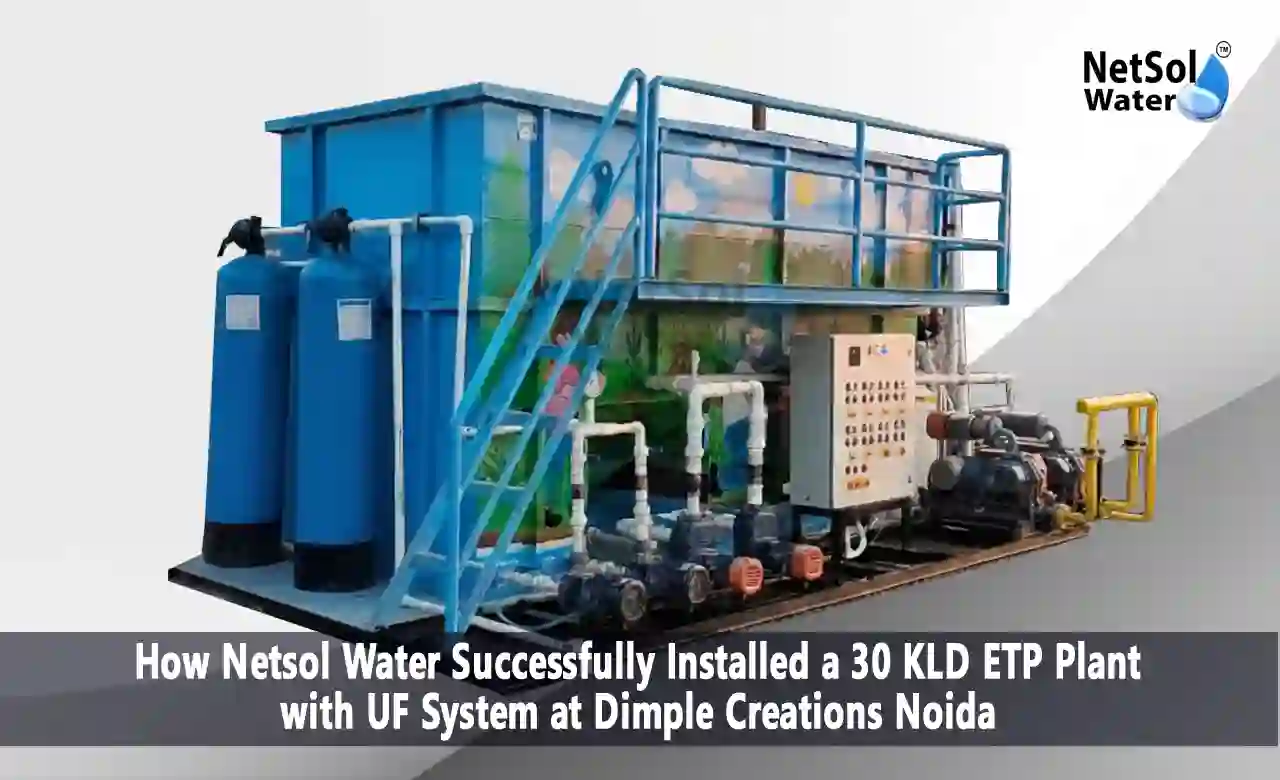
Case Study: 30 KLD ETP Plant with UF System Installed at Dimple Creations, Noida
In the textile and garment industry, water is both a critical resource and a major waste stream, and treating it responsibly is no longer optional. This case study looks at how Netsol Water designed, built and commissioned a 30 KLD ETP Plant with UF System for Dimple Creations, a garment manufacturing unit in Noida, Uttar Pradesh. Facing variable, colour and organic-heavy effluent, the client needed a compact treatment plant that could meet pollution control norms while opening the door to water reuse. The following pages walk through the challenges, the engineering approach and the results of an Effluent Treatment Plant tailored to the realities of textile industry wastewater treatment.
Project Snapshot
| Parameter | Details |
|---|---|
| Project Title | 30 KLD ETP Plant with UF System |
| Client | Dimple Creations |
| Location | Noida, Uttar Pradesh |
| Industry | Textile / Garment Manufacturing |
| Plant Capacity | 30 KLD (Kilolitres per Day) |
| Core Technology | Effluent Treatment Plant (ETP) with Ultrafiltration (UF) System |
| Executed By | Netsol Water |
| Project Status | Successfully Installed and Commissioned |
| Scope | Design, Engineering, Manufacturing, Installation, Testing and Commissioning |
About the Client
Dimple Creations is a textile and garment manufacturing unit based in Noida, Uttar Pradesh, operating within one of North India's most active industrial corridors. Garment manufacturing of this kind typically involves processes such as fabric washing, dyeing or post-dyeing finishing, rinsing and laundering, each of which consumes significant volumes of water and, in turn, generates a steady stream of process wastewater.
Like most units in the textile and garment segment, the client's day-to-day operations produced effluent that could not be discharged into the environment or a municipal sewer in its raw state. The wastewater carried a mix of dissolved organics, suspended solids and colour-bearing compounds that required structured treatment before disposal or reuse. Recognising both the regulatory obligation and the operational value of treating this water on-site, the client approached Netsol Water for a purpose-built solution.
Project Background
Textile and garment manufacturing is among the more water-intensive industrial activities, and it is equally significant as a source of industrial wastewater. Wash and rinse cycles release detergents and surfactants, while dye-house and finishing operations contribute colour, organic load and suspended matter. Left untreated, this effluent poses a genuine environmental risk and exposes the manufacturer to non-compliance with State and Central pollution control board norms.
For Dimple Creations, installing a reliable Effluent Treatment Plant was not simply a box-ticking exercise. The unit needed a system that could keep pace with its production schedule, handle the natural fluctuation in effluent strength and volume across a working day, and consistently produce treated water that met discharge standards. Equally important, the client wanted to move toward water reuse, reducing dependence on fresh water and lowering the long-term cost and footprint of operations.
The brief to Netsol Water was therefore clear: design and deliver a compact, dependable ETP plant in Noida that would achieve regulatory compliance, support water recovery and run efficiently without demanding constant manual intervention. For a requirement of this kind, the client needed an experienced ETP Plant Manufacturer for Textile Industry operations, one that understood the specific contaminant profile of garment effluent rather than a generic treatment supplier.
Client Requirements
During the requirement-gathering and design phase, Netsol Water worked with the client to define the project around a set of practical, measurable expectations:
1. Treatment Capacity
A treatment capacity of 30 KLD, sized to match the unit's daily effluent generation with adequate buffering for peak-load periods.
2. Water Quality Standards
Treated water quality that meets the applicable discharge parameters, with the additional clarity and consistency required if the water is to be reused on-site. The Ultrafiltration stage was specified precisely to push final water quality beyond conventional ETP outputs.
3. Compliance Requirements
Full alignment with the discharge norms prescribed by the Uttar Pradesh Pollution Control Board (UPPCB) and the Central Pollution Control Board (CPCB).
4. Operational Efficiency
A plant that is straightforward to operate, energy-aware and built around components that the client's team can run and maintain with reasonable training and minimal downtime.
5. Future Sustainability Goals
A treatment train that positions the client for water recycling and resource recovery, supporting a lower freshwater draw and a credible environmental, social and governance (ESG) story for the business.
Challenges Identified
Before implementation, Netsol Water's engineering team assessed the conditions on the ground and identified several technical and operational challenges that the design would need to address:
• Variable effluent characteristics: Garment-unit effluent fluctuates through the day as different processes run. Strength (organic load) and flow can swing considerably, and a treatment system that is not buffered against this will suffer shock loads and inconsistent output.
• Colour and organic load: Dye and finishing chemistry contributes colour and a meaningful organic burden that conventional primary treatment alone does not fully resolve.
• Space constraints: Industrial units in built-up zones such as Noida often have limited footprint available for a treatment plant, so the design needed to be compact without compromising performance.
• Consistent final water quality: Achieving a stable, low-turbidity output suitable for reuse, not just for discharge, raised the bar on the tertiary treatment stages.
• Reliable, low-intervention operation: The client needed a plant that performed dependably day after day without requiring specialised round-the-clock supervision.
Wastewater Analysis
The nature of the raw effluent drives every downstream design decision, so understanding the contaminant profile was the starting point. Wastewater from textile and garment operations is generally characterised by:
• High and fluctuating COD and BOD, reflecting dissolved and biodegradable organic matter from washing, dyeing and finishing.
• Colour, introduced by residual dyes and auxiliaries.
• Total Suspended Solids (TSS), including lint, fibres and fine particulates.
• Variable pH, which can trend alkaline depending on the wash chemistry used.
• Surfactants and detergents, along with oil and grease in some streams.
• Total Dissolved Solids (TDS), which can be elevated where salt-based dyeing or fixing is involved.
The table below presents representative influent characteristics for textile/garment effluent of this kind. These are realistic, typical figures for such a unit; they should be cross-checked against the project's actual wastewater analysis report before being cited as measured values.
| Parameter | Representative Raw Effluent Value |
|---|---|
| pH | 7.5 - 9.0 (mildly to moderately alkaline) |
| COD | Approximately 1,000 mg/L |
| BOD | Approximately 350 mg/L |
| TSS | Approximately 300 mg/L |
| TDS | Approximately 2,000 mg/L |
| Colour | Dark, dye-bearing |
| Oil & Grease | Approximately 15 mg/L |
Netsol Water's Proposed Solution
After evaluating the effluent profile, the discharge and reuse objectives and the site constraints, Netsol Water proposed an Effluent Treatment Plant integrated with an Ultrafiltration (UF) System.
The logic behind this configuration is straightforward. A conventional ETP, built around biological treatment and settling, does an excellent job of reducing organic load and suspended solids. However, for water that needs to be reused, or that must meet a tighter clarity and turbidity specification, an additional polishing barrier delivers a step change in quality. That is the role of the UF system: a membrane stage that removes fine colloidal matter, residual suspended solids and micro-organisms, producing a clear, consistent permeate.
This ETP Plant with UF System was customised to the client in several ways. The capacity was fixed at 30 KLD to match daily generation with peak buffering. The biological stage was sized for the organic load, and the tertiary train (sand filtration, carbon adsorption and UF) was specified to take the water beyond basic discharge quality toward reuse readiness. The overall layout was kept compact to fit the available footprint, and component selection favoured dependable, maintainable equipment suited to a single-shift or multi-shift industrial operator.
Plant Design and Components
The 30 KLD ETP plant was engineered as an integrated train in which each unit performs a defined function and feeds cleanly into the next.
1. Screening and Raw Effluent Collection
Raw effluent is first screened to remove lint, fibre, fabric scraps and other coarse solids that would otherwise foul pumps and downstream equipment. The screened effluent is collected in a raw effluent sump.
2. Equalisation Tank
The equalisation tank buffers the plant against the natural swings in flow and organic strength across the day. By homogenising the effluent and releasing it at a controlled rate, it protects the biological stage from shock loads. Air mixing in this tank keeps solids in suspension and prevents the effluent from turning septic. pH correction is typically managed at this stage where required.
3. Aeration System (Biological Treatment)
The aeration tank is the biological heart of the plant. Here, a population of aerobic micro-organisms metabolises the dissolved and biodegradable organic matter, driving down BOD and a significant portion of COD. The aeration system supplies the dissolved oxygen the biomass needs to remain active and efficient.
4. Clarifier (Secondary Settling)
From aeration, the mixed liquor passes to the clarifier, where gravity separation allows the biological sludge to settle out from the treated water. Clarified supernatant moves forward to tertiary treatment, while settled sludge is partly returned to maintain the biomass and partly wasted to the sludge handling system.
5. Pressure Sand Filter (PSF)
The pressure sand filter removes residual suspended solids and turbidity through depth filtration across graded media. This protects and prolongs the life of the downstream carbon and membrane stages.
6. Activated Carbon Filter (ACF)
The activated carbon filter polishes the water further by adsorbing residual colour, dissolved organics and odour-causing compounds, an especially valuable step given the dye-related colour load typical of garment effluent.
7. Ultrafiltration (UF) System
The UF system is the final barrier and the defining feature of this plant. Its membranes reject fine colloidal particles, residual suspended solids and micro-organisms, producing a clear, low-turbidity permeate with consistent quality. This is the quality of water that makes safe discharge straightforward and on-site reuse genuinely viable.
8. Sludge Handling System
Sludge generated by the biological and settling stages is collected, thickened and dewatered so that it can be handled and disposed of safely and in a reduced volume, keeping the plant clean and manageable.
Treatment Process Flow
The complete treatment sequence moves the effluent from raw, contaminated wastewater to clear, reusable water through the following steps:
1. Raw effluent collection and screening removes coarse solids and lint.
2. Equalisation buffers flow and load fluctuations and conditions the effluent (including pH correction where needed).
3. Aerobic biological treatment in the aeration tank breaks down organic matter, reducing BOD and COD.
4. Secondary clarification separates biological sludge from the treated water.
5. Pressure sand filtration strips out residual suspended solids and turbidity.
6. Activated carbon adsorption removes residual colour, dissolved organics and odour.
7. Ultrafiltration delivers the final polish, producing clear permeate of consistent quality.
8. Treated water output is then suitable for compliant discharge or for reuse in non-critical applications.
9. Sludge handling runs in parallel, thickening and dewatering the solids removed along the way.
Project Execution
Netsol Water managed the project end to end, taking ownership of every phase from concept to a running plant.
1. Engineering and Design
The team translated the client's requirements and the effluent analysis into a detailed plant design, sizing each unit operation, selecting equipment and planning a layout that fit the available space.
2. Manufacturing
Tanks, equipment skids and the treatment units were fabricated and assembled to the engineered specifications, with quality checks built into the manufacturing process.
3. Installation
The plant was installed on-site at the client's premises in Noida, with mechanical, piping and electrical works integrated into a coherent, operable system.
4. Testing
Once installed, the plant underwent functional testing to confirm that each unit operated as designed and that the train performed as an integrated whole.
5. Commissioning
The plant was commissioned with live effluent, the biological process was stabilised, and treated water quality was confirmed against the target parameters before the plant was handed over as a fully operational system.
The project reached the status of successfully installed and commissioned.
Technologies Used and Their Role
| Technology | Primary Role |
|---|---|
| Equalisation Tank | Balances flow and organic load; protects downstream biology from shock loads. |
| Aeration System | Aerobic biological breakdown of organic matter; major BOD and COD reduction. |
| Clarifier | Gravity separation of biological sludge from treated water. |
| Pressure Sand Filter | Removal of residual suspended solids and turbidity. |
| Activated Carbon Filter | Adsorption of residual colour, dissolved organics and odour. |
| UF System | Membrane polishing; removes fine colloids, residual solids and micro-organisms for reuse-grade clarity. |
| Sludge Handling System | Thickening and dewatering of waste sludge for safe, reduced-volume disposal. |
Results Achieved
With the plant commissioned and stabilised, the treatment train delivers the multi-stage reduction in contaminant load that the combination of biological treatment, conventional filtration and UF membrane polishing is designed to provide.
The table below shows the plant's performance using representative inlet and outlet values for an ETP with UF system treating textile/garment effluent. The figures are realistic and internally consistent for this configuration; please confirm them against the verified commissioning data before publishing them as measured results.
| Parameter | Raw Effluent (Inlet) | Treated Water (Outlet) | Reduction |
|---|---|---|---|
| pH | 7.5 - 9.0 | 6.5 - 8.0 | Neutralised |
| COD | Approx. 1,000 mg/L | Below 100 mg/L | Approx. 90% |
| BOD | Approx. 350 mg/L | Below 20 mg/L | Approx. 94% |
| TSS | Approx. 300 mg/L | Below 10 mg/L | Approx. 97% |
| Turbidity | High | Below 1 NTU | Low after UF |
| TDS | Approx. 2,000 mg/L | Approx. 1,900 mg/L | Largely unchanged |
A technical note on TDS: ultrafiltration removes suspended and colloidal matter and micro-organisms, but it does not remove dissolved salts, so TDS stays broadly unchanged through this train. If the client later needs TDS reduction for higher-grade reuse, a reverse osmosis (RO) stage would be added after the UF system.
In qualitative terms, the achieved outcomes are:
• Improved water quality, with clear, low-turbidity treated water leaving the UF stage.
• Reduction in COD, BOD and TSS through the combined biological and tertiary treatment train.
• Compliance with discharge norms, with the treated water comfortably within the general CPCB inland surface water discharge standards (broadly BOD up to 30 mg/L, COD up to 250 mg/L, TSS up to 100 mg/L and pH 5.5 to 9.0). These limits should be confirmed against the specific consent conditions for the site, as they vary by discharge route and may be revised over time.
• Improved operational efficiency, through a buffered, integrated design that runs consistently with manageable supervision.
Benefits to the Client
The completed 30 KLD ETP Plant with UF System delivers value across business, environmental and operational dimensions:
• Regulatory compliance and risk reduction: Treated water that meets discharge requirements protects the business from non-compliance exposure and supports its consent to operate.
• Water reuse and lower freshwater cost: UF-grade treated water opens the door to on-site reuse in suitable applications, reducing freshwater draw and the associated cost over time.
• Sustainability and ESG positioning: On-site treatment and recovery strengthen the unit's environmental credentials, an increasingly important factor for buyers and partners in the textile supply chain.
• Operational stability: A buffered, well-integrated plant runs predictably, with the sludge handling system keeping the facility clean and manageable.
• A scalable foundation: The treatment train provides a sound basis for future enhancements, such as adding a reverse osmosis stage if the client later targets higher levels of water recovery.
Project Video
You can see the 30 KLD ETP Plant with UF System for Dimple Creations in the project video here:
The video offers a real-world look at the installed and commissioned plant. Viewers can expect to get a sense of the plant layout and footprint, the major treatment units in operation, and the clarity of the treated water that the ETP with UF system produces. For prospective clients in the textile and garment sector evaluating their own effluent treatment needs, a walkthrough like this is a useful way to understand how a compact, well-engineered industrial ETP plant comes together in practice.
Why Netsol Water?
Netsol Water designs, manufactures and commissions effluent and wastewater treatment plants for industrial clients, and this project reflects the capabilities that industries look for in an ETP plant manufacturer in Noida and across India. As an ETP Plant Manufacturer for Textile Industry requirements specifically, the team brings a practical understanding of the colour, organic load and flow variability that define garment-sector effluent:
• End-to-end engineering capability: From effluent analysis and process design through manufacturing, installation, testing and commissioning, the project was delivered as a single, accountable scope.
• Customisation, not templates: The treatment train, capacity and tertiary stages were configured around this client's specific effluent profile, site constraints and reuse goals rather than dropped in as a standard package.
• Technology depth: The integration of biological treatment with conventional filtration and a UF membrane stage demonstrates a command of both established and advanced treatment technology.
• Compliance focus: The plant is built to help clients meet pollution control board requirements dependably.
• After-sales support: Long-term plant performance depends on responsive support, and Netsol Water positions itself to stand behind the systems it installs.
Conclusion
The 30 KLD ETP Plant with UF System delivered for Dimple Creations in Noida is a clear example of how thoughtful engineering turns a regulatory obligation into an operational and environmental asset. By combining proven biological treatment with multi-stage filtration and an Ultrafiltration polishing barrier, Netsol Water provided the client with a compact, reliable plant that targets compliant discharge, supports water reuse and lays a foundation for future sustainability gains.
For a textile and garment manufacturer, treating wastewater well is no longer optional; it is part of running a responsible, future-ready business. This project shows what that looks like in practice: a successfully installed and commissioned industrial ETP that does its job day after day.
Ready to Treat Your Industrial Wastewater the Right Way?
If your facility generates industrial effluent and you need a compliant, efficient and customised treatment solution, Netsol Water can help. As an experienced ETP Plant Manufacturer for Textile Industry and other industrial clients, we deliver ETP, STP and water recycling systems built around your effluent and your goals, including dedicated textile industry wastewater treatment.
Contact Netsol Water today to discuss a customised Effluent Treatment Plant with UF System for your operation, and take a confident step toward compliance, water reuse and long-term sustainability.