

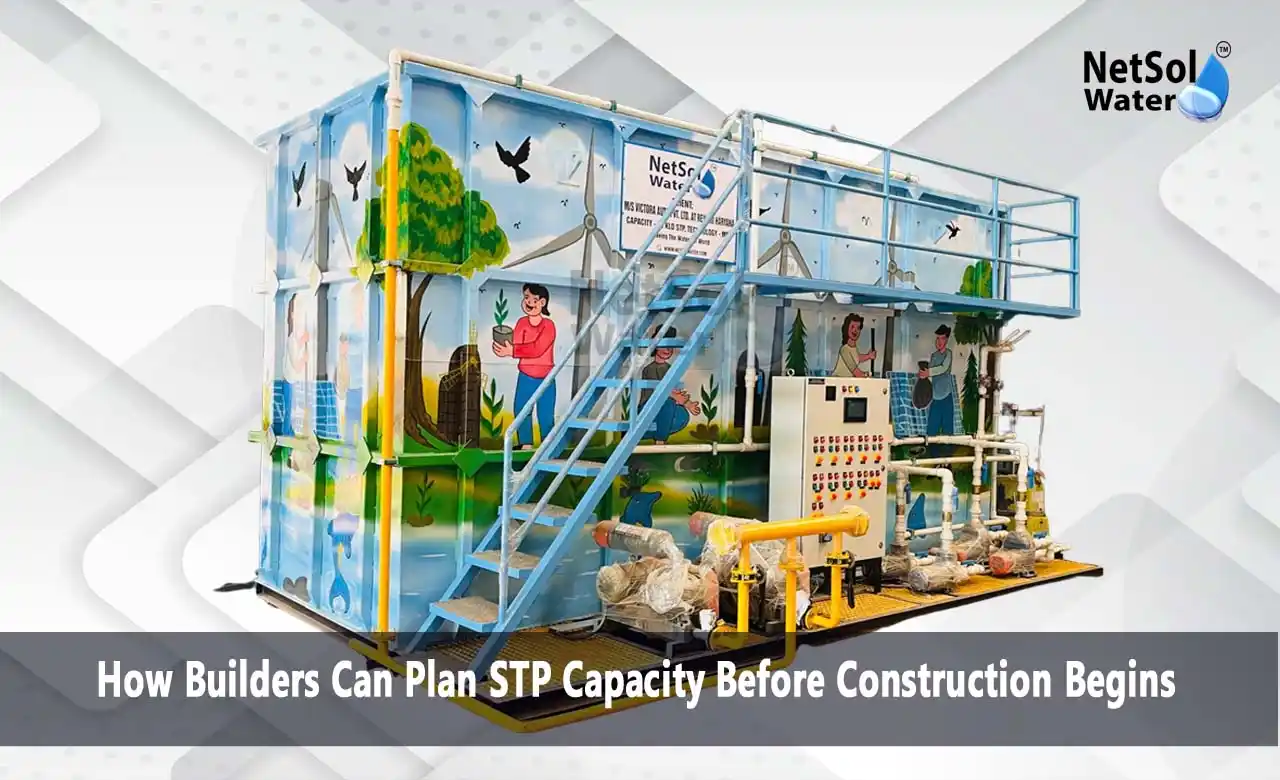
How Builders Can Plan STP Capacity Before Construction?
For residential projects, commercial buildings, hotels, hospitals, schools and large developments, planning a Sewage Treatment Plant (STP) prior to construction is necessary. The sewage produced by the completed project should be able to be treated without overloading or oversizing the STP.
The designers of the STP can prevent these costly modifications later in the project by making provisions for its STP capacity at the planning stage. Good planning helps design the spaces, plumbing, water reuse, meet regulations, and costs of operations over the years.
Estimate the Number of Users
The first is to calculate the number of users of the building when it is completed. This will be the number of people expected to live in the residence for residential projects. In the case of commercial buildings, employees, visitors, customers and other regular users should be taken into consideration.
The number of expected occupiers should not be solely based on the number of occupants in the initial stages of the project, but rather on the number of occupants as approved by the project. This gives a more realistic prediction of future sewage production.
Calculate Daily Water Consumption
The amount of sewage generated will closely correspond with the amount of daily water consumption. Builders should take into account how much water they can expect to use per person / per occupant per day.
Wastewater is generated when water is used for drinking, bathing, washing, flushing toilets, in the kitchen, and other household purposes. But not everything water coming into a building translates to sewage. Water used for gardening, cooling, firefighting and other uses may travel other routes.
The accurate calculation of water-use helps to determine an achievable STP capacity.
Estimate Sewage Generation
Once the water demand is calculated, the water builders can estimate the amount of sewage generation which will get to the STP.
One of the commonly accepted methods of planning is to assume a percentage of the total domestic use as sewage generation. The exact value should be decided based on the actual usage pattern, local requirements and design of the project.
Peak flows should also be taken into account in the calculation since the sewage generation is not even throughout the day.
Consider Peak Sewage Flow
STP need not only be based on the average daily sewage production. Residential and commercial buildings have periods of time where the amount of peak sewage flow exceeds normal levels.
Sewage may flood in a short period during the morning hours, evening hours and other periods of use. These variations should be accommodated in the collection system, equalization arrangement, pumps and treatment units to prevent overflow and poor treatment.
Plan for Future Occupancy
Occupancy of buildings can change following construction. Residential communities can fill up over time and commercial spaces can hire staff or have tenants.
The final occupancy of the building should be taken into account when determining the capacity of an STP. If a reasonable design margin is maintained, the property is not likely to be overloaded when it starts to become fully operational.
However, additional capacity should not be added that is too great as an oversized STP can lead to higher capital cost and may not be efficient in operation at very low flow situations.
Consider the Type of Building
The STP design is different for various types of development. Domestic sewage is typically generated at a residential apartment complex, and wastewater characteristics and flow rate may vary for hotels, hospitals, malls and commercial facilities.
. Residential Complexes
Generate fairly consistent domestic sewage patterns based on household use.
. Hotels
Occupancy — and therefore wastewater load — can vary seasonally.
. Hospitals
Contaminants may necessitate extra treatment considerations due to the nature of hospital wastewater.
. Commercial Buildings and Malls
Can have significant fluctuations in wastewater flow throughout the day.
The actual wastewater usage pattern and building wastewater characteristics should therefore be similar to the STP design.
Plan Space for the STP
Incorporate STP planning before construction as the plant needs specific area for treatment tanks, pumps, blowers, electrical panels, sludge handling and other plant equipment.
There should also be adequate access for maintenance, inspection, desludging, and replacement of equipment for the builders. Early planning of the layout of the STP reduces problems associated with space during the later stages of construction.
Space should also be available for the pipelines to be connected to the treatment plant and to the sewage collection network.
Plan the Plumbing Network with the STP
Both sewage collection system and STP should be planned simultaneously. Sizing, slopes, or collection systems may be improperly designed which can impact flow to the treatment plant.
There can also be separate lines for sewage and stormwater. Prevention of rain water entering the sewage network limits the hydraulic loading on the STP during rainfall.
Design of the plumbing contributes to the reliability of the wastewater treatment system.
Plan for Treated Water Reuse
As a general rule, this is an issue that a builder needs to address prior to construction. Treated water reuse can apply to cooling, gardening, landscaping, toilet flushing and other appropriate non-potable uses.
It is easier to install separate pipelines for treated and re-used water if the systems are planned from the outset of construction. This will decrease fresh water use and enhance project overall water efficiency.
Consider Regulatory Requirements
The design and capacity of the STP should meet local environmental and building regulations. Before finalizing the system, builders must consult with relevant authorities for the requirements.
The project can require approvals for wastewater treatment, treated water quality, sludge management and water use. It is best to take these requirements into account early to minimize the chances of redesign or approval delays later on.
Choose the Right STP Technology
Treatment technology is a function of project size, wastewater characteristics, space available, treated water needs, budget, and operating conditions.
Various STP technology options like MBBR, SBR and MBR may be considered for various applications. They each require different space, energy, automation and maintenance needs.
. MBBR (Moving Bed Biofilm Reactor)
A compact option suited to space-constrained sites.
. SBR (Sequencing Batch Reactor)
Operates in batch cycles and suits variable flow patterns.
. MBR (Membrane Bioreactor)
Delivers high-quality treated water suited for reuse applications.
An experienced manufacturer of STPs can evaluate the project and suggest the appropriate technology and capacity.
Conclusion
Reservations of STP capacity during planning stage ensures the builders to make reliable and efficient wastewater management system. The process shall take into account daily water use, peak water flow, future needs, building type, available space, plumbing design, sewage generation, treated water reuse, and regulatory requirements, among other factors.
An STP that is sized correctly will not overload or be an over-investment. Incorporating an experienced STP manufacturer into the planning process will allow the builder to incorporate wastewater treatment into the project design, and be certain of the system operating efficiently when the building is fully occupied.
Do you need an advice or assistance on selecting the best water and waste water treatment unit? We have solutions for all your problems!
Let us know your problem, our experts will make sure that it goes away.
For an assistance or related query,
Call on +91-9650608473 Or write us at enquiry@netsolwater.com