

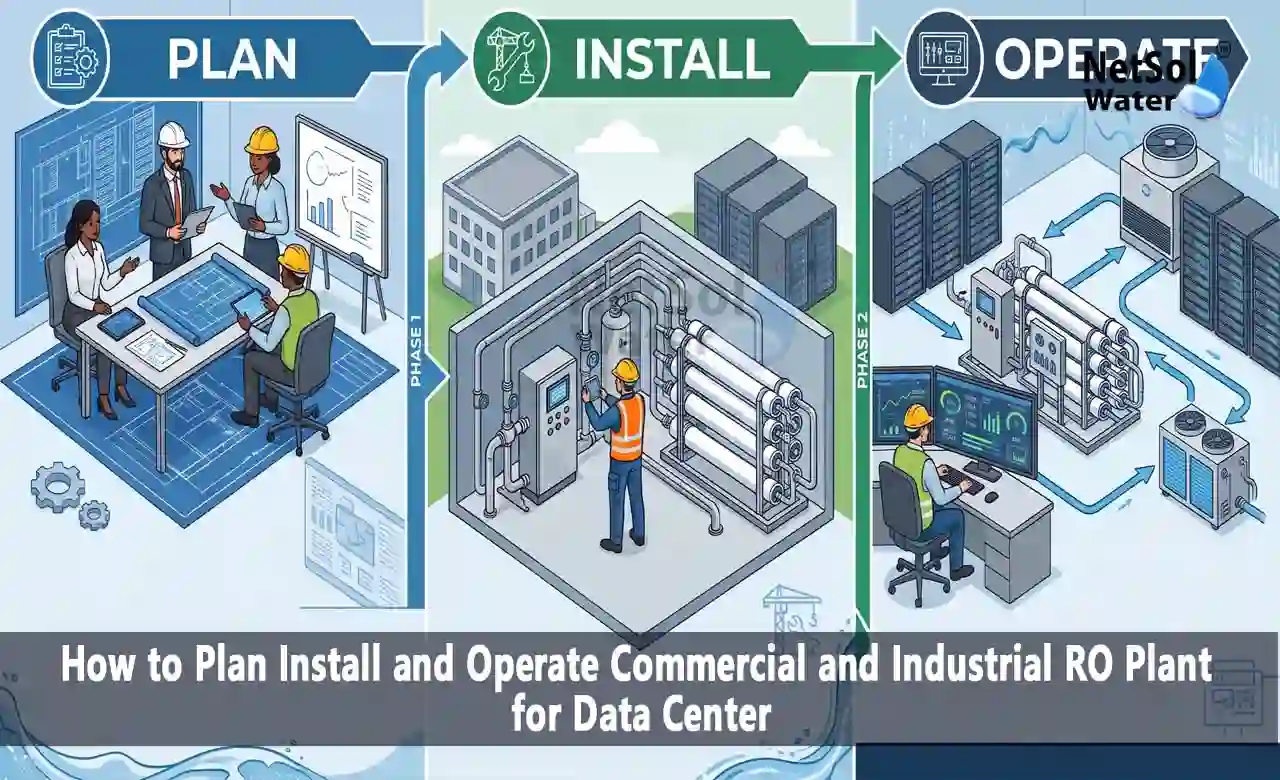
How to Install & Operate Commercial & Industrial RO Plant for Data Center?
Spend a few minutes near a data center’s water treatment room and you’ll notice something. It’s quieter than the server halls, sure, but honestly just as critical to keeping the whole place running. Every liter feeding those cooling towers has to be clean enough not to wreck the equipment it’s supposed to protect. That job falls almost entirely on the RO plant tucked away in the utility yard, doing work nobody thinks twice about until the day it stops working properly.
Here’s the thing about data centers. They run hot, nonstop, and cooling that kind of heat load takes serious amounts of water. But you can’t just pump in whatever comes out of a borewell or the municipal line and call it done. Raw water carries dissolved salts, minerals, and impurities that scale up cooling systems fast, cutting efficiency and wearing down equipment years before it should fail. Reverse osmosis strips most of that out, turning unreliable source water into something the cooling infrastructure can actually count on, day after day. That’s really why RO-treated water isn’t some nice-to-have for a facility running twenty-four seven. It’s foundational.
Getting there properly means working through three connected phases, planning, installation, and operation, and giving each one the attention it actually deserves. Rush through any single phase and it tends to show up as a problem later, usually the expensive kind, once the plant’s already live and there’s no easy fix.
Why Do Data Centers Use RO Plants?
Cooling towers need consistent water quality to function the way they’re supposed to, and raw water almost never delivers that on its own. Reverse osmosis pulls out dissolved salts, hardness causing minerals, and other contaminants before that water ever touches the cooling loop. Skip this step, and scale builds up on heat exchange surfaces fast, dragging down cooling efficiency and forcing equipment to work harder than it was ever designed to.
What Is the Ideal Feed Water Quality for RO Plant?
Feed water quality varies a lot depending on where it’s coming from, but generally, lower starting TDS and hardness make the whole treatment process smoother and cheaper to run long term. Water carrying excessive iron, silica, or organic content needs extra pre treatment before it even reaches the RO membranes, otherwise those membranes clog up and degrade way faster than anyone budgeted for.
Can Borewell Water Be Treated Using RO Plant for Data Centers?
Yes, and plenty of data centers actually lean on borewell water as either their primary or backup source. That said, borewell water tends to carry higher hardness and dissolved solids compared to municipal supply, so the RO system needs to be designed around that reality from day one, not built assuming it’ll behave like a gentler water source. This is the foundation of a reliable borewell water RO plant setup.
What Pre-Treatment Is Required Before RO Plant?
RO membranes are genuinely delicate, and skipping proper pre treatment shortens their working life dramatically. Most systems need sediment filtration first to catch larger particles, followed by activated carbon filtration to strip out chlorine and organic compounds that would otherwise damage the membranes over time. Depending on the source, iron removal or water softening might need to happen too, before the water ever reaches the RO stage itself.
What Feed Water Sources Are Suitable for Commercial and Industrial RO Plants?
A handful of sources typically feed into these systems, and each one brings its own quirks to the table.
| Feed Water Source | Typical Characteristics |
|---|---|
| Borewell or groundwater | Common for facilities without reliable municipal access. |
| Municipal water supply | Generally cleaner but still requires basic pre-treatment. |
| Treated STP or wastewater output | Increasingly used to reduce dependence on fresh water. |
| Surface water from nearby sources | Less common but suitable with advanced pre-treatment. |
The RO design needs to account for whichever combination a facility actually depends on, not some generic assumption pulled from a brochure.
What Is the Difference Between Commercial and Industrial RO Plants?
Commercial RO plants are generally sized for smaller needs, offices, retail spaces, facilities with moderate daily water demand. Industrial RO plants are a different animal entirely, built to handle far higher volumes and engineered for continuous, heavy duty operation, exactly the kind of nonstop demand a data center’s cooling infrastructure places on a system that basically never gets a day off.
| Aspect | Commercial RO Plant | Industrial RO Plant |
|---|---|---|
| Typical Use | Offices, retail spaces | Data centers, heavy industry |
| Water Demand | Moderate, daily use | High volume, continuous |
| Operation Pattern | Intermittent | Continuous, round the clock |
| Build Focus | Compact, standard duty | Durability, automation, high output |
Why Are Industrial RO Plants Essential for Hyperscale Data Centers?
At hyperscale volume, water demand isn’t just large, it’s relentless. A facility running dozens of cooling towers needs an RO system built for continuous high output, not something meant for intermittent commercial use that would buckle under that kind of constant pressure. Industrial grade systems bring the durability, automation, and sheer output capacity that hyperscale data center water treatment genuinely needs, otherwise the water treatment side becomes the bottleneck holding back the entire cooling operation.
What Is the Installation Process for a Commercial and Industrial RO Plant?
RO plant installation generally moves through a sequence that starts with site assessment and water testing, followed by equipment procurement, civil work for foundations and piping, then mechanical and electrical installation, and finally testing and commissioning before the plant goes fully live. Larger industrial systems naturally take longer through each of these stages compared to smaller commercial units, simply because there’s more equipment and more integration work involved.
| Stage | What Happens |
|---|---|
| 1. Site Assessment & Water Testing | Evaluate site conditions and analyze feed water quality. |
| 2. Equipment Procurement | Source RO membranes, pumps, pressure vessels, control panels, and other system components. |
| 3. Civil Work | Prepare foundations, drainage, piping, and supporting infrastructure. |
| 4. Mechanical & Electrical Installation | Install the RO system, connect pipelines, electrical wiring, and automation controls. |
| 5. Testing & Commissioning | Verify system performance, water quality, and operational parameters before handover. |
Which RO Membrane Is Best for Data Center Applications?
Membrane selection really depends on feed water quality and the recovery rate a facility is aiming for. Thin film composite membranes get used widely because they balance rejection rate and durability well, though facilities dealing with particularly high TDS water sometimes need membranes rated for higher pressure operation just to maintain performance without burning through extra energy doing it.
What Is a CIP System in RO Plant?
CIP stands for Clean In Place, and it’s basically a built in cleaning system that flushes membranes with cleaning solutions periodically, without needing to shut the whole plant down and pull everything apart. This CIP system RO plant approach matters a lot for data centers specifically, where unplanned downtime on cooling water supply just isn’t something anyone can afford to risk.
How Does RO Water Improve Cooling Tower Performance?
Clean, low mineral water means less scale forming on heat exchange surfaces, which keeps cooling towers running at their designed efficiency instead of slowly losing performance as deposits pile up over months. That translates pretty directly into lower energy consumption and fewer maintenance headaches down the line.
How Does TDS Affect Data Center Cooling Systems?
High TDS water forces cooling towers to blow down more often just to avoid excessive mineral concentration building up, which wastes water and drives up operating costs. RO treated water, carrying significantly lower TDS, lets cooling towers run at higher cycles of concentration before needing that blowdown, stretching every liter of makeup water a lot further.
What Is the Recovery Percentage of RO Plant?
Recovery percentage is basically how much of the feed water actually comes out as usable treated water, with the rest becoming reject water. Most commercial and industrial RO systems land somewhere between 65 and 80 percent recovery, though this shifts depending on feed water quality and the specific membrane setup being used. This is a key part of understanding RO plant recovery percentage for any facility.
How Can RO Reject Water Be Reused?
Reject water, sometimes called concentrate, doesn’t have to just go to waste. Depending on its quality, it can work for non sensitive applications like landscaping or dust suppression, and in some setups, it gets treated further for additional reuse. Facilities chasing tighter water sustainability targets are increasingly looking for ways to put this reject stream to some kind of use instead of discharging it outright.
How Do Industrial RO Plants Reduce Scaling?
By stripping out most dissolved minerals before water ever reaches the cooling system, RO plants tackle scaling right at the source instead of trying to manage it after the fact through chemical dosing alone. That proactive approach tends to work a lot better than leaning purely on scale inhibitors downstream.
Can Industrial RO Plants Handle High TDS Water?
Yes, though high TDS water usually needs a system built with higher pressure pumps, and sometimes a two pass RO configuration, to hit the output quality you’re after. It’s not something a standard system just absorbs without adjustment, which is exactly why proper water testing before design matters so much here.
How Does Membrane Fouling Affect RO Plant Performance?
Fouling happens when particles, organic matter, or biological growth build up on membrane surfaces, cutting down flow and forcing the system to push water through at higher pressure just to keep output steady. Left unmanaged, fouling drags down performance, drives up energy use, and shortens membrane life considerably faster than normal wear ever would.
How Frequently Should RO Membranes Be Cleaned?
This depends on feed water quality and how hard the system’s running, but most facilities schedule RO membrane cleaning (CIP) somewhere between every one to three months. Systems dealing with harder or more contaminated feed water often need cleaning more often just to keep performance from sliding.
What Is the Expected Life of RO Membranes?
With proper pre treatment and regular cleaning, RO membranes typically hold up anywhere from three to seven years before needing replacement. Poor pre treatment or inconsistent maintenance can cut that lifespan down significantly, sometimes by half or more, which is a costly mistake that’s entirely avoidable.
Quick Reference: Key RO Plant Performance Parameters
| Parameter | Typical Range / Frequency |
|---|---|
| Recovery Percentage | 65% to 80% |
| CIP Cleaning Frequency | Every 1 to 3 months |
| Membrane Lifespan (with proper maintenance) | 3 to 7 years |
What Are the Major Operating Costs of RO Plant?
Running costs generally fall into a few buckets, electricity for pumps, membrane replacement over time, chemicals for pre treatment and cleaning, and routine maintenance labor. These numbers should be treated as planning ranges during budgeting, since actual costs shift depending on feed water quality, system size, and how consistently the plant gets maintained.
| Cost Category | Description |
|---|---|
| Electricity | Power consumption for high-pressure pumps, motors, and overall system operation. |
| Membrane Replacement | Periodic replacement of RO membranes after reaching the end of their service life. |
| Chemicals | Pre-treatment chemicals, antiscalants, pH adjustment, and CIP cleaning solutions. |
| Maintenance Labor | Routine inspection, preventive maintenance, repairs, and system monitoring. |
How Can Energy Consumption Be Reduced in Commercial and Industrial RO Plants?
Energy recovery devices, which capture pressure energy from the reject stream and feed it back into the system, can meaningfully cut power consumption on larger installations. Beyond that, proper pre treatment reduces fouling, which keeps pumps from working harder than they need to just to maintain steady output.
How Do Industrial RO Plants Improve Cooling Efficiency?
By consistently feeding low TDS water into cooling towers, RO plants let the whole cooling system run closer to its designed efficiency instead of gradually slipping as scale and mineral buildup accumulate over time. Across a facility’s operational life, that consistency adds up to real energy savings and fewer unplanned maintenance calls.
Conclusion
Planning, installing, and operating a commercial and industrial RO plant for a data center isn’t something that wraps up the day the system gets switched on. It’s ongoing work, starting with honest water testing and capacity planning, moving through careful installation that respects both approval timelines and technical requirements, and continuing for years through steady maintenance and monitoring. Facilities that take each of these phases seriously end up with cooling systems that run efficiently, cost less over time, and actually hold up to the kind of nonstop demand a data center places on them daily.
How Can You Maximize Water Quality, Cooling Efficiency, and Sustainability with the Right Commercial and Industrial RO Plant for a Data Center?
This really comes down to working with a manufacturer who understands data centers specifically, not one applying a generic industrial template and hoping it fits. NetSol Water is an ISO certified RO Plant Manufacturer and Supplier working across India, with genuine experience designing commercial and industrial RO systems built around the continuous, high stakes demands of data center cooling water treatment infrastructure. This makes NetSol Water a trusted RO plant manufacturer India for such demanding applications.
Our team starts with proper water testing and site assessment, not assumptions, and builds systems around your actual feed water quality, recovery targets, and reuse goals. From initial planning through installation and long term operational support, we stay involved because an RO plant that performs well on day one but starts slipping by year two isn’t actually solving your water problem, it’s just delaying it. If your data center needs a new RO plant for data center applications or wants an existing one fixed properly, NetSol Water brings the technical depth and nationwide service reach to get every phase of this right.
Frequently Asked Questions (FAQs)
| Question | Answer |
|---|---|
| Can an existing RO plant be upgraded as water demand increases? | Yes. Most RO systems can be expanded by adding membrane trains, increasing pump capacity, or upgrading automation, provided the original design allows for future expansion. |
| How much space is required to install RO plant in a data center? | Space depends on the treatment capacity and water quality. Compact skid-mounted RO systems are widely used because they provide high performance while minimizing installation space. |
| What automation features are recommended for modern RO plants? | Modern systems typically include PLC-SCADA controls, online TDS monitoring, pressure and flow sensors, automatic alarms, remote monitoring, and data logging for efficient operation. |
| How long does it take to install and commission RO plant? | Installation time varies by plant size and site conditions. Most commercial and industrial RO plants are completed within a few weeks to a few months, including testing and commissioning. |
| How do you choose the right Commercial or Industrial RO Plant manufacturer and supplier? | Select a manufacturer with proven experience, successful installations, strong engineering capabilities, reliable after-sales support, AMC services, and the ability to customize the RO system according to your feed water quality and application. |