

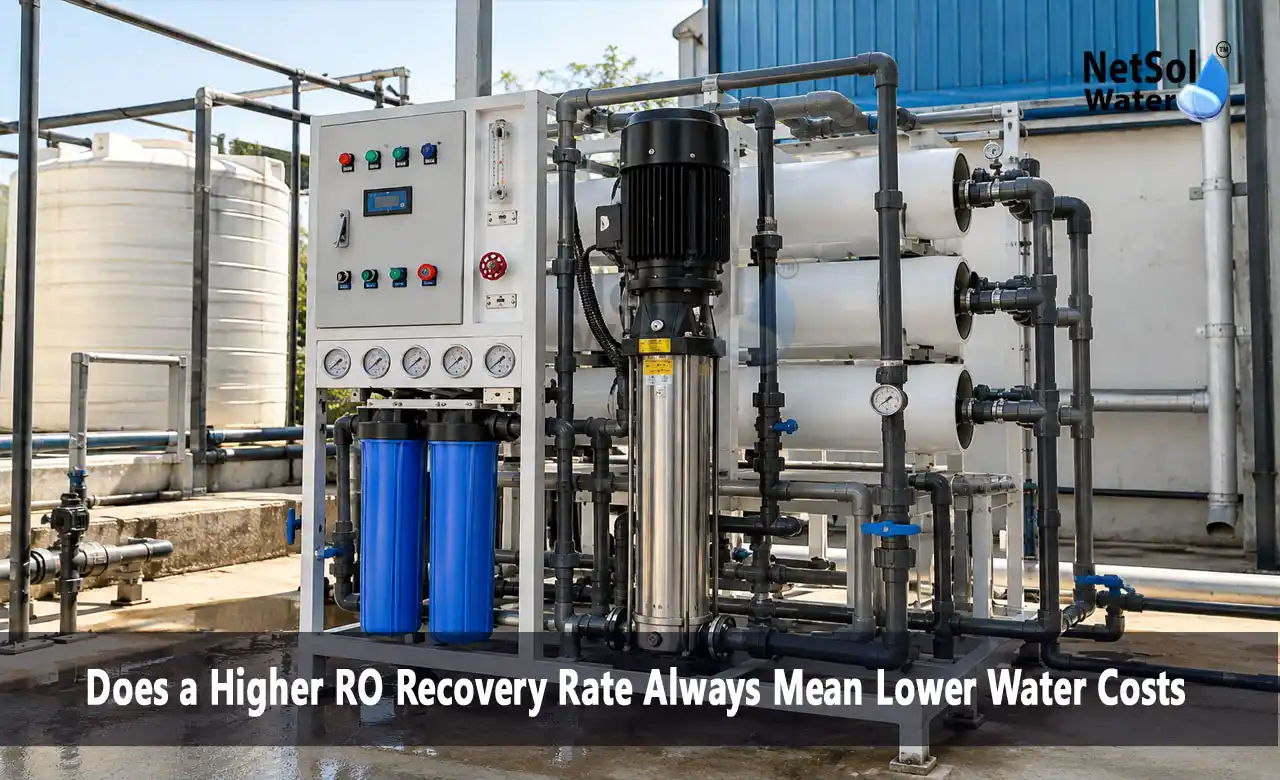
Does Higher RO Recovery Lower Water Cost?
Ask a plant manager how to cut water bills, and a common answer is to push the RO recovery rate up. The logic is simple. If more of the feed becomes product water, less water is bought, pumped and sent to drain. On paper, that sounds like a clear win.
In real plants, the answer is less tidy. Recovery is one lever in a system where scaling, pressure, power, chemicals and membrane life all move together. A higher recovery rate can lower your cost per cubic metre, or it can quietly raise it. The result depends on your feed water and how the plant is designed and run.
This guide explains where higher recovery saves money, where it adds cost, and how to find the recovery rate that makes sense for your site.
What Is RO Recovery Rate?
Recovery rate is the share of feed water that comes out as permeate, which is the treated product water. The rest leaves the system as reject, also called concentrate or brine.
Recovery (%) = (Permeate flow ÷ Feed flow) × 100
If a plant takes in 100 m³ of feed and produces 75 m³ of permeate, recovery is 75%. The remaining 25 m³ is reject, and it carries nearly all the dissolved salts that the membranes held back. This is the key point. As recovery rises, the same amount of salt is packed into a smaller volume of reject, so the reject becomes more concentrated.
Where Higher Recovery Does Reduce Cost
The benefits are real, and in some plants they are large.
. Lower feed water demand. To make the same amount of product, you draw less raw water. This matters most where water is bought from a municipal supply or tanker, or where groundwater is limited.
. Less reject to manage. A smaller reject stream means lower drain, treatment or evaporation load. Sites with strict discharge rules or high disposal charges gain the most.
. Smaller upstream equipment. Lower feed flow can reduce the size of pre-treatment units and feed pumps for a given output.
These savings are strongest when feed water is expensive, scarce or hard to dispose of after use.
Where Higher Recovery Adds Cost
1. Scaling and fouling risk
Sparingly soluble salts such as calcium carbonate, calcium sulphate, barium sulphate and silica can start to precipitate once their concentration crosses a limit. Higher recovery pushes the last stage of the RO train closer to that limit. Once scale forms on the membrane, flow drops, pressure rises, and cleaning becomes more frequent. In bad cases, membranes age early and need replacement.
2. Higher energy use
As the reject gets saltier, its osmotic pressure rises. The pump must overcome this to keep permeate flowing, so operating pressure goes up. Power for the high pressure pump is often the largest running cost of an RO plant, so even a modest pressure increase can cancel out part of the water saving.
3. More chemicals and cleaning
Running close to the scaling limit usually needs a higher antiscalant dose and tighter pH control. Clean-in-place cycles also become more frequent. Each cleaning uses chemicals, labour and plant downtime, and repeated cleaning can shorten membrane life.
4. Lower permeate quality
Salt passage tends to rise with concentration on the feed side. In applications where product water quality is tight, such as boiler feed or process water, this can force an extra polishing step.
A Worked Example: Volumes and Costs
Take a plant that must deliver 80 m³ of permeate per day. The table shows how feed and reject change with recovery. These figures come straight from the recovery formula and assume steady operation with no other losses.
| Recovery Rate | Feed Water Needed | Reject Water |
|---|---|---|
| 70% | 114.3 m³/day | 34.3 m³/day |
| 80% | 100.0 m³/day | 20.0 m³/day |
| 85% | 94.1 m³/day | 14.1 m³/day |
Moving from 70% to 80% recovery saves about 14.3 m³ of feed water and cuts the same amount of reject every day. Now let us put a price on it. The rates below are assumed for illustration only. Please replace them with your own site data.
. Raw water cost: INR50 per m³ (assumed)
. Reject disposal cost: INR30 per m³ (assumed)
Daily saving from lower feed and reject: (14.3 × 50) + (14.3 × 30) ≈ INR1,144 per day.
Now the other side. If the higher recovery needs extra power, more antiscalant and more frequent cleaning worth INR900 per day, the net gain is about INR 244 per day. If those extra costs reach INR1,300 per day, the plant loses about INR156 per day despite using less water.
The lesson is not that 80% is good or bad. The right number depends on how your own costs compare, and that must be checked with real data.
How to Find the Economical Recovery Rate
The goal is the lowest total cost per cubic metre of permeate, not the highest recovery. A well designed industrial RO plant is sized around this balance from the start. These are the factors to check:
. Feed water analysis: Test hardness, alkalinity, silica, sulphate, barium, strontium, iron and TDS. These decide your scaling limit.
. Power at different recovery points: Compare specific energy consumption (kWh per m³) at each recovery level you are considering.
. Chemical demand: Estimate antiscalant dose, pH adjustment and cleaning frequency at each point.
. Membrane life: Include replacement cost spread across expected life. Scale-related damage shortens it.
. Reject handling: Count disposal, treatment or reuse cost per m³ of reject.
. Pre-treatment: Good filtration, softening or antiscalant selection can safely raise the recovery ceiling.
Membrane projection software, pilot trials and a few weeks of logged plant data can all help define the practical limit for a given source.
Ways to Improve Recovery Without Raising Risk?
. Improve pre-treatment so that feed to the membranes is consistent and low in suspended solids and organics.
. Select antiscalant based on the actual feed analysis, not a generic default.
. Use staged or multi-pass designs, so that concentration builds up gradually and flux is balanced.
. Add pressure recovery devices where pump energy is a large share of cost.
. Track normalised permeate flow, differential pressure and salt passage so that fouling is caught early.
. Consider treating or reusing the reject where regulations and economics allow.
Common Mistakes to Avoid
. Raising recovery without re-checking the scaling limit of the last stage.
. Judging savings by water volume alone and ignoring power and chemicals.
. Using one recovery target all year when feed quality or temperature changes with the season.
. Skipping routine data logging, which makes early fouling hard to notice.
Frequently Asked Questions (FAQs)
Q1. What is a good RO recovery rate?
There is no single number. Brackish water plants often run at moderate to high recovery depending on feed hardness, while seawater plants run much lower because of high osmotic pressure. The right target comes from feed analysis and system design.
Q2. Does higher RO recovery reduce water cost?
It can, if the saved feed and reject costs are larger than the added energy, chemical, cleaning and membrane costs. It must be checked case by case.
Q3. How is RO recovery calculated?
Divide permeate flow by feed flow and multiply by 100. Both flows should be measured at the same time and in the same units.
Q4. Can scaling be fixed by cleaning alone?
Cleaning removes scale that has formed, but it does not remove the cause. Pre-treatment, antiscalant dosing and a safe recovery setting are what keep it from returning.
Conclusion
A higher RO recovery rate saves feed water and reduces reject, but it also raises concentration, pressure and scaling risk. Whether it lowers your cost depends on your feed quality, power tariff, chemical use, membrane life and reject disposal cost. The smartest approach is to calculate the full cost per cubic metre at several recovery points and pick the one that is both cost-effective and safe for the membranes.
If you are planning a new plant or want to review an existing one, talk to a trusted Industrial RO Plant Manufacturer in India who can study your feed water and recommend a recovery target that fits your site.
Need advice on selecting the right water and wastewater treatment system? Share your requirement with the Netsol Water team and our experts will guide you.
Call: +91-9650608473, Email: enquiry@netsolwater.com