
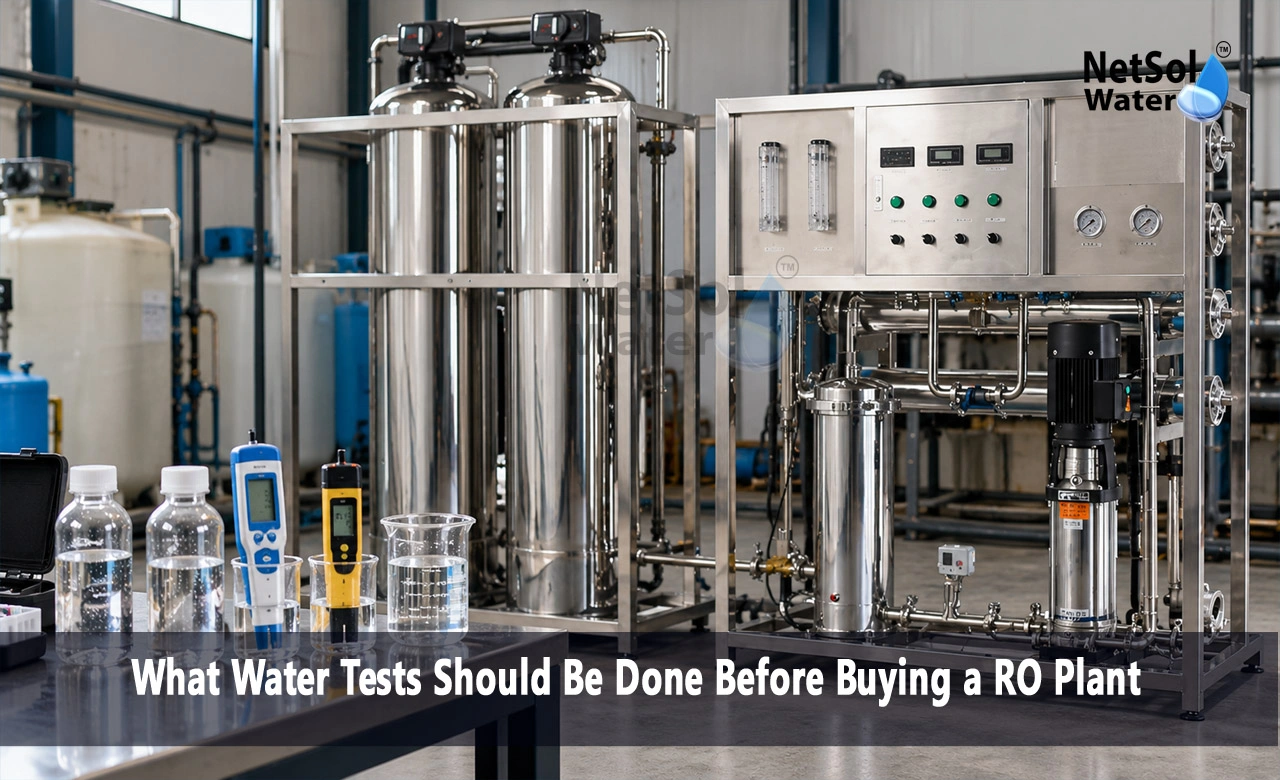
What Water Tests Should Be Done Before Buying a RO Plant?
Two borewells in the same town can both show a TDS of 1,200 ppm and still need completely different RO plants. One may carry hardness and silica that scale a membrane within months. The other may be rich in sodium chloride and run for years with simple pretreatment. A TDS meter cannot tell these apart. A proper water analysis can.
This guide explains which tests to get done before you finalise a RO plant, why each one matters, and how the results change the design, the cost and the day-to-day running of the plant.
Why Feed Water Analysis Must Come Before Plant Selection?
A RO membrane is only as reliable as the water it is fed. Pretreatment, membrane type, operating pressure, recovery rate and antiscalant dosing are all decided by the feed water chemistry. If these are guessed instead of calculated, the usual results are early membrane fouling, frequent cleaning, falling permeate flow and a higher power bill.
A reliable industrial RO plant manufacturer will always ask for a full feed water report before quoting a design. If a supplier quotes a plant on the basis of a TDS reading alone, treat it as a warning sign.
12 Water Tests to Do Before Buying a RO Plant
1. TDS and Conductivity
These give a first idea of the total dissolved salt load. Higher salinity means higher operating pressure, a more careful membrane choice and a larger concentrate stream to handle. Conductivity is also the easiest way to track salt rejection after installation. Remember that TDS shows how much is dissolved, not what is dissolved.
2. pH
pH affects scaling tendency, membrane performance and chemical dosing. Measure it on site with a calibrated meter, because pH can drift in a stored sample. Read it together with alkalinity and hardness rather than on its own.
3. Hardness (Calcium and Magnesium)
Calcium and magnesium are the main scale formers. Hardness results decide whether you need a softener, antiscalant dosing or both. For some groundwater sources, barium and strontium should also be checked, since they can form scale at very low levels.
4. Alkalinity
Alkalinity buffers the water and takes part in carbonate scaling. Together with calcium, magnesium, pH and temperature, it is used to estimate scaling indices such as LSI or S&DSI for the concentrate.
5. Silica
Silica is one of the most overlooked parameters. Once it crosses its solubility limit in the concentrate (often quoted at roughly 100 to 120 mg/L, depending on pH, temperature and antiscalant), it forms a hard scale that is difficult to clean. High silica usually forces a lower recovery rate.
6. Iron and Manganese
Even small amounts of iron and manganese can foul membranes and stain downstream equipment. Most membrane makers ask for iron in the feed to be kept very low, commonly below about 0.1 mg/L. If your water exceeds this, plan for oxidation and filtration before the RO.
7. Turbidity, TSS and SDI
Turbidity and TSS show the presence of particles. The Silt Density Index (SDI) goes a step further and indicates how quickly the feed water will foul RO membranes. Membrane manufacturers generally want an SDI below 5, and lower is better. SDI is best measured on site with fresh water.
8. Chloride and Sulphate
These ions add to the dissolved salt load and influence both permeate and concentrate quality. Chloride also decides the corrosion risk for pipes, fittings and pressure vessels, which affects the material selection for the plant.
9. Free Chlorine and Oxidants
Municipal and treated water often carries residual chlorine. Polyamide RO membranes tolerate very little of it, so it must be removed before the membrane, usually with an activated carbon filter or sodium bisulphite dosing. Skipping this test can damage a new membrane quickly.
10. Organic Matter (TOC, COD)
Organics feed biological growth and foul membranes. They matter most for surface water, effluent reuse and any source near agriculture or industry. High organics usually mean a stronger pretreatment train.
11. Microbiological Quality
Bacterial counts are important when the source is surface water, an open tank or any stored supply. The result tells you whether disinfection is needed before the RO to control biofouling.
12. Temperature
Water temperature changes membrane flux and operating pressure. A plant designed for summer water may fall short in winter, so record the temperature range at the time of sampling.
Quick Reference: Test, Purpose and Design Impact
| Test | What it tells you | Design decision it affects |
|---|---|---|
| TDS / Conductivity | Overall salinity | Membrane type, pressure, recovery |
| Hardness, Alkalinity, pH | Carbonate scaling risk | Softener or antiscalant, recovery |
| Silica | Silica scaling risk | Maximum recovery rate |
| Iron, Manganese | Metal fouling risk | Oxidation and filtration |
| Turbidity, TSS, SDI | Particle fouling risk | Multigrade, UF or cartridge filters |
| Free chlorine | Membrane damage risk | Carbon filter or bisulphite dosing |
| TOC, COD, Bacteria | Organic and biological fouling | Disinfection and strong pretreatment |
Choose the Test Panel Based on Your Water Source
Not every source needs every test at the same depth. Use the table below as a starting point and let your RO designer add to it.
| Water source | Tests to prioritise |
|---|---|
| Borewell or groundwater | TDS, hardness, alkalinity, silica, iron, manganese, fluoride, nitrate |
| Municipal supply | TDS, hardness, free chlorine, turbidity, SDI |
| Surface water (river, canal, pond) | Turbidity, TSS, SDI, TOC, COD, bacteria, seasonal variation |
| Treated industrial effluent for reuse | COD, oil and grease, TSS, heavy metals, full ion balance |
Test for the Water You Actually Need
Feed water data is only half of the picture. The quality of treated water you need depends on what it will be used for. Boiler feed, pharmaceutical processing, electronics washing, food production and drinking water each have different limits for conductivity, silica and microbial count. Always tell your supplier the end use so the RO can be designed backwards from the required permeate quality. You can read more about how different industries benefit in our guide on the advantages of an industrial RO plant.
How to Collect and Time the Water Sample?
. Use a proper lab. Choose an accredited laboratory and use the clean bottles it provides.
. Sample from the real source. Collect from the point that will actually feed the plant, after letting the water run for a few minutes.
. Test sensitive parameters on site. pH, temperature, free chlorine and SDI change in transit, so measure them at the source.
. Deliver quickly. Send samples to the lab on the same day wherever possible.
. Capture seasonal change. If the source changes with monsoon, summer or production cycles, test more than once so the design covers the worst case, not an unusually clean day.
What Happens After the Test: How the Results Are Used?
A good designer takes your report and runs it through membrane projection software to check scaling limits, recovery, flux and permeate quality before proposing any equipment. You should receive a clear explanation of the pretreatment train (for example multigrade filter, activated carbon, softener, antiscalant, cartridge filter), the expected recovery rate and the expected permeate quality. Ask for these details in writing. They make quotations from different suppliers easy to compare on a like for like basis.
Common Mistakes to Avoid
. Choosing a plant on TDS alone.
. Testing already treated or stored water instead of the raw feed.
. Using a single sample taken in one season.
. Ignoring silica, free chlorine and SDI because they are not on the basic lab panel.
. Not telling the supplier how the treated water will be used.
Frequently Asked Questions (FAQs)
Q1. Is a TDS meter enough to select a RO plant?
No. A TDS meter shows total dissolved solids but not hardness, silica, iron, organics or SDI, which are the parameters that actually decide pretreatment and recovery.
Q2. How often should feed water be tested?
Test before purchase, again during commissioning, and whenever the source, season or process changes. Industrial plants often keep a routine monthly or quarterly schedule.
Q3. Which test is most often missed?
Silica and SDI are the two most commonly skipped tests, and both can strongly limit recovery and membrane life.
Q4. Can the same RO plant be used for borewell and municipal water?
Only if the pretreatment is designed for both. Borewell water often needs hardness and iron control, while municipal water usually needs chlorine removal.
Conclusion
Before buying a RO plant, get the feed water tested for TDS, conductivity, pH, hardness, alkalinity, silica, iron, manganese, turbidity, TSS, SDI, chloride, sulphate, free chlorine, organics, microbiological quality and temperature. Choose the panel according to your water source and your end use, and sample in a way that reflects real operating conditions. A RO plant designed on measured water chemistry costs less to run, needs fewer cleanings and gives you steady water quality for years.
Do you need advice or assistance in selecting the best water and wastewater treatment unit? We have solutions for all your water problems.
Share your water report or your problem with us, and our experts will suggest the right solution.
Call on +91-9650608473 Or write to us at enquiry@netsolwater.com