

What Happens When Mixing Is Inadequate in an Equalization Tank?
The equalization tank sits at the start of most effluent treatment plants, and it has one job: give the next stage a steady feed. Flow and pollution load both swing through a working day in an industrial unit. This tank is there to flatten those swings.
It only works if the water inside is actually mixed. With weak mixing, the tank looks fine from the walkway. Water goes in, water comes out. But what comes out is uneven, and the rest of the plant pays for it.
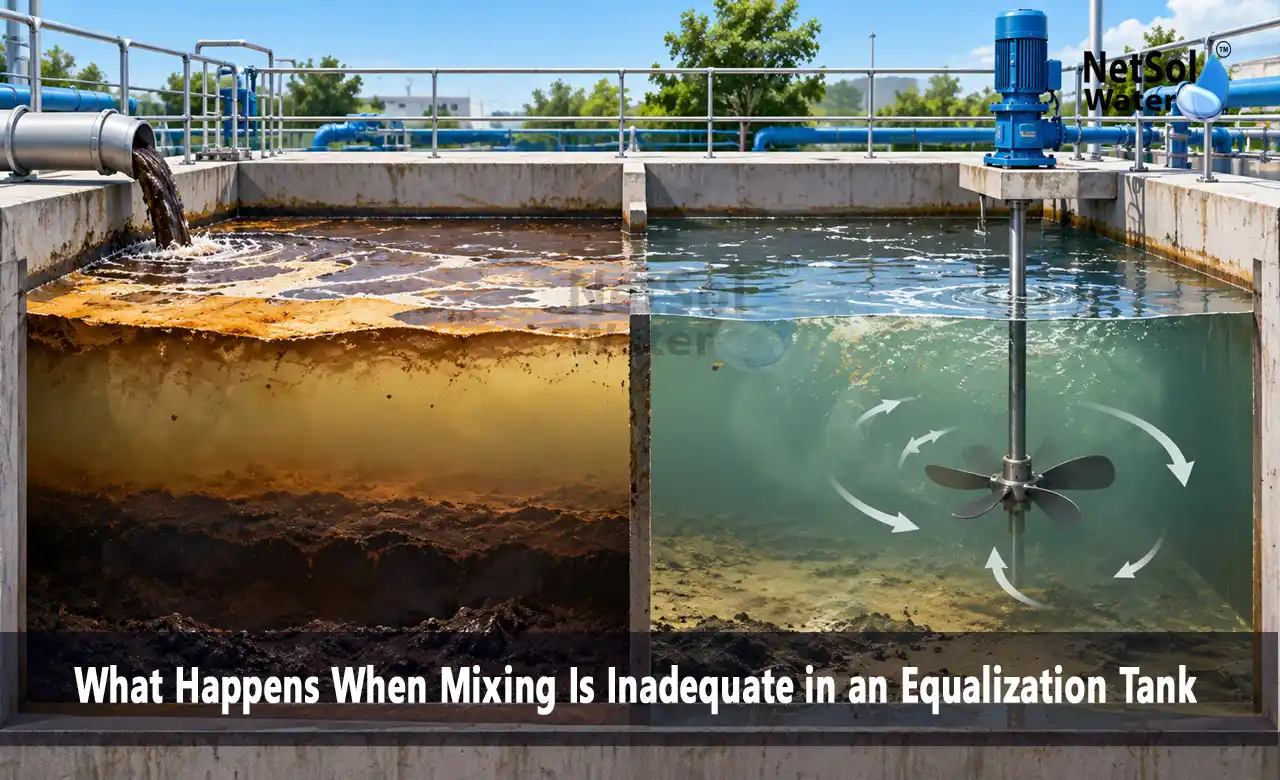
Inadequate mixing in an equalization tank lets solids settle on the floor, leaves pockets of water with different pH and COD, and lets stagnant corners turn anaerobic and smell. That uneven water then reaches the biological stage, the pumps and the chemical dosing, and each of them has to handle swings the tank was supposed to remove.
What mixing does inside the tank?
Mixing keeps suspended solids from dropping out. It blends the different streams entering the tank, so the water leaving is close to the tank average. And where aeration is used for mixing, it keeps the contents fresh enough to hold odour back.
Take mixing away and the tank turns into a holding pit. The volume is still there. The equalization is not.
What happens when mixing is inadequate?
. Solids settle and the tank loses working volume
Heavier particles drop first once mixing energy falls below what the solids load needs. They form a sludge layer on the floor, and every centimetre of that layer is volume the tank no longer has for equalization.
Left alone, the layer compacts. Compacted sludge is much harder to pump or vacuum out, and cleaning goes from a routine job to a shutdown job.
. Wastewater quality differs from one zone to another
A well-mixed tank gives an outlet that matches the tank average. A poorly mixed one does not. COD, BOD, suspended solids and pH can all differ between the inlet corner, the middle and the suction point.
The outlet draws from one spot. If that spot holds the strongest water, the next unit takes a sudden jump in load. Nothing changed upstream. The tank just handed over its worst corner.
. pH swings at the discharge point
Industrial plants rarely send one steady stream. Acidic rinse water from one section and alkaline wash water from another is common, in textile and metal finishing units for example.
Good mixing lets these neutralise each other inside the tank. Poor mixing keeps them in separate zones, and the pH leaving the tank follows whichever zone the pump is pulling from. Coagulation, chemical dosing and biological treatment all need a steady pH, so you end up with dosing that never seems to settle however carefully the operator tunes it.
. The biological stage becomes unstable
MBBR, SBR and activated sludge systems like a predictable load. The microorganisms adjust to what they are fed day after day.
Uneven feed breaks that pattern. A heavy slug raises oxygen demand suddenly and stresses the biomass. A weak slug starves it. If your biological treatment keeps misbehaving while the design looks sound, poor mixing upstream is worth checking.
. Odour starts at the stagnant spots
Dead zones collect solids and organic matter, and very little oxygen reaches them. Once conditions turn anaerobic, offensive gases come off the tank, often with a rotten-egg smell.
The risk goes up with a high organic load, or when the tank sits unmixed for long stretches such as overnight shutdowns.
. Transfer pumps pick up settled solids
Solids that settle near the suction get pulled into the transfer pumps. Blocked impellers, faster wear and falling flow are the usual result. The same solids also travel on to the next unit, where they were never expected.
Pump position, sump shape and mixing pattern should be planned together. Fixing one without the others rarely holds.
.The mixing equipment is undersized or misplaced
Sometimes the mixer runs perfectly and the problem is still there. Tank volume, solids concentration, wastewater characteristics, operating depth and mixer location all decide whether a given unit can mix a given tank.
A correctly sized mixer in the wrong position still leaves dead zones, usually in corners or behind columns and baffles. And if the water level drops low during operation, a submersible mixer can lose effective mixing because it sits too close to the surface or the floor.
How to tell mixing is poor?
You don't need special instruments for a first read. A walk around the tank and a few samples tell most of the story.
| What You See | What It Usually Points To |
|---|---|
| Floating layer or scum on the surface | Oil, grease or light solids not being broken up and redistributed. |
| Sludge building on the floor or in corners | Mixing energy too low, or mixer in the wrong place. |
| Colour or turbidity differs between spots | Incoming streams are not blending evenly. |
| pH differs between inlet, middle and outlet | Separate acidic and alkaline zones may be present. |
| Smell from the tank, mostly near quiet corners | Possible anaerobic pockets. |
| Outlet COD or load jumps with no change upstream | A concentrated zone may be getting drawn into the suction. |
| Pump blockages or impeller wear | Settled solids near the suction. |
Practical checks you can do this week
1. Take samples from the inlet corner, the centre and near the outlet at the same time, and compare pH and COD.
2. Measure sludge depth at several points with a pole or sludge judge. One reading tells you little; a pattern tells you a lot.
3. Check mixer rotation direction, mounting and running hours, and confirm it actually runs when it is supposed to.
4. If aeration does the mixing, look at the surface. Patches with no bubble activity show where diffusers are choked or missing.
5. Log outlet pH and load over a full day, then compare that with what the biological stage is receiving.
How to improve mixing in an equalization tank?
The fix depends on the cause, so find the cause first. These are the usual routes.
| Option | Where It Fits | Watch Out For |
|---|---|---|
| Submersible mixer | Tanks with settling solids that need strong bulk movement. | Mixer position, submergence at low water level, and easy access for maintenance. |
| Coarse bubble aeration | Tanks where some oxygen is also needed to control odour. | Higher power use, possible foaming, and clogged diffusers leaving dead patches. |
| Jet mixing | Tanks with high solids where pumped recirculation helps. | Pump wear and nozzle layout. |
The choice should come from the actual wastewater flow, solids load and tank shape, not from a catalogue rule of thumb. Some plants run mixing continuously. Others use timed intermittent mixing to save power. Which one is acceptable depends on the process design and how fast solids settle in that particular wastewater.
And check again later. A mixing arrangement that worked at commissioning can fall short after production changes or once solids start building up.
Why this matters for the rest of the ETP?
An effluent treatment plant is a chain, and the equalization tank is the first link that decides how steady everything after it will be. Getting mixing right here is usually easier than chasing symptoms in the biological tank, chemical dosing or pumps later. When planning a new system or reviewing an existing one, an experienced effluent treatment plant manufacturer will normally start from your wastewater data, not just the tank size.
Frequently asked questions (FAQs)
Q1. What is the purpose of mixing in an equalization tank?
Mixing keeps solids suspended and blends the incoming streams, so the water leaving the tank is close to uniform in pH, load and solids.
Q2. Can poor mixing cause bad smell?
Yes. Stagnant zones collect solids and run short of oxygen. They turn anaerobic and release offensive gases, particularly with a high organic load.
Q3. How do I know if the mixer is undersized?
If the mixer turns the right way and runs as intended but solids still settle, sludge builds up and samples from different spots disagree, then size or position is the likely issue. A design review using real flow and solids data will confirm it.
Q4. Should an equalization tank be mixed continuously?
It depends on the process design and the wastewater. Some tanks need continuous mixing. Others can run timed intermittent mixing without letting solids settle. The decision should be tested against the actual load, not assumed.
Q5. Does inadequate mixing affect MBBR and SBR systems?
It can. Both depend on a reasonably steady organic load, and an uneven feed from the equalization tank makes that harder to maintain.
Conclusion
Poor mixing turns an equalization tank into a tank that only stores water. Solids settle, quality varies by zone, pH moves, odour builds and the downstream units get an unsteady feed.
Netsol Water can evaluate your wastewater characteristics, tank condition and mixing requirement before recommending any change. If your plant is in Delhi, you can also see our effluent treatment plant manufacturer in Delhi page for how we work.
Need advice on selecting the right water and wastewater treatment unit? Share your problem with the Netsol Water team and we will guide you on the next step.