

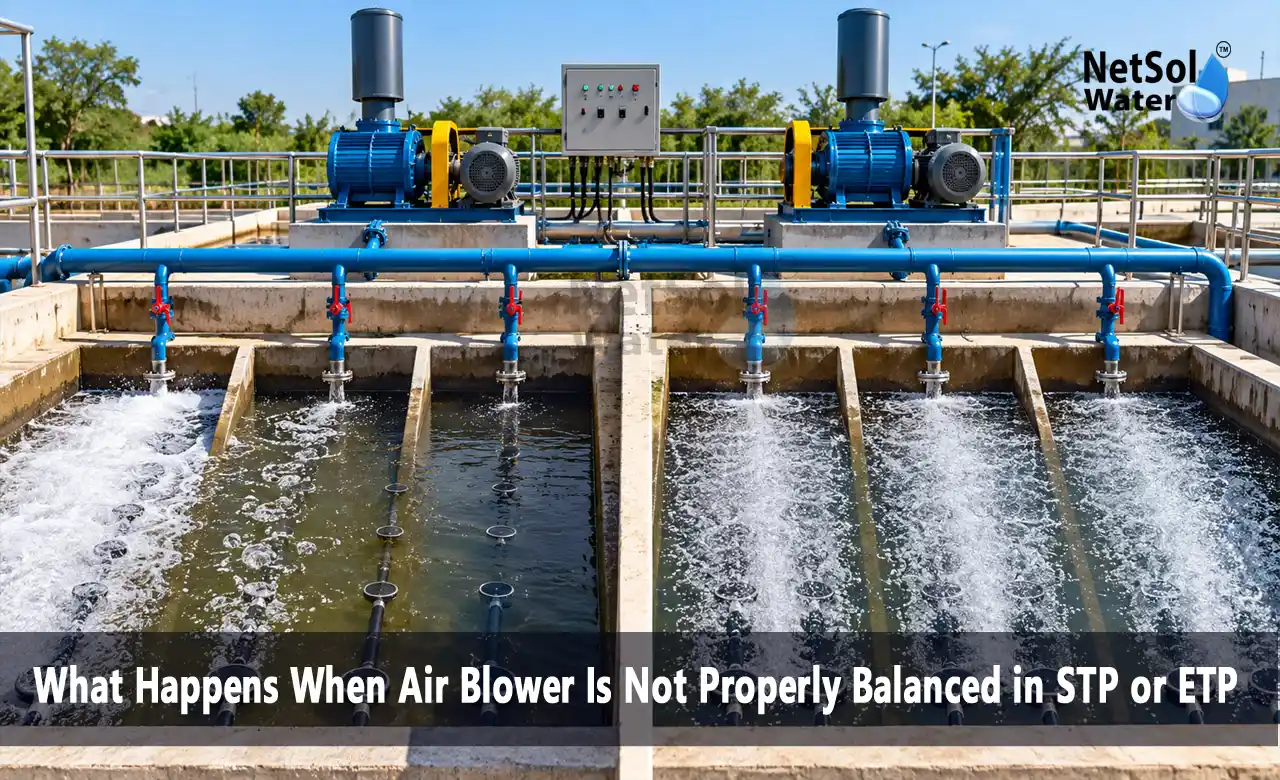
What Happens When Air Blower Is Not Properly Balanced in STP or ETP?
In a sewage treatment plant or an effluent treatment plant, the blower pushes air through the air header, branch lines, valves and diffusers into the aeration tank. That air feeds the bacteria that clean your wastewater.
If the air does not reach every zone in the right amount, some parts of the tank get too much and some get too little. The plant still runs. The problem shows up later, in power bills, unstable treatment and a treated water report you did not expect.
This blog explains what goes wrong, why it happens and how an operator can fix it step by step.
Why blower air balancing matters?
Biological treatment depends on dissolved oxygen. Bacteria use oxygen to break down organic matter, and the aeration system is the only source of that oxygen.
Every zone in the tank has its own oxygen demand. Good air distribution means each zone gets air in proportion to that demand. When the air is uneven, the tank stops behaving like one system and starts behaving like several badly matched ones.
What happens when blower air is not balanced?
1. Some zones get too much air
Air always takes the path of least resistance. Zones with clean diffusers and short branches pull in more air than their share.
Too much air creates heavy turbulence and mixing in those zones. It also burns blower energy without improving treatment, and it can upset sludge conditions.
2. Other zones get too little air
These zones usually cause more trouble. With low oxygen, microorganisms cannot break down organic matter properly.
If this continues, dissolved oxygen becomes unstable and treated water BOD or COD can go up.
3. Dissolved oxygen becomes uneven
A well-designed aeration system supplies air in line with oxygen demand. With unbalanced air, one part of the tank shows high DO while another part runs short.
This makes process control hard. A single DO probe reading does not tell you what the rest of the aeration tank is doing.
4. Blower power consumption goes up
When some zones starve, operators often run the blower harder to compensate. That raises discharge pressure and blower power consumption.
More power does not always fix the distribution. If the real cause is a blocked diffuser, a wrong valve setting or unequal branch resistance, the extra air mostly goes to zones that already have enough.
5. Diffusers start working unevenly
Fouled, damaged or partly blocked diffusers create different pressure losses across the aeration zones. Clean diffusers pass more air and restricted ones pass less.
Over time the gap widens, and the imbalance becomes part of how the plant runs.
6. Biological treatment becomes unstable
Where oxygen is short, biological activity drops. Where air is excessive, energy is wasted and the process conditions drift from the design.
Stable treatment needs the right amount of air in every zone, not a high average across the tank.
Common signs of unbalanced blower air
You do not need special instruments to notice the first warning signs. Watch for these during routine rounds:
. Bubble pattern on the tank surface looks heavy in one area and weak in another
. DO readings differ a lot from one point of the tank to another
. Blower discharge pressure is higher than normal for the same airflow
. Treated water BOD or COD drifts up with no change in inlet load
. Blower runs longer or harder than before without a clear reason
What causes air distribution to become unbalanced?
Several things can disturb the air balance in a plant. The table below lists the usual ones.
| Cause | What It Does to Air Distribution |
|---|---|
| Incorrect valve adjustment | Sends more air to some branches and starves others. |
| Unequal branch lengths | Longer branches lose more pressure and receive less air. |
| Clogged or damaged diffusers | Increase resistance in one zone and push air elsewhere. |
| Air leakage | Air escapes before reaching the diffusers. |
| Wrong air header sizing | Causes uneven pressure drops along the header. |
| Pressure differences between zones | Air favours the lower-pressure zone. |
| Changes made after installation | The original balance may no longer match the revised layout. |
Deposits can also build up on diffuser surfaces and raise resistance slowly. So airflow should be checked at regular intervals. Do not assume that the first settings made at commissioning are still right.
How to balance blower air step by step?
1. Run the blower and note the discharge pressure and total airflow.
2. Compare airflow or pressure in each branch and each aeration zone.
3. Check all valves for position and condition.
4. Inspect the air header, branch lines and joints for leaks.
5. If one section shows unusually low airflow, check its diffusers and branch line for blockage and added resistance.
6. Take DO readings at different points of the tank to confirm which zones are over or under aerated.
7. Adjust valves in small stages and re-measure after each change. One adjustment can shift air away from another zone and create a new imbalance.
Patience matters here. Quick, large valve moves usually trade one problem for another.
Habits that keep the air balanced
. Log blower pressure, airflow and DO readings at the same points every time
. Clean or replace fouled diffusers on a schedule, not only after a failure
. Mark valve positions once the plant is balanced, so any change is easy to spot
. Re-check air balance after any change to piping, diffusers or tank layout
If the plant is new or you are planning an expansion, ask your supplier to review the air header and branch design early. It is far cheaper to fix on paper than in a running tank. Netsol Water designs and supplies STP plants and ETP plants for homes, industries and institutions, and our team can help you check your aeration layout.
Frequently asked questions (FAQs)
Q1. Can I fix an air imbalance by increasing blower speed?
Usually not. A higher speed raises pressure and power use, but the extra air tends to go to zones with the least resistance. Find and remove the cause first.
Q2. How often should I check air balance in my plant?
Check it at regular intervals and after any change to the aeration system. Plants with heavy fouling or variable load may need closer checks.
Q3. Does uneven aeration affect treated water quality?
Yes. Low oxygen zones reduce the breakdown of organic matter, and that can raise BOD or COD in the treated water.
Q4. Can one DO probe tell me if the tank is balanced?
No. One reading shows one point. Compare readings from several zones to see the real picture.
Conclusion
Unbalanced blower air leads to uneven dissolved oxygen, unstable treatment, wasted power and extra stress on aeration equipment. Excess air in one zone does not make up for a shortage in another.
Keep an eye on DO levels, valve settings, diffuser condition, pressure and airflow across the whole system. A balanced aeration system gives the bacteria the oxygen they need, and the blower does not run harder than it has to.
Need help choosing the right water or wastewater treatment plant? We have solutions for your problem.
Tell us your problem and our experts will help you solve it.
Call: +91-9650608473, Email: enquiry@netsolwater.com