

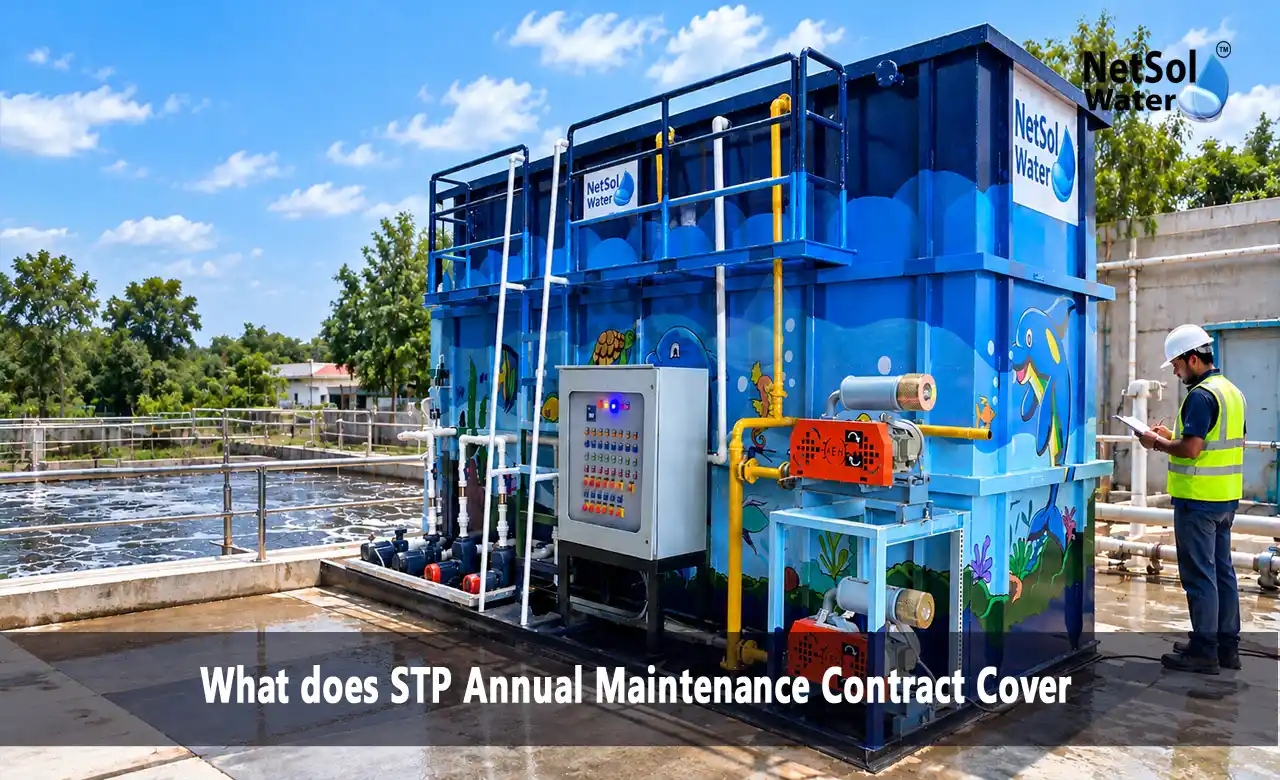
STP Annual Maintenance Contract: What Does It Cover?
A sewage treatment plant (STP) takes wastewater from a housing society, hotel, hospital or factory and cleans it before it is reused or discharged. Setting up the plant is one job. Keeping it in good shape every day of the year is another.
STP problems rarely show up overnight. A blower loses pressure bit by bit. A diffuser gets clogged. Sludge piles up in the tank. By the time the treated water starts to smell, the repair is already bigger than it needed to be.
This is where an STP Annual Maintenance Contract comes in. It is a written agreement under which a service provider looks after your plant for a year, with fixed visits, fixed checks and a clear line on who pays for what. Netsol Water, a water and wastewater treatment company based in Greater Noida, Delhi NCR, hears questions about these contracts all the time. So here is what an STP AMC usually includes and what to confirm before you sign.
What does an STP Annual Maintenance Contract include?
No two contracts read the same. The scope depends on plant size, the treatment technology and whatever the provider agrees to in writing. Most STP AMC services fall under the heads below.
. Routine inspection of equipment
On each visit the technician walks through the plant and checks the main equipment: pumps, blowers, motors, valves, pipelines, diffusers and the electrical panel. Loose connections get tightened. Dirty parts get cleaned. An odd noise or vibration from a motor is noted before it turns into a breakdown.
Ask for the list of covered equipment. If a pump is not on the list, assume it is not covered.
. Process and water quality checks
Machines are half the story. The biological process inside the plant needs watching too. Depending on the plant type, the team checks aeration, sludge level, chemical dosing and how clear the treated water looks.
The contract should say how often water samples are tested, who sends them to the lab and who pays the lab fee. Test results give your team something solid to work from when the process needs adjusting.
. Cleaning and preventive work
Screens, tanks, diffusers and filters collect dirt over time. A good plan has cleaning on a schedule, not only when someone complains about a smell.
. Reports and operator support
Every visit should end with a short report: what was checked, what was found, what needs attention. Over a year these reports show repeat faults and help you decide whether to repair or replace an item.
The service team can also guide your plant operator on daily checks and safe handling of controls. That helps a lot when operators change often. The contract should also say who keeps the equipment log and the water quality log.
. Breakdown calls
Ask how fast the provider responds to a breakdown call, whether emergency visits are part of the contract and what is charged outside normal working hours.
Comprehensive vs non-comprehensive AMC
Two types of contract are common in sewage treatment plant maintenance. A comprehensive AMC bundles more under one yearly fee. A non-comprehensive AMC covers visits and labour, and bills the rest as it comes.
| What You Are Checking | Comprehensive AMC | Non-Comprehensive AMC |
|---|---|---|
| Scheduled Visits and Inspection | Included | Included |
| Spare Parts | Usually covered, subject to listed exclusions | Charged separately |
| Consumables Such as Chemicals | Depends on the contract | Usually charged separately |
| Major Repairs | As specified in the contract | Quoted separately |
| Yearly Cost | Generally higher, with more predictable costs | Generally lower, but repair costs may vary |
| Best Suited For | Sites without an in-house technical team | Sites with their own maintenance staff |
These are common arrangements. The signed AMC contract determines the actual coverage and exclusions.
Why an STP AMC is worth having?
. Fewer breakdowns, easier budgeting
A worn pump or a choked line cuts the flow. A blower fault hits aeration, and treated water quality drops with it. Regular checks catch these early, so repairs are planned instead of rushed. Planned work usually costs less than emergency work, and you can put it in the yearly budget.
. Records ready when inspectors ask
Pollution control authorities can ask for operating records. Visit reports and test logs from your STP maintenance contract give you something to show. Norms differ by state and plant type, so confirm what applies to you with your local pollution control board.
. A steadier plant
An STP runs around the clock, and the load changes with occupancy. A hotel on a wedding weekend sends a very different load than on a quiet Tuesday in July. Planned service helps the plant cope with that swing.
Questions to ask before you sign
1. How many visits are included in a year, and how long is each visit?
2. Which equipment is listed in the contract?
3. Are spare parts and consumables covered? What is excluded?
4. How often is water tested, and who pays the lab fee?
5. What is the response time for a breakdown call?
6. What report will you receive after each visit?
7. What are the terms for renewal and for ending the contract early?
What affects the cost of an STP AMC
Providers price contracts differently, so we do not quote a standard figure here. The cost usually depends on:
. Plant capacity, measured in KLD
. Treatment technology, such as MBBR, SBR or MBR
. Age and condition of the equipment
. Number of visits in a year
. Whether spare parts and consumables are included
. Site location and distance from the service team
A site survey is the fair way to get a number. Be careful with quotes given over the phone without seeing the plant.
Frequently asked questions (FAQs)
Q1. What is an STP Annual Maintenance Contract?
It is a yearly agreement with a service provider for planned inspection, upkeep, water testing and technical support for your sewage treatment plant. The exact scope is whatever the contract lists.
Q2. How often should an STP be serviced?
It depends on plant size and technology. Many contracts set monthly or quarterly visits, while your own operator handles daily checks in between.
Q3. Does an STP AMC cover spare parts?
Sometimes. A comprehensive AMC often covers parts with a list of exclusions. A non-comprehensive AMC usually bills parts separately. Read the exclusions line by line.
Q4. Can I get an AMC for a plant built by another company?
Many providers take on plants built by others after a site visit to check the equipment. Ask before you assume.
Conclusion
A good STP maintenance contract has few surprises. It tells you what is checked, how often, who pays for parts and what you get on paper after every visit. Compare the terms with your equipment list before you pick a provider.
If you are planning a new plant, or want to talk about maintenance for an existing one, speak to a sewage treatment plant manufacturer that also handles service. Netsol Water can walk you through what suits your plant. Call or write to us for details, or to book a consultation.
Contact Netsol Water
Phone: +91-9650608473, Email: enquiry@netsolwater.com