

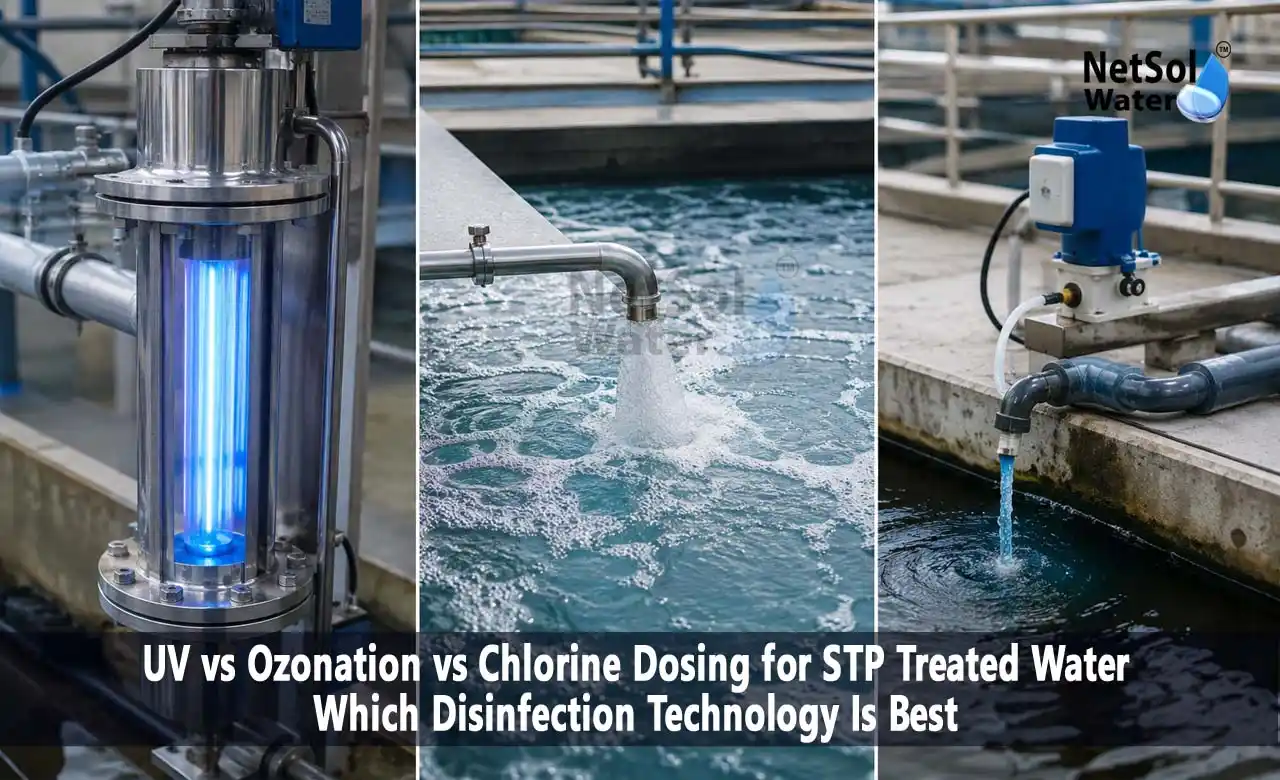
UV vs Ozonation vs Chlorine Dosing for STP Treated Water
Here's a pattern that trips up a lot of plant operators the first time they see it: BOD under 10 mg/L, COD under 50, TSS in single digits, everything on the sheet looking like a plant running exactly as designed, and then the fecal coliform result comes back several orders of magnitude above what it should be. Nothing's wrong with the lab. What's actually happening is that organic removal and pathogen removal were never the same fight to begin with, and secondary treatment was built to win the first one, not the second.
Activated sludge, SBR, MBBR, MBR, whichever biological process a plant runs, all of them exist to strip organic load and suspended solids out of the water. They do that well. Pathogen numbers do drop somewhat along the way too, some of it through predation by the biomass itself, some through sedimentation, some through membrane rejection where MBR is in use, but that reduction is incidental rather than engineered, and it's nowhere near reliable enough to satisfy microbiological standards on its own. A meaningful population of bacteria, viruses, and protozoan cysts gets through secondary treatment more often than not, and stays in the effluent unless something is specifically put there to deal with it.
That's the entire reason tertiary disinfection has stopped being optional. CPCB's General Standards for Discharge of Environmental Pollutants, issued under the Environment (Protection) Rules, 1986, along with the specific limits individual states layer on top, commonly set a fecal coliform ceiling of 100 MPN/100 mL for surface discharge, and reuse applications, irrigation, flushing, industrial process water, tend to get held to something tighter still. Getting there means picking the right disinfection technology, or combination of them, for the water you're actually treating and the use it's actually going to.
This piece works through the three technologies that see real deployment in Indian STPs: UV, ozonation, and chlorine dosing. We'll go through how each one actually kills or disables pathogens, compare them head to head on the numbers that matter, talk through what water quality and end-use should be steering your decision, get honest about cost and safety, and end with something close to a practical checklist for making the call.
Why Disinfection Is Critical After Secondary Treatment?
1. Two Different Fights, Not One
BOD and COD are about oxygen-demanding organic matter. TSS is about suspended particles. None of the three tell you anything about how many pathogens are still in the water, because the organisms responsible for actually making someone sick belong to a completely different category than what these three tests are measuring. A plant can be biologically excellent and microbiologically unsafe at the same time, and that's not a contradiction, it's just two separate jobs, one of which the biological process was never asked to do.
2. What's Actually Left in the Water
Three broad groups of organisms matter here, and each one behaves differently across the three disinfection technologies. A comparative review of virus removal across UV, ozonation, and chlorination, published through the National Library of Medicine's PMC database, lays out exactly how differently:
| Organism Group | Behaviour Across Technologies |
|---|---|
| Bacteria | E. coli and the broader coliform used as fecal contamination indicators, plus various pathogenic species. Generally the easiest to knock down across all three technologies; 4-log bacterial inactivation is achievable at a UV dose as low as 10 mJ/cm². |
| Viruses | Rotavirus, norovirus, adenovirus, and similar enteric viruses. This is where UV struggles the most relative to bacteria, needing anywhere from 10 to 140 mJ/cm² depending on which virus is involved, and adenovirus specifically can demand upward of 150–170 mJ/cm² for 4-log removal in tertiary effluent, roughly ten times what bacteria need. |
| Protozoa | Cryptosporidium and Giardia, both of which form tough, resistant cysts and oocysts. These organisms are famously chlorine-resistant, needing CT values far beyond what bacteria or viruses require, yet they are actually fairly UV-sensitive, with several studies showing effective inactivation at just 5–20 mJ/cm², lower than what many viruses need. |
3. Why Reuse Changes the Stakes
Discharging into a large river with plenty of dilution is one risk profile. Putting that same water onto irrigated crops, into a residential garden where kids play nearby, through a dual-plumbing flushing system, or into an industrial process where workers handle it directly is a very different one. The margin for error shrinks fast once human contact enters the picture, which is exactly why reuse-focused STPs increasingly treat disinfection as a genuine process step, engineered and checked with the same seriousness as the biological train, not just a compliance box ticked at the end of the line.
Understanding the Three Disinfection Technologies
1. UV Disinfection
UV works by damaging DNA and RNA directly. Germicidal UV-C, centred around 254 nm for standard low-pressure mercury lamps, gets absorbed by nucleic acids and forms pyrimidine dimers that stop transcription and replication cold. An organism that can't replicate can't cause an infection, which is really all that matters from a public health standpoint, even though technically the organism hasn't been physically destroyed.
A few things actually drive the design:
. UV dose (fluence), in mJ/cm², is intensity multiplied by exposure time. Tertiary STP disinfection typically gets designed around 30-40 mJ/cm² as a working baseline, though that number needs validating against whatever pathogen target the application actually calls for.
. UV Transmittance (UVT) measures how much light actually makes it through a given path length of water instead of getting absorbed or scattered. This is arguably the single most important design input for UV, and we'll come back to it properly in Section 5.2.
. Contact time is essentially instant, seconds, since the reaction happens the moment the photon is absorbed, not through some slower chemical process.
. Reactivation is a real limitation worth knowing about. Certain bacteria can partially repair UV-induced DNA damage afterward, through photoreactivation or dark repair, particularly if the original dose was on the low side. Designing to a solid minimum, generally 40 mJ/cm² or above, cuts this risk down considerably.
UV leaves nothing behind chemically. Sometimes that's exactly what you want; other times, where a residual is actually needed downstream, it's a real gap.
2. Ozonation
Ozone is unstable and has to be made on-site, usually via corona discharge or electrolysis, since it can't be stored or shipped. It disinfects by directly attacking cell walls, membranes, and internal structures, a chemical assault rather than the genetic-level damage UV inflicts.
What governs the design here:
. Ozone demand is how much of the dosed ozone gets consumed reacting with residual organics before any is left to actually do disinfection work.
• CT value (concentration times time) is the number that really matters. Ozone is remarkably potent compared to chlorine, a microorganism needing a CT of roughly 0.2 mg·min/L with ozone might need something in the range of 600 mg·min/L with chlorine to get the same kill, a gap of about three orders of magnitude. Contact times in practice run 4-20 minutes.
. Off-gas destruction isn't optional. Whatever ozone doesn't get consumed in the contact chamber has to be captured and destroyed, thermally or catalytically, before venting, since ozone itself is toxic and can't just be let out into the air.
Ozone breaks back down to oxygen within minutes to hours after dosing, so like UV, it leaves nothing behind once water moves past the contact chamber.
3. Chlorine Dosing
Chlorine, almost always dosed as sodium hypochlorite in Indian STP practice rather than gas, works by oxidising enzymes and structural proteins inside the cell, shutting down the organism's metabolism. It's still the most widely used disinfection method in water and wastewater treatment worldwide, and the reason is straightforward: it's cheap, well understood, and, unlike the other two, it actually leaves a residual behind.
What matters for design:
. Chlorine demand, same idea as ozone demand, is what gets consumed by organics and ammonia before disinfection-effective chlorine remains.
. CT value governs chlorine dosing too, just at much higher numbers than ozone given how much weaker an oxidiser it is. Published CT values for 4-log virus inactivation generally sit below 10 mg·min/L, still an order of magnitude above ozone's requirement.
. Residual is chlorine's real selling point. A properly run system holds a measurable free or combined residual, usually 0.5-1.0 mg/L, in the treated water, and that residual keeps working against regrowth as water sits in storage or moves through reuse piping.
. Contact time runs longer than UV, at least 30 minutes at peak flow as standard practice.
. Byproducts are the real downside. Chlorine reacting with leftover organic matter produces trihalomethanes and related compounds, several of which are suspected carcinogens under chronic exposure. React it with ammonia instead and you get chloramines, weaker disinfectants that also bring taste and odour problems in reuse applications.
And there's a real weak spot against protozoa. Cryptosporidium in particular shrugs off chlorine at conventional dosing and contact times, needing CT values that are often simply impossible to hit within a normal contact tank's dimensions.
Technical Comparison Matrix
| Parameter | UV Disinfection | Ozonation | Chlorine Dosing |
|---|---|---|---|
| Water quality tolerance | Low turbidity, high UVT essential | Moderate; organic load raises demand | Fairly tolerant; organic load raises demand |
| Bacterial log reduction | High (3–4 log at 2–10 mJ/cm²) | High, low CT | High, moderate CT |
| Viral log reduction | Variable, dose-dependent; adenovirus resistant | Very strong, CT typically under 1 mg·min/L | Good, CT typically under 10 mg·min/L |
| Protozoan reduction | Effective at 5–20 mJ/cm², more sensitive than expected | Effective | Weak, needs impractical CT |
| Contact time | Seconds | 4–20 minutes | 30+ minutes |
| Residual | None | None (reverts to O?) | Yes, sustained |
| Byproduct concern | Minimal | Minimal (some bromate risk) | THMs, chloramines |
| Flow variation sensitivity | Moderate | Low | Low |
| Energy intensity | Moderate | High (0.4–1.0 kWh/kg O?, modern systems) | Low |
The through-line across this table is worth stating plainly: chlorine is the only one that leaves anything behind, and it's also the weakest against protozoa. UV is the pickiest about water quality going in. Ozone lands somewhere strong on raw performance but demands the most energy and the most serious safety setup of the three.
Parameter-by-Parameter Selection Criteria
1. TSS and Turbidity
UV only works if light actually reaches the organism. Push turbidity or TSS up and two things happen at once: particles absorb and scatter light before it does any good, and pathogens sitting inside or riding on those particles get physically shielded from exposure no matter how much dose you're pumping through the reactor.
Plants running MBR or solid tertiary filtration ahead of disinfection usually sit under 5-10 mg/L TSS, comfortably inside UV's reliable range. Plants relying only on conventional secondary clarification are far more exposed to a turbidity spike during upset conditions, and that spike can quietly wreck UV performance without the water looking any different to the naked eye.
Ozone and chlorine tolerate moderate TSS a good deal better, though neither is entirely immune, suspended solids eat into disinfectant demand and offer some shielding either way, just far less dramatically than with UV.
2. UV Transmittance (UVT)
This is the parameter that catches people off guard most often. UVT isn't just about suspended solids, it's affected by dissolved organics, colour, and iron content too, none of which show up on a standard TSS or turbidity test.
Domestic sewage after decent secondary and tertiary treatment usually sits around 55-70% UVT, a range most commercial UV reactors are comfortable handling with standard margin. But push in more dissolved organics, some colour from an industrial cross-connection, or elevated iron, and that number can fall to 30-40% or lower. A reactor sized for 65% UVT hitting water that's actually at 35% will deliver a fraction of its intended dose, quietly, with nothing on the flow meter or power draw telling you anything's wrong.
The takeaway is simple: size UV against your own site's actual UVT data, gathered across seasons and flow conditions, not a number pulled from a textbook.
3. Flow Rate
Small STPs, roughly under 50-100 KLD, generally do best with UV. Capital cost scales sensibly at that size, and the system is simple enough to run without dedicated technical staff on hand round the clock.
Once you're talking several hundred KLD and up, the economics shift. Both ozone and chlorine scale efficiently, and chlorine in particular stays remarkably cheap per kilolitre even at municipal scale, which is exactly why most large city STPs in India still run chlorination as the primary barrier, sometimes with UV layered on top for extra virus and protozoa coverage.
Flow variability matters here too. Multi-bank UV systems can throttle reasonably well, but a system that isn't explicitly designed against peak flow will under-dose exactly when it matters most, morning and evening peaks. Ozone and chlorine contact tanks, having more buffering volume, ride out short flow spikes with far less drama.
4. End-Use
| End-Use | Typical Preference | Why |
|---|---|---|
| Surface discharge | UV or chlorine (with dechlorination if needed) | Meets fecal coliform norms without necessarily needing a residual |
| Irrigation reuse | UV or chlorine, site-dependent | Depends on crop type and state reuse guidance |
| Flushing / dual plumbing | Chlorine preferred | Residual guards against regrowth in storage and building piping |
| Gardening / landscaping | UV or chlorine, site-dependent | Depends on how much direct human contact happens |
| Industrial reuse | Chlorine or ozone, occasionally UV plus a chlorine boost | Depends on process water spec and biofouling control needs |
5. Regulatory and Residual Requirements
If the water is going into storage or a distribution network afterward, the residual question usually settles the technology choice on its own. Neither UV nor ozone protects the water once it's left the reactor or contact chamber, so using either alone for a flushing or distributed reuse application leaves the system genuinely exposed to regrowth, especially given how warm most of India stays for most of the year. That's the actual engineering reason behind the popular UV-plus-chlorine hybrid setup covered in Section 9: UV or ozone handles the heavy lifting on log reduction, including protozoa, and a small chlorine residual downstream exists purely to keep storage and piping from regrowing anything afterward.
CAPEX, OPEX, and Long-Term Cost Analysis
| Cost Factor | Chlorine Dosing | UV Disinfection | Ozonation |
|---|---|---|---|
| Upfront capital | Wins on upfront capital almost every time — dosing pumps, storage, and a contact chamber, none of the specialised generation or safety infrastructure ozone needs | Sits in the middle, driven mostly by lamp count, reactor design, and sensors | Comes in highest — generator, oxygen feed, contact chamber, and a mandatory off-gas destruct unit add up to a genuinely more complex install |
| Power | Dosing pumps barely register on an electricity bill | Draws steady, predictable power tied to dose and flow | The clear outlier, running roughly 0.4–1.0 kWh per kg of ozone on modern, well-optimised systems, climbing toward 10 kWh per kg on older equipment |
| Consumables | An ongoing chemical bill for hypochlorite, scaling directly with flow and dose | Periodic lamp replacement, typically rated around 9,000–12,000 hours, plus sleeve cleaning | Recurring costs sit mostly around dielectric components and off-gas catalyst, on a longer replacement cycle than either of the other two |
| Maintenance skill | Needs the least specialised training | Needs a moderate amount of training | Needs the most, often justifying a service contract with the equipment supplier rather than relying purely on in-house staff |
Safety and Operational Considerations
| Technology | Key Safety / Operational Considerations |
|---|---|
| Chlorine Dosing | Sodium hypochlorite is safer than chlorine gas, but it's still corrosive and will release chlorine gas if it comes into contact with acidic cleaning agents or other incompatible chemicals, a mistake that's happened at more than a few facilities. Proper ventilation, spill containment, and PPE around storage areas are optional extras. Training needs are the least demanding of the three. |
| Ozonation | A more acute hazard — a regulated toxic gas with occupational limits set well below what's detectable by smell at higher concentrations. Off-gas destruction has to be treated as core infrastructure, not a nice-to-have, and generator rooms need continuous gas detection and ventilation. Training needs are the most demanding, covering gas safety and emergency response specifically. |
| UV Disinfection | Concerns are narrower but still real. Most low-pressure lamps contain elemental mercury and need hazardous waste disposal, something that's easy to overlook at the operational level. Standard electrical safety practice around ballasts and wet environments applies as it would anywhere else. Training needs sit at a moderate level, focused on lamp handling and sensor readings. |
Reliability and Maintenance Comparison
| Aspect | UV Disinfection | Ozonation | Chlorine Dosing |
|---|---|---|---|
| Component lifespan | Lamps typically rated for 9,000–12,000 hours before replacement | Generator components, dielectrics and electrodes mainly, tend to last several years to a decade depending on how well the system's run | Dosing hardware, being mechanically the simplest of the three, generally outlasts both |
| Fouling | Lamp sleeves pick up mineral scale and biofilm, gradually cutting transmittance and needing periodic cleaning, often via a built-in wiper | Diffusers and nozzles foul from suspended solids and mineral buildup | Lines scale up too, particularly in hard water, and need periodic flushing |
| Redundancy | N+1 lamp banks recommended for compliance-critical applications | Duty-standby generators recommended for compliance-critical applications | More forgiving given mechanical simplicity, though duty-standby pumps remain good practice regardless |
For anything with a hard compliance obligation, redundancy matters, N+1 UV lamp banks or duty-standby ozone generators, since neither can be fixed instantly if something fails mid-operation.
Decision Framework — How to Choose the Right Technology
Work through four things in order: design flow, end-use and its residual requirement, actual influent water quality (TSS, turbidity, UVT if UV is on the table), and what budget and staffing can realistically support.
As a rough guide:
. Need a sustained residual, flushing, storage, distributed reuse piping? Chlorine has to be part of the picture, whether standalone or in combination.
. Consistently low TSS with validated high UVT, and no downstream storage needing residual protection? UV alone is often the cleanest, cheapest fit, particularly for surface discharge.
. Protozoa are a genuine concern and chlorine-only can't hit the CT within a realistic contact tank size? UV or ozone needs to carry the primary log-reduction load.
. Large plant, energy budget is the binding constraint? Chlorine as the primary barrier, UV as a polishing step where virus or protozoa targets need it.
. Byproduct formation is a specific worry, food-crop irrigation being the classic example? Lean toward UV or ozone as primary.
In practice, hybrids show up constantly. UV-plus-chlorine is popular precisely because it combines UV's strength across bacteria, viruses, and protozoa with just enough chlorine residual downstream to stop regrowth in storage, without dosing high enough to generate meaningful THMs. Ozone paired with biological activated carbon turns up more in industrial or advanced reuse settings where organic micropollutant removal matters alongside disinfection. Chlorine on its own remains the default for large municipal STPs discharging to surface water with no particular reuse-driven residual demand.
NetSol Water's Approach to STP Disinfection Systems
Disinfection selection at NetSol doesn't start from a favourite technology and work backward, it starts from the site. Built up over more than 27 years of designing, commissioning, and maintaining sewage and effluent treatment infrastructure, the process generally runs through the following stages:
. Effluent Characterisation — Every project starts with actual lab testing of the specific effluent, TSS, turbidity, UVT where UV is even under consideration, and residual organic load, since these numbers, not assumptions borrowed from some other plant, are what actually decide whether a technology will hold up on-site.
. Mapping End-Use Against Residual Needs — Before any technology gets shortlisted, the intended use, discharge, irrigation, flushing, industrial reuse, gets matched against its specific microbiological and residual requirement, since this one step usually decides whether a single technology or a hybrid setup is the right call.
. Checking Regulatory Alignment — Designs get checked against both the CPCB baseline and whatever the relevant SPCB has separately notified, since the two don't always line up, and whichever is stricter is what governs.
. Weighing the Technologies Against Each Other — UV, ozone, and chlorine, alone or combined, get evaluated against the plant's real flow data, water quality, and budget, with cost, energy, residual need, and log-reduction target all weighed openly rather than defaulting to whatever's most familiar.
. Sizing With Peak Flow and Redundancy in Mind — Equipment gets sized against peak flow, not average, with duty-standby or N+1 redundancy built in wherever a compliance or reuse obligation genuinely can't tolerate downtime during routine servicing.
. Commissioning and Ongoing Support — Systems go live with dose or CT validated against real site water quality, followed by proper operator training and, where needed, an ongoing maintenance arrangement covering lamp replacement, ozone generator servicing, or dosing pump calibration for as long as the plant runs.
Conclusion
None of these three technologies is universally “best.” UV disinfects fast and chemical-free, performs well against bacteria and, surprisingly, protozoa, but demands consistently low turbidity and solid UVT to actually work, and leaves nothing behind once water moves on. Ozonation gives the strongest all-round microbiological performance with the least byproduct baggage, at the cost of the highest energy draw and the most serious safety infrastructure of the three. Chlorine stays the cheapest and simplest option at scale, and it's the only one that leaves a working residual behind, but it's genuinely weak against protozoa and comes with a byproduct profile that needs watching carefully in sensitive reuse settings.
Which one actually fits depends on your effluent quality after secondary treatment, what the water's actually being used for and whether that use needs a residual, what budget you're working with, and what your team can realistically maintain over the plant's life. More often than people expect, the right answer is a hybrid, usually UV or ozone doing the heavy lifting with a small, controlled chlorine residual layered on afterward, rather than any single technology carrying the whole job alone.
Given how much site-specific water quality changes everything laid out here, the right move is testing your actual effluent rather than assuming it behaves like water from a different plant entirely. NetSol's engineering team can review your site's water quality data, the regulatory requirements that actually apply to you, and your end-use goals before recommending a disinfection setup for a new or existing STP.
FAQs
Q1. Which disinfection technology is the most cost-effective?
Chlorine dosing usually comes out cheapest per kilolitre, especially at larger plant sizes, given how simple the equipment is and how little energy it draws. That said, cost-effectiveness only means something once you factor in the end-use requirement, if a residual isn't wanted or byproducts are a genuine concern, UV or ozone can end up cheaper overall once compliance risk and reuse quality are properly accounted for.
Q2. Does UV disinfection work in turbid water?
Not reliably. Turbidity and TSS both cut into how much light actually reaches the organisms, and particles can physically shield pathogens from exposure regardless of the dose being applied. UV tends to perform well only where upstream treatment, tertiary filtration or MBR usually, keeps TSS low and UVT validated and high. Running UV against poorly filtered, turbid effluent carries a genuine risk of under-dosing.
Q3. What are the downsides of chlorine dosing for reused water?
Mainly disinfection byproducts, trihalomethanes and chloramines, formed when chlorine reacts with whatever organic matter is still in the water. These carry suspected long-term health risks under chronic exposure and get more regulatory attention the closer the reuse gets to food crops or occupied indoor spaces.
Q4. Is ozone disinfection practical for STPs in India?
Technically, yes, and it performs well without chlorine's byproduct baggage. Practically, the high energy cost, elevated capital investment, and mandatory safety infrastructure, off-gas destruction and gas detection included, mean it tends to show up mostly in larger industrial or advanced reuse projects where the budget and technical staff can support that complexity. It's still far less common than UV or chlorine across smaller and mid-size STPs.
Q5. Why does residual disinfectant matter for some applications?
Because water doesn't stay put after treatment, it sits in tanks, moves through pipes, waits before use, and any of that gives microorganisms a chance to regrow if nothing's protecting the water in the meantime. UV and ozone both stop working the moment water leaves their reactor or chamber, so anything involving storage or extended distribution, dual-plumbing flushing being the obvious case, generally needs a chlorine residual as part of the setup, no matter which technology handled the initial disinfection.