

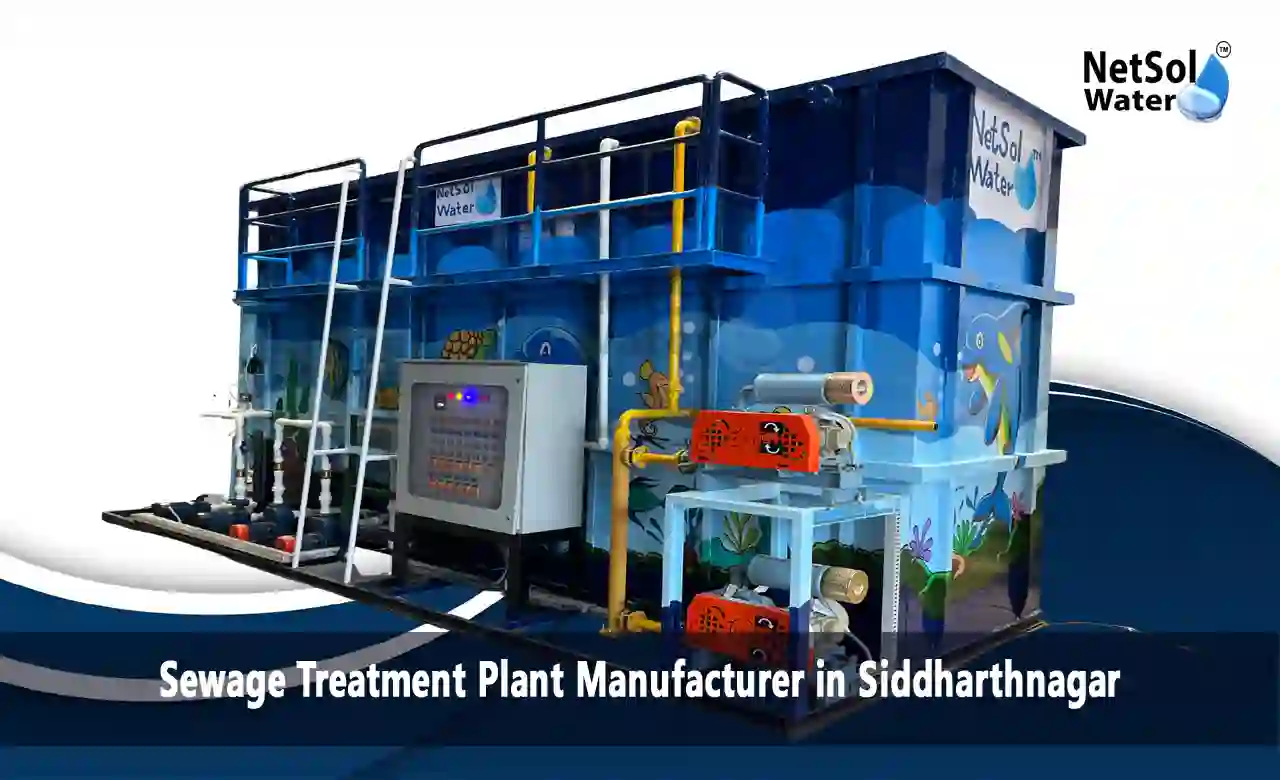
Sewage Treatment Plant Manufacturer in Siddharthnagar
Siddharthnagar is changing. New housing societies are rising, institutions are expanding, and commercial activity is picking up pace. But with growth comes a challenge that's easy to overlook until it becomes urgent: where does all the wastewater go?
Every home, apartment block, hospital, and school in Siddharthnagar generates sewage daily. When this wastewater flows untreated into drains, water bodies, or open land, it becomes a public health crisis - not just an environmental inconvenience.
Sewage Treatment Plants (STPs) are the proven, responsible answer. And Netsol Water is the trusted STP manufacturer in Siddharthnagar helping institutions, builders, and local bodies manage wastewater the right way.
What Is a Sewage Treatment Plant and Why Does It Matter?
A Sewage Treatment Plant is a facility that processes domestic or municipal wastewater - the water that comes from kitchens, bathrooms, laundry rooms, and similar sources. The goal is simple: remove harmful contaminants so the treated water can either be safely discharged into the environment or reused for non-drinking purposes like gardening or flushing.
Modern STPs use biological, chemical, and physical treatment processes to eliminate suspended solids, organic matter, pathogens, and nutrients from wastewater. The result is treated effluent that meets regulatory discharge standards set by pollution control boards.
The Growing Need for STPs in Siddharthnagar
1. Rapid Population Growth and Urbanization
Siddharthnagar's population is growing steadily, and with more residents come more residential developments. Apartment complexes, gated societies, and institutional campuses all require dedicated sewage treatment systems - and many of them are now mandated by state pollution control regulations.
2. Inadequate Municipal Drainage Infrastructure
In many parts of Siddharthnagar, the existing drainage network is either outdated or lacks the capacity to handle increasing sewage volumes. Buildings and institutions cannot rely solely on municipal systems - they need on-site treatment solutions.
3. Health Risks from Untreated Sewage
Untreated sewage is a primary vector for waterborne diseases including cholera, typhoid, hepatitis A, and dysentery. When wastewater enters groundwater sources or nearby water bodies without treatment, it can contaminate drinking water sources for entire communities.
4. Regulatory and RERA Compliance
New housing projects in Uttar Pradesh exceeding a certain capacity are required under environmental regulations and RERA guidelines to install sewage treatment facilities. Builders who ignore this requirement risk project delays, penalties, and legal action.
5. Water Conservation Through Reuse
Treated sewage water isn't waste - it's a resource. When properly treated, it can be used for landscaping, toilet flushing, vehicle washing, and construction purposes. In water-scarce regions, this recycled water can significantly reduce dependency on fresh water sources.
Why Netsol Water is the Top STP Choice in Siddharthnagar
1. Deep Understanding of Local Conditions
We don't apply a generic solution to every project. We study the local water table, the type of sewage generated (residential, commercial, or institutional), and the site layout before recommending a treatment approach. This site-specific thinking produces better-performing plants.
2. Proven Track Record Across UP
Netsol Water has successfully installed and commissioned STPs across multiple districts in Uttar Pradesh. Our clients include residential societies, private schools, hospitals, and government-assisted housing projects.
3. Technology-First Approach
We utilize the latest treatment technologies - MBBR, SBR, and biological treatment - to ensure your STP meets current pollution control board norms for BOD, COD, TSS, and other parameters.
4. Transparent Pricing, No Hidden Costs
Our quotations are detailed and transparent. We break down every cost - equipment, civil work, installation, and commissioning - so there are no surprises. We believe informed clients make better partners.
Also Read: STP Plant Manufacturer and Supplier in U.P.
Treatment Technologies We Use
1. MBBR - Moving Bed Biofilm Reactor
MBBR is one of the most space-efficient and effective biological treatment technologies available. Small plastic media carriers create a large surface area for bacteria to grow on, breaking down organic waste efficiently. MBBR plants are compact, energy-efficient, and require minimal operator intervention.
Best for: Housing societies, schools, mid-size commercial buildings in Siddharthnagar.
2. SBR - Sequencing Batch Reactor
SBR technology operates in timed cycles of filling, reacting, settling, and decanting. The result is very high-quality treated water that consistently meets discharge standards. SBR plants are popular where treated water needs to be reused or where regulatory standards are strict.
Best for: Large housing complexes, hospitals, and institutional campuses requiring high-quality effluent.
3. Activated Sludge Process (ASP)
A proven, established biological treatment method suitable for large volumes of sewage. ASP uses aeration to promote microbial activity that breaks down organic matter, followed by sedimentation to separate treated water from sludge.
4. Compact Packaged STPs
Prefabricated, modular STPs that can be installed quickly with minimal civil work. Ideal for projects with space constraints or those requiring fast deployment. These systems come fully assembled and tested from our facility.
Applications of Our STPs in Siddharthnagar
Our sewage treatment plants serve a wide spectrum of clients across Siddharthnagar:
• Residential apartments and gated housing societies - managing daily domestic sewage from hundreds of families
• Schools and educational campuses - ensuring hygienic disposal of institutional wastewater
• Hospitals and healthcare facilities - treating wastewater that may contain pathogens and medical contaminants
• Hotels and commercial complexes - maintaining sanitation standards and compliance
• Government housing projects and rural community projects - providing affordable, reliable sewage management
Understanding STP Costs in Siddharthnagar
1. Key Cost Factors
The cost of installing a sewage treatment plant in Siddharthnagar is influenced by several factors:
• Daily Sewage Volume: Higher daily sewage generation requires larger capacity plants, which cost more.
• Treatment Technology: Advanced technologies like SBR or MBBR may cost more upfront but offer better performance and lower operational costs.
• Site Conditions: Underground installation, limited access, or rocky terrain may require additional civil engineering work.
• Automation Level: Fully automated plants with PLC controls and remote monitoring cost more initially but reduce ongoing labor costs significantly.
• Quality of Materials: High-grade stainless steel, FRP tanks, and quality pumps offer longer life and better reliability.
2. Return on Investment
An STP is not just a cost center - it's an asset. Buildings with functioning STPs command higher rents, meet regulatory requirements, and avoid the cost of penalties or forced shutdowns. The treated water produced can reduce fresh water purchase costs as well.
Our Process: Working With You From Start to Finish
• Site Assessment: We visit your property, measure space, assess sewage load, and review access requirements.
• Technology Recommendation: Based on your project, we recommend the most suitable treatment technology and capacity.
• Detailed Proposal: We share a comprehensive technical and commercial proposal with full cost breakdown.
• Design Approval: Our engineers finalize the plant design with your input and approval.
• Manufacturing: All systems are built and tested at our facility before delivery.
• Installation & Commissioning: Our team installs, connects, and tests the plant on-site before handover.
• Operator Training: We train your building staff on daily operations and basic maintenance.
• After-Sales Support: Ongoing maintenance, AMC, and technical support available on demand.
Frequently Asked Questions
Q1. What size STP is required for a 100-flat apartment complex in Siddharthnagar?
For 100 flats with an average occupancy of 4 persons per flat (400 people), assuming 135 liters per person per day sewage generation, you'd need an STP with a minimum capacity of 54,000 liters per day (54 KLD). We recommend adding a 10–15% buffer, so a 60–65 KLD STP would be appropriate.
Q2. Is it mandatory to install an STP in new housing projects in Uttar Pradesh?
Yes. As per UPPCB (Uttar Pradesh Pollution Control Board) norms and RERA regulations, new housing projects generating sewage above a specified threshold must install sewage treatment plants. Non-compliance can result in occupancy certificate denial and legal penalties.
Q3. How long does it take to install an STP?
Installation time depends on the plant size and site conditions. A compact packaged STP for a mid-size building can be commissioned in 2–4 weeks. Larger, custom-built systems for big complexes or institutions may take 6–12 weeks from order to commissioning.
Q4. What happens to the sludge from an STP?
Biological sludge produced during the treatment process is dried and can be used as organic fertilizer. Our systems include sludge management provisions - either a sludge drying bed or a mechanical dewatering system depending on the scale of the plant.
Q5. Can an existing building add an STP if it was built without one?
Yes, and we do this regularly. Retrofitting an STP in an existing building is more complex than a new installation, but entirely feasible with good planning. We assess the available space, existing plumbing, and sewage routing before designing a compact retrofit solution.
Q6. What is the energy consumption of a typical STP?
A well-designed STP consumes between 0.3 to 0.8 kWh per cubic meter of sewage treated, depending on technology. MBBR-based systems are among the most energy-efficient. We design our plants to minimize power consumption while maintaining treatment quality.
Q7. Does treated water from an STP need further purification before drinking?
No. STP-treated water is not designed or safe for direct drinking without further treatment. However, it is suitable for toilet flushing, irrigation, gardening, and construction use. For drinking purposes, treated water would need to go through an additional RO or UV filtration system.
Q8. Does Netsol Water provide UPPCB compliance documentation for STPs?
Yes. We provide all technical documentation required for UPPCB clearance, including design reports, capacity calculations, and performance guarantee sheets. We assist clients through the regulatory approval process to ensure smooth compliance.
Call to Action
If you're building a new housing society, institution, or commercial complex in Siddharthnagar - or if you're managing an existing property that needs a compliant STP - reach out to Netsol Water today.
Get a free site assessment, a transparent quotation, and expert guidance from our team. We're here to make sewage management simple, compliant, and efficient.