

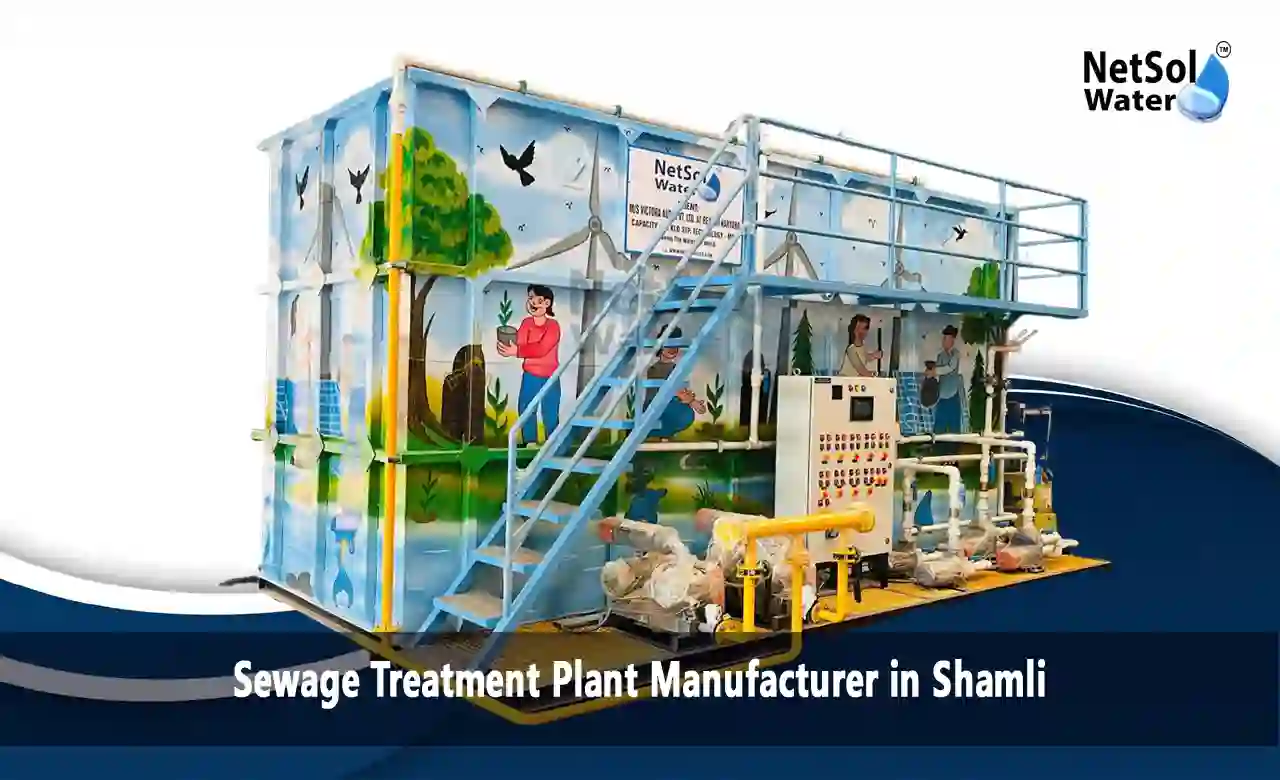
Sewage Treatment Plant Manufacturer in Shamli
Shamli is a city in transition. New housing colonies are developing along the city periphery. Commercial spaces and institutional buildings are multiplying. And with every new structure, a fundamental question arises: what happens to the wastewater generated every day?
Without a proper sewage treatment system, this wastewater flows into open drains, waterlogged plots, or nearby agricultural land - causing health hazards, odor issues, and long-term environmental damage. With a properly installed and operated STP, the same wastewater becomes a manageable, even valuable, resource.
Netsol Water is the sewage treatment plant manufacturer in Shamli's builders, institutions and property owners trust for reliable, compliant, and cost-effective STP solutions.
The Real Impact of Untreated Sewage in Shamli
Let's be direct about what untreated sewage actually means at a community level. It's not just an environmental concern on paper - it has daily, tangible consequences for the people of Shamli.
1. Groundwater Contamination
Shamli, like most districts in western UP, relies significantly on groundwater for drinking and agricultural use. When untreated sewage seeps into the soil through open drains or inadequate disposal, it contaminates the shallow water table. Communities drinking this water are exposed to nitrates, pathogens, and chemical pollutants without even knowing it.
2. Waterborne Disease Risk
Untreated domestic sewage is a breeding ground for bacteria like E. coli and pathogens causing typhoid, cholera, dysentery, and hepatitis A. In densely populated areas of Shamli, contamination spreads quickly. Children and elderly populations are most vulnerable.
3. Soil and Agricultural Damage
Many areas around Shamli are agriculturally active. Sewage water that enters fields through overflow or drainage channels gradually degrades soil quality, introduces salt build-up, and can contaminate crops - creating both health and economic consequences for farming families.
4. Urban Amenity and Property Value
Buildings and housing societies without proper sewage management struggle with foul odors, pest infestations, and recurring sanitation complaints. This directly impacts the quality of life for residents and can lower property values.
Why STPs Are Now Mandatory and Market-Driven
The installation of sewage treatment plants in Shamli is no longer just a regulatory obligation - it's increasingly a market expectation.
1. Regulatory Requirements
New construction projects generating more than a threshold volume of sewage must comply with UPPCB (Uttar Pradesh Pollution Control Board) wastewater management norms. Builders who don't install STPs face delays in occupancy certificates, penalties, and legal action from pollution control authorities.
2. Home Buyer Expectations
Modern home buyers - especially in tier-2 cities like Shamli - are increasingly aware of green building features. An STP that recycles water for flushing and gardening is now a genuine selling point for residential projects.
3. Institutional Compliance
Schools, hospitals, and commercial establishments with more than a minimum threshold of daily sewage generation must have functional treatment systems to maintain their operational licenses. This creates consistent, organic demand for STPs across different user categories.
What Makes Netsol Water the Right Partner in Shamli?
1. Local Knowledge, Professional Execution
We understand the local water table, soil conditions, and regulatory environment in Shamli and western UP. This means our designs aren't just theoretically correct - they're practically optimized for local conditions.
2. Range of Technologies
We're not committed to one technology. We offer MBBR, SBR, activated sludge, and compact packaged systems. Our recommendation is always based on what's best for your project - not what's easiest for us to supply.
3. Quality Construction, Lasting Performance
We use high-quality FRP tanks, food-grade blowers, corrosion-resistant pumps, and media with proven biofilm retention. Our plants are built to perform for 15+ years with proper maintenance.
4. Complete Project Responsibility
We're the single point of contact from feasibility to commissioning. Civil guidelines, equipment supply, installation, testing, and UPPCB documentation - all of it managed by Netsol Water, so you don't need to coordinate multiple vendors.
Also Read: STP Manufacturer in U.P.
STP Technologies We Offer in Shamli
1. MBBR - Moving Bed Biofilm Reactor
MBBR is currently one of the most preferred technologies for residential and commercial STPs across India. It uses small, buoyant plastic carriers (media) with a honeycomb structure inside aeration tanks. Bacteria colonize these carriers and break down organic matter in the sewage.
Advantages of MBBR: Compact footprint, easy operation, tolerant of sewage load variations, low sludge generation, and high-quality effluent. Ideal for housing societies and apartment complexes in Shamli.
2. SBR - Sequencing Batch Reactor
SBR operates in time-based cycles within a single tank - eliminating the need for separate clarifiers. Each cycle includes filling, reaction, settling, and decanting phases. The flexibility of SBR allows treatment parameters to be adjusted without changing physical infrastructure.
Advantages of SBR: Superior effluent quality, flexible operation, good nitrogen and phosphorus removal, suitable for institutions requiring very clean treated output.
3. Extended Aeration (EA) Systems
A well-established, robust technology for larger STPs. EA plants use prolonged aeration to achieve thorough biological treatment. These systems are highly reliable and require minimal chemical dosing.
4. Compact Packaged STPs
Pre-fabricated, skid-mounted systems that can be installed in 1–2 weeks with minimal civil work. Ideal for projects with tight timelines or limited space. Available in standard capacities from 10 KLD to 100 KLD.
Applications Across Shamli
• Residential apartments and gated societies: Daily domestic sewage management with treated water reuse for common area landscaping
• Schools and educational institutions: Safe disposal of institutional wastewater protecting students and staff health
• Hospitals and nursing homes: Treatment of potentially pathogen-rich healthcare wastewater
• Hotels, dharamshalas, and guest houses: Maintaining hygiene and sanitation compliance
• Municipal and government housing projects: Community-scale sewage management in planned developments
• Commercial complexes: Office and retail wastewater management
How We Size an STP for Your Project?
Proper sizing is critical. An undersized STP leads to overloading and poor effluent quality. An oversized STP wastes capital and may not operate efficiently at low loads. Here's how we approach sizing:
• Determine number of users (population equivalent)
• Apply per capita sewage generation factor (typically 135 L/person/day for residential)
• Calculate peak flow factor based on building type
• Add buffer for future growth (typically 15–20%)
• Select appropriate technology and determine tank volumes, aerator sizing, and sludge handling capacity
Understanding STP Costs in Shamli
STP costs vary depending on several factors. Here's an honest breakdown:
• Capacity: The biggest cost driver. A 10 KLD plant costs far less than a 100 KLD plant.
• Technology: MBBR and packaged systems may have different cost profiles than conventional ASP.
• Civil Work: Underground tanks vs. above-ground installations, accessibility of the site.
• Automation: Manual, semi-automatic, or fully automatic with remote monitoring.
• Material Grade: FRP, MS with lining, or RCC - each with different durability and cost implications.
• Location: Accessibility and local logistics affect transportation and installation costs.
Frequently Asked Questions
Q1. What is the minimum capacity STP required for a housing society in Shamli?
For a small housing society of 20–30 families, a 5–10 KLD (kiloliters per day) STP is typically sufficient. For larger societies of 100+ families, you'd need 30–50 KLD or more. Exact sizing depends on per capita water consumption and the number of permanent residents.
Q2. How much space is needed to install an STP in an apartment complex?
Space requirement depends on technology and capacity. A compact MBBR or packaged STP for a 50-flat society typically requires 25–60 square meters. Underground options can reduce the visible footprint significantly. We conduct a site visit to assess available space before finalizing the design.
Q3. What maintenance does an STP require and who handles it?
Routine STP maintenance includes daily equipment checks, weekly cleaning of screens and settling zones, monthly sludge level monitoring, and periodic media/media carrier inspection. Netsol Water provides Annual Maintenance Contracts (AMC) where our technicians handle all scheduled maintenance so your staff doesn't need specialized training.
Q4. Can treated STP water be used for drinking purposes?
No. STP-treated water (secondary or tertiary) is not suitable for drinking without further treatment through RO or advanced filtration. However, it is perfectly safe and effective for toilet flushing, gardening, vehicle washing, and construction activities - significantly reducing fresh water demand.
Q5. How do I get UPPCB clearance for an STP in Shamli?
UPPCB clearance involves submitting a detailed technical report about your STP design, capacity, and performance. Netsol Water prepares all documentation required for Consent to Establish and Consent to Operate applications. We guide you through the submission and follow-up process to ensure timely approvals.
Q6. What is the typical lifespan of an STP?
A well-built and properly maintained STP can last 20–25 years. Mechanical components like pumps and blowers have shorter service lives (5–10 years) and require periodic replacement. Our AMC contracts cover this maintenance systematically.
Q7. Is there government subsidy available for STP installation in Shamli?
Central and state government schemes under Swachh Bharat Mission and Namami Gange have offered subsidies for sewage treatment infrastructure in certain categories of beneficiaries. We keep track of applicable schemes and can advise clients on potential subsidy eligibility during the project planning phase.
Q8. What happens if my STP is not functioning properly and discharges untreated sewage?
Non-compliant discharge can result in UPPCB show cause notices, environmental compensation orders, temporary or permanent closure of your facility, and in serious cases, criminal prosecution under environmental protection laws. This makes proper installation and regular maintenance critically important.
Let's Build a Cleaner Shamli Together
Every STP installed in Shamli is a step toward cleaner groundwater, healthier communities, and a more sustainable city. Netsol Water is proud to be the partner that makes this possible for builders, institutions, and property owners across the region.
Reach out to our team today. We'll start with a free consultation, understand your project requirements, and give you a clear roadmap from planning to commissioning.