

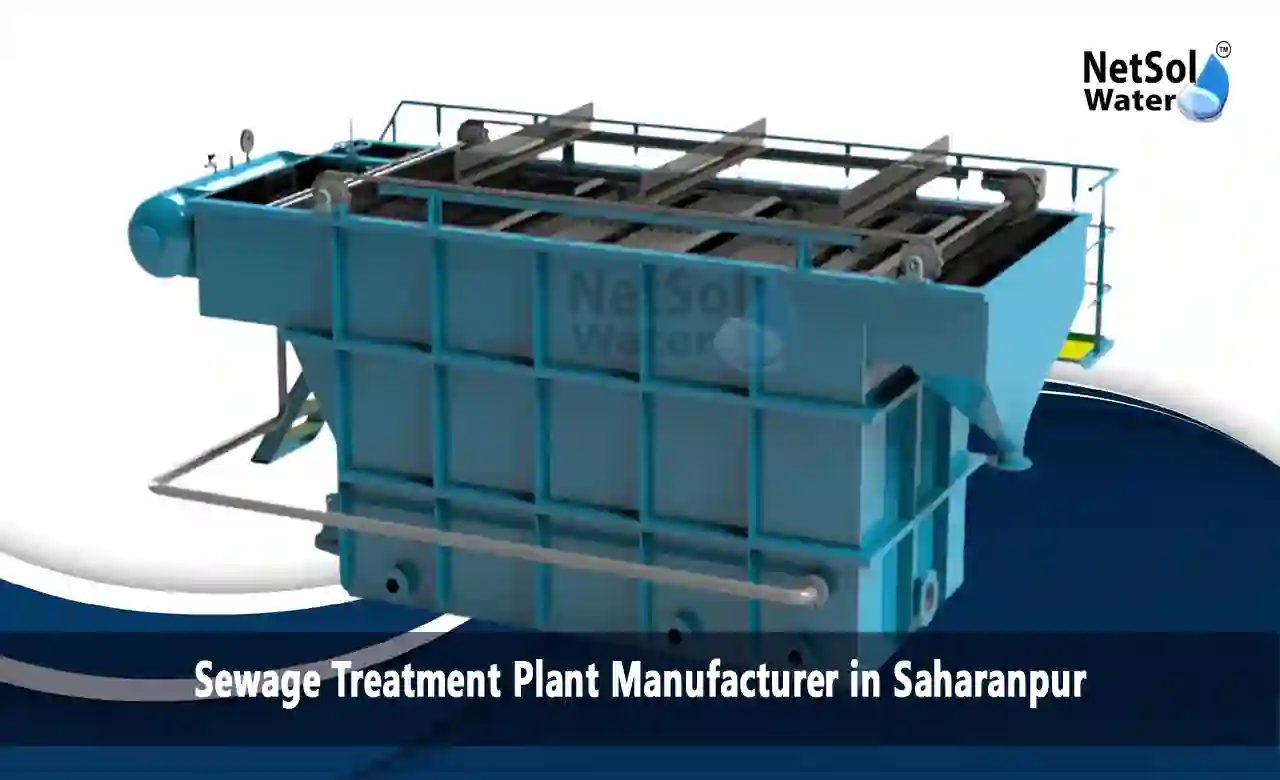
Sewage Treatment Plant Manufacturer in Saharanpur
Saharanpur is growing in multiple directions - new residential colonies, expanding industries, growing commercial zones, and a swelling urban population. Behind every new building, institution, and business is one unchangeable reality: wastewater is being generated every day, and it needs to be managed responsibly.
The challenge in Saharanpur is real and urgent. Many areas still lack comprehensive municipal sewage infrastructure. New housing projects generate sewage that existing drains can't handle. Industries discharge water that must meet pollution control standards. And regulatory authorities are increasingly serious about enforcement.
Netsol Water is the sewage treatment plant manufacturer in Saharanpur that understands this challenge - and has the technical capability, local experience, and commitment to provide real solutions.
Why Proper Sewage Treatment Is No Longer Optional in Saharanpur?
1. Regulatory Enforcement is Tightening
UPPCB (Uttar Pradesh Pollution Control Board) regulations require new construction projects above a certain sewage generation threshold to install functional sewage treatment plants. The enforcement of these rules has become stricter in recent years, and non-compliant projects face occupancy certificate delays, penalties, and forced remediation.
2. Saharanpur's Water Bodies Are Under Pressure
The Dhamola and Krishni rivers, along with various irrigation channels and ponds in and around Saharanpur, are critically stressed from untreated sewage and industrial effluent. Every functioning STP that's installed reduces this pressure and helps restore the ecological health of these water bodies.
3. Health Implications for Dense Urban Areas
Saharanpur's urban density, particularly in older parts of the city, means that untreated sewage disposal has direct public health consequences. Groundwater contamination, open drain overflow, and vector breeding in stagnant sewage are all connected to waterborne disease outbreaks that affect entire neighborhoods.
4. Market Demand in the Real Estate Sector
Developers in Saharanpur are finding that buyers increasingly ask about environmental features - including sewage treatment. A project with a functional STP and water recycling for landscaping and flushing is more attractive to environmentally aware buyers and commands better pricing.
Who Needs an STP in Saharanpur?
Our STP clients in Saharanpur come from a wide range of sectors:
1. Residential Developers
Multi-story apartments, housing societies, gated communities, and plotted developments with clubhouses and common facilities all generate sewage that must be managed on-site or discharged to municipal systems. For larger projects, on-site treatment is often mandatory and more cost-effective.
2. Educational Institutions
Schools, colleges, and residential campuses in Saharanpur generate significant daily sewage volumes. Institutions with hostels, canteens, and large student populations need properly sized STPs to manage wastewater safely and maintain hygiene standards.
3. Healthcare Facilities
Hospitals, nursing homes, and diagnostic centers generate wastewater that may contain pathogens, pharmaceutical residues, and disinfectants. This wastewater requires careful treatment before disposal. Our healthcare-grade STP designs address these specific requirements.
4. Hotels and Hospitality Venues
Hotels, resorts, dharamshalas, and banquet halls generate high-volume wastewater from kitchens, laundry, bathrooms, and public areas. STPs allow these venues to manage wastewater responsibly while potentially reusing treated water for landscaping and non-potable uses.
5. Industrial Facilities with Domestic Sewage
Large industrial campuses have staff canteens, restrooms, and sometimes residential quarters for workers. The domestic sewage from these facilities requires STP treatment separate from industrial effluent.
Netsol Water's STP Expertise in Saharanpur
1. Experience Across Multiple STP Technologies
We're not a one-technology company. We design and install MBBR, SBR, Extended Aeration, and Packaged STP systems - each suited to different scenarios. Our recommendation is always based on the best technical and commercial fit for your specific project.
2. UPPCB Compliance Guaranteed
Our STP designs are engineered to meet UPPCB discharge norms for BOD, COD, TSS, and coliform count. We provide full technical documentation for regulatory submissions and guide clients through the consent process from application to approval.
3. Civil and Structural Coordination
STP installation involves civil work - tanks, platforms, pipelines, and electrical connections. We coordinate with your civil contractor or provide civil guidelines to ensure the plant is properly constructed and positioned. This integrated approach prevents costly rework.
4. Long-Term Performance Commitment
We stand behind the performance of every STP we install. Our AMC contracts provide scheduled maintenance, performance monitoring, and technical support to ensure your plant consistently meets regulatory discharge standards throughout its operational life.
Also Read: STP manufacturer and supplier in U.P.
Treatment Technologies Available in Saharanpur
1. MBBR (Moving Bed Biofilm Reactor)
The preferred technology for residential and mid-size commercial STPs. MBBR uses plastic carrier media with large surface area for biofilm growth. The biological treatment happens within the aeration tank, making the process highly efficient and compact. MBBR plants are easy to operate, require little maintenance, and produce consistent results.
2. SBR (Sequencing Batch Reactor)
SBR is a fill-and-draw technology where all treatment phases happen in a single reactor - eliminating the need for separate clarifiers. It produces very high-quality effluent and can be programmed to remove nutrients (nitrogen and phosphorus) as well as organic matter. Ideal for projects requiring treated water reuse.
3. Activated Sludge Process (ASP) with Clarifier
A robust, well-established technology for larger STP applications. ASP uses continuous aeration and biological treatment, followed by gravity settling in a secondary clarifier. Suitable for large housing complexes, institutional campuses, and commercial developments generating 200+ KLD of sewage.
4. Compact Packaged STPs
Prefabricated systems available in standard capacities from 10 KLD to 100 KLD. These systems are factory-tested before delivery, can be installed quickly, and are ideal for projects with tight timelines or limited space. Perfect for small to medium residential or commercial applications.
The Saharanpur Industrial STP Challenge
Saharanpur's industrial areas generate not just domestic sewage from worker facilities but also process wastewater from various manufacturing activities. We design Combined Effluent Treatment Plants (CETPs) that can handle mixed streams - treating domestic sewage and industrial effluent in segregated or integrated treatment trains depending on the nature of the industrial discharge.
Our Project Approach
1. Assessment Phase
We visit your site, study the layout, and calculate the sewage generation based on population, institution size, or operational capacity. We identify the best location for the STP, review soil conditions, and assess connection to drainage infrastructure.
2. Design Phase
Our engineers prepare a full technical design including process flow diagrams, equipment selection, tank sizing, civil layout, electrical design, and control system specifications. The design is reviewed against UPPCB standards before client approval.
3. Manufacturing Phase
Equipment is manufactured or procured to specification, tested at our facility, and prepared for delivery to site. We maintain quality records for all components.
4. Installation & Commissioning
Our installation team handles all mechanical and electrical connections. After installation, we commission the plant - bringing biological processes to life, running performance tests, and verifying that effluent meets discharge standards before formal handover.
5. Training and Documentation
We train your operating staff on daily procedures, emergency protocols, and basic troubleshooting. Complete O&M manuals, P&IDs, and equipment documentation are provided.
Understanding STP Investment in Saharanpur
The cost of an STP in Saharanpur depends on:
• Capacity Required: Larger daily sewage volumes need bigger plants - this is the primary cost driver.
• Technology Selected: MBBR and packaged systems typically have different cost profiles than conventional ASP.
• Civil Work Scope: Underground tanks require excavation; above-ground units require less civil investment.
• Automation Level: Remote monitoring and automated systems cost more upfront but reduce operational burden.
• Site Conditions: Challenging site access, high water table, or existing infrastructure conflicts can affect installation cost.
• Material and Equipment Grade: Higher-grade components cost more initially but deliver better long-term reliability.
Frequently Asked Questions
Q1. Is it mandatory to install an STP for a housing society in Saharanpur?
Yes, if the project generates sewage above the threshold specified by UPPCB. For residential projects, this typically applies to buildings with 50+ apartments or developments generating more than 10 KLD of sewage. Non-compliance can prevent issuance of occupancy certificates and attract penalties.
Q2. How much does it cost to maintain an STP in Saharanpur?
AMC costs for STPs in Saharanpur typically range from Rs 5,000–25,000 per month depending on plant capacity and scope of services. This covers scheduled maintenance visits, consumable replacement, performance monitoring, and technical support. We provide transparent AMC pricing with clear scope of services.
Q3. Can a small residential building of 20 flats afford an STP?
Yes. Compact packaged STPs for 20-flat buildings are available at much more affordable price points than large-capacity systems. We help smaller clients find cost-effective solutions that meet regulatory requirements without oversized investment.
Q4. How long does the treated water from an STP remain usable?
Treated water from an STP should be used promptly - within 24–48 hours - if stored in open tanks, as it can re-contaminate from airborne microbes. For longer storage, UV treatment of the stored water is recommended. Most applications (flushing, gardening) use treated water immediately from the treatment cycle.
Q5. What is the noise level of an operating STP and will it disturb residents?
Modern STPs with good equipment selection and proper enclosures operate at acceptable noise levels for residential environments. Blowers, which are the primary noise source, can be housed in acoustic enclosures. We design our systems to minimize noise impact, especially for residential installations in Saharanpur.
Q6. What happens to sludge from residential STPs?
Stabilized biological sludge from well-operated residential STPs can be used as organic fertilizer for garden or landscaping areas. The sludge generation rate from a well-designed STP is relatively low - a building of 100 flats might generate 50–100 liters of liquid sludge per week, which can be drained to a small drying bed and composted.
Q7. How does Netsol Water ensure the STP meets UPPCB discharge standards?
We design systems with built-in performance margins above the minimum regulatory requirements. Before handover, we conduct performance tests and provide test reports from certified laboratories confirming that treated effluent meets UPPCB norms for BOD, COD, TSS, and coliform count. Our AMC also includes periodic treated water testing to maintain ongoing compliance.
Q8. Can Netsol Water upgrade an old, non-performing STP in Saharanpur?
Absolutely. We carry out STP audits to assess existing plant condition, identify performance gaps, and recommend targeted upgrades. Often, relatively minor modifications or equipment replacements can bring an underperforming STP back to full regulatory compliance - at a fraction of the cost of a new installation.
Join Saharanpur's Move Toward Cleaner Water
Saharanpur's future depends on how well we manage the resources we have today - including water. Every properly functioning STP in the city is a step toward cleaner rivers, healthier communities, and a more livable city.
Netsol Water is committed to being the partner that makes this possible - not just by selling systems, but by ensuring they work, year after year.
Call us today for a free consultation and site assessment. We'll give you a clear picture of what your project needs, what it will cost, and how quickly we can get it done.