

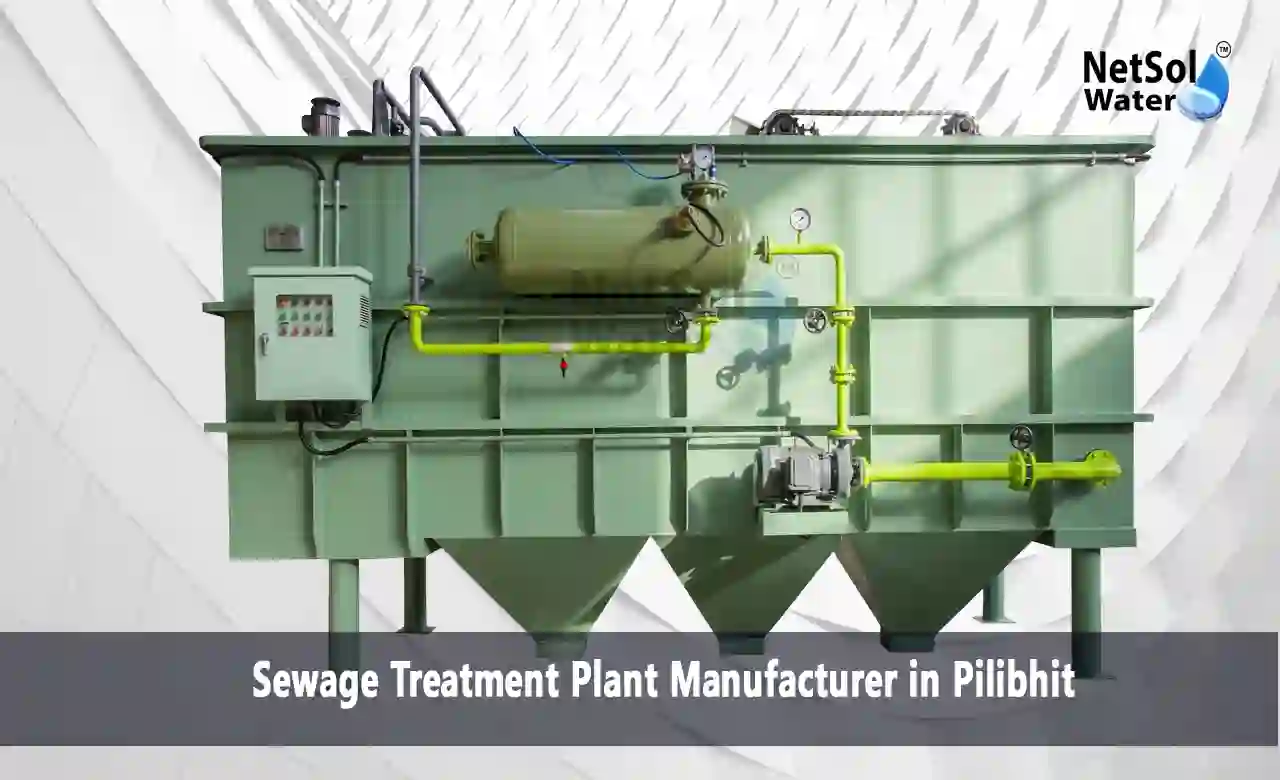
Sewage Treatment Plant Manufacturer in Pilibhit
Here's the uncomfortable reality: most residential societies, hotels, and small industries in Pilibhit are either operating without a sewage treatment plant - or running one that hasn't been properly maintained in years.
That's a legal liability. And as UPPCB enforcement intensifies across Uttar Pradesh, it's becoming an increasingly expensive one.
A properly designed STP isn't just a compliance checkbox. It reduces your freshwater bills through treated water reuse, eliminates odour complaints from residents or guests, and demonstrates environmental responsibility to regulators and stakeholders.
NetSol Water is an ISO-certified Sewage Treatment Plant manufacturer serving Pilibhit and the broader UP region. Here's what you need to know to make the right decision.
Why Pilibhit Needs Proper Sewage Treatment Now
Pilibhit is growing. New residential colonies, expanding commercial districts, and small-scale industrial growth are generating far more wastewater than existing drainage infrastructure can handle.
When sewage is released untreated, the effects are immediate and serious:
. Contamination of the Sharda and other local water bodies - a direct impact on agriculture and aquifers
. Proliferation of disease vectors (mosquitoes, flies) near drainage points and open drains
. Spread of waterborne diseases including typhoid, cholera, hepatitis A, and dysentery
. NGT and UPPCB enforcement actions, fines, and potential closure of non-compliant facilities
. For residential societies and commercial establishments, the additional risk is a RERA compliance gap and potential devaluation of the property. For industries, it's a direct threat to their operating licence.
What Is a Sewage Treatment Plant? (Plain Language Definition)
A Sewage Treatment Plant (STP) is a system that collects raw wastewater from toilets, kitchens, and drainage, then processes it through physical, biological, and chemical treatment stages to remove pathogens, organic matter, and pollutants.
The treated output - called effluent or treated water - is clean enough to be safely discharged or reused for landscape irrigation, toilet flushing, or industrial cooling.
STP Technologies Explained - Which One Is Right for You?
1. Activated Sludge Process (ASP)
The time-tested workhorse of sewage treatment. Ideal for large municipal volumes and industrial estates where space is available. Requires periodic sludge removal but delivers consistent results.
2. Moving Bed Biofilm Reactor (MBBR)
A compact, high-performance technology ideal for housing societies, hotels, and hospitals with space constraints. Plastic biofilm carriers inside the reactor support a dense microbial community that degrades organic matter quickly. Less sludge, smaller footprint.
3. Sequencing Batch Reactor (SBR)
Treats wastewater in timed cycles within a single tank - ideal for sites with variable daily wastewater flows, such as residential complexes or small industrial clusters. Very flexible and easy to automate.
4. Membrane Bioreactor (MBR)
The premium option. Combines biological treatment with ultrafiltration membranes to produce near-drinking-quality treated water. Perfect for sites prioritising water reuse or operating in space-constrained locations.
Who Needs an STP in Pilibhit?
| Facility Type | Primary Benefit |
|---|---|
| Residential Societies | Water reuse for gardens; RERA & UPPCB compliance |
| Hotels & Resorts | Reuse for landscaping & cooling; guest experience |
| Hospitals & Healthcare | Safe disposal of infectious wastewater; public health |
| Educational Institutions | Environmental compliance; educational leadership |
| Small Industries | Manage domestic-type wastewater alongside process effluent |
How an STP Works?
1. Screening & Grit Removal - Filters out plastics, rags, and coarse solids to protect pumps and downstream equipment.
2. Primary Sedimentation - Heavy solids settle to the bottom as primary sludge, reducing the load on biological treatment.
3. Biological Treatment (MBBR/SBR/ASP) - Microorganisms consume dissolved organics. This is the core stage where BOD and COD are dramatically reduced.
4. Secondary Clarification - Remaining suspended solids and biomass settle before the water moves to polishing.
5. Disinfection & Polishing - UV light, chlorination, or activated carbon removes pathogens, odour, and residual chemicals to meet CPCB norms.
6. Sludge Management - Sludge is thickened, dewatered using a filter press or centrifuge, and either composted for agriculture or safely disposed.
STP Maintenance - What You Must Get Right
Even the best STP underperforms without consistent maintenance. Here's what matters most in daily and periodic operations:
. Daily screening checks: Clear the screen manually or via automated rake to prevent overflow
. Blower and aerator monitoring: Oxygen supply is critical for biological treatment - any drop affects BOD removal efficiency
. Weekly water quality tests: BOD, COD, pH, and TSS should be tested and logged for UPPCB inspection readiness
. Monthly sludge audits: Check sludge levels in primary and secondary clarifiers; remove as required
. Operator training: Site operators must understand startup, shutdown, emergency procedures, and chemical dosing
Facilities that follow a structured STP maintenance schedule report 25–30% longer plant life and significantly fewer surprise failures before UPPCB inspections.
STP Sizing Guide for Pilibhit Applications
. 50–100 KLD: Small residential societies (200–400 residents) or mid-sized hotels
. 100–250 KLD: Large housing complexes, hospitals, or educational campuses
. 250–500 KLD: Municipal zones, industrial estates, or large commercial clusters
. 500 KLD+: Small municipalities or industrial areas requiring decentralised treatment
Why NetSol Water Is Pilibhit's Preferred STP Manufacturer
As a trusted STP Manufacturer and Supplier in U.P., we don’t sell off-the-shelf systems. Every STP we build starts with a site survey, a wastewater characterization study, and a custom engineering design. That’s why our systems pass UPPCB inspections-not just on commissioning day, but year after year.
. ISO-certified manufacturing: Every component tested before dispatch
. Custom design based on actual wastewater analysis - not assumptions
. MBBR, SBR, MBR, and ASP technologies available - we recommend what fits, not what's easiest to sell
. Full end-to-end execution: design, civil guidance, installation, commissioning, and operator training
. Annual Maintenance Contracts (AMC) with defined response times and spare parts supply
. Proven across residential, hospitality, healthcare, and industrial sectors in UP
Don't wait for a UPPCB notice to take action. Contact NetSol Water today for a free site survey and STP design proposal for your Pilibhit facility. We'll tell you exactly what technology suits your site, your budget, and your compliance timeline.
FAQs
Q: What is the cost of a sewage treatment plant for a housing society in Pilibhit?
A: STP costs for residential societies in Pilibhit depend on capacity and technology. A 50 KLD MBBR system typically costs Rs. 12–25 lakhs, while a 200 KLD SBR plant ranges from Rs. 40–75 lakhs. Costs vary based on civil work requirements and automation level. A site survey gives precise estimates.
Q: What is the difference between MBBR and SBR sewage treatment plants?
A: MBBR (Moving Bed Biofilm Reactor) uses plastic carriers to hold biofilm in a continuous flow process - compact and low-maintenance, ideal for hotels and housing societies. SBR (Sequencing Batch Reactor) treats water in timed batches in a single tank - flexible for variable daily flows and slightly lower capital cost.
Q: Is an STP mandatory for residential societies in Pilibhit?
A: Yes. Under UPPCB regulations and the Environment Protection Act, residential complexes generating more than a prescribed volume of wastewater daily must install a functioning STP before receiving or maintaining their occupancy certificate. Non-compliance can result in fines and legal notices.
Q: Can STP-treated water be reused for gardening and toilet flushing?
A: Yes. Treated water from a properly operating STP meets CPCB norms for reuse in landscape irrigation, toilet flushing, vehicle washing, and in some cases, cooling tower makeup. This reduces freshwater consumption by 30–40% in large complexes, delivering significant cost savings.
Q: How much space does an STP require for a housing society?
A: An MBBR-based STP for a 100-flat housing society (approximately 50 KLD capacity) typically requires 30–60 square metres of plant area. Underground or semi-underground configurations can reduce the visual and physical footprint significantly, freeing space for other uses.
Q: What are the UPPCB norms for STP effluent discharge in Uttar Pradesh?
A: UPPCB norms require treated effluent to meet: BOD below 10–20 mg/L, TSS below 10–20 mg/L, pH between 6.5 and 9.0, and total coliform less than 1,000 MPN/100 mL for surface water discharge. For reuse in irrigation, standards may vary - always verify with your specific consent conditions.
Q: How often does an STP need to be serviced?
A: Routine daily checks (screens, aerators, blowers) should be done by on-site operators. Professional servicing - including sludge removal assessment, membrane inspection (for MBR), and mechanical checks - should be done monthly. Annual inspections of civil structures and full system audits are recommended before UPPCB renewals.