

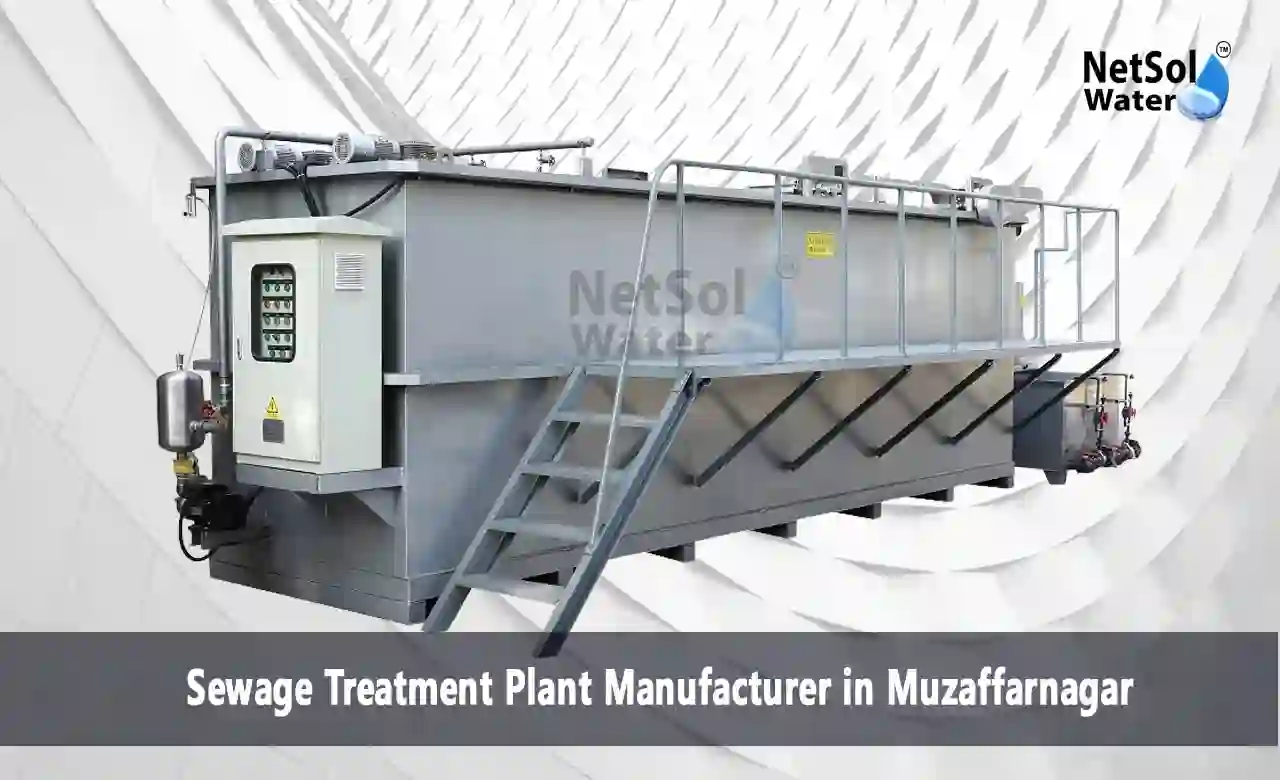
Sewage Treatment Plant Manufacturer in Muzaffarnagar
A residential society in Muzaffarnagar received a UPPCB shutdown notice last year. Not because of industrial pollution. Because their Sewage Treatment Plant was not working.
As Muzaffarnagar grows - new housing complexes, expanding sugar industry, more hospitals and hotels - the volume of untreated sewage entering the ground and local water bodies is rising fast. Regulatory response is rising just as fast.
Whether you manage an apartment complex, run a hospital, operate a hotel, or oversee a large industrial campus, you need a Sewage Treatment Plant that works - not one that looks good during the inspection and fails a month later. This page tells you exactly what to look for.
What Is a Sewage Treatment Plant?
A Sewage Treatment Plant (STP) processes domestic and municipal wastewater - from toilets, bathrooms, kitchens, and laundry facilities - removing pathogens, organic matter, and nutrients before the treated water is safely discharged or reused.
Sewage is not just unpleasant - it is a serious health and environmental hazard. It carries bacteria, viruses, pharmaceutical residues, and high levels of organic compounds. An STP converts this hazardous waste stream into treated effluent that meets CPCB and UPPCB discharge standards.
Why Muzaffarnagar Needs Proper Sewage Treatment Right Now
1. Rapid Growth Is Outpacing Existing Infrastructure
New housing developments, commercial complexes, and institutional campuses are being built faster than municipal sewage infrastructure can expand. Each new development either treats its own wastewater on-site or adds to the untreated load in open drains. UPPCB is increasingly targeting new developments without proper STP installations.
2. Groundwater Contamination Is a Real Risk
Muzaffarnagar sits on the Indo-Gangetic plain with a high water table. Untreated sewage seeping into the ground directly contaminates drinking water sources for communities throughout the region. This is not a theoretical risk - it is actively monitored by environmental regulators.
3. Sugar and Industrial Effluent Complicates the Problem
Muzaffarnagar is one of India's largest sugar-producing districts. When industrial process wastewater mixes with domestic sewage in open drains, the resulting combined effluent has far higher organic loads and is far harder to manage. Treating each stream at source prevents this problem entirely.
4. NGT and UPPCB Enforcement Is Tightening
The National Green Tribunal has been issuing directions to residential societies, hospitals, and commercial properties across UP to install and operate proper sewage treatment systems. Fines for non-compliance range from lakhs to crores depending on the violation severity and duration.
Who Needs an STP in Muzaffarnagar?
• Residential societies and apartment complexes (mandatory above specified unit counts)
• Hospitals and healthcare facilities (sewage contains pharmaceutical residues and pathogens)
• Hotels and hospitality properties (high daily sewage volume from rooms, kitchens, laundry)
• Educational institutions and hostels (large student populations, continuous high flow)
• Shopping centres and commercial complexes (washroom and food court wastewater)
• Sugar mills and food processing industries (high organic load combined with domestic sewage)
• Municipal bodies and industrial townships (municipal-scale treatment infrastructure)
STP Technology Comparison - Which Is Right for Your Project?
| Technology | Best Suited For | Key Advantage |
|---|---|---|
| MBBR | Residential societies, hotels, small-medium commercial | Compact footprint, handles variable flows well, simple operation |
| SBR | Larger installations, municipalities, townships | High output quality, effective nutrient removal, batch flexibility |
| ASP (Activated Sludge) | Large municipal, industrial townships | Proven technology, well understood, reliable at scale |
| Extended Aeration | Small-medium residential, commercial | Less sludge than ASP, simpler operation, good for moderate loads |
| MBR (Membrane Bioreactor) | Water reuse priority projects, premium applications | Highest output quality, ideal for treated water recycling |
Important: Technology selection must be based on your sewage volume, available space, required output quality, operator capability, and budget - not on what the manufacturer finds easiest to build. A responsible STP manufacturer will recommend the right technology for your specific project, not their preferred option.
STP Treatment Process - Stage by Stage
Preliminary Treatment: Bar screens remove rags, plastics, and large debris. Grit chambers settle sand. Protects all downstream equipment.
Primary Treatment: Primary settling tank removes 50–60% of suspended solids and 25–35% of BOD as primary sludge. Reduces biological treatment load.
Secondary Biological Treatment: Core stage - microorganisms break down dissolved organics using selected technology (MBBR/SBR/ASP/MBR). Achieves 85–95% BOD reduction.
Secondary Clarification: Biological sludge settles out. Return sludge maintains active microbial population. Excess sludge moves to treatment.
Tertiary + Disinfection: Filtration and UV or chlorine disinfection bring treated water to CPCB-compliant quality for discharge or reuse.
Sludge Treatment: Thickening, digestion/composting, dewatering. Properly treated sludge can be used as agricultural compost.
STP Capacity Planning Guide for Muzaffarnagar Projects
| Scale | Capacity | Typical Applications |
|---|---|---|
| Small | Up to 100 KLD | Small residential societies, schools, small hotels, commercial units |
| Medium | 100–500 KLD | Large townships, mid-sized hospitals, large hotels, industrial campuses |
| Large | 500 KLD – 5 MLD | Large industrial townships, municipal wards, large commercial developments |
| Municipal | Above 5 MLD | City-level infrastructure for municipal bodies and urban authorities |
Quick Sizing Reference: STP Per Person Calculation
The standard design basis for domestic sewage is 135 litres per person per day (LPCD) for residential applications, per CPHEEO guidelines. For a 200-unit housing society with an average occupancy of 4 persons per unit (800 people), the design flow would be approximately 108 KLD. Your actual design must account for peak flow factors and future capacity.
What Makes a Reliable STP Manufacturer in Muzaffarnagar
1. Technology Selection Based on Your Actual Requirements
No single technology suits every project. A reliable manufacturer evaluates your sewage volume, space constraints, output quality needs, and operational capability before making a recommendation - not after.
2. Odour Control Built Into the Design
Poorly designed STPs create odour problems that generate complaints, damage relationships with neighbours, and sometimes trigger regulatory action. Ventilation, covered tanks, and chemical dosing for odour suppression should be part of every residential or commercial STP design from day one.
3. Complete Sludge Management Planning
Many STP installations under-design the sludge handling side. This creates secondary disposal problems that are just as serious as the original sewage compliance issue. Insist on a complete sludge treatment and disposal plan as part of your project scope.
4. UPPCB Compliance Documentation Support
Your STP must pass UPPCB inspections. A manufacturer who understands what inspectors look for will help you set up the operating logs, performance records, and testing documentation that compliance requires.
5. After-Sales Service with Local Presence
Sewage does not stop coming when your STP breaks down. When a blower fails at midnight or a clarifier malfunctions, you need someone who can be on-site the next morning, not someone who has to travel from another state.
Why NetSol Water for Your STP in Muzaffarnagar
NetSol Water is an ISO certified STP manufacturer in U.P. with a proven track record across residential, commercial, industrial, and municipal projects.
• ISO certified manufacturing - every system follows documented quality standards.
• Technology-neutral recommendation - MBBR, SBR, MBR, or ASP based on your actual project requirements.
• Odour control as standard - ventilation and suppression systems included in every design.
• Complete sludge management - treatment and disposal plan included, not optional.
• UPPCB compliance documentation support - operating logs and inspection-ready records.
• Annual Maintenance Contracts - regular servicing, emergency support, and performance monitoring across UP.
• Experience across all project scales - from 50 KLD residential systems to multi-MLD municipal projects.
Let us assess your site and design the right STP for your project. Contact NetSol Water today for a free consultation. Tell us about your sewage challenge and we will design a solution that keeps you compliant, your neighbours happy, and your plant running reliably for years.
FAQs
Q 1: Is an STP mandatory for housing societies in Muzaffarnagar?
Yes. Under UP environmental regulations and UPPCB directives, residential societies above specified unit thresholds are required to install and operate a functional Sewage Treatment Plant. Societies failing to comply face notices, fines, and in serious cases, occupancy-related action. NGT orders have specifically targeted non-compliant housing complexes across Uttar Pradesh.
Q 2: What is the STP capacity required per person in UP?
The standard design basis is 135 litres per person per day (LPCD) for domestic sewage as per CPHEEO guidelines. To calculate STP capacity for your project, multiply total expected occupancy by 135 LPCD and apply a peak flow factor of 2–3x. A detailed hydraulic calculation from a qualified engineer is required for final design.
Q 3: What is the cost of an STP in Muzaffarnagar?
STP cost in Muzaffarnagar ranges from ?10–20 lakhs for small systems (up to 100 KLD) to ?40–100 lakhs for medium-large plants (100–500 KLD). Municipal-scale projects are priced on detailed engineering. Technology choice (MBBR, SBR, MBR) significantly affects cost. Always get a quote based on a site assessment, not industry averages.
Q 4: What is the difference between MBBR and SBR STP technology?
MBBR uses plastic media carriers suspended in a treatment tank with microorganisms growing on their surface. It is compact, robust, and handles variable flows well - ideal for residential and commercial projects. SBR treats sewage in timed batches within a single tank and offers higher output quality with better nutrient removal - better suited for larger installations or water reuse applications.
Q 5: Can STP treated water be reused?
Yes. Tertiary-treated STP water can be reused for gardening, toilet flushing, road washing, and some industrial cooling applications. This reduces freshwater demand and operational costs. MBR technology produces the highest reuse quality. UPPCB increasingly encourages on-site water reuse as part of conservation compliance requirements.
Q 6: How much space does an STP require?
Space requirements vary by technology and capacity. A 100 KLD MBBR-based STP typically requires 150–250 square metres. Underground STP designs are available for projects with severe space constraints, though they cost more. Your STP manufacturer should provide a detailed layout drawing as part of the design proposal.
Q 7: What happens if an STP is not maintained properly?
Poor maintenance leads to biological process failure, sludge bulking, aeration equipment breakdown, and effluent quality deteriorating below UPPCB standards. The consequences include pollution board notices, fines, and potential shutdown orders. An Annual Maintenance Contract prevents these failures by ensuring regular servicing, equipment checks, and early problem detection.
Q 8: Does hospital sewage need a special STP?
Yes. Hospital sewage contains pharmaceutical residues, antibiotic-resistant bacteria, biological waste, and chemical disinfectants. Standard domestic STP designs are often insufficient for hospitals. A hospital STP must include disinfection stages capable of handling drug-resistant pathogens and comply with biomedical waste regulations alongside standard UPPCB effluent norms.