

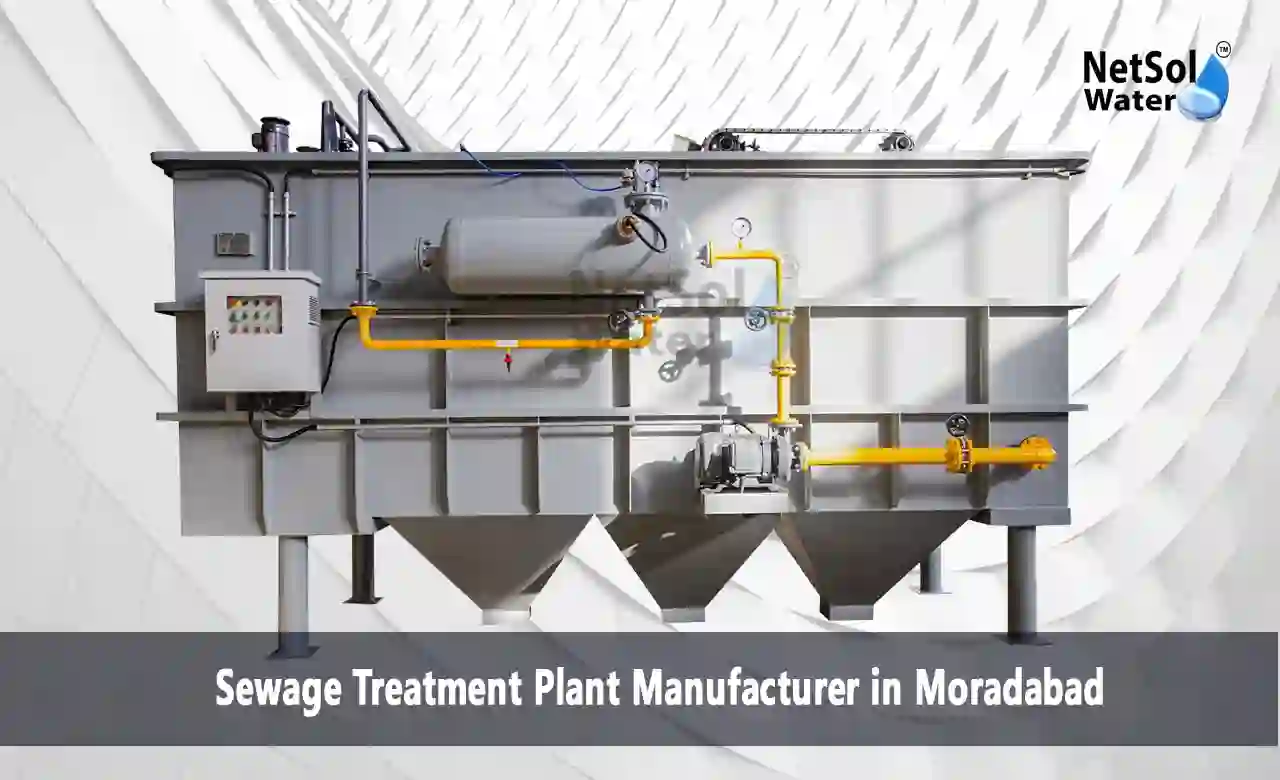
Sewage Treatment Plant Manufacturer in Moradabad
Moradabad is one of Uttar Pradesh's most active commercial cities - famous worldwide for its brass handicraft industry, and growing fast across residential, hospitality, and industrial sectors.
But this growth has a shadow. The city generates an estimated 120–130 million litres of sewage every day. A large fraction of that reaches the Ram Ganga river - one of the most polluted river stretches in UP - without adequate treatment. The National Green Tribunal and CPCB have repeatedly flagged this in enforcement orders.
If you operate a housing society, hotel, hospital, commercial building, or industrial unit in Moradabad, the right sewage treatment plant manufacturer in Moradabad is one of the most important partners you will choose. This guide helps you make that choice well.
Who Needs an STP in Moradabad?
The mandate covers far more establishments than most people realise. UPPCB has been actively targeting non-compliant units across the city:
• Residential apartments and housing societies (50+ units)
• Hotels, guest houses, and banquet halls
• Hospitals, nursing homes, and diagnostic centres
• Schools, colleges, and hostels
• Shopping malls and commercial complexes
• Brass and metal processing units with combined domestic and process wastewater
• Food processing and packaging plants
• Textile and garment manufacturers
• Municipal and government facilities
Brass manufacturing units in Moradabad deserve special attention. Many generate a mix of domestic sewage and process water containing metal traces, acids, and chemicals. These units often need a combined ETP + STP solution - two separate systems designed to handle different waste streams.
The 5-Stage Sewage Treatment Process Explained
Stage 1: Screening & Preliminary Treatment
Bar screens remove large solids - plastic, rags, debris. A grit chamber captures sand and heavy inorganic particles. This stage protects downstream equipment from wear and clogging.
Stage 2: Primary Sedimentation
Sewage slows down in a clarifier tank. Suspended solids settle as sludge; floating materials are skimmed off. This removes 50–65% of suspended solids and around 30% of BOD.
Stage 3: Secondary Biological Treatment
The most critical stage. Biological processes - MBBR, SBR, Extended Aeration, or Activated Sludge - break down dissolved organic matter. The right technology depends on your flow volume, available space, and treated water reuse goals.
Stage 4: Tertiary Polishing
Sand filtration, activated carbon, and UV disinfection remove remaining suspended solids, odour, colour, and pathogens. After this stage, treated water meets UPPCB discharge and reuse standards.
Stage 5: Sludge Handling
Sludge from all stages is collected, dewatered, and properly disposed of or composted. This is often the most overlooked part of an STP design - and one of the most important.
STP Technologies for Moradabad Projects - Quick Comparison
|
Technology |
Biggest Advantage |
Footprint |
Best Project Type |
|
MBBR |
Compact, easy to operate, handles load swings |
Small |
Housing societies, hotels, commercial |
|
SBR |
Flexible, energy-efficient, good for variable loads |
Small-Medium |
Municipal, large hospitals, campuses |
|
MBR |
Highest output quality, ideal for water reuse |
Small |
5-star hotels, hospitals, water-scarce projects |
|
Extended Aeration |
Proven, simple, reliable |
Large |
Open-land industrial or municipal sites |
How to Calculate the Right STP Capacity for Your Project in Moradabad
Getting capacity right from the start saves significant money. An undersized plant fails to treat your full sewage load. An oversized one wastes energy and increases operating costs. Use these standard benchmarks as a starting point:
|
Establishment Type |
Water Use Assumption |
Wastewater Generated |
|
Residential (per person) |
135 L/day |
~108 L/day (80% factor) |
|
Hotel (per guest) |
200–250 L/day |
~160–200 L/day |
|
Hospital (per bed) |
350–450 L/day |
~280–360 L/day |
|
Office/Commercial |
45 L/person/day |
~36 L/person/day |
Always add 20–30% buffer capacity to your estimate to accommodate future growth and peak load days.
UPPCB Regulatory Requirements in Moradabad - What You Must Know
• Any establishment exceeding prescribed daily wastewater volumes must install and operate a functional STP.
• Treated effluent must meet BOD < 10–30 mg/L, COD < 250 mg/L, TSS < 30 mg/L, and pH 6.5–8.5.
• Regular monitoring and compliance reporting is mandatory. Extended STP downtime can attract penalties.
• Environmental clearances for new construction increasingly require an approved STP design as part of the application - get this right early to avoid project delays.
• The NGT has issued specific orders regarding Ram Ganga pollution - Moradabad-based units are under heightened scrutiny.
5 Mistakes Moradabad Buyers Make (And How to Avoid Them)
1. Buying without a site assessment - every site in Moradabad is different. Generic designs underperform.
2. Choosing the lowest quote - cheap components, poor pre-treatment, and no after-sales support cost far more over time.
3. Ignoring sludge management - ask specifically: where does the sludge go? How is it dewatered and disposed of?
4. Not verifying output quality guarantees - insist on a written commitment to treated water quality standards.
5. Skipping the AMC - in Moradabad's demanding commercial environment, plants without regular maintenance deteriorate quickly.
Why Moradabad Businesses Choose NetSol Water?
We understand Moradabad. We know the brass industry's unique combination of domestic sewage and process wastewater. We know the UPPCB enforcement environment. And we know what it takes to design an STP that performs reliably in this city's conditions.
NetSol Water is ISO certified, STP Plant Manufacturer and Supplier in Uttar Pradesh. We handle everything: site assessment, sewage characterisation, custom system design, in-house fabrication, full installation, commissioning, and long-term AMC support.
We have delivered projects across UP including Agra, Amroha, Ambedkar Nagar, and now Moradabad. We bring real local knowledge to every project we take up here.
Talk to NetSol Water About Your Moradabad STP Project.
Share your project type, site details, and estimated sewage volume. Our engineers will assess your requirements and recommend the most cost-effective, UPPCB-compliant solution for Moradabad.
FAQs: Sewage Treatment Plant in Moradabad
Q: What is the cost of a sewage treatment plant in Moradabad?
A: STP cost in Moradabad depends on capacity, technology choice, and site conditions. A 50 KLD MBBR plant typically starts around ?15–25 lakhs. MBR systems cost more but deliver superior output quality. NetSol Water provides detailed pricing after a site visit and sewage characterisation.
Q: Does the brass industry in Moradabad need an STP?
A: Yes. Brass manufacturing units in Moradabad often need both an STP and an ETP. The STP handles domestic sewage from staff facilities, while the ETP treats process water containing metals, acids, and chemicals. UPPCB compliance requires both streams to be treated separately and adequately.
Q: How does Ram Ganga river pollution affect STP compliance in Moradabad?
A: The National Green Tribunal and CPCB have specifically flagged Ram Ganga pollution in Moradabad. This means UPPCB enforcement for non-compliant units in the city is stricter than many other areas. Any unit discharging to drains or waterways connected to the Ram Ganga faces heightened regulatory scrutiny.
Q: What is the best STP technology for a housing society in Moradabad?
A: MBBR is the top choice for most housing societies in Moradabad. It is compact, making it ideal for high-density residential areas where space is limited. It handles variable loads efficiently, meets UPPCB standards consistently, and is cost-effective to operate and maintain.
Q: How much sewage does a 100-room hotel in Moradabad generate per day?
A: A 100-room hotel in Moradabad generates approximately 15,000 to 20,000 litres (15–20 KLD) of sewage per day, based on an assumption of 200–250 litres per guest including staff. This figure should be verified with actual occupancy data before finalising plant capacity.
Q: Can an existing STP in Moradabad be upgraded if capacity is insufficient?
A: Yes, but upgrading later is more expensive and disruptive than designing right the first time. NetSol Water recommends sizing new STPs with 20–30% additional capacity buffer. For existing plants that have been outgrown, upgrade options include adding parallel treatment trains or adopting higher-efficiency technologies like MBR.
Q: What AMC services does NetSol Water offer for STPs in Moradabad?
A: NetSol Water's AMC programs for Moradabad STPs include scheduled service visits, equipment inspection, performance testing, sludge management guidance, chemical dosing adjustments, and rapid response to breakdowns. AMC programs are customised based on plant size and technology.